

Broadcom made three Kubernetes announcements at KubeCon North America 2026: its VM API project has been accepted into the CNCF Sandbox, it is co-chairing a newly formed Workload Conformance Working Group in the Kubernetes community, and more than 20 partner solutions have been validated to run on VMware vSphere Kubernetes Service (VKS), the Kubernetes runtime inside VMware Cloud Foundation.
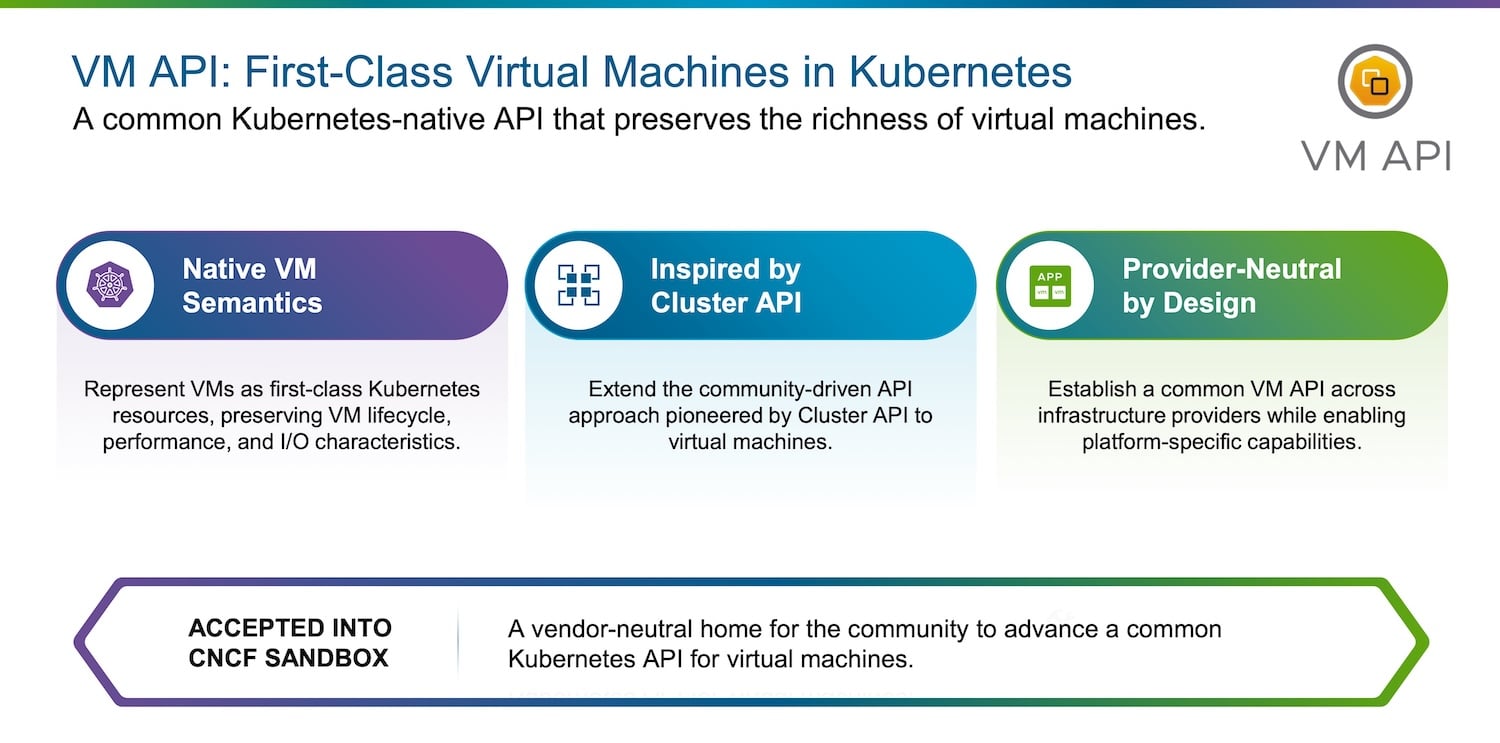
VM API Enters the CNCF Sandbox
VM API lets virtual machines be provisioned and managed through Kubernetes APIs across multiple heterogeneous infrastructure providers, so a VM becomes a first-class Kubernetes resource that sits next to containers under the same declarative model. It grows out of Broadcom’s VM Operator, which brought Kubernetes-native VM management to the vSphere side of VMware Cloud Foundation, and it borrows its shape from Cluster API, the community project that abstracted cluster lifecycle across providers. Moving the project under CNCF stewardship is meant to give other infrastructure providers a common API and operating model to implement, with workload consistency enforced through conformance.
Broadcom’s case for the project leans on the Linux Foundation’s 2026 Virtual Machines Report, a survey of 492 practitioners. That report found VMs still account for 53% of production applications, with most organizations expecting the share to hold, and that 34% of organizations growing their VM footprint cite AI and agentic workloads as a reason. Broadcom argues that advanced AI workloads need the strict hardware isolation of VMs combined with the agility of containers, and it positions VM API as the way to run both under one Kubernetes control plane.
Dilpreet Bindra, senior director of engineering in Broadcom’s VMware Cloud Foundation Division, said, “By contributing the VM API project to CNCF, we are bringing that enterprise-grade reliability to the Kubernetes community,” and described the goal as making VMs first-class citizens alongside containers. Broadcom says it is among the top five long-term contributors to CNCF projects.
Workload Conformance Working Group

Existing CNCF programs certify that a platform exposes the standard Kubernetes APIs, behaves correctly for core container orchestration, and can run AI and machine learning workloads portably. Nothing equivalent exists for the workloads themselves, so an ISV that wants to sell into several Kubernetes distributions certifies against each one. The new working group, which Broadcom co-chairs, aims to set a shared, verifiable standard for how workloads behave on any conformant Kubernetes environment, so an ISV validates once and deploys everywhere. Broadcom, as VMware, helped pioneer Sonobuoy, the diagnostic engine behind the CNCF’s Certified Kubernetes Conformance Program.
The group is newly formed and has not published a standard or a timeline. Matthew Flug, research manager for Intelligent Application Modernization and Deployment Platforms at IDC, said the priority for organizations running both VMs and containers “is applying consistent governance and policy enforcement across both,” adding that “conformance with open standards from the CNCF also helps mitigate vendor lock-in concerns as organizations decide how each workload should run.”
VKS Validated Partner Solutions
VKS is the CNCF-certified Kubernetes runtime built into VMware Cloud Foundation. It runs directly on the hypervisor, so VMs, containers, and AI workloads share the same clusters and one control plane, and Broadcom says that removes the separate infrastructure layer a standalone Kubernetes distribution needs. Broadcom groups the new validations into six areas, joining an existing catalog that includes names such as Cribl, Palo Alto Networks, F5, NetApp, Veeam, NVIDIA, and Redis:
- Beobachtbarkeit: Cisco Splunk, Datadog, Dynatrace, Grafana Labs, and New Relic.
- Security, compliance, and secrets management: CrowdStrike Falcon Platform, HashiCorp Vault, Sysdig Secure, Tigera Lynx, and Wiz.
- Networking, ingress, and service mesh: NetScaler ADC (Citrix), Solo.io (agentgateway, kagent, and Solo Enterprise for Istio), and Traefik Labs.
- Data protection, backup, and storage: Commvault, Dell Technologies PowerProtect Data Manager, HPE Alletra, and Scality RING.
- AI, machine learning, and analytics: Charmed Apache Spark from Canonical, H2O AI Cloud, and SAS Viya.
- Application delivery, databases, and developer platforms: Akuity Argo CD Enterprise and Kargo, KubeDB by AppsCode, Coherent Spark, and Siemens Mendix.
Broadcom’s argument for the list is operational: platform teams pick from a pre-validated catalog and keep the tools they already run as they move from day-one provisioning to day-two operations on VKS, and the working group above is meant to make that catalog grow without each vendor re-certifying per platform.
Varun Verma, GVP of Engineering at New Relic, said, “Enterprises running critical workloads on VKS can’t afford blind spots. With New Relic now validated on VKS, teams get unified cluster observability, find root causes faster, and tie operational performance directly to business impact.”
Broadcom also named Notruf Niederösterreich, which runs a 24×7 emergency response center with a small IT team, as a VKS customer. “VMware vSphere Kubernetes (VKS) Service lets us spin up encapsulated environments and scale horizontally within hours of a major incident, without being locked into specific hardware,” said Alexander Hopfgartner, Chief Technology Officer at Notruf Niederösterreich. “That flexibility is critical when lives depend on our systems staying available.”
Alongside these, Broadcom pointed to Velero 1.19 with block-level data movement, the Container Object Storage Interface moving toward beta with a vSphere COSI driver, and Agent Substrate, a CNCF Sandbox initiative for running agents.


 Amazon