---
description: The Intel Core i9-12900K combines two types of processor cores onto a single die. The 16-core, 24-thread chip can reach up to 5.2GHz.
title: Intel Core i9-12900K (Alder Lake) Review
image: https://www.storagereview.com/wp-content/uploads/2022/03/StorageReview-Intel-Alder-Lake-Build.jpg
---
[![Storage Review]()](https://storagereview.com/)
---
[Facebook](https://www.facebook.com/@storagereview) [X (Twitter)](https://twitter.twitter.com/storagereview) [Instagram](https://www.instagram.com/storagereview/) [LinkedIn](https://www.linkedin.com/company/storagereview-com) [YouTube](https://www.youtube.com/user/storagereview?sub_confirmation=1) [Email](mailto:info@storagereview.com) [Spotify](https://open.spotify.com/show/1y6VnznABhHeOSMOmbDTz0) [Reddit](https://www.reddit.com/r/StorageReview/) [Discord](https://discord.gg/TwMHb4azdC) [RSS Feed](https://www.storagereview.com/rss.xml) [TikTok](https://www.tiktok.com/@storagereview)
[Facebook](https://www.facebook.com/@storagereview) [X (Twitter)](https://twitter.com/storagereview) [Instagram](https://www.instagram.com/storagereview/) [LinkedIn](https://www.linkedin.com/company/storagereview-com) [YouTube](https://www.youtube.com/user/storagereview?sub_confirmation=1) [Email](mailto:info@storagereview.com) [Spotify](https://open.spotify.com/show/1y6VnznABhHeOSMOmbDTz0) [Reddit](https://www.reddit.com/r/StorageReview/) [Discord](https://discord.gg/TwMHb4azdC) [RSS Feed](https://www.storagereview.com/rss.xml) [TikTok](https://www.tiktok.com/@storagereview)
[](https://www.storagereview.com)
≡ Menu
- [Home](https://www.storagereview.com/)
- [Storage Reviews](https://www.storagereview.com/review)
- [End User Reviews](https://www.storagereview.com/consumer)
- [Enterprise Reviews](https://www.storagereview.com/enterprise)
- [Ubiquiti Reviews](https://www.storagereview.com/best/ubiquiti-reviews)
- [SR Merch](https://store.storagereview.com)
- [Leaderboards](https://www.storagereview.com/best)
- [Best Storage Arrays](https://www.storagereview.com/best/storage-arrays)
- [Best Enterprise SSDs](https://www.storagereview.com/best/enterprise-ssds)
- [Best Servers](https://www.storagereview.com/best/servers)
- [Best Enterprise GPUs](https://www.storagereview.com/best/enterprise-gpus)
- [Best Desktops for Local AI](https://www.storagereview.com/best/desktops-local-ai)
- [Best Laptops for Local AI](https://www.storagereview.com/best/laptops-local-ai)
- [Best Local LLM Tools](https://www.storagereview.com/best/local-llm-tools)
- [Agentic AI Hardware](https://www.storagereview.com/best/agentic-ai-hardware)
- [Best SSDs & Hard Drives](https://www.storagereview.com/best_drives)
- [Best Portable SSDs](https://www.storagereview.com/best/portable-ssds)
- [Best Business Laptops](https://www.storagereview.com/best/business-laptops)
- [Best Mobile Workstations](https://www.storagereview.com/best/mobile-workstations)
- [Best Desktop Workstations](https://www.storagereview.com/best/desktop-workstations)
- [Best Mini PCs](https://www.storagereview.com/best/mini-pcs)
- [Best Laptop Battery Life](https://www.storagereview.com/best/laptop-battery-life)
- [Storage Reference Guide](https://www.storagereview.com/storage-reference-guide)
- [About SR](https://www.storagereview.com/about-storagereview)
- [StorageReview.com Sweepstakes Rules and Regulations](https://www.storagereview.com/storagereview-com-sweepstakes-rules-and-regulations)
Search
[Home](https://www.storagereview.com/) » [Review](https://www.storagereview.com/review) » Intel Core i9-12900K (Alder Lake) Review
# Intel Core i9-12900K (Alder Lake) Review
by Charles P. Jefferies on March 8, 2022
[End User](https://www.storagereview.com/consumer) ◇ [Workstation](https://www.storagereview.com/consumer/workstation)
Intel’s 12th generation Core processors, formerly known as “Alder Lake”, are a major architectural departure from previous generations. We’re reviewing the flagship Core i9-12900K, which combines two different types of processor cores onto a single die. This 16-core, 24-thread chip can reach up to 5.2GHz and supports DDR5 memory and the latest PCI Express 4.0 and 5.0 standards. We put it through its paces in our custom Be Quiet!-equipped desktop build.
## **Intel Core i9-12900K Specifications**
The Alder Lake architecture’s biggest departure from previous Intel silicon is its inclusion of two kinds of processing cores. The Performance-cores, or P-cores, are the heavy hitters, based on Intel’s “Golden Cove” architecture. The Core i9-12900K has eight of them, with a base frequency of 3.2GHz and a maximum Turbo Boost of 5.1GHz. It also has eight of the Efficient- or E-cores, based on the “Gracemont” architecture; they run at a lower base frequency of 2.4GHz and scale to a maximum turbo boost of 3.9GHz.
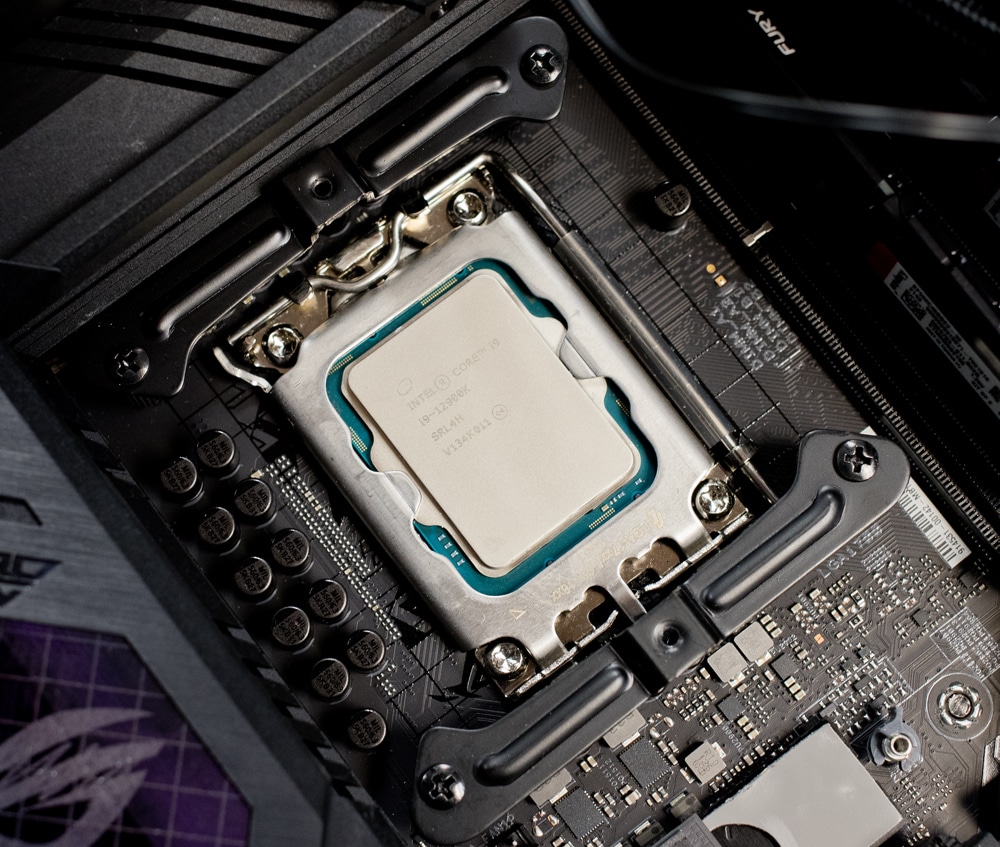
The P- and E-cores function alongside each other. Intel’s Thread Director technology handles sending tasks that require more performance to the P-cores and background or less demanding tasks to the E-cores. The downside to Thread Director is that it only works best if the operating system supports it; currently, that means Windows 11. Windows 10, for instance, will see all the Core i9-12900K’s cores as the same instead of “knowing” that some are stronger than others. That said, it’s not a problem for all Alder Lake chips since not all of them sport E-cores; for example, the mainstream Core i5-12400 has six P-cores and no E-cores. (See all Alder Lake chips on [Intel’s ARK](https://ark.intel.com/content/www/us/en/ark/products/codename/147470/products-formerly-alder-lake.html).)
Eight P-cores and eight E-cores mark the Core i9-12900K as a 16-core chip, so you would expect it to have a thread count of 32. However, it supports “just” 24 threads — only the P-cores support Intel’s Hyper-Threading technology, allowing them to process two threads simultaneously.
![alder lake be quiet cpu cooler]()
The K suffix indicates the Core i9-12900K is a multiplier-unlocked chip for overclocking. It’s rated for 125-watt base power, Intel’s new designation for Thermal Design Power (TDP). Intel has also started publishing maximum turbo power, which is 241 watts for the Core i9-12900K; that’s the maximum amount of thermal energy it generates in its turbo boost PL1 i.e., short-term turbo boost that usually lasts a few seconds.
Intel sells other desktop variants of the Core i9-12900K. For setups with less cooling and/or no need for overclocking, the 65-watt [Core i9-12900](https://ark.intel.com/content/www/us/en/ark/products/134597/intel-core-i912900-processor-30m-cache-up-to-5-10-ghz.html) runs at slightly lower frequencies (for instance, its P-cores have a 2.4GHz base frequency versus the Core i9-12900K’s 3.2GHz).
There are also F suffix versions of both chips, the Core i9-12900KF, and the Core i9-12900F; these chips lack onboard integrated graphics, meaning you must pair them with a dedicated graphics card. The Core i9-12900K we’re reviewing has Intel’s UHD Graphics 770 integrated GPU, suitable for the basics. (Realistically, though, anyone purchasing such a high-end chip will be pairing it with a dedicated GPU, so saving a few dollars with the less expensive Core i9-12900KF chip is a sensible idea.)
![]()
Alder Lake also brings other new technologies. Its predecessor, Rocket Lake, was Intel’s first mainstream platform to support PCIe 4.0. Alder Lake ups the ante with PCIe 5.0 support, though to our chagrin, PCIe 5.0 storage drives are nonexistent at the moment. (Listen to [our podcast](https://www.storagereview.com/podcast/podcast-92-intels-allyn-malventano-joins-brian-for-a-lively-discussion-on-pcie-gen-5-0) where Brian discusses PCIe 5.0 with Intel’s Allyn Malventano.)
![]()
Alder Lake is also the first Intel platform to support the DDR5 memory standard, though it still supports DDR4. If you’re buying a lower-tier Alder Lake chip, such as a Core i5, DDR4 will help keep the platform adoption cost lower. Platform adoption cost is indeed a concern with Alder Lake since there’s no upgrade path from an older platform; you must buy a new motherboard with the new-for-Alder-Lake FCLGA1700 socket. Because the socket is new, be sure to verify your cooler supports it, some older stock coolers may not just yet. We found this to be the case twice so far. Both companies quickly shipped the new bracket though, so no harm unless you’re in a hurry.
Intel’s Alder Lake chipsets include the enthusiast Z690, the mainstream B660, workstation W680 (which supports Intel vPro remote management), and the entry-level H670 and H610. The only sensible pairing for the Core i9-12900K is the Z690 (or perhaps the W680, which seems to be just a paper launch for now); neither of the H-series chipsets allows overclocking.
On the topic of workstations, the Core i9-12900K supports a healthy 20 PCIe lanes and ECC memory. The last is a curious inclusion; Intel’s past Core i9 K-series chips, such as the Core i9-11900K, didn’t offer it. Traditionally, you’d need a Xeon chip for ECC support. This will definitely open up the use cases for the 12900K a little bit more.
Overall, the Core i9-12900K and Alder Lake look like a promising step forward for Intel, so let’s check out our test rig and get to testing. The Core i9-12900K’s full specifications are as follows:
| **Lithography** | Intel 7 |
| --- | --- |
| **Recommended Customer Price** | $589 – $599 |
| **CPU Specifications** | |
| *Total Cores* | 16 |
| *# of Performance-cores* | 8 |
| *# of Efficient-cores* | 8 |
| *Total Threads* | 24 |
| *Max Turbo Frequency* | 5.2GHz |
| *Performance-core Max Turbo Frequency* | 5.1GHz |
| *Efficient-core Max Turbo Frequency* | 3.9GHz |
| *Performance-core Base Frequency* | 3.2GHz |
| *Efficient-core Base Frequency* | 2.4GHz |
| *Cache* | 30MB Intel Smart Cache |
| *Total L2 Cache* | 14MB |
| *Processor Base Power* | 125W |
| *Maximum Turbo Power* | 241W |
| **Memory Specifications** | |
| *Max Memory Size* | 128GB |
| *Memory Types* | - Up to DDR5 4800MT/s
- Up to DDR4 3200MT/s
|
| *Max # of Memory Channels* | 2 |
| *Max Memory Bandwidth* | 76.8GB/s |
| *ECC Memory Supported* | Yes |
| **Processor Graphics** | |
| *Processor Graphics* | Intel UHD Graphics 770 |
| *Graphics Base Frequency* | 300MHz |
| *Graphics Max Dynamic Frequency* | 1.55GHz |
| *Execution Units* | 32 |
| *DirectX Support* | 12 |
| *OpenGL Support* | 4.5 |
| *# of Displays Supported* | 4 |
| *OpenCL Support* | 2.1 |
| **Expansion Options** | |
| *Direct Media Interface (DMI) Revision* | 4.0 |
| *Max # of DMI Lanes* | 8 |
| *PCI Express Revision* | 5.0 and 4.0 |
| *PCI Express Configurations* | Up to 1×16+4, 2×8+4 |
| *Max # of PCI Express Lanes* | 20 |
| **Package Specifications** | |
| *Sockets Supported* | FCLGA1700 |
| *Max CPU Configuration* | 1 |
| *T-junction* | 100 degrees C |
| *Package Size* | 45.0mm x 37.5mm |
| **Advanced Technologies** | - Intel® Gaussian & Neural Accelerator 3.0
- Intel® Thread Director
- Intel® Deep Learning Boost (Intel® DL Boost)
- Intel® Optane™ Memory Supported
- Intel® Speed Shift Technology
- Intel® Turbo Boost Max Technology 3.0
- Intel® Turbo Boost Technology 2.0
- Intel vPro® Platform Eligibility
- Intel® Hyper-Threading Technology
- Intel® Virtualization Technology (VT-x)
- Intel® Virtualization Technology for Directed I/O (VT-d)
- Intel® VT-x with Extended Page Tables (EPT)
- Intel® 64
- Instruction Set 64-bit
- Instruction Set Extensions: Intel® SSE4.1, Intel® SSE4.2, Intel® AVX2
- Idle States
- Enhanced Intel SpeedStep® Technology
- Thermal Monitoring Technologies
- Intel® Stable IT Platform Program (SIPP)
- Intel® Volume Management Device (VMD)
|
| **Security and Reliability** | - Intel vPro® Enterprise Platform Eligibility
- Intel® Threat Detection Technology (TDT)
- Intel® Active Management Technology (AMT)
- Intel® Standard Manageability (ISM)
- Intel® One-Click Recovery
- Intel® Hardware Shield Eligibility
- Intel® AES New Instructions
- Secure Key
- Intel® OS Guard
- Intel® Trusted Execution Technology
- Execute Disable Bit
- Intel® Boot Guard
- Mode-based Execute Control (MBEC)
- Intel® Control-Flow Enforcement Technology
- Intel® Total Memory Encryption
|
## **Intel Core i9-12900K Be Quiet! Test Rig**
Much of a CPU’s performance depends on the rig where it’s installed. Let’s look at our custom mid-tower, which is composed largely of German-engineered components from [Be Quiet!](https://www.bequiet.com/en). The company offers top-notch desktop components that are as close to silent as they can be. Indeed, our rig is barely audible under load; the [Eaton 5P UPS](https://www.storagereview.com/review/eaton-5p1550gr-l-ups-review) that we had it hooked up to was louder.
![]()
The case is the austere [Silent Base 802](https://www.bequiet.com/en/case/2049). It’s uniquely configurable for either maximum airflow or maximum performance. Two sets of front and side panels are included, one that’s solid for quietness and another that’s mesh for airflow. Behind the front panel is a location to mount three fans.
![]()
The case is quiet even with the airflow panels since the interior is lined with sound insulation.
![]()
The case includes three Be Quiet! [Pure Wings 2](https://www.bequiet.com/en/casefans/pure-wings-2/783) fans. We swapped those for three 120mm Be Quiet! [Light Wings](https://www.bequiet.com/en/casefans/light-wings/3447) ARGB fans for flare. We also added a 140mm Light Wings High-Speed fan to the inside of the case.
For CPU cooling, we’re using a Be Quiet! [Pure Loop 360mm](https://www.bequiet.com/en/watercooler/1959) sealed liquid-cooler, with the radiator mounted at the top of the case. This cooler was critical in our build since the Core i9-12900K runs extraordinarily hot. We actually undervolted the chip in the BIOS for better temperature control.
![]()
The case’s modular interior makes building a desktop a breeze. The motherboard tray comes out and can be installed in an inverted layout. The board we’re using is an [Asus ROG Strix Z690-E Gaming WiFi](https://rog.asus.com/us/motherboards/rog-strix/rog-strix-z690-e-gaming-wifi-model/), a solid middle ground between Asus’s entry-level Prime and TUF boards and the pricier ROG Maximus and ROG Crosshair lines. Our board has 18+1 power stages and dedicated VRM cooling. It also has an M.2 PCIe 5.0 slot for whenever supporting drives come to market.
![]()
Back to the case. As expected, the Silent Base 802 has a lower compartment dedicated to the power supply. The Be Quiet! [Dark Power Pro 1200](https://www.bequiet.com/en/powersupply/1946) power supply we installed is about as high-end as power supplies get, with an 80 Plus Titanium rating and full digital control. It is, of course, fully modular. It can run silently under light workloads, but we didn’t hear it even during peak benchmarking. The power supply carries a confidence-inspiring 10-year warranty. Overall, this rig will let the Core i9-12900K show what it can do.
![]()
## **Intel Core i9-12900K Performance**
Now for testing. Our test rig has the following basic hardware:
- Intel Core i9-12900K CPU (slightly undervolted)
- Asus ROG Strix Z690-E Gaming WiFi motherboard
- Microsoft Windows 11
- 32GB of Kingston Fury DDR5-5200 RAM (2x 16GB)
- [Seagate FireCuda 530 2TB](https://www.storagereview.com/review/seagate-firecuda-530-ssd-review) SSD
- [Nvidia GeForce RTX 3080 Ti](https://www.storagereview.com/review/nvidia-geforce-rtx-3080-ti-review) or [RTX A6000](https://www.storagereview.com/review/nvidia-rtx-a6000-review) graphics cards
We’re using an AMD-based [Lenovo ThinkStation P620](https://www.storagereview.com/review/lenovo-thinkstation-p620-review) workstation for comparisons, which isn’t exactly apples to apples, but is what we’ve tested recently. It uses the 64-core, 128-thread AMD Threadripper Pro 3995WX. We also published newer PC builds on the [Intel Core i5-12600K](https://www.storagereview.com/review/intel-core-i5-12600k-alder-lake-review-tuf-gaming-alliance) and the [Core i7-12700K](https://www.storagereview.com/review/intel-core-i7-12700k-xpg-build-review) in which we compared those builds to each other.
**SPECviewperf 2020**
SPECviewperf 2020 is the worldwide standard for measuring graphics performance of professional applications under the OpenGL and Direct X application programming interfaces. The viewsets (or benchmarks) represent graphics content and behavior from actual applications, without having to install the applications themselves. The newest version of this benchmark went through major updates late last year, including new viewsets taken from traces of the latest versions of 3ds Max, Catia, Maya, and Solidworks applications. In addition, they added support within all viewsets for both 2K and 4K resolution displays. Our tests were run with a windowed resolution of 3800×2120.
Testing with the RTX A6000, our Core i9-12900K rig stays about even with the Lenovo workstation or does slightly better, especially when we switched to the GeForce RTX 3080 Ti.
| **SPECviewperf 2020 (Higher is better)** | | | | |
| --- | --- | --- | --- | --- |
| **Viewsets** | **StorageReview Test Rig (Core i9-12900K, RTX A6000)** | **Lenovo ThinkStation P620 (AMD TR Pro 3995WX, RTX A6000)** | **StorageReview Test Rig (Core i9-12900K, RTX 3080 Ti)** | **Lenovo ThinkStation P620 (AMD TR Pro 3995WX, RTX 3080 Ti)** |
| **3dsmax-07** | 138.71 | 131.96 | 140.71 | 129.39 |
| **Catia-06** | 99.21 | 90.99 | 60.23 | 50.58 |
| **Creo-03** | 154.25 | 125.88 | 110.67 | 74.65 |
| **Energy-03** | 42.89 | 42.22 | 28.51 | 28.07 |
| **Maya-06** | 334.1 | 314.82 | 341.04 | 315.31 |
| **Medical-03** | 34.92 | 34.87 | 20.07 | 20.11 |
| **Snx-04** | 446.73 | 450.72 | 25.3 | 19.71 |
| **Sw-05** | 166.42 | 161.4 | 187.52 | 176.4 |
**SPECworkstation 3**
Moving on with our performance benchmarks, we ran SPECworkstation3. This is a test that specializes in benchmarks designed for testing all key aspects of workstation performance; it uses over 30 workloads to test CPU, graphics, I/O, and memory bandwidth. The workloads fall into broader categories such as Media and Entertainment, Financial Services, Product Development, Energy, Life Sciences, and General Operations. We are going to list the broad-category results for each, as opposed to the individual workloads. The results are an average of all the individual workloads in each category.
Equipped with the A6000, our test rig wouldn’t complete the Media & Entertainment or Product Development. Equipped with either the RTX A6000 or the GeForce RTX 3080 Ti, however, our rig generally trailed the ThinkStation P620, an expected result given the vast thread disparity. The Core i9-12900K is, nonetheless, capable of acting as a workstation CPU. Two areas were unable to complete through multiple runs, which we labeled as DNF. The benchmark specifically that was unable to provide a score was the Blender component inside SPEC WPC.
| **SPECworkstation 3 (Higher is better)** | | | | |
| --- | --- | --- | --- | --- |
| **Category** | **StorageReview Test Rig (Core i9-12900K, RTX A6000) 3.1
** | **Lenovo ThinkStation P620 (AMD TR Pro 3995WX, RTX A6000) 3.04
** | **StorageReview Test Rig (Core i9-12900K, RTX 3080 Ti) 3.1
** | **Lenovo ThinkStation P620 (AMD TR Pro 3995WX, RTX 3080 Ti) 3.04
** |
| M&E | DNF | 6.04 | 5.16 | 6.21 |
| ProdDev | DNF | 5.49 | 4.84 | 4.34 |
| LifeSci | 5.19 | 4.61 | 4.6 | 3.8 |
| Energy | 6.34 | 5.58 | 5.06 | 4.79 |
| FSI | 5.54 | 9.49 | 4.65 | 9.49 |
| GeneralOps | 3.14 | 2.14 | 3.14 | 2.19 |
| GPU Compute | 7.76 | 7.44 | 7.92 | 7.72 |
**Blender
**
Next up is Blender, an open-source 3D modeling application. This benchmark was run using the Blender Benchmark utility. The score is samples per minute, with higher being better.
We have just results for our test rig in this test since we switched to the new Blender 3.0.1. The scores aren’t too different, though the higher-clocked GeForce RTX 3080 Ti produced better numbers as expected.
| **Blender, rendering time in seconds (higheris better)** | | |
| --- | --- | --- |
| **Category** | **StorageReview Test Rig (Core i9-12900K, RTX A6000)** | **StorageReview Test Rig (Core i9-12900K, RTX 3080 Ti)** |
| **Monster** | 2,774 | 2,926 |
| **Junkshop** | 1,552 | 1,660 |
| **Classroom** | 1,364 | 1,447 |
**Esri**
Next up is the Environmental Systems Research Institute (Esri) benchmark. Esri is a supplier of Geographic Information System (GIS) software. Esri’s Performance Team designed their PerfTool add-in scripts to automatically launch the ArcGIS Pro. This application uses a “ZoomToBookmarks” function to browse various predefined bookmarks and create a log file with all the key data points required to predict the user experience. The script automatically loops the bookmarks three times to account for caching (memory and disk cache). In other words, this benchmark simulates heavy graphical use that one might see through Esri’s ArcGIS Pro software.
We test three models – Montreal, Philly, and Portland. First up is Montreal. This testing depends more on the GPU than anything, and doesn’t use a lot of CPU threads, so our Core i9-12900K rig performed up to 10% better than the ThinkStation P620.
| **ESRI ArcGIS Pro 2.3 Montreal** | |
| --- | --- |
| **Average FPS** | **Average** |
| ***StorageReview Test Rig (Core i9-12900K, RTX A6000)*** | 607.29 |
| Lenovo ThinkStation P620 (AMD TR Pro 3995WX, RTX A6000) | 561.46 |
| ***StorageReview Test Rig (Core i9-12900K, RTX 3080 Ti)*** | 626.66 |
| Lenovo ThinkStation P620 (AMD TR Pro 3995WX, RTX 3080 Ti) | 561.46 |
| **Minimum FPS** | **Average** |
| ***StorageReview Test Rig (Core i9-12900K, RTX A6000)*** | 324.74 |
| Lenovo ThinkStation P620 (AMD TR Pro 3995WX, RTX A6000) | 231.67 |
| ***StorageReview Test Rig (Core i9-12900K, RTX 3080 Ti)*** | 334.37 |
| Lenovo ThinkStation P620 (AMD TR Pro 3995WX, RTX 3080 Ti) | 231.67 |
The Philly model is next. Our rig continued to prove faster than the workstations. It did slightly better with the GeForce RTX 3080 Ti than it did with the RTX A6000.
| **ESRI ArcGIS Pro 2.3 Philly** | |
| --- | --- |
| **Average FPS** | **Average** |
| ***StorageReview Test Rig (Core i9-12900K, RTX A6000)*** | 473.49 |
| Lenovo ThinkStation P620 (AMD TR Pro 3995WX, RTX A6000) | 542.70 |
| ***StorageReview Test Rig (Core i9-12900K, RTX 3080 Ti)*** | 490.25 |
| Lenovo ThinkStation P620 (AMD TR Pro 3995WX, RTX 3080 Ti) | 459.25 |
| **Minimum FPS** | **Average** |
| ***StorageReview Test Rig (Core i9-12900K, RTX A6000)*** | 273.93 |
| Lenovo ThinkStation P620 (AMD TR Pro 3995WX, RTX A6000) | 237.54 |
| ***StorageReview Test Rig (Core i9-12900K, RTX 3080 Ti)*** | 285.55 |
| Lenovo ThinkStation P620 (AMD TR Pro 3995WX, RTX 3080 Ti) | 216.55 |
The story remains the same in our last animation, Portland; our Core i9-12900K rig wasn’t to be caught.
| **ESRI ArcGIS Pro 2.3 Portland** | |
| --- | --- |
| **Average FPS** | **Average** |
| ***StorageReview Test Rig (Core i9-12900K, RTX A6000)*** | 2,980.10 |
| Lenovo ThinkStation P620 (AMD TR Pro 3995WX, RTX A6000) | 2,756.82 |
| ***StorageReview Test Rig (Core i9-12900K, RTX 3080 Ti)*** | 3,035.61 |
| Lenovo ThinkStation P620 (AMD TR Pro 3995WX, RTX 3080 Ti) | 2,220.86 |
| **Minimum FPS** | **Average** |
| ***StorageReview Test Rig (Core i9-12900K, RTX A6000)*** | 1,360.30 |
| Lenovo ThinkStation P620 (AMD TR Pro 3995WX, RTX A6000) | 906.17 |
| ***StorageReview Test Rig (Core i9-12900K, RTX 3080 Ti)*** | 1,445.21 |
| Lenovo ThinkStation P620 (AMD TR Pro 3995WX, RTX 3080 Ti) | 813.5 |
**Luxmark**
Another 3D benchmark we will be looking at is LuxMark, an OpenCL GPU benchmarking utility. This is another test where the CPU isn’t a major factor, the load mostly falling on the GPU. Thus, our rig’s and the ThinkStation P620’s numbers are similar.
| **LuxMark (Higher is better)** | | | | |
| --- | --- | --- | --- | --- |
| **Category** | **StorageReview Test Rig (Core i9-12900K, RTX A6000)** | **Lenovo ThinkStation P620 (AMD TR Pro 3995WX, RTX A6000)** | **StorageReview Test Rig (Core i9-12900K, RTX 3080 Ti)** | **Lenovo ThinkStation P620 (AMD TR Pro 3995WX, RTX 3080 Ti)** |
| **hallbench** | 21,365 | 20,983 | 21,821 | 21,378 |
| **food** | 8,088 | 8,088 | 8,194 | 7,864 |
**OctaneBench**
Last, we look OctaneBench, a benchmarking utility for OctaneRender, which is another 3D renderer with RTX support that is similar to V-Ray. Higher scores are better. Like Luxmark, OctaneBench is large GPU-dependent, so the differences are slight between our rig and the workstation. The similarity bodes well for the Core i9-12900K; if what you’re doing is GPU-dependent, spending all-out for a heavily threaded workstation CPU isn’t necessarily required.
| **Scene** | **Kernel** | **StorageReview Test Rig (Core i9-12900K, RTX A6000)** | **Lenovo ThinkStation P620 (AMD TR Pro 3995WX, RTX A6000)** | **StorageReview Test Rig (Core i9-12900K, RTX 3080 Ti)** | **Lenovo ThinkStation P620 (AMD TR Pro 3995WX, RTX 3080 Ti)** |
| --- | --- | --- | --- | --- | --- |
| Interior | Info channels | 18.53 | 19.30 | 18.74 | 19.30075 |
| Interior | Direct lighting | 67.25 | 70.35 | 69.41 | 70.34825 |
| Interior | Path tracing | 87.28 | 91.34 | 89.75 | 91.33624 |
| Idea | Info channels | 11.52 | 12.11 | 11.87 | 12.1124 |
| Idea | Direct lighting | 52.74 | 56.11 | 55.98 | 56.10834 |
| Idea | Path tracing | 65.34 | 68.99 | 68.27 | 68.89837 |
| ATV | Info channels | 29.15 | 30.44 | 29.97 | 30.44490 |
| ATV | Direct lighting | 74.84 | 78.15 | 78.61 | 78.14789 |
| ATV | Path tracing | 94.82 | 98.43 | 98.64 | 98.42735 |
| Box | Info channels | 15.90 | 16.59 | 16.11 | 16.59334 |
| Box | Direct lighting | 66.80 | 70.11 | 69.83 | 70.10809 |
| Box | Path tracing | 75.93 | 79.21 | 79.01 | 79.21098 |
## **Conclusion**
Alder Lake is Intel’s first CPU architecture to include two different CPU cores on the same die, support PCIe 5.0, and the DDR5 memory standard. Our testing demonstrated it provides ample CPU horsepower for graphics card-dependent workstation tasks where it kept up with a 64-core AMD workstation. We tested with a high-end NVIDIA RTX A6000 and a GeForce RTX 3080 Ti to ensure the CPU was as much of a limiting factor as possible.
Though its performance is promising, Alder Lake CPUs have challenges. The biggest downside is heat; despite using a top-shelf Be Quiet! 360mm liquid cooler, we needed to undervolt our Core i9-12900K to keep its temperatures down from 100C peak. The other significant issue is operating system support. Intel’s Thread Director technology that coordinates workloads between P- and E-cores is only truly effective if the operating system supports it, so presently that means the Core i9-12900K will only perform its best under Windows 11.
That said, overall we like what we see in the Core i9-12900K. The future is very bright, especially thanks to its potential to bring down workstation cost for those that have extremely resource-hungry applications. Not only does it support PCIe 5.0, but it also supports ECC memory, a feature Intel usually reserves for its Xeon chips. Once Gen5 SSDs arrive later this year, the storage performance available to this system will destroy all previous PC records.
If you’re going for the bleeding edge, the Core i9-12900K will get you there first class, with plenty more potential on the horizon.
**Engage with StorageReview**
[Newsletter](https://www.storagereview.com/storage_newsletter) | [YouTube](https://www.youtube.com/user/StorageReview "Opens in a new window") | Podcast [iTunes](https://podcasts.apple.com/gb/podcast/storagereview-com-storage-reviews/id1060681115 "Opens in a new window")/ [Spotify](https://open.spotify.com/show/1y6VnznABhHeOSMOmbDTz0 "Opens in a new window") | [Instagram](https://www.instagram.com/storagereview/ "Opens in a new window") | [Twitter](https://twitter.com/storagereview "Opens in a new window") | [TikTok](https://www.tiktok.com/@storagereview? "Opens in a new window") | [RSS Feed](https://www.storagereview.com/rss.xml)
![]()
### Charles P. Jefferies
I'm a lifelong technology enthusiast and have been reviewing consumer and enterprise technology since 2005. I specialize in laptops, tablets, and enterprise hardware. I'm a graduate of Rochester Institute of Technology. Outside of work, I love the gym, reading, and photography.
Previous post: [Micron 7400 Pro SSD Review](https://www.storagereview.com/review/micron-7400-pro-ssd-review)
Next post: [Quantum Scalar Ransom Block Creates Physical Barrier to Ransomware](https://www.storagereview.com/review/quantum-scalar-ransom-block-creates-physical-barrier-to-ransomware)
Trusted Vendors
Products and solutions from our affiliate partners:
- [

Ubiquiti
](https://store.ui.com/us/en?a_aid=StorageReview "Opens in a new window")
- [

Newegg
](https://click.linksynergy.com/fs-bin/click?id=g5terNMDhz0&offerid=1207190.18&subid=0&type=4 "Opens in a new window")
- [
 Amazon
](https://amzn.to/4fLJUEW "Opens in a new window")
Newsletter
Subscribe to the StorageReview newsletter to stay up to date on the latest news and reviews. We promise no spam!
1
Leave this field empty if you’re human:
## Advertisement
Content Categories
[Facebook](https://www.facebook.com/@storagereview) [X](https://twitter.com/storagereview) [Instagram](https://www.instagram.com/storagereview/) [LinkedIn](https://www.linkedin.com/company/storagereview-com) [YouTube](https://www.youtube.com/user/storagereview?sub_confirmation=1) [Email](mailto:info@storagereview.com) [Spotify](https://open.spotify.com/show/1y6VnznABhHeOSMOmbDTz0) [Reddit](https://www.reddit.com/r/StorageReview/) [Discord](https://discord.gg/TwMHb4azdC) [RSS](https://www.storagereview.com/rss.xml) [TikTok](https://www.tiktok.com/@storagereview)
Copyright © 1998-2025 Flying Pig Ventures, LLC Cincinnati, Ohio. All rights reserved.
Manage your privacy
To provide the best experiences, we and our partners use technologies like cookies to store and/or access device information. Consenting to these technologies will allow us and our partners to process personal data such as browsing behavior or unique IDs on this site and show (non-) personalized ads. Not consenting or withdrawing consent, may adversely affect certain features and functions.
Click below to consent to the above or make granular choices. Your choices will be applied to this site only. You can change your settings at any time, including withdrawing your consent, by using the toggles on the Cookie Policy, or by clicking on the manage consent button at the bottom of the screen.
Functional Functional Always active
The technical storage or access is strictly necessary for the legitimate purpose of enabling the use of a specific service explicitly requested by the subscriber or user, or for the sole purpose of carrying out the transmission of a communication over an electronic communications network.
Preferences Preferences
The technical storage or access is necessary for the legitimate purpose of storing preferences that are not requested by the subscriber or user.
Statistics Statistics
The technical storage or access that is used exclusively for statistical purposes. The technical storage or access that is used exclusively for anonymous statistical purposes. Without a subpoena, voluntary compliance on the part of your Internet Service Provider, or additional records from a third party, information stored or retrieved for this purpose alone cannot usually be used to identify you.
Marketing Marketing
The technical storage or access is required to create user profiles to send advertising, or to track the user on a website or across several websites for similar marketing purposes.
Statistics
Marketing
Features
Always active
Special features
Special purposes
Always active
- Manage options
- Manage services
- Manage {vendor\_count} vendors
- [Read more about these purposes](https://cookiedatabase.org/tcf/purposes/)
Accept Deny Manage options Save preferences Manage options
- {title}
- {title}
- {title}
Manage your privacy
To provide the best experiences, we use technologies like cookies to store and/or access device information. Consenting to these technologies will allow us to process data such as browsing behavior or unique IDs on this site. Not consenting or withdrawing consent, may adversely affect certain features and functions.
Functional Functional Always active
The technical storage or access is strictly necessary for the legitimate purpose of enabling the use of a specific service explicitly requested by the subscriber or user, or for the sole purpose of carrying out the transmission of a communication over an electronic communications network.
Preferences Preferences
The technical storage or access is necessary for the legitimate purpose of storing preferences that are not requested by the subscriber or user.
Statistics Statistics
The technical storage or access that is used exclusively for statistical purposes. The technical storage or access that is used exclusively for anonymous statistical purposes. Without a subpoena, voluntary compliance on the part of your Internet Service Provider, or additional records from a third party, information stored or retrieved for this purpose alone cannot usually be used to identify you.
Marketing Marketing
The technical storage or access is required to create user profiles to send advertising, or to track the user on a website or across several websites for similar marketing purposes.
Statistics
Marketing
Features
Always active
Special features
Special purposes
Always active
- Manage options
- Manage services
- Manage {vendor\_count} vendors
- [Read more about these purposes](https://cookiedatabase.org/tcf/purposes/)
Accept Deny Manage options Save preferences Manage options
- {title}
- {title}
- {title}
Manage consent Manage consent
```json
{"@context":"https:\/\/schema.org","@graph":[{"@type":"WebPage","@id":"https:\/\/www.storagereview.com\/review\/intel-core-i9-12900k-alder-lake-review","url":"https:\/\/www.storagereview.com\/review\/intel-core-i9-12900k-alder-lake-review","name":"Intel Core i9-12900K (Alder Lake) Review - StorageReview.com","isPartOf":{"@id":"https:\/\/www.storagereview.com\/#website"},"primaryImageOfPage":{"@id":"https:\/\/www.storagereview.com\/review\/intel-core-i9-12900k-alder-lake-review#primaryimage"},"image":{"@id":"https:\/\/www.storagereview.com\/review\/intel-core-i9-12900k-alder-lake-review#primaryimage"},"thumbnailUrl":"https:\/\/www.storagereview.com\/wp-content\/uploads\/2022\/03\/StorageReview-Intel-Alder-Lake-Build.jpg","datePublished":"2022-03-08T19:09:42+00:00","dateModified":"2022-05-03T14:53:05+00:00","description":"The Intel Core i9-12900K combines two types of processor cores onto a single die. The 16-core, 24-thread chip can reach up to 5.2GHz.","breadcrumb":{"@id":"https:\/\/www.storagereview.com\/review\/intel-core-i9-12900k-alder-lake-review#breadcrumb"},"inLanguage":"en-US","potentialAction":[{"@type":"ReadAction","target":["https:\/\/www.storagereview.com\/review\/intel-core-i9-12900k-alder-lake-review"]}]},{"@type":"ImageObject","inLanguage":"en-US","@id":"https:\/\/www.storagereview.com\/review\/intel-core-i9-12900k-alder-lake-review#primaryimage","url":"https:\/\/www.storagereview.com\/wp-content\/uploads\/2022\/03\/StorageReview-Intel-Alder-Lake-Build.jpg","contentUrl":"https:\/\/www.storagereview.com\/wp-content\/uploads\/2022\/03\/StorageReview-Intel-Alder-Lake-Build.jpg","width":1500,"height":1107},{"@type":"BreadcrumbList","@id":"https:\/\/www.storagereview.com\/review\/intel-core-i9-12900k-alder-lake-review#breadcrumb","itemListElement":[{"@type":"ListItem","position":1,"name":"Home","item":"https:\/\/www.storagereview.com\/"},{"@type":"ListItem","position":2,"name":"Review","item":"https:\/\/www.storagereview.com\/review"},{"@type":"ListItem","position":3,"name":"Intel Core i9-12900K (Alder Lake) Review"}]},{"@type":"WebSite","@id":"https:\/\/www.storagereview.com\/#website","url":"https:\/\/www.storagereview.com\/","name":"StorageReview.com","description":"StorageReview.com is a leading provider of news and reviews throughout the entire IT stack - from the datacenter to the edge, and all points in between.","publisher":{"@id":"https:\/\/www.storagereview.com\/#organization"},"potentialAction":[{"@type":"SearchAction","target":{"@type":"EntryPoint","urlTemplate":"https:\/\/www.storagereview.com\/?s={search_term_string}"},"query-input":{"@type":"PropertyValueSpecification","valueRequired":true,"valueName":"search_term_string"}}],"inLanguage":"en-US"},{"@type":"Organization","@id":"https:\/\/www.storagereview.com\/#organization","name":"StorageReview.com","url":"https:\/\/www.storagereview.com\/","logo":{"@type":"ImageObject","inLanguage":"en-US","@id":"https:\/\/www.storagereview.com\/#\/schema\/logo\/image\/","url":"https:\/\/www.storagereview.com\/wp-content\/uploads\/2020\/02\/Storage-Reviews-2-2.png","contentUrl":"https:\/\/www.storagereview.com\/wp-content\/uploads\/2020\/02\/Storage-Reviews-2-2.png","width":344,"height":61,"caption":"StorageReview.com"},"image":{"@id":"https:\/\/www.storagereview.com\/#\/schema\/logo\/image\/"},"sameAs":["https:\/\/x.com\/storagereview","http:\/\/youtube.com\/user\/storagereview"]}]}
```