---
description: There's little doubt that edge use cases are a primary concern for many IT organizations. You don't have to be in retail or oil and gas exploration to...
title: High-Capacity SSDs Enable Data Collection and AI at the Edge
image: https://www.storagereview.com/wp-content/uploads/2023/08/StorageReview-CheethaRAID-Raptor-5.jpg
---
[![Storage Review]()](https://storagereview.com/)
---
[Facebook](https://www.facebook.com/@storagereview) [X (Twitter)](https://twitter.twitter.com/storagereview) [Instagram](https://www.instagram.com/storagereview/) [LinkedIn](https://www.linkedin.com/company/storagereview-com) [YouTube](https://www.youtube.com/user/storagereview?sub_confirmation=1) [Email](mailto:info@storagereview.com) [Spotify](https://open.spotify.com/show/1y6VnznABhHeOSMOmbDTz0) [Reddit](https://www.reddit.com/r/StorageReview/) [Discord](https://discord.gg/TwMHb4azdC) [RSS Feed](https://www.storagereview.com/rss.xml) [TikTok](https://www.tiktok.com/@storagereview)
[Facebook](https://www.facebook.com/@storagereview) [X (Twitter)](https://twitter.com/storagereview) [Instagram](https://www.instagram.com/storagereview/) [LinkedIn](https://www.linkedin.com/company/storagereview-com) [YouTube](https://www.youtube.com/user/storagereview?sub_confirmation=1) [Email](mailto:info@storagereview.com) [Spotify](https://open.spotify.com/show/1y6VnznABhHeOSMOmbDTz0) [Reddit](https://www.reddit.com/r/StorageReview/) [Discord](https://discord.gg/TwMHb4azdC) [RSS Feed](https://www.storagereview.com/rss.xml) [TikTok](https://www.tiktok.com/@storagereview)
[](https://www.storagereview.com)
≡ Menu
- [Home](https://www.storagereview.com/)
- [Storage Reviews](https://www.storagereview.com/review)
- [End User Reviews](https://www.storagereview.com/consumer)
- [Enterprise Reviews](https://www.storagereview.com/enterprise)
- [Ubiquiti Reviews](https://www.storagereview.com/best/ubiquiti-reviews)
- [SR Merch](https://store.storagereview.com)
- [Leaderboards](https://www.storagereview.com/best)
- [Best Storage Arrays](https://www.storagereview.com/best/storage-arrays)
- [Best Enterprise SSDs](https://www.storagereview.com/best/enterprise-ssds)
- [Best Servers](https://www.storagereview.com/best/servers)
- [Best Enterprise GPUs](https://www.storagereview.com/best/enterprise-gpus)
- [Best Desktops for Local AI](https://www.storagereview.com/best/desktops-local-ai)
- [Best Laptops for Local AI](https://www.storagereview.com/best/laptops-local-ai)
- [Best Local LLM Tools](https://www.storagereview.com/best/local-llm-tools)
- [Agentic AI Hardware](https://www.storagereview.com/best/agentic-ai-hardware)
- [Best SSDs & Hard Drives](https://www.storagereview.com/best_drives)
- [Best Portable SSDs](https://www.storagereview.com/best/portable-ssds)
- [Best Business Laptops](https://www.storagereview.com/best/business-laptops)
- [Best Mobile Workstations](https://www.storagereview.com/best/mobile-workstations)
- [Best Desktop Workstations](https://www.storagereview.com/best/desktop-workstations)
- [Best Mini PCs](https://www.storagereview.com/best/mini-pcs)
- [Best Laptop Battery Life](https://www.storagereview.com/best/laptop-battery-life)
- [Storage Reference Guide](https://www.storagereview.com/storage-reference-guide)
- [About SR](https://www.storagereview.com/about-storagereview)
- [StorageReview.com Sweepstakes Rules and Regulations](https://www.storagereview.com/storagereview-com-sweepstakes-rules-and-regulations)
Search
[Home](https://www.storagereview.com/) » [Review](https://www.storagereview.com/review) » High-Capacity SSDs Enable Data Collection and AI at the Edge
# High-Capacity SSDs Enable Data Collection and AI at the Edge
by Brian Beeler on August 9, 2023
[Enterprise](https://www.storagereview.com/enterprise) ◇ [Server](https://www.storagereview.com/enterprise/server)
There’s little doubt that edge use cases are a primary concern for many IT organizations. You don’t have to be in retail or oil and gas exploration to understand that with more data being created and collected at the edge, IT needs better hardware solutions designed for this vast array of emerging edge tasks. Layer in the additional benefits of real-time AI at the edge, and the lightweight edge servers are easily overtaxed.
There is an interesting alternative, though. The Cheetah RAID Raptor helps organizations manage sprawling edge data with a server that offers modular storage canisters that can now support nearly 3/4 of a petabyte across just 12 drives.
## Cheetah RAID Raptor
The Cheetah RAID Raptor is a high-performance server designed to overcome the common bottleneck of storage performance that often limits server performance in edge scenarios. In addition to a wide variety of PCIe® expansion options, the Raptor is highlighted by three hot-pluggable Gen4 NVMe® canisters, AMD EPYC CPUs with up to 64 cores, and 128x Gen4 PCIe lanes.
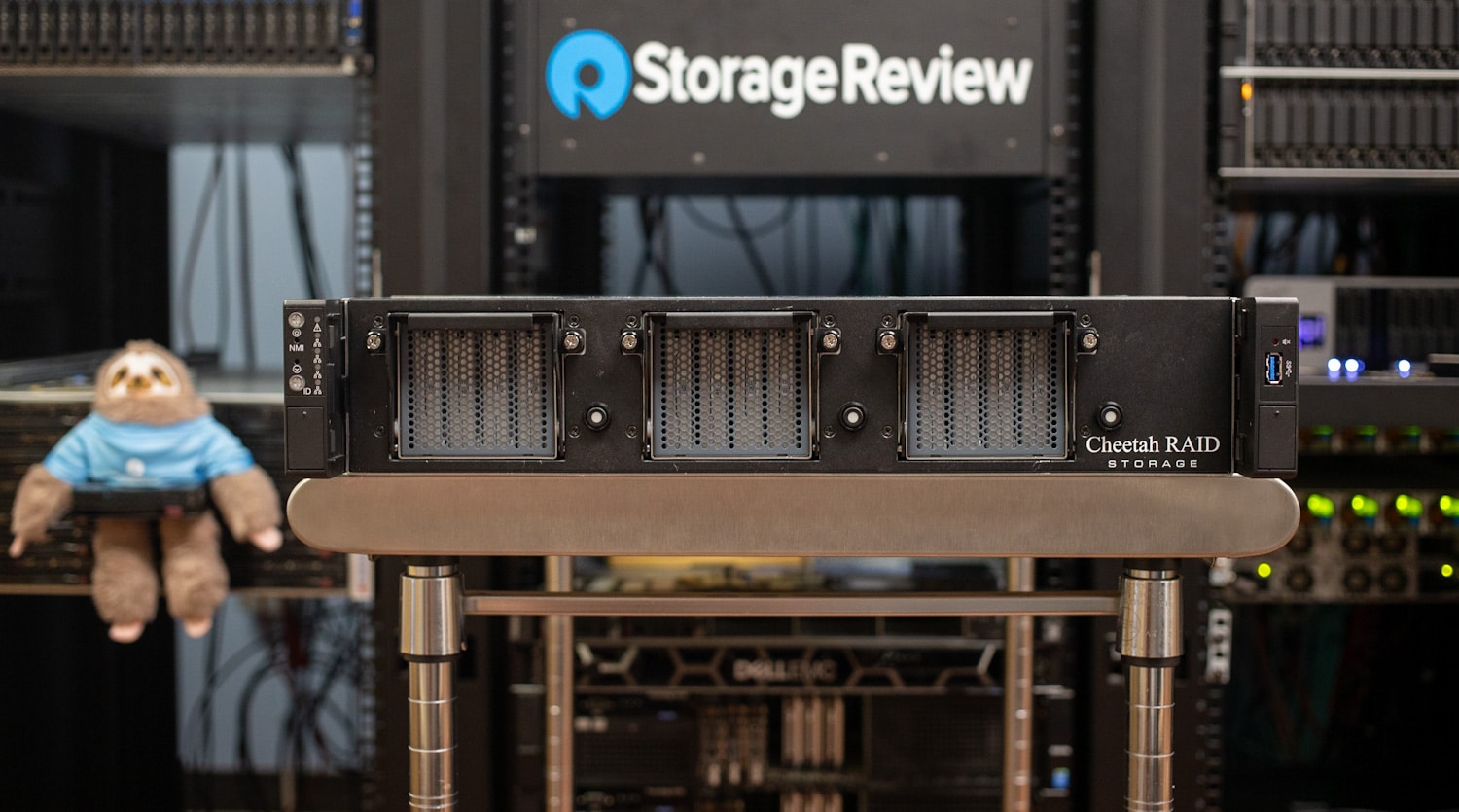
From a server design perspective, the triple canister design is a core feature that differentiates the Raptor. Each of the canisters holds up to four SSDs. The canisters allow data to be logged and processed independently, and the modularity allows for easy hot-swapping and migration of canisters to different locations. The ability to physically swap canisters frees data migration from the constraints of the network fabric.
![]()
For the variety of edge use cases that generate immense amounts of data, the Raptor benefits greatly from high-capacity drives. In this case, SSDs are a perfect fit since these servers find themselves in the back of autonomous vehicles or embedded in aircraft or other vehicles with plenty of jostling. With the recently launched [Solidigm 61.44TB SSDs](https://www.storagereview.com/news/solidigm-p5336-61-44tb-ssds-announced), a single system can hold an astonishing amount of data density. The ability to store nearly a petabyte of data in a single server equates to more data collection and less time swapping canisters. In our testing, we’re leveraging 12x Solidigm P5316 SSDs with a 30.72TB drive capacity.
## Cheetah RAID Raptor Design
As previously mentioned, the server comes with an AMD EPYC Zen 3 (Milan) CPU, providing the Cheetah RAID Raptor with impressive processing power. Cheetah’s data canisters were designed to support AMD Milan, allowing the canisters to migrate data from a moving vehicle to a data center instantly.
![]()
The Raptor design includes detailed airflow considerations that take advantage of the AMD Milan processor power with the ability to use all 64 cores and the 128x Gen4 PCIe lanes. The Raptor, equipped with AMD Milan, can support demanding applications while still offering low-latency access to storage.
![]()
The canister design allows data to be logged and processed separately. After the data has been processed, the canister can hot-swap to a different location. Raptor has cut the cord that restricted data migration to an external network fabric. The canisters support SED drives and can be encrypted to provide additional data security.
#### Cheetah RAID Raptor Spec Sheet
| Supported CPU | Support AMD EPYC™ 7003 and 7002 Series Processors |
| --- | --- |
| Socket | Single Socket SP3 (LGA4094) |
| Chipset | System on Chip |
| Supported RAM | 8 DIMM slots (1DPC)
Supports up to 2TB Registered ECC DDR4 3200MHz SDRAM
8-channel memory bus |
| IO Interface | 1x COM Port
1x VGA Port
4x Type-A (USB3.0)
2x RJ45
1x IPMI |
| Expansion Slots | 5 PCI-E 4.0 x16
2 PCI-E 4.0 x8
– Supports 3x Broadcom/Microchip Hardware RAID Controllers or 3x Gen4 x16 Retimer Cards
– Four spare slots for Network Adapters or Hardware Accelerators |
| Drive Bays | 12x U.2/U.3 2.5” NVMe PCIe Gen 4 SSDs via 3 Hot-Swappable NVMe canisters |
| Cooling | 4x 80x38mm high-speed cooling fans |
| Front Panel | Power On/OFF with LED
Reset Switch
NMI switch
Locate Switch with LED
4x LAN LED
Warning LED |
| Supported OS | Microsoft® Windows:
– Server 2016 (64bit)
– Server 2019 (64bit)
Linux:
– RedHat Enterprise Linux Server 8.2 (64bit) / 7.9 (64bit)
– CentOs 8.2 (64 bit) / 7.9 (64 bit)
– SUSE SLES 15.2(64 bit) / 12.5(64bit)
– UBuntu 20.04.1 (64 bit) /18.04.5 (64 bit) / 16.04.7 (64 bit)
Hypervisor:
– VMWare® ESXi 6.7 u3 / 7.0 u1
– vSphere 6.7 u3 / 7.0 u1
– CITRIX Hypervisor 8.1.0 |
| Power | 800W Redundant Power Supply |
| Environmental | Operation temperature: 10°C \~ 35°C
Non-operation temperature: -40°C \~ 70°C
Non-operation humidity: 20% \~ 90% (Non-condensing) |
## Migrating the Data
Each Cheetah RAID Raptor canister can be directly connected to the AMD CPU via 16x PCIe Gen4 Lanes or linked through a hardware NVMe RAID controller. To meet the requirements for a high-capacity, high-transfer-rate storage server with hot-swap capabilities, Cheetah RAID Storage utilized Microchip’s [Adaptec SmartRAID 3200 series RAID adapters](https://www.microchip.com/en-us/products/storage/adaptec-smartraid-raid-adapters).
![]()
The Adaptec SmartRAID 3200 series is built on Microchip’s 5th-generation storage controller, the SmartROC 3200, with support for x8 and x16 PCIe Gen 4 host interface adapters delivering improved performance and bandwidth with up to 29.6 GB/s throughput. The Adaptec SmartRAID adapters are feature-rich, support for up to 32 NVMe devices and up to 256 SAS/SATA and up to 64 LD/RAID arrays, SAS/SATA/NVMe tri-mode functionality, Trusted Platform support for a greater level of compute and supply-chain security, maxView™ tools suite support, secure boot, secure update, and attestation, and Self-Encrypting Drive (SED) management software.
![]()
We reviewed Cheetah RAID Prowler in December 2021 to highlight the demands for a ruggedized server that could be mounted in an automobile under the seat or in the trunk (boot for the Brits). There is an enormous amount of work that goes into building a server that will withstand the harsh conditions in a vehicle, aircraft, ship, or edge location. For background, read what we found out in our [Cheetah RAID Prowler Addresses Rugged Edge Computing](https://www.storagereview.com/review/cheetah-raid-prowler-addresses-rugged-edge-computing) post.
## Storage Performance
Quad-Level Cell (QLC) drives offer a compelling set of benefits in the world of Solid State Drives (SSDs) and are proving their worth. QLC drives advantage lies in its higher storage capacity and lower cost compared to other NAND technologies. QLC drives have a lower cost-per-gigabyte, making them a great choice for budget-conscious users. QLC drives are available in SATA and NVMe form factors, with NVMe owning the faster data transfer speeds due in great part to the efficiency of the NVMe protocol.
![]()
The Cheetah RAID Raptor solution utilizes the recently announced [Solidigm D5-P5336](https://www.storagereview.com/news/solidigm-p5336-61-44tb-ssds-announced), a purpose-built QLC drive ideal for data-intensive workloads, such as data pipelines, AI-driven data lakes, big data analytics, scale-out NAS, and edge computing, delivering efficient and rapid storage and retrieval of extensive datasets. For users requiring massive storage capacity for read-centric applications and general-purpose computing, QLC drives present an attractive and cost-efficient option.
##### Solidigm D5-P5336 Series (15.36TB, E1.L 9.5mm PCIe 4.0 x4, 3D5, QLC)
| Essentials
| |
| --- | --- |
| Product Collection | Solidigm D5-P5336 Series |
| Capacity | 15.36TB
30.72TB
61.44TB |
| Lithography Type | 192L QLC 3D NAND |
| Use Conditions | Server/Enterprise |
| MMID | 99C54G |
| Performance Specifications
| |
| Sequential Bandwidth – 100% Read (up to) | 7000 MB/s |
| Sequential Bandwidth – 100% Write (up to) | 3100 MB/s |
| Random Read (100% Span) | 1005 KIOPS (4K, QD256) |
| Random Write (100% Span) | 35 KIOPS (16K, QD256) |
| Latency – Sequential Read (typ.) | 8μs (4K Blocks) |
| Latency – Sequential Write (typ.) | 15μs (16K Blocks) |
| Latency – Read | 110μs (4K Blocks) |
| Latency – Write | 31μs (16K Blocks) |
| Power – Active | 25W |
| Power – Idle | 5W |
| Reliability
| |
| Vibration – Operating | 2.17 GRMS (5 – 700 Hz) Max |
| Vibration – Non-Operating | 3.13 GRMS (5 – 800 Hz) Max |
| Shock (Operating and Non-Operating) | 1,000 G (Max) at 0.5 msec |
| Operating Temperature Range | 0 – 70°C |
| Endurance Rating (Lifetime Writes) | 14.11 PBW (16K RW) |
| Mean Time Between Failures (MTBF) | 2 million hours |
| Uncorrectable Bit Error Rate (UBER) | <1 sector per 10^17 bits read |
| Warranty Period | 5 years |
| Package Specifications
| |
| Weight | 185g +/- 10g |
| Form Factor | E1.L |
| Interface | PCIe 4.0 x4, NVMe |
| Advanced Technologies
| |
| Enhanced Power Loss Data Protection | |
| Hardware Encryption | |
| Temperature Monitoring and Logging | |
| End-to-End Data Protection | |
For our storage performance workloads, we measured the performance through the Microchip Adaptec SmartRAID 3200 series RAID adapters with the SSDs in JBOD mode. We then tested 4, 8 and 12 drive combinations, with each group of 4 SSDs representing a full NVMe pod and an additional RAID adapter. To that end we leveraged our Vdbench workloads for throughput and bandwidth testing, measuring 64K sequential and 4K random performance.
**VDBench Workload Analysis**
When it comes to benchmarking storage devices, application testing is best, and synthetic testing comes in second place. While not a perfect representation of actual workloads, synthetic tests do help to baseline storage devices with a repeatability factor that makes it easy to do apples-to-apples comparisons between competing solutions. These workloads offer a range of different testing profiles ranging from “four corners” tests, common database transfer size tests, to trace captures from different VDI environments.
All of these tests leverage the common vdBench workload generator, with a scripting engine to automate and capture results over a large compute testing cluster. This allows us to repeat the same workloads across a wide range of storage devices, including flash arrays and individual storage devices. Our testing process for these benchmarks fills the entire drive surface with data, and then partitions a drive section equal to 25 percent of the drive capacity to simulate how the drive might respond to application workloads. This is different from full entropy tests which use 100 percent of the drive and takes them into a steady state. As a result, these figures will reflect higher-sustained write speeds.
Profiles:
- 4K Random Read: 100% Read, 128 threads, 0-120% iorate
- 4K Random Write: 100% Write, 128 threads, 0-120% iorate
- 64K Sequential Read: 100% Read, 32 threads, 0-120% iorate
- 64K Sequential Write: 100% Write, 16 threads, 0-120% iorate
In our first test looking at 4K random read performance leveraging 4, 8 and 12 QLC SSDs inside the CheetahRAID Raptor, we measured performance of 2.5M IOPS from 4 SSDs, 3.5M IOPS from 8 and 3.54M IOPS from 12 SSDs.
![CheetahRAID QLC 4K Random Read]()
In our 4K random write workload, we see a much more defined difference between 4, 8 or 12 SSDs inside the Raptor. Here we measured 75K IOPS from 4, 146K IOPS from 8 and 218K IOPS from 12 SSDs. Its important to note that 4K random write performance is an Achilles heel of this type of QLC SSD. The Solidigm P5430 for example is a QLC model that is more optimized for smaller block sizes.
![CheetahRAID QLC 4K Random write]()
Switching focus to peak bandwidth inside the CheetahRAID Raptor, we measured 10.8GB/s from 4 SSDs, 16.9GB/s from 8 SSDs and 31.2GB/s from 12 SSDs. The primary difference in scaling here is the additional RAID card brought into the mix with each additional 4 SSDs added.
![CheetahRAID QLC 64K sequential read]()
In our final workload measured 64K sequential write performance, we measured 5.6GB/s from 4 SSDs, 11.3GB/s from 8 SSDs and 16.8GB/s from 12 SSDs.
![CheetahRAID QLC 64K sequential write]()
## AI Performance
One of the truly spectacular benefits of the Raptor server is its ability to not just log data quickly and efficiently, but with a low-power GPU inside, it can also handle real-time AI tasks. We configured the server with an NVIDIA A2 inferencing GPU to test Raptor’s edge AI chops.
Thanks to the Raptor’s compatibility with GPUs, such as the NVIDIA A2 we added to ours, it further positions itself as a premier choice for edge computing, particularly in the realm of artificial intelligence and machine learning.
![]()
Equipped with high-throughput SSDs and up to 64-core AMD EPYC CPUs, the Raptor can handle demanding AI algorithms, offering low-latency access to storage for rapid edge data processing and inferencing. The hot-swappable design ensures that data can be migrated without network constraints, further enhancing the lifecycle speed of AI applications from data gathering to real-time inferencing.
In scenarios where edge devices such as autonomous vehicles, industrial machines, or even drones are processing vast amounts of data, the Raptor’s ability to handle real-time AI tasks will prove to be valuable. AI inferencing on the edge brings decision-making closer to the data source, resulting in more immediate actions and insights. For example, in autonomous vehicles, immediate processing of sensor data can lead to real-time decision-making that enhances safety and efficiency. The Raptor’s rugged, solid-state design ensures that it can withstand the vibrations and temperature variations of these harsh environments while delivering the required computational power.
The ability to bring the processing power for AI at the edge also reduces the need to send vast amounts of raw data to a central data center, decreasing bandwidth usage and lowering costs. Instead, only processed, relevant information can be stored and brought back with the drive sled, if necessary, for further analysis or long-term storage.
The Raptor’s support for high-capacity, high-transfer-rate storage, coupled with advanced GPU capabilities, means it can be tailored to specific AI use cases. Whether it’s real-time video analysis, predictive maintenance, or AI-driven data analytics, the Cheetah RAID Raptor’s configuration means that it can be adapted to the unique demands of various edge environments.
## Final Thoughts
This latest offering from Cheetah RAID Storage changes the game for the ruggedized, high-performance computing market. The Raptor pulls it all together to meet the rigorous performance requirements for edge applications with support for sequential operations and multithreaded access for capturing, processing, and storing critical data. Application use cases for the Raptor include video surveillance, streaming, data logging/capturing, autonomous vehicles, and ruggedized storage for defense and industrial purposes.
The small footprint for Cheetah RAID Storage products is impressive. The server design is ideal for harsh environments that demand a rugged build but still allow components such as the NVMe flash to be quickly swapped when full. They are designed to fit under a seat or in the trunk of an AV, or in an aircraft, or ship. They can withstand extreme temperatures and the constant jostling felt on land, sea, and air.
By moving computing and data closer to the user, edge computing can provide significantly improved throughput, better performance, and real-time processing. The ability to analyze data closer to the source will minimize latency, reduce network traffic, and lower data management costs while improving privacy and security. With the hot-swap drive canisters users can move encrypted data on the fly to be analyzed in real-time.
To meet the requirements for a high-capacity, high-transfer-rate storage server with hot-swap capabilities, Cheetah RAID Storage utilized Microchip’s Adaptec SmartRAID 3200 series RAID adapters. The SmartRAID 3200 Series are secure, feature-rich, tri-mode capable, and high-performant adapters with almost 30GB of throughput. This type of performance and throughput is essential for the use cases the Raptor was designed to support.
Utilizing the new Solidigm D5-P5336 QLC SSDs, the Raptor can collect, log, and store close to a petabyte of data resulting in fewer data migrations. These new QLC SSDs meet the read/write speed requirements for the AV and military market while delivering a more cost-effective $/TB profile.
Ultimately, Cheetah RAID Storage Raptor is a high-performance server with a small footprint designed to survive even the harshest conditions.
[Cheetah RAID Storage](https://www.cheetahraid.com)
[Adaptec SmartRAID Adapters](https://www.microchip.com/en-us/products/storage/adaptec-smartraid-raid-adapters)
[Solidigm D5-P5336](https://www.solidigm.com/products/data-center/d5/p5336.html)
*This report is sponsored by Solidigm. All views and opinions expressed in this report are based on our unbiased view of the product(s) under consideration.*
**Engage with StorageReview**
[Newsletter](https://www.storagereview.com/storage_newsletter) | [YouTube](https://www.youtube.com/user/StorageReview "Opens in a new window") | Podcast [iTunes](https://podcasts.apple.com/gb/podcast/storagereview-com-storage-reviews/id1060681115 "Opens in a new window")/ [Spotify](https://open.spotify.com/show/1y6VnznABhHeOSMOmbDTz0 "Opens in a new window") | [Instagram](https://www.instagram.com/storagereview/ "Opens in a new window") | [Twitter](https://twitter.com/storagereview "Opens in a new window") | [TikTok](https://www.tiktok.com/@storagereview? "Opens in a new window") | [RSS Feed](https://www.storagereview.com/rss.xml)
![]()
### Brian Beeler
Brian is located in Cincinnati, Ohio and is the chief analyst and President of StorageReview.com.
Previous post: [ADATA Legend 970 Gen5 SSD Review](https://www.storagereview.com/review/adata-legend-970-gen5-ssd-review)
Next post: [Samsung PRO Plus microSD Card Review (512GB)](https://www.storagereview.com/review/samsung-pro-plus-microsd-card-review-512gb-2)
Trusted Vendors
Products and solutions from our affiliate partners:
- [

Ubiquiti
](https://store.ui.com/us/en?a_aid=StorageReview "Opens in a new window")
- [

Newegg
](https://click.linksynergy.com/fs-bin/click?id=g5terNMDhz0&offerid=1207190.18&subid=0&type=4 "Opens in a new window")
- [
 Amazon
](https://amzn.to/4fLJUEW "Opens in a new window")
Newsletter
Subscribe to the StorageReview newsletter to stay up to date on the latest news and reviews. We promise no spam!
1
Leave this field empty if you’re human:
## Advertisement
Content Categories
[Facebook](https://www.facebook.com/@storagereview) [X](https://twitter.com/storagereview) [Instagram](https://www.instagram.com/storagereview/) [LinkedIn](https://www.linkedin.com/company/storagereview-com) [YouTube](https://www.youtube.com/user/storagereview?sub_confirmation=1) [Email](mailto:info@storagereview.com) [Spotify](https://open.spotify.com/show/1y6VnznABhHeOSMOmbDTz0) [Reddit](https://www.reddit.com/r/StorageReview/) [Discord](https://discord.gg/TwMHb4azdC) [RSS](https://www.storagereview.com/rss.xml) [TikTok](https://www.tiktok.com/@storagereview)
Copyright © 1998-2025 Flying Pig Ventures, LLC Cincinnati, Ohio. All rights reserved.
Manage your privacy
To provide the best experiences, we and our partners use technologies like cookies to store and/or access device information. Consenting to these technologies will allow us and our partners to process personal data such as browsing behavior or unique IDs on this site and show (non-) personalized ads. Not consenting or withdrawing consent, may adversely affect certain features and functions.
Click below to consent to the above or make granular choices. Your choices will be applied to this site only. You can change your settings at any time, including withdrawing your consent, by using the toggles on the Cookie Policy, or by clicking on the manage consent button at the bottom of the screen.
Functional Functional Always active
The technical storage or access is strictly necessary for the legitimate purpose of enabling the use of a specific service explicitly requested by the subscriber or user, or for the sole purpose of carrying out the transmission of a communication over an electronic communications network.
Preferences Preferences
The technical storage or access is necessary for the legitimate purpose of storing preferences that are not requested by the subscriber or user.
Statistics Statistics
The technical storage or access that is used exclusively for statistical purposes. The technical storage or access that is used exclusively for anonymous statistical purposes. Without a subpoena, voluntary compliance on the part of your Internet Service Provider, or additional records from a third party, information stored or retrieved for this purpose alone cannot usually be used to identify you.
Marketing Marketing
The technical storage or access is required to create user profiles to send advertising, or to track the user on a website or across several websites for similar marketing purposes.
Statistics
Marketing
Features
Always active
Special features
Special purposes
Always active
- Manage options
- Manage services
- Manage {vendor\_count} vendors
- [Read more about these purposes](https://cookiedatabase.org/tcf/purposes/)
Accept Deny Manage options Save preferences Manage options
- {title}
- {title}
- {title}
Manage your privacy
To provide the best experiences, we use technologies like cookies to store and/or access device information. Consenting to these technologies will allow us to process data such as browsing behavior or unique IDs on this site. Not consenting or withdrawing consent, may adversely affect certain features and functions.
Functional Functional Always active
The technical storage or access is strictly necessary for the legitimate purpose of enabling the use of a specific service explicitly requested by the subscriber or user, or for the sole purpose of carrying out the transmission of a communication over an electronic communications network.
Preferences Preferences
The technical storage or access is necessary for the legitimate purpose of storing preferences that are not requested by the subscriber or user.
Statistics Statistics
The technical storage or access that is used exclusively for statistical purposes. The technical storage or access that is used exclusively for anonymous statistical purposes. Without a subpoena, voluntary compliance on the part of your Internet Service Provider, or additional records from a third party, information stored or retrieved for this purpose alone cannot usually be used to identify you.
Marketing Marketing
The technical storage or access is required to create user profiles to send advertising, or to track the user on a website or across several websites for similar marketing purposes.
Statistics
Marketing
Features
Always active
Special features
Special purposes
Always active
- Manage options
- Manage services
- Manage {vendor\_count} vendors
- [Read more about these purposes](https://cookiedatabase.org/tcf/purposes/)
Accept Deny Manage options Save preferences Manage options
- {title}
- {title}
- {title}
Manage consent Manage consent
```json
{"@context":"https:\/\/schema.org","@graph":[{"@type":"WebPage","@id":"https:\/\/www.storagereview.com\/review\/high-capacity-ssds-enable-data-collection-and-ai-at-the-edge","url":"https:\/\/www.storagereview.com\/review\/high-capacity-ssds-enable-data-collection-and-ai-at-the-edge","name":"High-Capacity SSDs Enable Data Collection and AI at the Edge - StorageReview.com","isPartOf":{"@id":"https:\/\/www.storagereview.com\/#website"},"primaryImageOfPage":{"@id":"https:\/\/www.storagereview.com\/review\/high-capacity-ssds-enable-data-collection-and-ai-at-the-edge#primaryimage"},"image":{"@id":"https:\/\/www.storagereview.com\/review\/high-capacity-ssds-enable-data-collection-and-ai-at-the-edge#primaryimage"},"thumbnailUrl":"https:\/\/www.storagereview.com\/wp-content\/uploads\/2023\/08\/StorageReview-CheethaRAID-Raptor-5.jpg","datePublished":"2023-08-09T14:52:08+00:00","dateModified":"2023-10-04T17:14:02+00:00","breadcrumb":{"@id":"https:\/\/www.storagereview.com\/review\/high-capacity-ssds-enable-data-collection-and-ai-at-the-edge#breadcrumb"},"inLanguage":"en-US","potentialAction":[{"@type":"ReadAction","target":["https:\/\/www.storagereview.com\/review\/high-capacity-ssds-enable-data-collection-and-ai-at-the-edge"]}]},{"@type":"ImageObject","inLanguage":"en-US","@id":"https:\/\/www.storagereview.com\/review\/high-capacity-ssds-enable-data-collection-and-ai-at-the-edge#primaryimage","url":"https:\/\/www.storagereview.com\/wp-content\/uploads\/2023\/08\/StorageReview-CheethaRAID-Raptor-5.jpg","contentUrl":"https:\/\/www.storagereview.com\/wp-content\/uploads\/2023\/08\/StorageReview-CheethaRAID-Raptor-5.jpg","width":1500,"height":1140},{"@type":"BreadcrumbList","@id":"https:\/\/www.storagereview.com\/review\/high-capacity-ssds-enable-data-collection-and-ai-at-the-edge#breadcrumb","itemListElement":[{"@type":"ListItem","position":1,"name":"Home","item":"https:\/\/www.storagereview.com\/"},{"@type":"ListItem","position":2,"name":"Review","item":"https:\/\/www.storagereview.com\/review"},{"@type":"ListItem","position":3,"name":"High-Capacity SSDs Enable Data Collection and AI at the Edge"}]},{"@type":"WebSite","@id":"https:\/\/www.storagereview.com\/#website","url":"https:\/\/www.storagereview.com\/","name":"StorageReview.com","description":"StorageReview.com is a leading provider of news and reviews throughout the entire IT stack - from the datacenter to the edge, and all points in between.","publisher":{"@id":"https:\/\/www.storagereview.com\/#organization"},"potentialAction":[{"@type":"SearchAction","target":{"@type":"EntryPoint","urlTemplate":"https:\/\/www.storagereview.com\/?s={search_term_string}"},"query-input":{"@type":"PropertyValueSpecification","valueRequired":true,"valueName":"search_term_string"}}],"inLanguage":"en-US"},{"@type":"Organization","@id":"https:\/\/www.storagereview.com\/#organization","name":"StorageReview.com","url":"https:\/\/www.storagereview.com\/","logo":{"@type":"ImageObject","inLanguage":"en-US","@id":"https:\/\/www.storagereview.com\/#\/schema\/logo\/image\/","url":"https:\/\/www.storagereview.com\/wp-content\/uploads\/2020\/02\/Storage-Reviews-2-2.png","contentUrl":"https:\/\/www.storagereview.com\/wp-content\/uploads\/2020\/02\/Storage-Reviews-2-2.png","width":344,"height":61,"caption":"StorageReview.com"},"image":{"@id":"https:\/\/www.storagereview.com\/#\/schema\/logo\/image\/"},"sameAs":["https:\/\/x.com\/storagereview","http:\/\/youtube.com\/user\/storagereview"]}]}
```