

HPE announced HPE Spaceborne Computer-4, a compute module that will run AI inference and what HPE says will be the first HPC benchmarks on the Moon. Loaded with KIOXIA SSDs, the module will fly as a payload on Astrolab’s FLIP rover, which Voyager Technologies’ Griffin-1 lander will deliver near the lunar south pole. Launching in late 2026, this mission is part of NASA’s Commercial Lunar Payload Services (CLPS) initiative, which aims to bring scientific, exploration, and technology payloads to the Moon from commercial vendors.
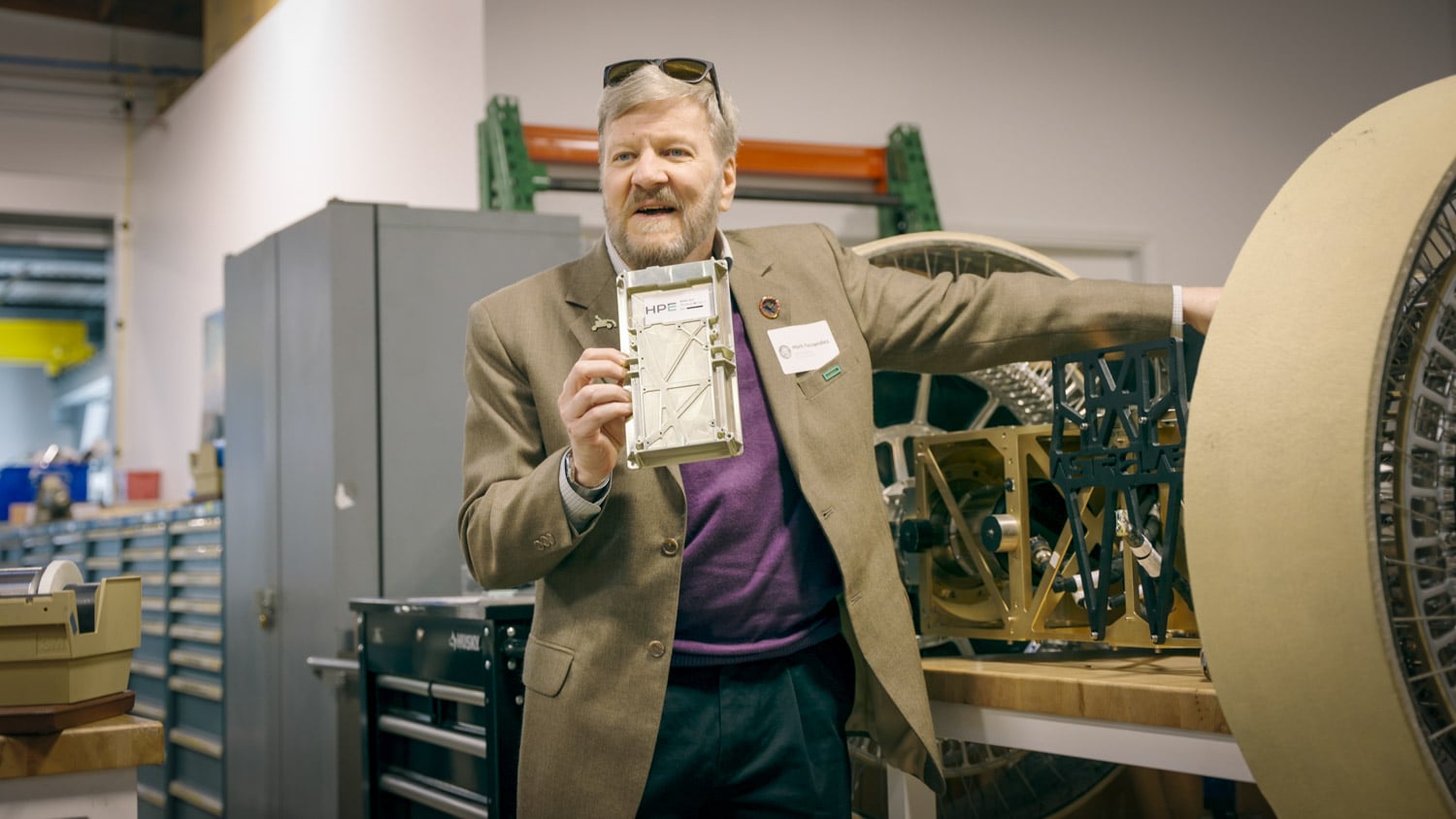
HPE’s Dr. Mark Fernandez, principal investigator for HPE Spaceborne Computer-2, holds a mockup of HPE Spaceborne Computer-4. The entire system is contained in an approximately 249 mm by 132 mm by 26 mm aluminum chassis.
HPE invited us to a press event at Astrolab’s Hawthorne, California facility. The event included a one-hour panel featuring Francisco Cordova, COO of the ISS National Laboratory; HPE’s Scott Wiest; Astrolab’s CEO Jaret Matthews; and KIOXIA’s Faraz Velani. The panel discussion was followed by a tour of the facility, including what will become mission control (powered by HP Omen systems) and its IT infrastructure, which runs on HPE Alletra Storage and HPE Private Cloud PC3000.
We were also given a tour of the clean room and an up-close look at the actual Moon-bound FLIP rover. We learned about the rover, its mission, and how HPE’s Spaceborne Computer-4 will help process scientific data from FLIP’s instruments on-prem (which is such a weird way to describe the surface of the Moon).
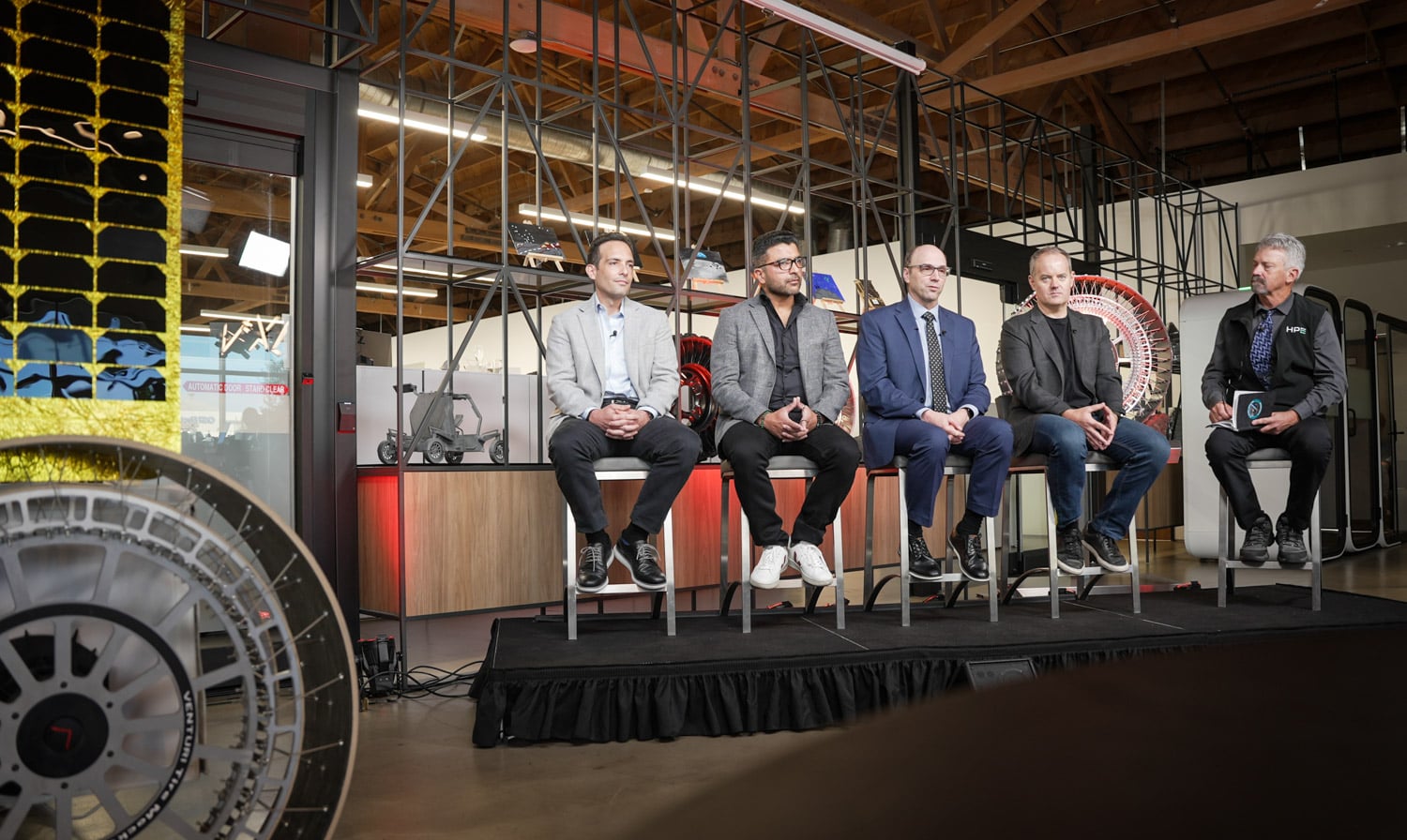
Francisco Cordova, Faraz Velani, Scott Wiest, and Jaret Matthews sit on a panel moderated by HPE’s Norm Follett next to a mockup of FLIP.
Astrolab’s FLIP Rover
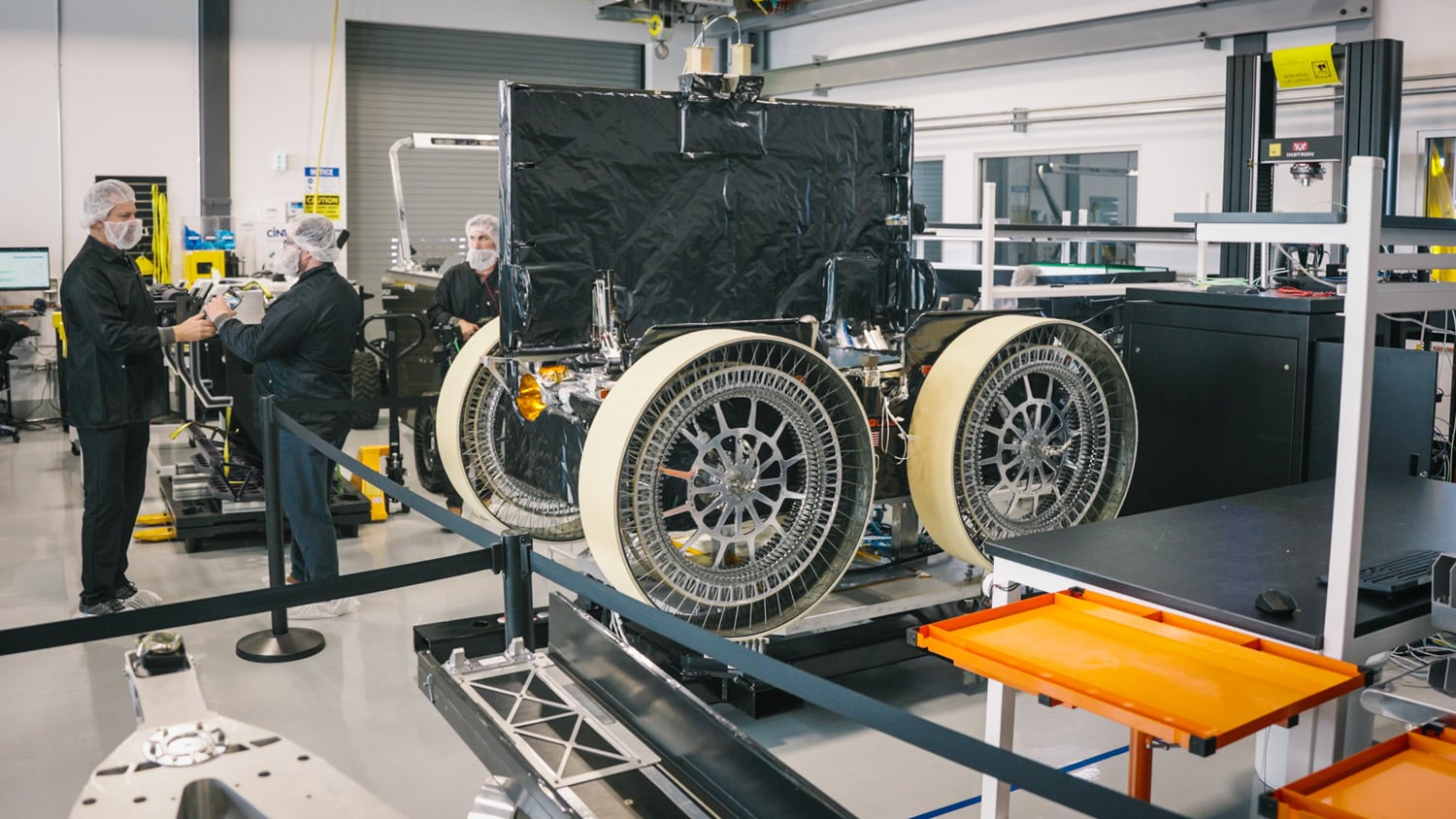
Astrolab’s FLIP rover sits in their clean room ready for launch at the end of 2026. The vertical flat piece is the back of the solar panel, which will deploy in this position, since FLIP will work at the lunar south pole where the Sun is always on the horizon during the lunar day.
Let’s start with FLIP, the Flex Lunar Innovation Platform. It’s a Lunar rover developed by Astrolab. It features several scientific payloads and, of course, HPE Spaceborne Computer-4. The rover will land on the Moon’s south pole to provide research and data for a potential Moon base. The south pole is of particular interest because the craters there are in perpetual darkness and may contain large amounts of water ice, a valuable resource for a future Moon base.
FLIP’s most obvious feature is its large wheels, designed by Venturi, which will allow it to traverse the difficult Lunar regolith. I couldn’t confirm whether they were inspired by Cadillac’s classic wire wheels, but I have my suspicions. FLIP is intended to evaluate and mature several components and subsystems for FLEX, Astrolab’s future rover, including full-sized batteries, tires, avionics systems, sensors, and software.
HPE Spaceborne Computer-4: Software and AI Applications
The software evaluations are where HPE Spaceborne Computer-4 comes in, aiming to do as much AI inference and processing on-prem (the “prem” here is the Moon’s south pole) as possible. The software stack runs in a container on a Linux-based operating system.
For benchmarking, HPE will run High-Performance LINPACK (HPL) to evaluate the sustained performance Spaceborne Computer-4 can provide in a constrained environment, and High-Performance Conjugate Gradient (HPCG) to evaluate performance characteristics under workloads that stress memory access and communication patterns. These benchmarks will help characterize how the system will run workloads in a lunar environment, providing invaluable technical data for future missions. It’s also just cool to submit a benchmark with the location set to “the Moon.”
There will also be a few core AI applications, including an LLM RAG (retrieval-augmented generation) to show how an LLM can integrate mission-specific information for more context-aware insights at the lunar edge (The Lunar Edge is a great band name). This can also be used on Earth to search text-dense mission documents more efficiently.
HPE isn’t the only one with workloads on the module. NASA will run its Federated Learning for Unbounded and Intelligent Decentralization (FLUID) experiment, an AI neural net trained on data from Earth, the Moon, and the International Space Station, to demonstrate coordination of three separate AI models, along with a tuned LLM test for searching and interpreting onboard documents. Deloitte’s Silent Shield, a new intrusion detection system, will provide near real-time predictive cyber-analytics and anomaly detection.
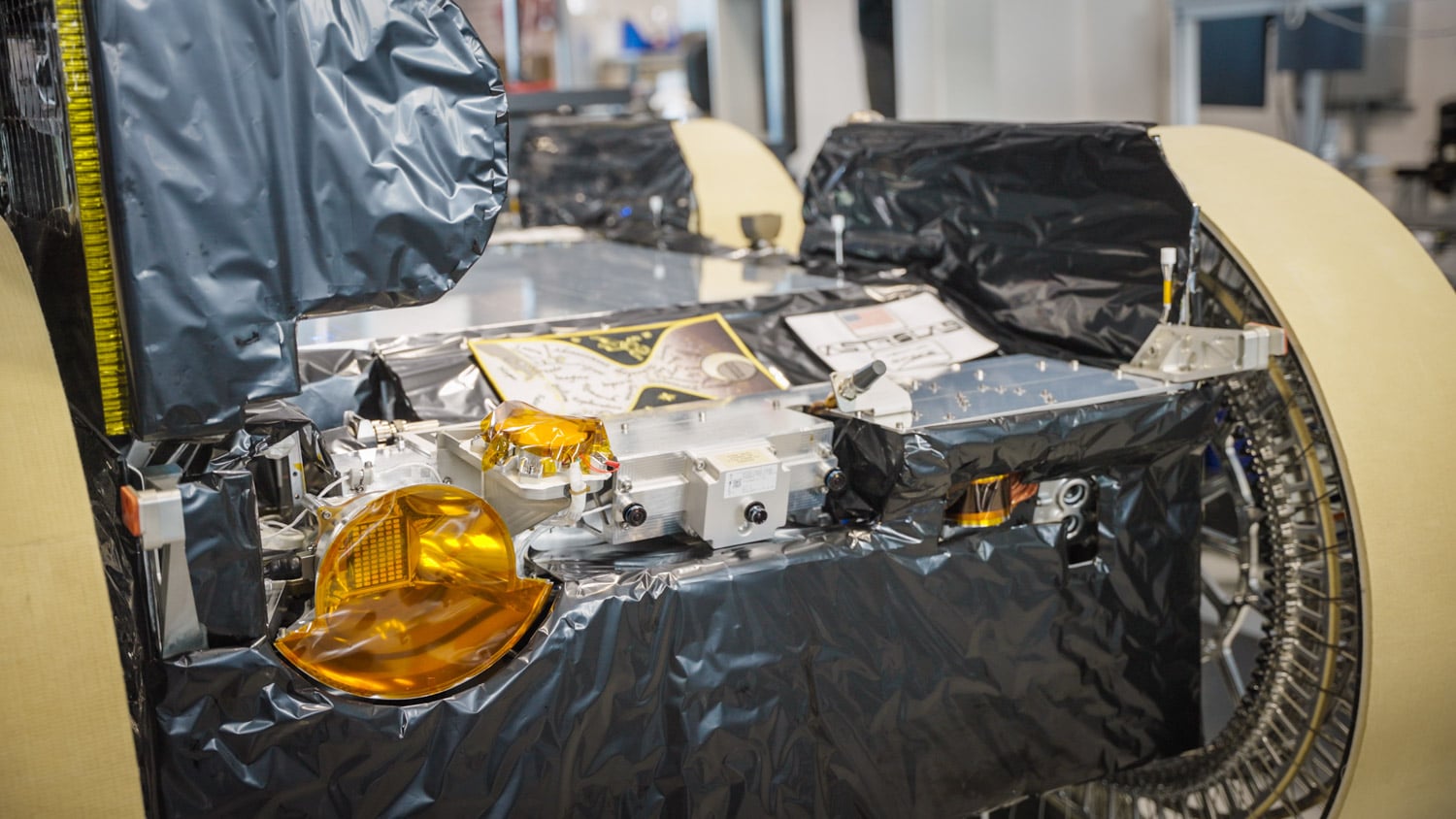
Pictured are some of FLIP’s instruments, including a headlight, camera array, LiDAR, and image projector. Also included is an American Flag patch that went to the Moon during the Apollo program.
HPE Spaceborne Computer-4 will also evaluate LLM vision inference. This workload is intended to analyze and interpret the data from the rover’s many cameras. Performing visual inference locally can enable the system to identify or interpret information without continuously transmitting the underlying visual data to Earth. This is especially useful given FLIP’s location at the Moon’s south pole, where data rates back to Earth are quite slow.
LiDAR data will also be processed for mapping, navigation, and terrain analysis. Particularly for navigation, LiDAR processing is necessary for the rover to navigate safely on the lunar surface. Because a round trip to the Moon takes at least 2.6 seconds at the speed of light, and longer once ground processing is added, real-time control of FLIP is impossible and, like the Mars rovers, FLIP must navigate on its own.
HPE Spaceborne Computer-4: Hardware and the Challenges of Space
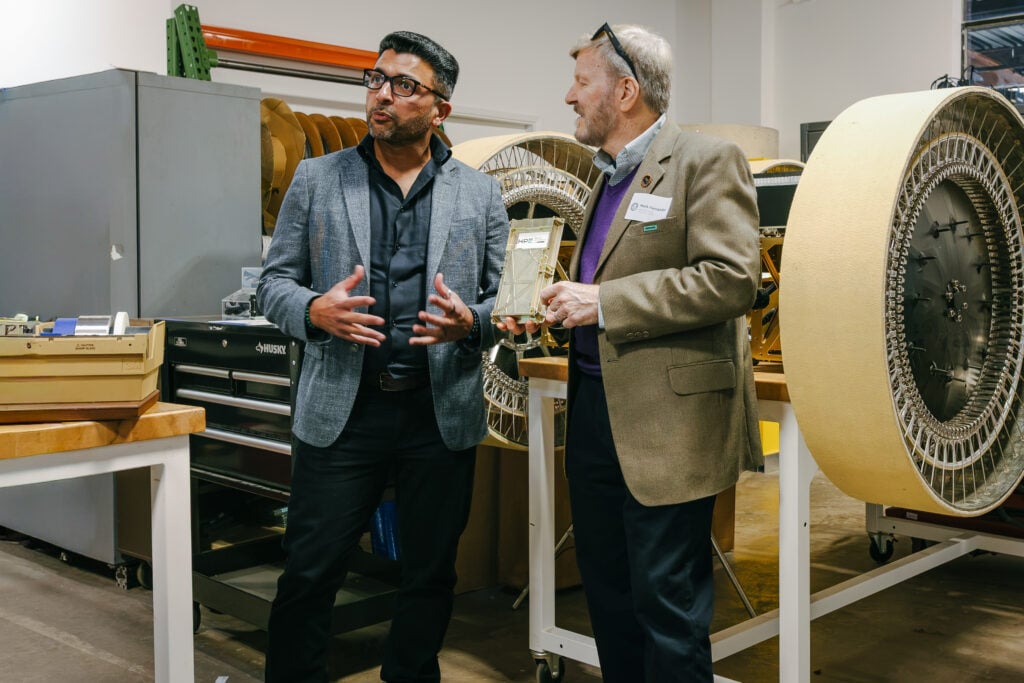
KIOXIA’s Faraz Velani stands next to HPE’s Dr. Mark Fernandez, who is holding a mockup of Spaceborne Computer-4. There are two 1TB KIOXIA BG6 SSDs in the module. (Photo courtesy of HPE).
On the hardware side, the Spaceborne Computer-4 is a purpose-built compute module adapted to the unique constraints of a lunar rover, like power, heat, and form factor.
For power, the rover runs at 28 VDC and has limited wattage to spare. Spaceborne Computer-4 has a low-power CPU and GPU from an undisclosed company, and storage from KIOXIA, a long-time partner for the Spaceborne systems. The storage is an off-the-shelf BG6 from KIOXIA’s client storage line, but it has a power-limiting feature enabled that caps usage at 5W. Apparently, it’s been available on most KIOXIA drives for many years, but no one on Earth (not hyperbole) wants to limit drive performance. It was, however, perfect for this use case.
For heat management, the Spaceborne Computer-4 is in a bespoke aluminum chassis and is integrated into the rover’s thermal management system. In fact, some of the heat the system produces can be used to help keep the rest of the rover warm, particularly during the lunar night, when surface temperatures fall to around -280 F and lower still in the shadowed polar craters. The system is fanless because there’s no air on the Moon, obviously. The chassis and its components have been optimized for the rover’s form factor and weigh only 2.6 pounds.
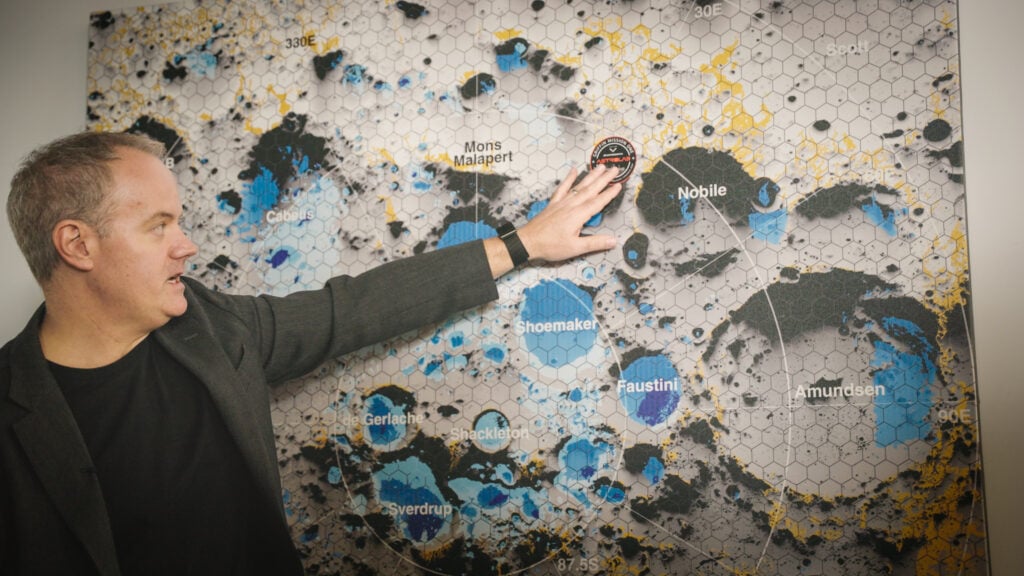
Astrolab CEO Jaret Matthews shows where FLIP will be deployed on the Moon’s south pole. The blue-shaded areas are crater basins that are in perpetual darkness and may contain large amounts of water ice.
Another major consideration for lunar operations is exposure to cosmic rays. Here on Earth, our atmosphere absorbs most cosmic rays and charged particles from the Sun. Bit-flips, or Single-Event Upsets (SEUs), happen, but are very rare here on Earth. On the Moon, FLIP is pretty much in open space, with no magnetic field or atmosphere to protect the onboard electronics. I asked about hardware shielding and space hardening, and the answer is there’s surprisingly very little on the Spaceborne Computer-4, if any. In discussions with HPE, they told me about space hardening with software. There are two KIOXIA drives that are mirrored, but beyond that, the resiliency comes from the software checking and double-checking itself. You trade some CPU cycles for this, but it is ultimately worth it to ensure reliability.
맺음말
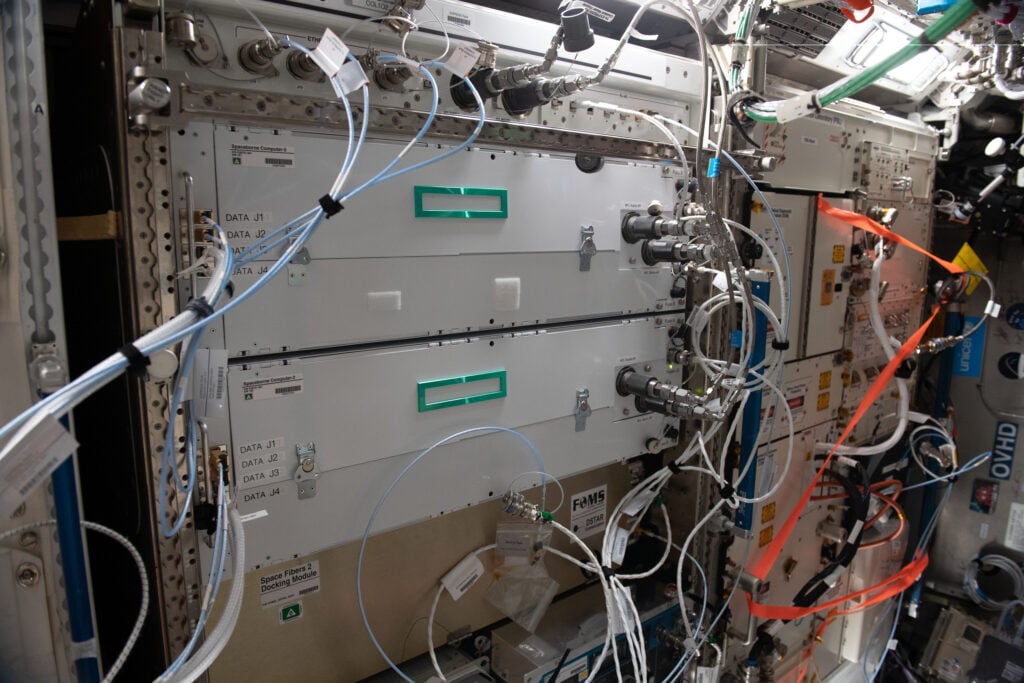
HPE’s Spaceborne Computer-2 onboard the International Space Station (Photo by NASA).
HPE Spaceborne Computer-4 is just the latest system HPE has designed specifically for space use; Spaceborne Computer-2 has been doing scientific work aboard the International Space Station for years. Bill Hewlett and David Packard even have a history with the Apollo program, and some of HP’s earliest products and instruments were used on the US’s first satellites in the late 1950s. This deployment will be exciting to watch, and I look forward to all the scientific insights FLIP and Spaceborne Computer-4 will provide. See you in the stars!


 아마존