

AMD introduced Helion today, an open rack reference design for agentic AI that builds on its 赫利俄斯 rack-scale platform. Helion comes in two versions: a CPU-only rack for hyperscalers with up to 32,768 Zen 6 cores from 6th Gen EPYC 9006 Series processors, and an all-in-one enterprise rack that mixes EPYC CPU blades with up to 16 Instinct MI350P GPUs. AMD plans to contribute the Helion specification to the Open Compute Project.
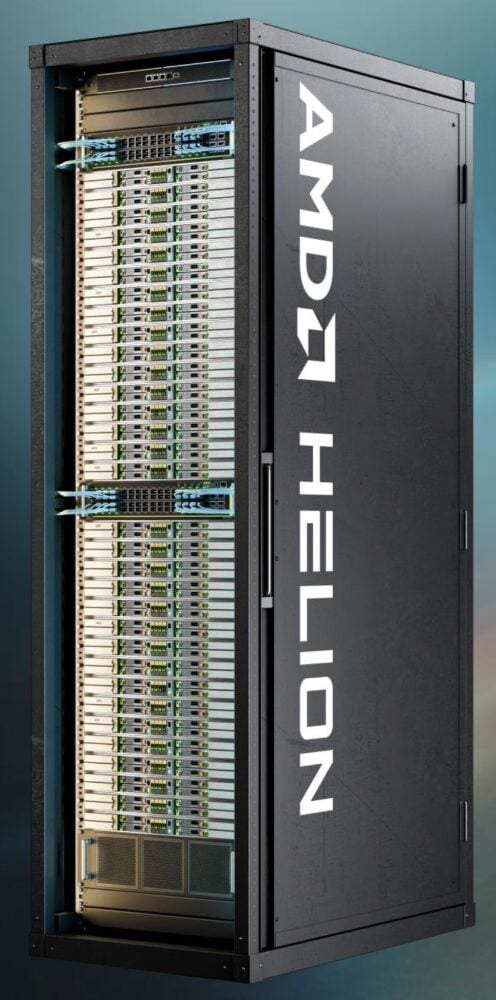
Configurable Architectures for Dense Agent Execution and Inference
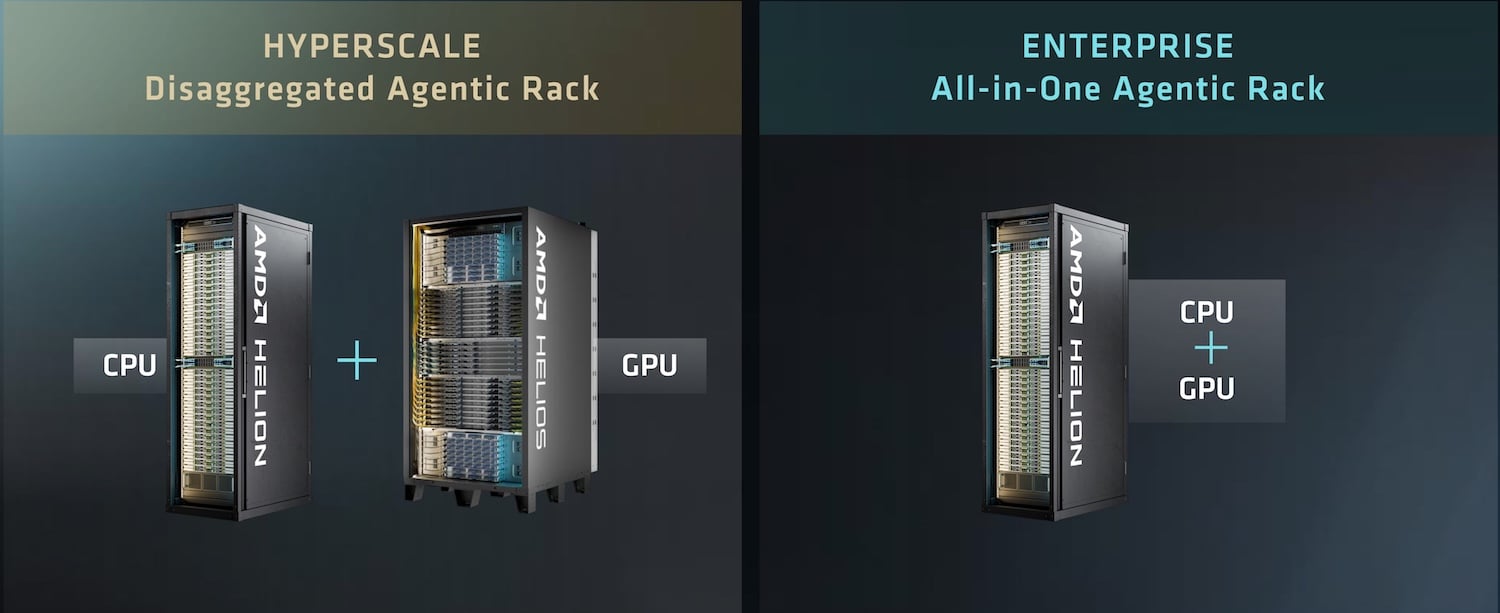
Both versions use a 21-inch ORv3 44OU rack built on OCP-compliant standard modular compute boards, with direct liquid cooling or air cooling, up to 102Tbps of programmable networking, and an open-source software stack. The hyperscale version is CPU-only and hands model inference to separate accelerator infrastructure, which AMD’s diagram shows as a Helion CPU rack paired with a Helios GPU rack. The enterprise version puts CPU and GPU blades in one rack, with GPU capacity added in pairs of 8-GPU MI350P servers.
AMD builds the hyperscale rack from three CPU node types matched to classes of agents. Personal agents run on dense servers with 256-core Venice processors at 400W, enterprise agents run on balanced servers with 256-core Venice at 600W, and technical agents run on performance servers with 96-core, high-frequency Venice parts. At 256 cores per socket, the 32,768-core ceiling works out to 128 processors in a single rack.
The enterprise rack splits into three node roles. Agentic “sandbox” nodes run either the dense 256-core, 400W Venice or a 96-core Venice at 5.0GHz, and inference nodes carry the Instinct MI350P GPUs, up to 16 per rack rated at 74 petaflops of FP4 combined. General-purpose nodes use Venice on SP7 or SP8 for database and storage work, or Venice-X for technical compute. An integrated token router directs the agents’ model calls across frontier and open-source models.
Those bins line up with the Venice parts AMD detailed in July: the 256-core EPYC 9996 and EPYC 9956, with the 9956 rated at 400W, and the 96-core EPYC 9686F high-frequency part. For GPU host nodes, AMD lists a high-frequency Venice bin with RDIMM or MRDIMM memory alongside 维拉诺, the low-power Zen 6 host processor built around LPDDR memory, which AMD has slated for the second half of 2027.
“Agentic AI is not a single workload,” said Dan McNamara, senior vice president and general manager, Compute and Enterprise AI at AMD. McNamara said AMD is bringing EPYC performance, open software, and flexible rack designs together so customers can deploy systems that match their agent workloads.
Ecosystem Reference Design Development
AMD says Helion configurations are under development with ecosystem partners and are planned to be available in November 2026. AMD has not published per-rack power figures, node counts for the hyperscale version, or pricing. MiTAC, Inventec, ASUS, ASRock Rack, and GIGABYTE also appear on AMD’s Helion partner list, and the partners below announced Helion plans alongside AMD:
- 思科: Jeremy Foster, SVP and GM of Cisco Compute, says agentic AI is changing what customers need from their infrastructure and points to connectivity, management, and security across the system.
- 戴尔科技: Dell will support Helion in Dell PowerRack, with extensions for PowerRack for Networking and Storage. Arun Narayanan, SVP of Compute and Networking, calls it “a complete, validated path to deploy agentic compute at scale.”
- Hon Hai Technology Group (Foxconn): Hon Hai cites rack-level system integration and global manufacturing for hyperscale and enterprise deployments.
- 慧与: Building on its recent customer agreement to deploy Helios, HPE says it will keep advancing open standards with AMD, including air-cooled and direct liquid-cooled networking.
- 联想: Lenovo ties Helion to its Lenovo Hybrid AI Advantage offering.
- QCT: President Mike Yang says the open blueprint gives QCT flexibility to tailor compute configurations.
- 超微: Supermicro will bring Helion to market as an ORv3-compliant rack-scale architecture through its Data Center Building Block Solutions (DCBBS).
- Wiwynn: President and CEO William Lin calls Helion “an open, flexible foundation for agentic AI infrastructure.”


 Amazon