存儲評論網

Nerdio首席技術官Scott Manchester談傳統VDI遷移僵局以及將AI代理視為Entra身份

企業  ◇  軟體

Between sessions at EUC World Amplify in Milwaukee, we sat down for an extended conversation with an industry veteran whose fingerprints are all over the modern enterprise desktop: Scott Manchester. Many in our community know Manchester from his 25-year run at Microsoft, where he led Azure 虛擬桌面 (AVD) 開設第一家的素食保健食品店。第二家開設在 Windows 365 雲端電腦. In January he took on the role of Chief Product and Technology Officer at 內爾迪奧, one of the five sponsors we profiled ahead of the show.

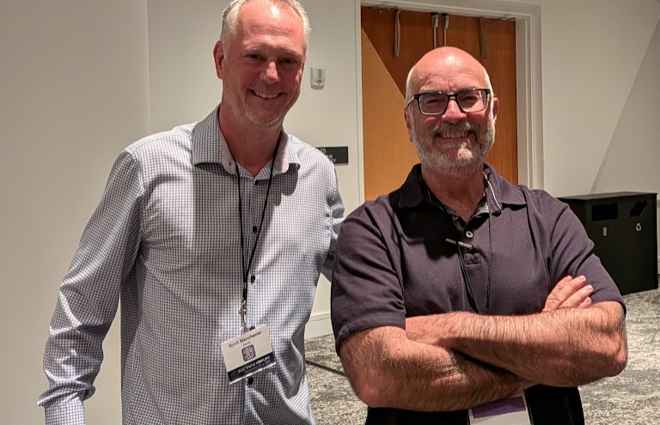
Scott Manchester, Chief Product and Technology Officer at Nerdio, standing with StorageReview's Tom Fenton in a conference hallway at EUC World Amplify 2026 in Milwaukee

Scott Manchester (left), CPTO of Nerdio, with Tom Fenton (right) at EUC World Amplify in Milwaukee.

After comparing notes on the joys and soggy realities of Pacific Northwest skiing, we dove into two immediate challenges facing sysadmins today: untangling the multi-million-seat on-premises desktop migration deadlock, and the looming operational headaches of governing autonomous AI agents in enterprise workspaces.

Unpacking the 60-Million-Seat Migration Deadlock

Despite all the talk about public cloud migration over the past six years, most enterprise data centers remain stubbornly on-premises. Roughly 60 million virtual desktop seats, by Manchester’s count, remain anchored to legacy infrastructure. Many of these estates run on legacy Citrix or Omnissa Horizon deployments that have accumulated years of bespoke configurations, institutional debt, and shadow administrative tweaks.

When we asked Manchester what keeps IT leadership from modernizing these deployments, he pointed directly to operational opacity. In many shops, the current director or principal architect is the third or fourth person to inherit the environment. The original blueprint from half a decade ago rarely reflects how internal business units consume resources today. Because ripping and replacing an infrastructure stack without understanding daily workloads invites business disruption, organizations repeatedly take the path of least resistance by rubber-stamping legacy maintenance contracts during renewal cycles.

Bridging this gap starts with telemetry-driven rationalization. Nerdio’s own discovery tool, Nerdio 指南針, is free during its public preview and runs without agents; it reads a Citrix, AVD, or Intune estate and reports environment structure, workload profiles, policy configuration, and cost, with Omnissa Horizon support on the roadmap.

With that picture in hand, administrative teams can parse workloads into native Azure Virtual Desktop multi-session pools, persistent personal desktops, or fixed-cost Windows 365 Cloud PCs. A blind migration provisions a static 1:1 desktop for every legacy user.

From an engineering perspective, this phased approach takes the high-wire act out of platform migrations. Organizations can stage user migrations department by department, run pilot cohorts in parallel, validate burdened cost models, and decommission legacy hardware only after establishing operational parity.

Dogfooding the Stack: Customer Zero

One of Manchester’s immediate priorities as CPTO has been establishing a strict internal baseline: running Nerdio entirely on Nerdio.

While “eating your own dog food” is a familiar phrase across Redmond and Palo Alto, enforcing it across a globally distributed workforce of several hundred remote employees provides critical architectural telemetry. In this environment, internal IT operates as Customer Zero. Every internal employee onboarding workflow, from provisioning 微軟Entra ID objects and assigning conditional access policies to delivering localized Cloud PCs or hybrid AVD session hosts, executes directly through Nerdio Manager.

Subjecting product engineering teams to the operational quirks, interface friction, and edge cases of their own automation engine creates a crucial feedback loop. When engineering teams live inside the operational guardrails they build for customers, product roadmaps align far more closely with the day-to-day realities of enterprise administrators.

Taming Agentic Workflows: From Copilots to Autonomous Actors

Our conversation turned toward the broader structural transformation sweeping enterprise workspaces: the rapid deployment of agentic AI.

We shared an observation from our hands-on lab testing with Tassient’s Aipex AI-assisted management platform, where we used natural language prompts to diagnose driver faults, parse crash dumps, remediate kernel panics, and stand up tiered infrastructure services. While the productivity gains of natural language infrastructure management are undeniable, the operational questions remain substantial: Who holds accountability when an automated agent misconfigures a production subnet or exfiltrates corporate data?

Manchester outlined a clear operational framework for evaluating agentic maturity in the enterprise, delineating three distinct stages:

  • Stage 1, Human in the Loop: The agent evaluates telemetry, models solutions, and presents recommendations, but cannot execute administrative changes without explicit human authorization.
  • Stage 2, Human on the Loop: The agent possesses sufficient verified accuracy to execute bounded tasks independently, keeping the administrator informed via telemetry dashboards and real-time execution logs.
  • Stage 3, Fully Autonomous Execution: The agent continuously remediates issues, manages capacity, and applies security baselines independently within strict policy constraints, escalating only when an exception occurs outside its operational boundaries.

The primary headache for IT is keeping autonomous models from running wild across corporate endpoints. Manchester’s answer is to treat machine actors like any standard user, under the policy frameworks already in place.

By treating an AI agent as a discrete identity object within Microsoft Entra, administrators can apply the same compliance architectures that already govern human staff: role-based access control (RBAC), Microsoft Intune device compliance, and Microsoft Purview data loss prevention (DLP) filters. If an agent working on behalf of an engineer attempts an outbound data transfer that violates corporate policy, established DLP rules block the exfiltration just as they would for a standard endpoint.

The Looming Challenge of Tokenomic Shock

Beyond security policies, the explosive sprawl of AI tooling is introducing an unexpected operational headache: tokenomic shock.

Enterprise organizations are finding themselves balancing concurrent subscriptions across OpenAI, Anthropic, and Microsoft Copilot. Much like the early days of unmonitored cloud computing, where runaway egress fees surprised finance teams at the end of the quarter, unmetered multi-agent consumption models are driving unpredictable operational expenditure.

As Manchester noted, the immediate challenge for systems architects is consolidating this fragmented sprawl. IT departments cannot manage three distinct administrative consoles, three proprietary token allocation schemes, and three incompatible security schemas without increasing human overhead.

The industry is already shifting toward centralized abstraction layers that sit above disparate foundation models. Enterprise administrative consoles will need to enforce unified governance: translating a single set of corporate compliance and budgetary rules across multiple underlying engines, controlling invocation costs, and ensuring that automation enhances administrative productivity without breaking the IT budget.

For IT professionals responsible for enterprise workspaces, the mandate over the next twelve months is clear. Whether you are modernizing legacy on-premises desktop estates or establishing the initial identity boundaries for autonomous software agents, success hinges on disciplined governance, granular workload visibility, and architectural pragmatism.

For a closer look at where Nerdio’s platform is heading, our NerdioCon 2026 coverage walks through Nerdio Manager for Enterprise 8.0, including AVD hybrid on Nutanix and global pools, and our preview of EUC World Amplify 2026 explains why we made the trip to Milwaukee.

非常感謝

We need to offer a heartfelt thanks to Scott for being so generous with his time, as what was originally set to be a high-level 30-minute discussion became an hour-plus, in-depth conversation spanning everything from VDI migrations to AI accountability.

參與 StorageReview

電子報| YouTube | PodcastiTunes / Spotify | Instagram | Twitter | TikTok | RSS訂閱

湯姆芬頓

Tom Fenton 在過去 27 年的各種技術中積累了豐富的 IT 實踐經驗,過去 20 年專注於虛擬化和存儲。 他之前曾在 VMware 擔任高級課程開發人員、解決方案工程師,並在競爭營銷小組工作。 他還曾在 The Taneja Group 擔任高級驗證工程師,領導驗證服務實驗室,並在啟動其 vSphere Virtual Volumes 實踐方面發揮了重要作用。 他在推特上@vDoppler