

VAST Data announced the Agent Sandbox Foundation Stack with NVIDIA at NVIDIA GTC Berlin, a reference architecture that runs NVIDIA NemoClaw agents inside NVIDIA OpenShell sandboxes on the VAST AI Operating System. OpenShell handles isolated execution and policy enforcement around each agent, and VAST handles the parts that have to outlive the sandbox: the agent’s workspace, its memory and context, and a record of every action it took. VAST says the design is meant to run thousands of agents and sub-agents in production without tying their state to whichever compute node happens to be running them.
Zero-Copy Workspaces Separate Storage from Agent Execution
VAST is addressing the churn that agent fleets create: thousands of isolated workspaces built and torn down in an hour, and long-running agents that sleep, resume, and hand work to short-lived sub-agents along the way. The stack decouples each agent’s persistent state from any one compute node, so an agent can pause, resume, or move to other eligible infrastructure without losing its progress or working data, and the compute can stay ephemeral while the state stays durable.
When a new agent task starts, the VAST DataStore Block CSI driver provisions a persistent volume for the OpenShell sandbox from a zero-copy clone, which VAST says takes seconds and avoids a full copy of the underlying data. In the reference implementation VAST published on GitHub under an Apache 2.0 license, each workflow gets a head persistent volume claim, and each sub-agent gets a clone of it; volume snapshots cover suspend and resume, and a sleeping sandbox keeps its volume.
VAST DataBase serves as the shared vector store and knowledge base, which VAST says lets hundreds of reasoning agents query the same dataset concurrently without a copy per agent. In the GitHub implementation, it also holds per-department agent memory, the trace spans and turns, and the finished reports, and a Model Context Protocol server is the only path from a sandbox to the database. NemoClaw supplies the agent layer and supports Hermes, LangChain, OpenClaw, or a custom harness.
“Every enterprise that puts an agent into production will eventually need to answer what it did and why it did it,” said Alon Horev, CTO and Co-Founder at VAST Data. “An agent might exist for minutes, spawn thousands of other agents and then disappear, but its work has to persist and its actions have to stay understandable long afterward.”
Persistent Records Track Activity Beyond Sandbox Lifetimes
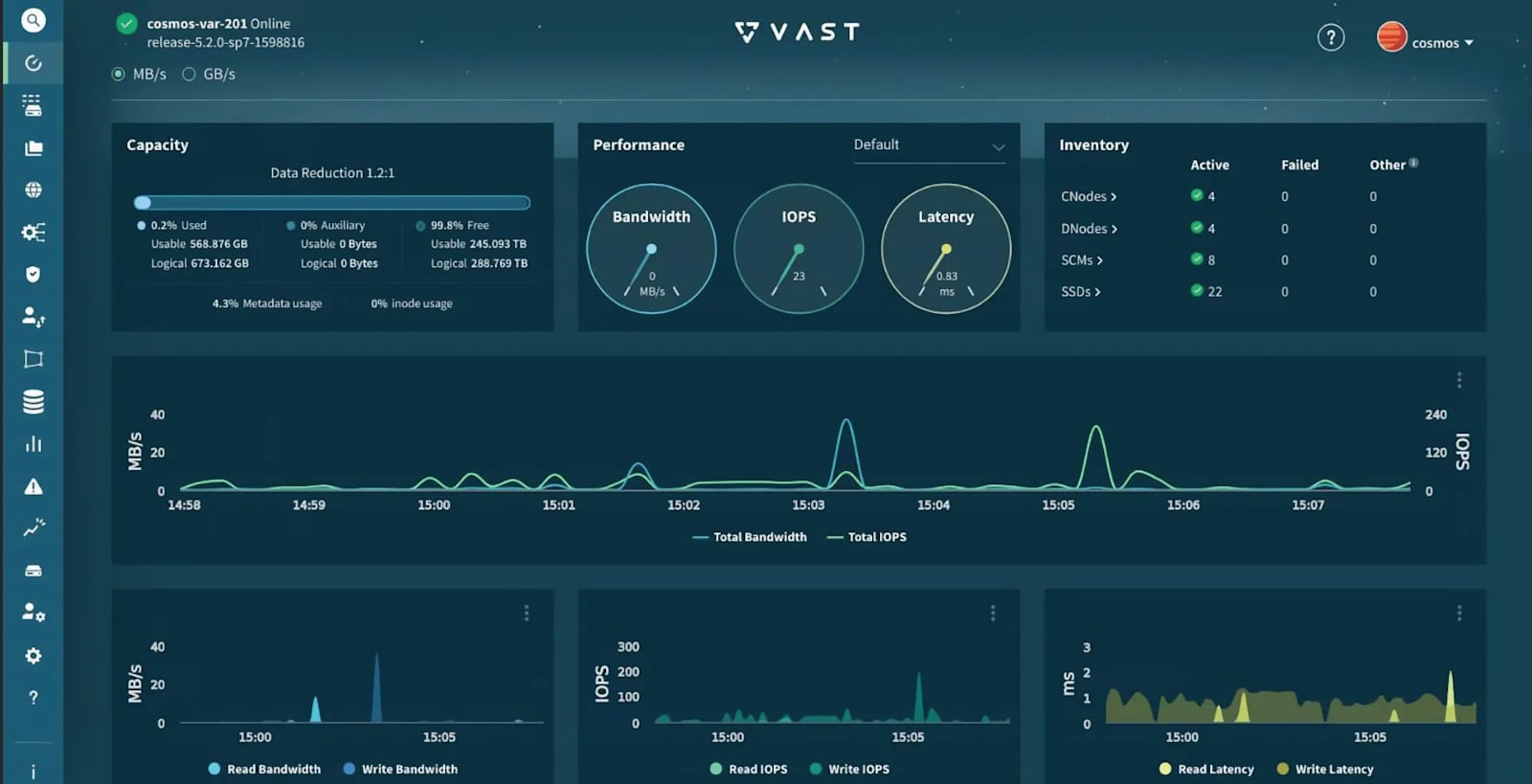
OpenShell applies identity-based access and behavior policies and logs every interaction between an agent and anything outside its sandbox. VAST DataBase keeps the durable copy of that record, logging every tool call, prompt, token, cost, and decision so the audit trail survives after the agent and its sandbox are gone. The VAST Management System adds real-time telemetry on data flows across the fleet, and VAST says that telemetry interoperates with NVIDIA Sentry, the BlueField-4 DPU layer that monitors traffic between agents on Vera CPUs and models on Rubin GPUs.
When Sentry flags or quarantines a misbehaving agent, VAST says the AI OS isolates that agent’s data access and freezes the sandbox state for forensic review. “As AI agents take on more complex work, enterprises need infrastructure that can support secure execution while preserving the data, context and state agents depend on across their lifecycle,” said Kari Briski, Vice President of Generative AI Software at NVIDIA.
Foundation Stacks are VAST’s packaging of NVIDIA AI Blueprints into repeatable deployments on the AI OS. The first two covered an enterprise research assistant on VAST DataEngine with NVIDIA Nemotron and video intelligence on NVIDIA Cosmos reasoning models with NVIDIA Video Search and Summarization; this one covers the agent runtime itself. It also builds on VAST DataEnclave, the confidential computing runtime VAST previewed in September, and on the OpenShell reference architecture NVIDIA detailed at the same show.
VAST is demonstrating the stack at GTC Berlin with a governed multi-agent workflow in which agents spawn, pull from persistent data services, and keep their state as the compute underneath them changes. The GitHub implementation runs that pattern as a supervised research job: a lead agent plans the work on an NVIDIA NIM model, a human can approve or edit the plan, and sub-agents run in parallel inside OpenShell sandboxes against an earnings-call corpus in VAST DataBase.
VAST has not published a general availability date, required software versions, or hardware configurations for the stack, and the thousands-of-agents figure is a design target with no measured provisioning rate or concurrency result behind it.


 Amazon