

Brian sat down with Chris Sullivan, Director of Research and Academic Computing in Oregon State University’s College of Earth, Ocean, and Atmospheric Sciences, for a live podcast at Yotta 2026 in Las Vegas. This is an audio-only episode, recorded on the show floor. Chris has been a steady collaborator on our edge AI work, from the research vessel data center we wrote about last fall to the DGX Spark shared storage concept we published the week of the show. This conversation is about the data behind the science: 4,000 acoustic recorders in the forest, 100TB of plankton imagery per five-day cruise, Solidigm high-capacity SSDs in a ranger station, and why he tells people that AI is a data problem.
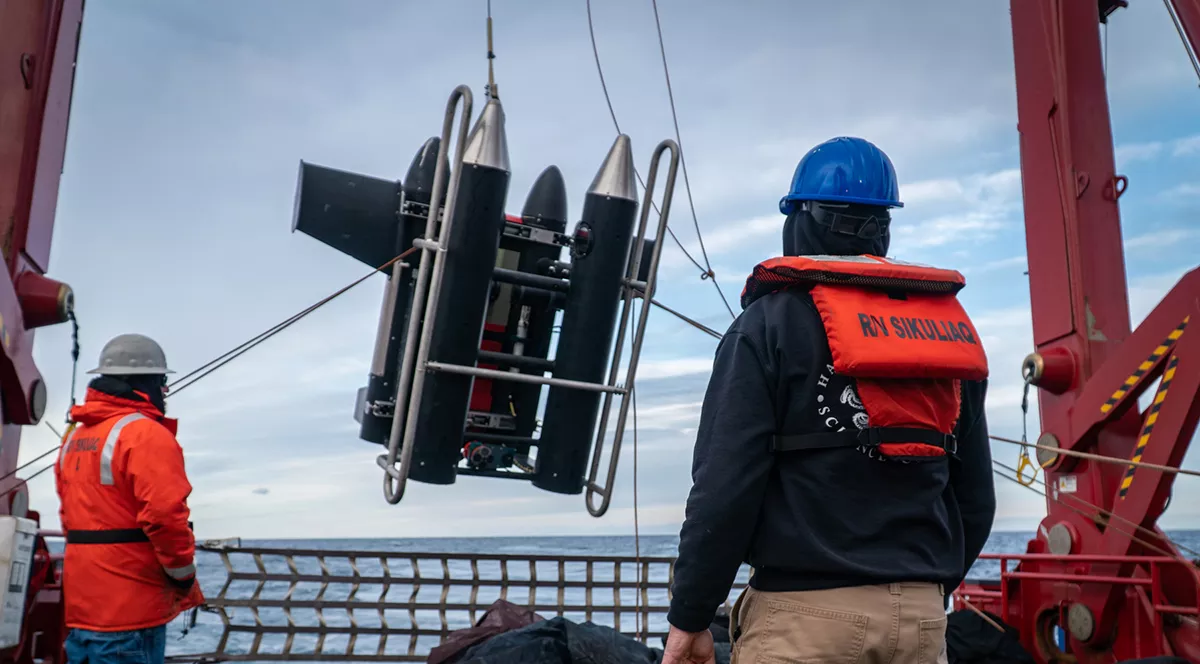
Oregon State deploys an imaging instrument at sea. Photo: Oregon State University
Chris Sullivan runs research and academic computing for Oregon State’s College of Earth, Ocean, and Atmospheric Sciences, which puts him in charge of the infrastructure behind forest monitoring, ocean observing, and the data center work the university does for partner institutions. He describes himself as a data scientist first, and his argument throughout the whole episode is that every scientist is one. We first spoke with him on 播客#145, covered his work with Metrum AI on AI-assisted academic assessment, and hosted him on a LinkedIn Live 在五月。
The episode runs about 22 minutes. The numbers that stuck with us: a $150 million ship that costs $1 million per ten-day cruise, 55GB/s reads from U.2 QLC in the validation system, 250TB arriving from a ranger station every six to eight weeks, and a grant cycle that assumes 18-month hardware refreshes while the industry is moving in three to six. If you don’t have time to listen end-to-end, we have broken it into segments so you can choose what’s most important to you.
[00:00] Universities as Data Stewards
The opening segment sets up why Oregon State’s work looks different from most of the Yotta crowd: the data is collected from instruments in the field and kept forever, because nobody knows which model will make it valuable next.
- Chris’s position is that all scientists are data scientists, since every experiment, whether in a lab or on a cluster, produces data that has to be stored and curated.
- Universities have traditionally been good at curating and proving the value of data, and he sees them as the natural long-term data stewards as AI raises the value of old records.
- Oregon State’s stated mission is “prosperity widely shared,” and the data center work is framed as a direct contribution to that.
[01:45] Spotted Owls, 4,000 Recorders, and a 135-Species Model
Chris works with the U.S. Forest Service on a program that monitors the northern spotted owl, an umbrella species whose presence says a lot about the health of the forest, and the project has grown into a general acoustic census.
- About 4,000 autonomous recording units are deployed between San Francisco and Canada, recording the forest continuously.
- The convolutional neural net he published this spring identifies 135 species from sound, works through rain and aircraft noise, and can estimate direction of travel from Doppler shift and distinguish male from female calls.
- The goal is finding mating pairs, backed by statistical models, so the timber industry can harvest without taking out habitat. Chris stresses this is a partnership with industry, not a fight.
- One field problem the model cannot solve: when a human walks through the forest, the animals go quiet, which is why sampling has to happen unattended.
[04:22] Plankton and the $150 Million Ship
The ocean side of the program centers on plankton, which Chris calls one of the most crucial species on the planet, and on the NSF-funded regional class research vessels that will carry the imaging work.
- Chris co-wrote the plankton identification algorithm. He cites plankton as the base of the food web, a major source of the oxygen we breathe, and a large carbon sink, which is why warming water matters.
- NSF is funding three regional class research vessels, and Oregon State expects the first one this December. Chris has spent the past year specifying the onboard technology.
- The ship costs $150 million, a ten-day cruise costs about $1 million in hardware and labor, and roughly 15 experiments run at once. The plankton experiment alone generates about 100TB of captured data in five days.
- Processing at sea lets the team steer the ship toward plankton in real time. Plankton drift on currents, and a transect that comes back without plankton on camera is a wasted cruise, which has happened.
[07:09] Power, Not Rack Units: Sizing the Shipboard Data Center
Brian asks how big the data center on each ship is, and the answer is that physical space was never the constraint. Power and cooling at sea are, and that pushed the storage design toward large-capacity SSDs.
- The ship budget is in the 30kW to 50kW range, enough for several racks but not for the biggest new hardware. Testing a Dell PowerEdge XE7745 with four NVIDIA RTX Pro 6000 GPUs showed how quickly GPUs eat into that budget.
- Once the GPU power was committed, the question became how to save energy on storage, which led to the Solidigm D5-P5336 family. The 122TB drives worked well, and the 30TB versions delivered better performance for the deployment that needed it.
- In the plankton validation runs, the U.2 drives delivered reads around 55GB/s and writes around 15GB/s, enough to process six to eight streams at a time. Chris notes the limit was disk, since more GPUs could have been added, and that this was a test to justify the purchase to NSF.
- Landing all the data on one machine removed the disk arrays that used to surround the GPUs, and the simplicity matters to researchers who get one shot at the data. Brian draws the comparison to a PBS crew we recently outfitted with QLC RAID boxes for filming rare birds in Brazil.
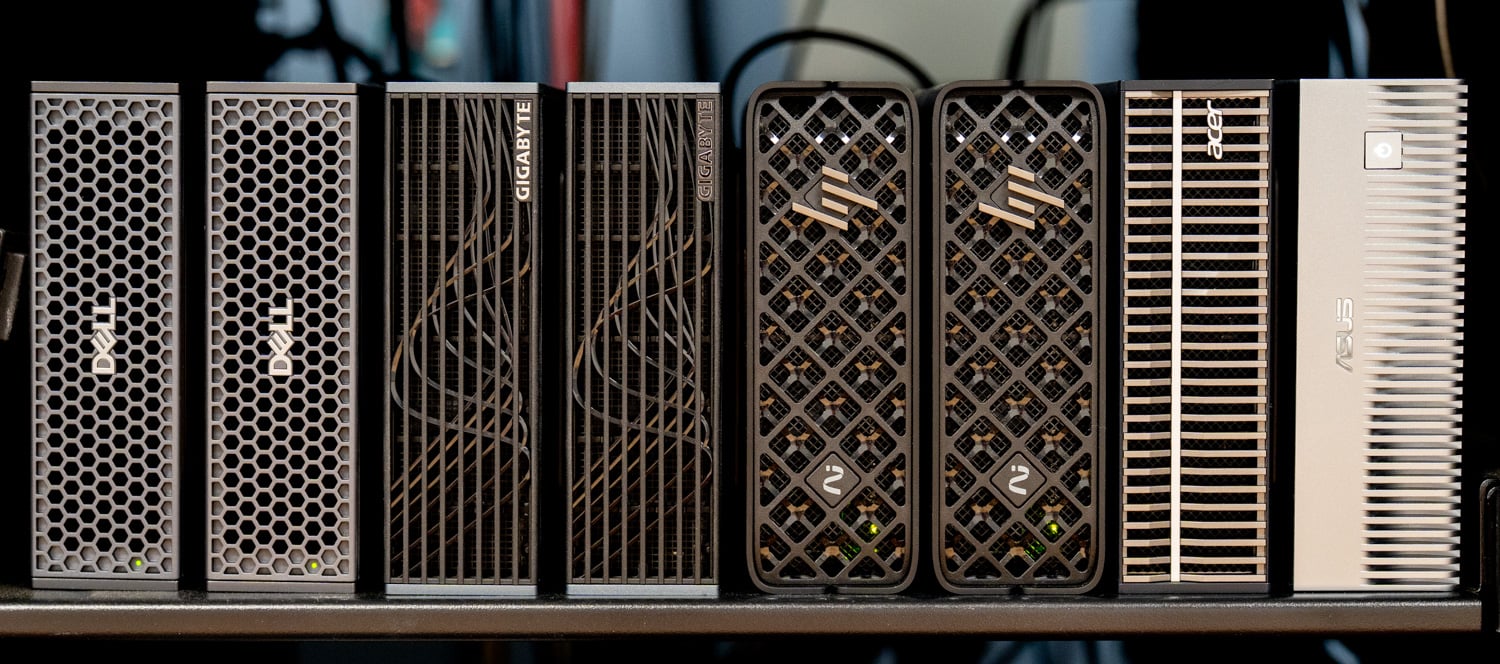
Eight GB10 systems from our DGX Spark shared storage project, built around Oregon State’s Spark lab concept
[11:37] 300TB in a Ranger Station
The forest deployment is harder than the ship in one respect: there is no data center at all, only a ranger station with limited power and no cooling, so compute and storage both have to live at the edge.
- Oregon State worked with Supermicro on a liquid-cooled GPU system that runs on a standard 15A circuit, since the ranger station has no air conditioning and limited electricity.
- The system has two drive slots, filled with 122TB Solidigm D5-P5336 drives, giving Chris roughly 300TB of local capacity so data lands in one place and is processed in one place.
- The recorders bring in about 250TB every six to eight weeks, and the longer sampling interval is the point: catching rare events without a human nearby. Female spotted owls go quiet once paired, so finding a mating pair takes long unattended recording plus the historical data to validate the statistical models.
[13:45] Keeping Data for 50 Years: Tape, Stone Tablets, and the OOI
Brian connects the enterprise instinct to never delete data with the scientific version of the same problem, and Chris explains what long-term stewardship looks like in practice at Oregon State.
- His answer to “how would you send data 50 years into the future” is stone tablets or tape, and he still pulls decades-old ship data off tape for modern analysis.
- The Ocean Observatories Initiative is a 25-year project with one-minute interval data from wire walkers, gliders, and seafloor instruments. Oregon State holds that data for 25 years minimum and expects to keep it for 50 to 100.
- Oregon State runs the data center behind that program for the University of Washington, Rutgers, and Woods Hole Oceanographic Institution. The underwater earthquake data UW published last year came from Oregon State’s data center.
- Models are retrained constantly against the archive, and the move toward transformer models is meant to handle multiple tasks at once and reduce bias.
[16:54] The Huang Complex and the Case for Data Centers
Jensen and Lori Huang are both Oregon State graduates, and the Jen-Hsun and Lori Huang Collaborative Innovation Complex puts an NVIDIA supercomputer on campus. Chris explains how it fits with the edge work and makes his case for data centers as a public good.
- The complex includes a data center with Vera Rubin NVL72 systems, which Chris plans to use for the same mission as the field work: understanding how the planet is changing.
- Oregon State uses AWS, Azure, and Google Cloud as well. Chris’s NOAA work runs entirely in Google Cloud.
- His response to data center criticism is that every technology has problems to communicate and fix, and that science is not going to fix the planet without data centers.
[18:18] The Next 6 to 12 Months: Smaller Data Centers and a Broken Grant Cycle
Brian asks for the forward view, and Chris argues for smaller, liquid-cooled, distributed facilities, then explains why the current pace of hardware change is a real problem for research budgets.
- Data centers do not need to be gigantic. Liquid cooling packs more capability into smaller spaces that can be distributed with less impact.
- AI is a data problem and an arms race: every time processing gets faster, there is more data to throw at it. His kitchen analogy is that the processors are the fork and knife, the refrigerator holds everything you care about, and the food is the data.
- Grants are awarded months after quotes are submitted, and with hardware cycles compressed from 18 months to three to six, awarded grants are no longer buying the technology they were written around.
- Eight 122TB drives give him a petabyte and retire a full rack of spinning disk, and the savings show up in the hardware around the drives as much as the drives themselves.
- Moving data is where science loses time. Getting data off the ship meant running a 100GbE line down the dock, and high-capacity SSDs cut the number of times data has to move at all.
You can find Chris Sullivan on Oregon State’s Research and Academic Computing Services page, and our prior coverage of the program at the links above.


 Amazon