---
description: Gen4 performance from this drive offering isn't anything special, but the Seagate IronWolf 525 does has a lot to offer the NAS crowd.
title: Seagate IronWolf 525 SSD Review
image: https://www.storagereview.com/wp-content/uploads/2021/09/storagereview-ironwolf-525-ssd-back.jpg
---
[![Storage Review]()](https://storagereview.com/)
---
[Facebook](https://www.facebook.com/@storagereview) [X (Twitter)](https://twitter.twitter.com/storagereview) [Instagram](https://www.instagram.com/storagereview/) [LinkedIn](https://www.linkedin.com/company/storagereview-com) [YouTube](https://www.youtube.com/user/storagereview?sub_confirmation=1) [Email](mailto:info@storagereview.com) [Spotify](https://open.spotify.com/show/1y6VnznABhHeOSMOmbDTz0) [Reddit](https://www.reddit.com/r/StorageReview/) [Discord](https://discord.gg/TwMHb4azdC) [RSS Feed](https://www.storagereview.com/rss.xml) [TikTok](https://www.tiktok.com/@storagereview)
[Facebook](https://www.facebook.com/@storagereview) [X (Twitter)](https://twitter.com/storagereview) [Instagram](https://www.instagram.com/storagereview/) [LinkedIn](https://www.linkedin.com/company/storagereview-com) [YouTube](https://www.youtube.com/user/storagereview?sub_confirmation=1) [Email](mailto:info@storagereview.com) [Spotify](https://open.spotify.com/show/1y6VnznABhHeOSMOmbDTz0) [Reddit](https://www.reddit.com/r/StorageReview/) [Discord](https://discord.gg/TwMHb4azdC) [RSS Feed](https://www.storagereview.com/rss.xml) [TikTok](https://www.tiktok.com/@storagereview)
[](https://www.storagereview.com)
≡ Menu
- [Home](https://www.storagereview.com/)
- [Storage Reviews](https://www.storagereview.com/review)
- [End User Reviews](https://www.storagereview.com/consumer)
- [Enterprise Reviews](https://www.storagereview.com/enterprise)
- [Ubiquiti Reviews](https://www.storagereview.com/best/ubiquiti-reviews)
- [SR Merch](https://store.storagereview.com)
- [Leaderboards](https://www.storagereview.com/best)
- [Best Storage Arrays](https://www.storagereview.com/best/storage-arrays)
- [Best Enterprise SSDs](https://www.storagereview.com/best/enterprise-ssds)
- [Best Servers](https://www.storagereview.com/best/servers)
- [Best Enterprise GPUs](https://www.storagereview.com/best/enterprise-gpus)
- [Best Desktops for Local AI](https://www.storagereview.com/best/desktops-local-ai)
- [Best Laptops for Local AI](https://www.storagereview.com/best/laptops-local-ai)
- [Best Local LLM Tools](https://www.storagereview.com/best/local-llm-tools)
- [Agentic AI Hardware](https://www.storagereview.com/best/agentic-ai-hardware)
- [Best SSDs & Hard Drives](https://www.storagereview.com/best_drives)
- [Best Portable SSDs](https://www.storagereview.com/best/portable-ssds)
- [Best Business Laptops](https://www.storagereview.com/best/business-laptops)
- [Best Mobile Workstations](https://www.storagereview.com/best/mobile-workstations)
- [Best Desktop Workstations](https://www.storagereview.com/best/desktop-workstations)
- [Best Mini PCs](https://www.storagereview.com/best/mini-pcs)
- [Best Laptop Battery Life](https://www.storagereview.com/best/laptop-battery-life)
- [Storage Reference Guide](https://www.storagereview.com/storage-reference-guide)
- [About SR](https://www.storagereview.com/about-storagereview)
- [StorageReview.com Sweepstakes Rules and Regulations](https://www.storagereview.com/storagereview-com-sweepstakes-rules-and-regulations)
Search
[Home](https://www.storagereview.com/) » [Review](https://www.storagereview.com/review) » Seagate IronWolf 525 SSD Review
# Seagate IronWolf 525 SSD Review
by Lyle Smith on October 1, 2021
[Client SSD](https://www.storagereview.com/consumer/client-ssd) ◇ [End User](https://www.storagereview.com/consumer)
The Seagate IronWolf 525 is the company’s newest NVMe NAS SSD to hit the market. Offering fast access to data in low latency, multi-user environments, the IronWolf 525 is ideal for commercial and entry-level Enterprise NAS solutions as well as creative professionals with high-performance needs. Seagate’s new NAS drive is available in three capacities (500GB, 1TB, and 2TB) and can be used either as a primary storage drive or as a fast-caching option.
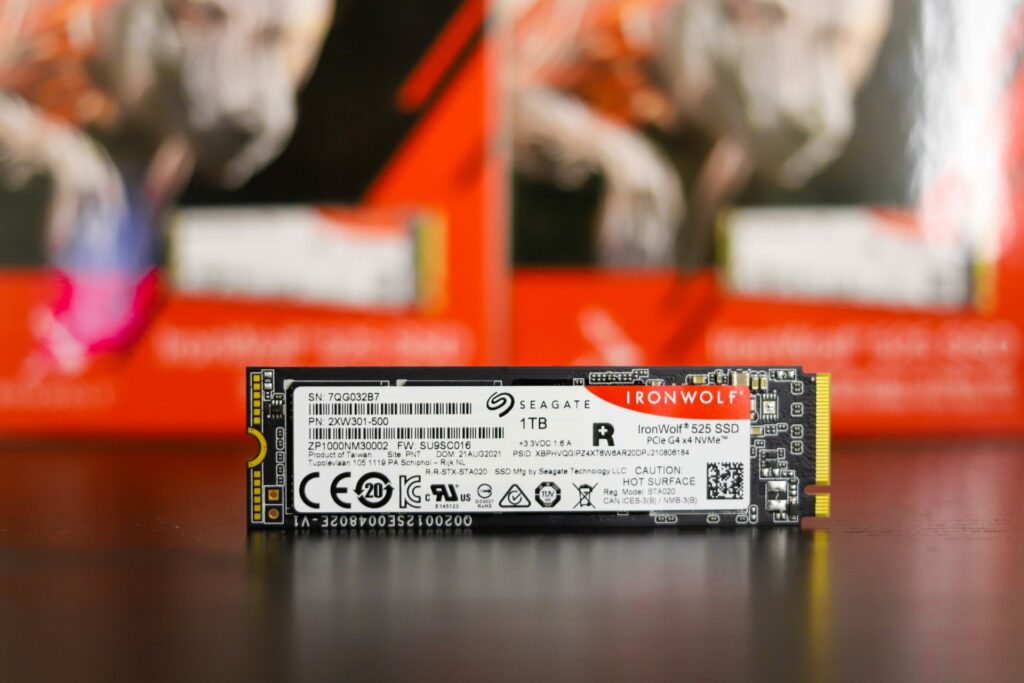
Compared to its predecessor, the [IronWolf 510](https://www.storagereview.com/review/seagate-ironwolf-510-ssd-review), Seagate’s new IronWolf 525 is quoted with better performance (both sequential and random speeds) though its TBW (total bytes written) and power efficiency are a little less. Both drives have the same Mean Time Between Failures (MTBF) rating of 1.8 million hours.
![Seagate IronWolf 525 Oracle back view]()
All this said, Seagate went with an older controller (Phison E16) with the IronWolf 525 rather than the new E18 model, which is used by their flagship [FireCuda 530](https://www.storagereview.com/review/seagate-firecuda-530-ssd-review) drive. This makes the IronWolf 525 more in line with the FireCuda 520. The older E16 is used in drives such as the [Corsair MP600](https://www.storagereview.com/review/corsair-mp600-pro-ssd-review) and [Sabrent Rocket](https://www.storagereview.com/review/sabrent-rocket-pcie-gen3-ssd-review) and is combined with two Kioxia BiCS4 96-layer 3D (TABBG65AWV) flash chips.
## **Seagate IronWolf 525 vs. WD Red SN700**
Western Digital also recently released their own NVMe NAS SSD, the [WD Red SN700](https://www.storagereview.com/news/wd-red-sn700-nvme-nas-ssds-now-available). Like the IronWolf 525, this is a high-endurance, caching drive designed for SMB customers in 24/7 NAS environments and always-on applications. There are some differences between the two, however. While companies like Western Digital are still using the Gen3 interface, Seagate has made the jump to Gen4, allowing it to potentially leverage all of the high-performance benefits that come with it.
The IronWolf 525 drive (2TB model) has slightly better reliability numbers versus the SN700, quoting an MTBF rating of 1.8 million hours (vs. 1.75 million hours) and a higher endurance at 2,800 TBW (vs. 2,600 TBW). The WD SN700 line, however, offers a higher-capacity 4TB model, as the Seagate drive only goes up to 2TB. This can be a deal-breaker for businesses looking to get the most high-speed storage footprint from their NAS.
![]()
For performance, Seagate quotes sequential speeds up to 5GB/s read and 4.4GB/s write, while random speeds (QD32) are expected to reach 760,000 IOPS read and 700,000 IOPS write. WD has specced the SN700 with noticeably lower numbers: 3,430MB/s read and 3,100MB/s write for sequential performance while random speeds (QD32) are quoted up to 550K read and 560K write.
Backed by a 5-year limited warranty and 3 years of data recovery services, the Seagate IronWolf 525 carries an [MSRP of $119.99 (500GB), $199.99 (1TB), and $419.99 (2TB)](https://amzn.to/3or0Qc6). At the time of this review, the drives haven’t quite made it into retail just yet.
## **Seagate IronWolf 525 Specifications**
| Specifications | 2TB | 1TB | 500GB |
| --- | --- | --- | --- |
| Standard Model | ZP2000NM30002 | ZP1000NM30002 | ZP500NM30002 |
| Interface | PCIe Gen4 x4,
NVMe 1.3 | PCIe Gen4 x4,
NVMe 1.3 | PCIe Gen4 x4,
NVMe 1.3 |
| NAND Flash Type | 3D TLC | 3D TLC | 3D TLC |
| Form Factor | M.2 2280-D2 | M.2 2280-D2 | M.2 2280-D2 |
| Performance (PCIe Gen4 x4) | | | |
| Sequential Read (MB/s) FOB, 128KB QD325 | 5000 | 5000 | 5000 |
| Sequential Write (MB/s) FOB, 128KB QD325 | 4400 | 4400 | 2500 |
| Random Read (IOPS) FOB, 4KB QD32 T85 | 740,000 | 760,000 | 420,000 |
| Random Write (IOPS) FOB, 4KB QD32 T85 | 700,000 | 700,000 | 630,000 |
| Sequential Read (MB/s) Sustained, 128KB QD326 | 4300 | 4350 | 3300 |
| Sequential Write (MB/s) Sustained, 128KB QD326 | 965 | 995 | 525 |
| Random Read (IOPS) Sustained, 4KB QD2566 | 425,000 | 445,000 | 230,000 |
| Random Write (IOPS) Sustained, 4KB QD2566 | 19,500 | 19,500 | 10,800 |
| Performance (PCIe Gen3 x4) | | | |
| Sequential Read (MB/s) FOB, 128KB QD325 | 3400 | 3400 | 3400 |
| Sequential Write (MB/s) FOB, 128KB QD325 | 3200 | 3200 | 2500 |
| Random Read (IOPS) FOB, 4KB QD32 T85 | 640,000 | 640,000 | 420,000 |
| Random Write (IOPS) FOB, 4KB QD32 T85 | 565,000 | 565,000 | 550,000 |
| Sequential Read (MB/s) Sustained, 128KB QD326 | 3300 | 3300 | 3250 |
| Sequential Write (MB/s) Sustained, 128KB QD326 | 965 | 995 | 525 |
| Random Read (IOPS) Sustained, 4KB QD2566 | 425,000 | 445,000 | 230,000 |
| Random Write (IOPS) Sustained, 4KB QD2566 | 19,500 | 19,500 | 10,800 |
| Endurance / Reliability | | | |
| Total Bytes Written (TB) | 2,800 | 1,400 | 700 |
| Nonrecoverable Read Errors per Bits Read | 1 per 10E16 | 1 per 10E16 | 1 per 10E16 |
| Mean Time Between Failures (MTBF, hours) | 1,800,000 | 1,800,000 | 1,800,000 |
| Rescue Data Recovery Services (years)7 | 3 | 3 | 3 |
| Warranty, Limited (years) | 5 | 5 | 5 |
| Power Management | | | |
| Power Supply (V) | 3.3 | 3.3 | 3.3 |
| Active Max Average Power (W) | 6.5 | 6.5 | 5.6 |
| Average Idle Power PS3 (mW) | 30 | 20 | 20 |
| Environmental | | | |
| Temperature, Operating Internal (°C) | 0 to 70 | 0 to 70 | 0 to 70 |
| Temperature, Non-operating (°C) | –40 to 85 | –40 to 85 | –40 to 85 |
| Shock, Non-operating 0.5ms (G) | 1500 | 1500 | 1500 |
| Physical | | | |
| Height (mm / in, max) | 3.58 / 0.140 | 3.58 / 0.140 | 3.58 / 0.140 |
| Width (mm / in, max) | 22.15 / 0.872 | 22.15 / 0.872 | 22.15 / 0.872 |
| Length (mm / in, max) | 80.15 / 3.156 | 80.15 / 3.156 | 80.15 / 3.156 |
| Weight (g / lb) | 8.7 / 0.019 | 8.5 / 0.018 | 8.0 / 0.017 |
## **Seagate IronWolf 525 Performance**
**VDBench Workload Analysis**
When it comes to benchmarking storage devices, application testing is best, and synthetic testing comes in second place. While not a perfect representation of actual workloads, synthetic tests do help to baseline storage devices with a repeatability factor that makes it easy to do apples-to-apples comparison between competing solutions. These workloads offer a range of different testing profiles ranging from “four corners” tests, common database transfer size tests, to trace captures from different VDI environments.
![]()
All of these tests leverage the common vdBench workload generator, with a scripting engine to automate and capture results over a large compute testing cluster. This allows us to repeat the same workloads across a wide range of storage devices, including flash arrays and individual storage devices. Our testing process for these benchmarks fills the entire drive surface with data, then partitions a drive section equal to 5% of the drive capacity to simulate how the drive might respond to application workloads. This is different than full entropy tests which use 100% of the drive and take them into a steady state. As a result, these figures will reflect higher-sustained write speeds.
Profiles:
- 4K Random Read: 100% Read, 128 threads, 0-120% iorate
- 4K Random Write: 100% Write, 64 threads, 0-120% iorate
- 64K Sequential Read: 100% Read, 16 threads, 0-120% iorate
- 64K Sequential Write: 100% Write, 8 threads, 0-120% iorate
- Synthetic Database: SQL and Oracle
- VDI Full Clone and Linked Clone Traces
Comparables
- [Seagate IronWolf 510](https://www.storagereview.com/review/seagate-ironwolf-510-ssd-review)
- [Synology SVN3400](https://www.storagereview.com/review/synology-snv3400-400g-ssd-review)
- [Samsung DCT983](https://www.storagereview.com/review/samsung-983-dct-nvme-ssd-review)
First up is our random 4K read. Here, the Seagate IronWolf 525 SSD peaked at 396,247 IOPS with a latency of 321.3µs, which placed it 2nd overall though well back of the Samsung drive.
![Seagate IronWolf 525 4K random read performance]() In 4K write, the Seagate started with very low latency (like all the tested drives) then went on to peak at just over 57,784 IOPS with a latency at about 2,208µs.![Seagate IronWolf 525 4K random write performance]()
Switching over to sequential workloads, the new Seagate drive performed much better. Here, the IronWolf 525 had sub-millisecond latency performance throughout with a peak of boasted peaks of 59,499 IOPS (3.74GB/s) and 536.7µs latency, placing it first by a large margin.
![Seagate IronWolf 525 sequential read performance]()
The Seagate struggled once again in writes. Here, it had peaks of 5,207 IOPS (or 323MB/s) and 3,060µs latency, placing well back of the leaders.
![Seagate IronWolf 525 64K sequential write performance]()
Next, we move on to our SQL workloads, where all drives (including the Seagate IronWolf 525) were well behind the Samsung DCT983. That said, the IronWolf 525 SSD stayed below 1ms throughout with a peak of 123,829 IOPS with a latency of 257.2µs latency in the SQL workload. The Samsung drive had over 200K in IOPS performance and 150 µs in latency for comparison.
![]()
For SQL 90-10 the Seagate peaked at 100,370 IOPS with a latency of 313.7µs. Again, the Samsung drive outperformed the other drives by far, more than doubling the IOPS of Synology and Seagate IronWolf 510 SSDs.
![]()
With SQL 80-20 we see the IronWolf 525 hit a peak of 77,352 IOPS with a latency of 411.5µs.
![]()
Moving on to Oracle workloads, the Seagate IronWolf 525 continued its sub-millisecond latency throughout the tests. For the Oracle Workload profile, we saw a peak performance of 69,567 IOPS at 535.4µs.
![Seagate IronWolf 525 Oracle]() Oracle 90-10 saw the IronWolf 525 hit 86,292 IOPS at 253.7µs. The Samsung once again encroaching on double the IOPS and boasting half the latency of the new Seagate drive.
![]()
For Oracle 80-20 the IronWolf 525 peaked at 68,018 IOPS at 321.7µs for latency.
![]()
Next, we switched over to our VDI clone test, Full and Linked. For VDI Full Clone Boot, the Seagate IronWolf 525 SSD peaked at 80,655 IOPS at a latency of 419µs before just slightly dropping off.
![]() VDI FC Initial Login saw the Seagate IronWolf 525 actually outperform the Samsung, though it showed a severe spike in performance at the end of the test, peaking at 19,409 IOPS at 1.5ms. The IronWolf 510 model had better results here with a peak of 22,260 IOPS at 1,300 µs.
![]()
With the VDI FC Monday Login, the IronWolf 525 showed similar (yet less stable) results to the 510 model, posting a peak of 18,319 IOPS at 869.4µs.
![]()
Switching over to Linked Clone, the Seagate IronWolf 525 fell way back down the leaderboard (last place by a large margin) peaking at 24,389 IOPS with a latency of 252.7µs.
![]() Like we saw in the VDI Full Clone test, the IronWolf 525 performed much better when we switched to Initial Login (though it barely edged out the IronWolf 510). Here, it had peak scores of 11,044 IOPS with 720µs for latency.
![]()
Finally, with VDI LC Monday Login, the Seagate showed some huge dips in performance though ending with a peak performance of 12,223 IOPS and a latency of 1,298 µs.
![]()
## **Conclusion**
The Seagate IronWolf 525 is an M.2 Gen4 NVMe SSD built for both NAS caching and primary storage use cases. Available in capacities from 500GB to 2TB, the new Seagate drive offers plenty of endurance (2,800 TBW) and is quoted to reach sequential speeds up to 5GB/s read and 4.4GB/s write.
![seagate ironwolf 525 pair]()
Looking at performance, we compared the Seagate IronWolf 525 (.7DWPD) to other similar SSDs: the Synology SVN3400, Samsung DCT983, and its predecessor, the IronWolf 510 (1DWPD). With the exception of a few tests, the Samsung drive topped the leaderboard by a noticeable margin, though this is due to its more up-market enterprise design (.8DWPD). Though the IronWolf 525 showed strong random read performance in our 64k test, it was outpaced in every other benchmark by some of the Gen3 drives in many of the tests.
![]()
For highlights, the IronWolf 525 was able to hit peak scores of 396,247 IOPS in 4K read, 57,784 IOPS in 4K write, 3.74GB/s in 64K read, and 323MB/s in 64K write. For SQL we saw 123,829 IOPS, 100K IOPS for SQL 90-10, and 77K IOPS SQL 80-20. Oracle had the IronWolf peaking at 70K IOPS, while Oracle 90-10 80-20 saw 86K IOPS and 68K IOPS, respectively. Like the IronWolf 510 before it, the 525 interestingly outperformed the Samsung in both the Initial Login and Monday Login of both the VDI Linked and Full clone tests.
Though Gen4 performance from this Seagate offering isn’t anything special, the IronWolf 525 is one of the few NAS drives that leverage the new PCIe interface. That said, Gen4 support on NAS devices themselves is pretty rare at the moment, making the IronWolf 525 a somewhat niche (and unique) offering for the time being.
For example, QNAP is only now in the process of upgrading a single NAS, the [TS-h2490FU](https://www.storagereview.com/review/qnap-ts-h2490fu-review) (a 2U rackmount NAS), to support the PCIe Gen4 NVMe interface with an expected release by the end of Q4 2021. Synology has no plans to support Gen4 on any models in the near term.
This is a bizarre release for Seagate. After the really great [FireCuda 530 launch](https://www.storagereview.com/review/seagate-firecuda-530-ssd-review), this one is a tremendous letdown. Seagate took an old controller (July 2019) that isn’t very good by today’s standards and released a NAS caching drive (high write workload) with a lower endurance rating than the model prior. Performance is subpar, the drive is on the expensive side and there are few ports within the NAS world that even support Gen4. There are better options out there, this drive should be a hard pass unless it’s much less expensive than other choices.
**Engage with StorageReview**
[Newsletter](https://www.storagereview.com/storage_newsletter) | [YouTube](https://www.youtube.com/user/StorageReview "Opens in a new window") | Podcast [iTunes](https://podcasts.apple.com/gb/podcast/storagereview-com-storage-reviews/id1060681115 "Opens in a new window")/ [Spotify](https://open.spotify.com/show/1y6VnznABhHeOSMOmbDTz0 "Opens in a new window") | [Instagram](https://www.instagram.com/storagereview/ "Opens in a new window") | [Twitter](https://twitter.com/storagereview "Opens in a new window") | [TikTok](https://www.tiktok.com/@storagereview? "Opens in a new window") | [RSS Feed](https://www.storagereview.com/rss.xml)
![]()
### Lyle Smith
Lyle is a writer for StorageReview, covering a broad set of end user and enterprise IT topics.
Previous post: [Kingston DataTraveler Max Review](https://www.storagereview.com/review/kingston-datatraveler-max-review)
Next post: [GRAID SupremeRAID SR-1000 Review](https://www.storagereview.com/review/graid-supremeraid-sr-1000-review)
Trusted Vendors
Products and solutions from our affiliate partners:
- [

Ubiquiti
](https://store.ui.com/us/en?a_aid=StorageReview "Opens in a new window")
- [

Newegg
](https://click.linksynergy.com/fs-bin/click?id=g5terNMDhz0&offerid=1207190.18&subid=0&type=4 "Opens in a new window")
- [
 Amazon
](https://amzn.to/4fLJUEW "Opens in a new window")
Newsletter
Subscribe to the StorageReview newsletter to stay up to date on the latest news and reviews. We promise no spam!
1
Leave this field empty if you’re human:
## Advertisement
Content Categories
[Facebook](https://www.facebook.com/@storagereview) [X](https://twitter.com/storagereview) [Instagram](https://www.instagram.com/storagereview/) [LinkedIn](https://www.linkedin.com/company/storagereview-com) [YouTube](https://www.youtube.com/user/storagereview?sub_confirmation=1) [Email](mailto:info@storagereview.com) [Spotify](https://open.spotify.com/show/1y6VnznABhHeOSMOmbDTz0) [Reddit](https://www.reddit.com/r/StorageReview/) [Discord](https://discord.gg/TwMHb4azdC) [RSS](https://www.storagereview.com/rss.xml) [TikTok](https://www.tiktok.com/@storagereview)
Copyright © 1998-2025 Flying Pig Ventures, LLC Cincinnati, Ohio. All rights reserved.
Manage your privacy
To provide the best experiences, we and our partners use technologies like cookies to store and/or access device information. Consenting to these technologies will allow us and our partners to process personal data such as browsing behavior or unique IDs on this site and show (non-) personalized ads. Not consenting or withdrawing consent, may adversely affect certain features and functions.
Click below to consent to the above or make granular choices. Your choices will be applied to this site only. You can change your settings at any time, including withdrawing your consent, by using the toggles on the Cookie Policy, or by clicking on the manage consent button at the bottom of the screen.
Functional Functional Always active
The technical storage or access is strictly necessary for the legitimate purpose of enabling the use of a specific service explicitly requested by the subscriber or user, or for the sole purpose of carrying out the transmission of a communication over an electronic communications network.
Preferences Preferences
The technical storage or access is necessary for the legitimate purpose of storing preferences that are not requested by the subscriber or user.
Statistics Statistics
The technical storage or access that is used exclusively for statistical purposes. The technical storage or access that is used exclusively for anonymous statistical purposes. Without a subpoena, voluntary compliance on the part of your Internet Service Provider, or additional records from a third party, information stored or retrieved for this purpose alone cannot usually be used to identify you.
Marketing Marketing
The technical storage or access is required to create user profiles to send advertising, or to track the user on a website or across several websites for similar marketing purposes.
Statistics
Marketing
Features
Always active
Special features
Special purposes
Always active
- Manage options
- Manage services
- Manage {vendor\_count} vendors
- [Read more about these purposes](https://cookiedatabase.org/tcf/purposes/)
Accept Deny Manage options Save preferences Manage options
- {title}
- {title}
- {title}
Manage your privacy
To provide the best experiences, we use technologies like cookies to store and/or access device information. Consenting to these technologies will allow us to process data such as browsing behavior or unique IDs on this site. Not consenting or withdrawing consent, may adversely affect certain features and functions.
Functional Functional Always active
The technical storage or access is strictly necessary for the legitimate purpose of enabling the use of a specific service explicitly requested by the subscriber or user, or for the sole purpose of carrying out the transmission of a communication over an electronic communications network.
Preferences Preferences
The technical storage or access is necessary for the legitimate purpose of storing preferences that are not requested by the subscriber or user.
Statistics Statistics
The technical storage or access that is used exclusively for statistical purposes. The technical storage or access that is used exclusively for anonymous statistical purposes. Without a subpoena, voluntary compliance on the part of your Internet Service Provider, or additional records from a third party, information stored or retrieved for this purpose alone cannot usually be used to identify you.
Marketing Marketing
The technical storage or access is required to create user profiles to send advertising, or to track the user on a website or across several websites for similar marketing purposes.
Statistics
Marketing
Features
Always active
Special features
Special purposes
Always active
- Manage options
- Manage services
- Manage {vendor\_count} vendors
- [Read more about these purposes](https://cookiedatabase.org/tcf/purposes/)
Accept Deny Manage options Save preferences Manage options
- {title}
- {title}
- {title}
Manage consent Manage consent
```json
{"@context":"https:\/\/schema.org","@graph":[{"@type":"WebPage","@id":"https:\/\/www.storagereview.com\/review\/seagate-ironwolf-525-ssd-review","url":"https:\/\/www.storagereview.com\/review\/seagate-ironwolf-525-ssd-review","name":"Seagate IronWolf 525 SSD Review - StorageReview.com","isPartOf":{"@id":"https:\/\/www.storagereview.com\/#website"},"primaryImageOfPage":{"@id":"https:\/\/www.storagereview.com\/review\/seagate-ironwolf-525-ssd-review#primaryimage"},"image":{"@id":"https:\/\/www.storagereview.com\/review\/seagate-ironwolf-525-ssd-review#primaryimage"},"thumbnailUrl":"https:\/\/www.storagereview.com\/wp-content\/uploads\/2021\/09\/storagereview-ironwolf-525-ssd-back.jpg","datePublished":"2021-10-01T18:48:18+00:00","description":"Gen4 performance from this drive offering isn't anything special, but the Seagate IronWolf 525 does has a lot to offer the NAS crowd.","breadcrumb":{"@id":"https:\/\/www.storagereview.com\/review\/seagate-ironwolf-525-ssd-review#breadcrumb"},"inLanguage":"en-US","potentialAction":[{"@type":"ReadAction","target":["https:\/\/www.storagereview.com\/review\/seagate-ironwolf-525-ssd-review"]}]},{"@type":"ImageObject","inLanguage":"en-US","@id":"https:\/\/www.storagereview.com\/review\/seagate-ironwolf-525-ssd-review#primaryimage","url":"https:\/\/www.storagereview.com\/wp-content\/uploads\/2021\/09\/storagereview-ironwolf-525-ssd-back.jpg","contentUrl":"https:\/\/www.storagereview.com\/wp-content\/uploads\/2021\/09\/storagereview-ironwolf-525-ssd-back.jpg","width":1920,"height":1280},{"@type":"BreadcrumbList","@id":"https:\/\/www.storagereview.com\/review\/seagate-ironwolf-525-ssd-review#breadcrumb","itemListElement":[{"@type":"ListItem","position":1,"name":"Home","item":"https:\/\/www.storagereview.com\/"},{"@type":"ListItem","position":2,"name":"Review","item":"https:\/\/www.storagereview.com\/review"},{"@type":"ListItem","position":3,"name":"Seagate IronWolf 525 SSD Review"}]},{"@type":"WebSite","@id":"https:\/\/www.storagereview.com\/#website","url":"https:\/\/www.storagereview.com\/","name":"StorageReview.com","description":"StorageReview.com is a leading provider of news and reviews throughout the entire IT stack - from the datacenter to the edge, and all points in between.","publisher":{"@id":"https:\/\/www.storagereview.com\/#organization"},"potentialAction":[{"@type":"SearchAction","target":{"@type":"EntryPoint","urlTemplate":"https:\/\/www.storagereview.com\/?s={search_term_string}"},"query-input":{"@type":"PropertyValueSpecification","valueRequired":true,"valueName":"search_term_string"}}],"inLanguage":"en-US"},{"@type":"Organization","@id":"https:\/\/www.storagereview.com\/#organization","name":"StorageReview.com","url":"https:\/\/www.storagereview.com\/","logo":{"@type":"ImageObject","inLanguage":"en-US","@id":"https:\/\/www.storagereview.com\/#\/schema\/logo\/image\/","url":"https:\/\/www.storagereview.com\/wp-content\/uploads\/2020\/02\/Storage-Reviews-2-2.png","contentUrl":"https:\/\/www.storagereview.com\/wp-content\/uploads\/2020\/02\/Storage-Reviews-2-2.png","width":344,"height":61,"caption":"StorageReview.com"},"image":{"@id":"https:\/\/www.storagereview.com\/#\/schema\/logo\/image\/"},"sameAs":["https:\/\/x.com\/storagereview","http:\/\/youtube.com\/user\/storagereview"]}]}
```