

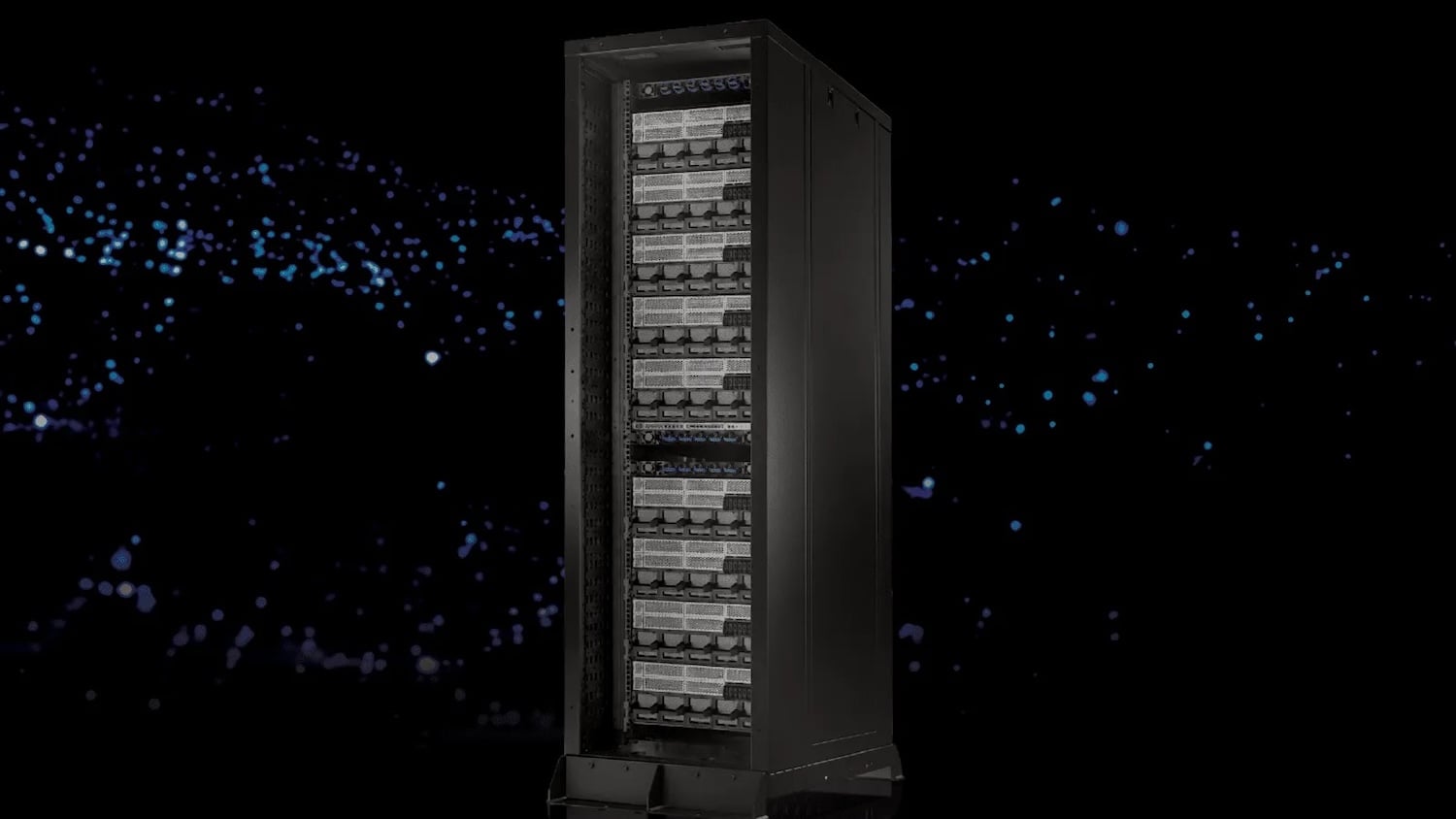
Astera Labs has announced Orion, a rack-scale reference design that lets a neocloud or enterprise pick its GPUs and CPUs after the rack is built. Accelerators arrive as PCIe plug-in cards, and a 320-lane PCIe switch fabric scales a pod from 8 to 160 of them, so an operator can deploy the rack once and swap compute as prices, lead times, and workloads change. Astera Labs is not building the racks itself; OEM and ODM partners will manufacture and sell them, with the first designs due in the first quarter of 2027.
Modular Pod Topologies and COSMOS Management
Orion ships as six reference designs that can be bought as a complete rack or one at a time: the Orion-CT compute tray with eight accelerators and CPU, GPU, or XPU options; the Orion-FT fabric tray that links trays across scale-up and scale-out topologies; the Orion-CB compute board, which puts eight accelerators and their peripherals under one fabric switch; the Orion-LB link board that carries the fabric between boards, trays, and racks; and the Orion-MT memory tray, listed as coming soon for fabric-attached KV cache offload near the GPU. The scale-up fabric runs on PCIe 6 today, and Astera Labs says UALink is on the roadmap.

The pitch is aimed at inference economics, where Astera Labs argues that operators have to commit to accelerator capacity long before they know which part will be available or affordable, and that a rack tied to one platform carries that risk for its whole life. Orion’s fabric adds In-Network Compute and Hypercast for collective traffic, and the company says the composable PCIe design helps the same accelerator deliver more tokens per second by keeping it busy, though it has published no throughput figures for a built rack.

COSMOS Rack Manager and COSMOS Fabric Manager handle discovery, telemetry, diagnostics, RAS, fabric routing, firmware and lifecycle management, and optimization APIs across every link in the rack. “We’re entering a new era of AI inference, where operators are judged on the tokens they deliver per dollar, not the hardware inside their racks,” said Pravin Patel, vice president and general manager of the AI Platform Solutions Group at Astera Labs. “Orion gives AI inference cloud providers a production-grade, compute-agnostic architecture so they can quickly bring inference capacity online, provide outcome-based pricing for their customers, and adapt as the industry and compute landscape evolves.”

A powered Orion rack with interchangeable, pre-validated compute trays in different CPU and accelerator configurations is on the floor at booth B34 at the OCP Global Summit in San Jose through October 15, the same show where AMD put its Helion rack blueprint into OCP.
Aries PCIe 7 Signal-Conditioning Portfolio
Four days earlier, on October 8, Astera Labs announced Aries 7, which it calls the industry’s first PCIe 7 signal conditioning portfolio to span copper and optical links. The family covers smart retimers, smart redrivers, smart cable modules, smart optical drivers, and optical transimpedance amplifiers, with reach running from centimeters of PCB trace to more than 50 meters over optical cable between racks. Each doubling of the PCIe data rate shrinks signal margin, and a single unstable link can idle an accelerator, which is the problem the retimer business has always solved one generation at a time.

The Aries 7 retimers and redrivers follow the OCP Signal Conditioner Standard Footprint, so a board designed for one can take the other later as trace loss, latency, and power budgets settle. The optical drivers and TIAs target near-package optics and linear pluggable optics across multi-rack fabrics, and the whole family reports into the same COSMOS software for monitoring and tuning. AMD and Intel have validated Aries retimers in production from PCIe 4 through PCIe 6, and both say they are working with Astera Labs on the PCIe 7 transition.
“The real question for architects isn’t retimer vs redriver, or copper vs optical: it’s whether they have one comprehensive toolbox with the optionality to pick the right tool for their evolving reach, density and power requirements,” said Adit Narasimha, senior vice president of the Signal Connectivity Group at Astera Labs. Aries 7 retimers, redrivers, cable modules, and optical drivers and TIAs are expected to sample to select hyperscale, OEM, and NPO customers in the fourth quarter of 2026, with broader availability after platform qualification. Astera Labs has not published data rates per lane, power, or pricing for the Aries 7 parts.


 Amazon