

Backblaze has published its Q1 2026 Performance Stats report, a quarterly series comparing cloud storage performance across Backblaze B2, AWS S3, Cloudflare R2, and Wasabi Object Storage. The report covers testing in US-East and EU-Central and includes both the results and the methodology used, with the stated goal of letting others review, reproduce, and compare the findings. As with any vendor-produced benchmark, the data comes from the company running the tests, so the results should be read with that context in mind.
Backblaze says its early Q1 2026 testing showed faster average upload and download times in US-East for most providers and file sizes than in Q4 2025, while results in EU-Central followed a different pattern. The data also showed wider variation in sustained throughput than in average transfer times, especially in multithreaded tests, and Backblaze noted that some of its own larger-file throughput tests hit rate limits, which it disclosed in the methodology update.
Backblaze Cloud Storage Performance Results Q1 2026: US-East
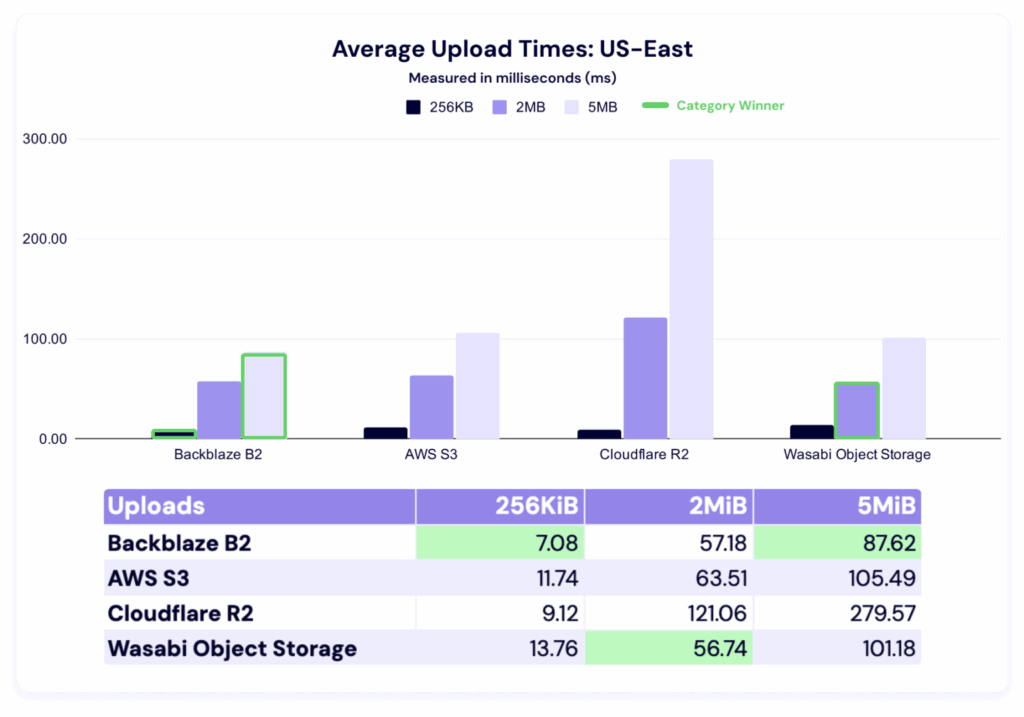
US-East was one of two regions included in Backblaze’s Q1 2026 testing, alongside EU-Central. The upload test measures average time, in milliseconds, to upload files of 256KiB, 2MiB, and 5MiB, using averages collected across a month. Lower times indicate better results. Based on Backblaze’s test data, Backblaze B2 posted the lowest average upload time for 256KiB files at 7.08 ms and for 5MiB files at 87.62 ms, while Wasabi recorded the lowest result for 2MiB files at 56.74 ms.
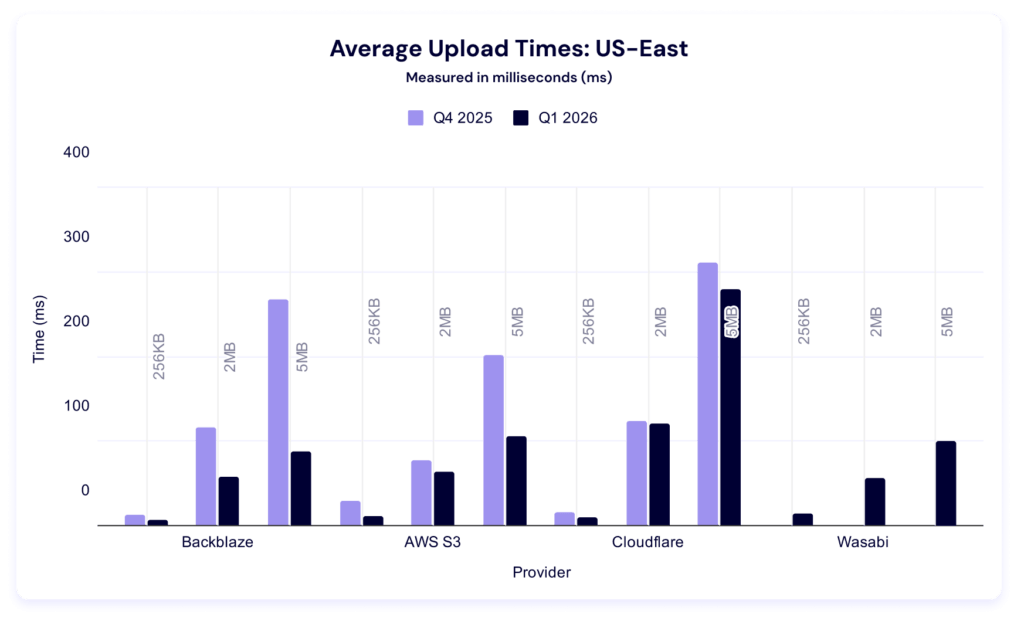
The quarter-over-quarter comparison indicates lower average upload times across all providers that had prior-quarter data in US-East. Backblaze, AWS S3, and Cloudflare R2 each posted lower averages than in Q4 2025 across the three file sizes shown. Wasabi was not included in the earlier quarter’s chart, so there is no direct Q4 comparison for that provider in this section.
In US-East multithreaded upload testing over five minutes, higher totals indicated more data transferred during the test window. Backblaze included two sets of results for its own service: one under standard conditions and one marked rate-limited. The 256KiB and 5MiB figures were identical in both cases at 80.00 and 324.00, while the larger file sizes diverged after rate limits were triggered.
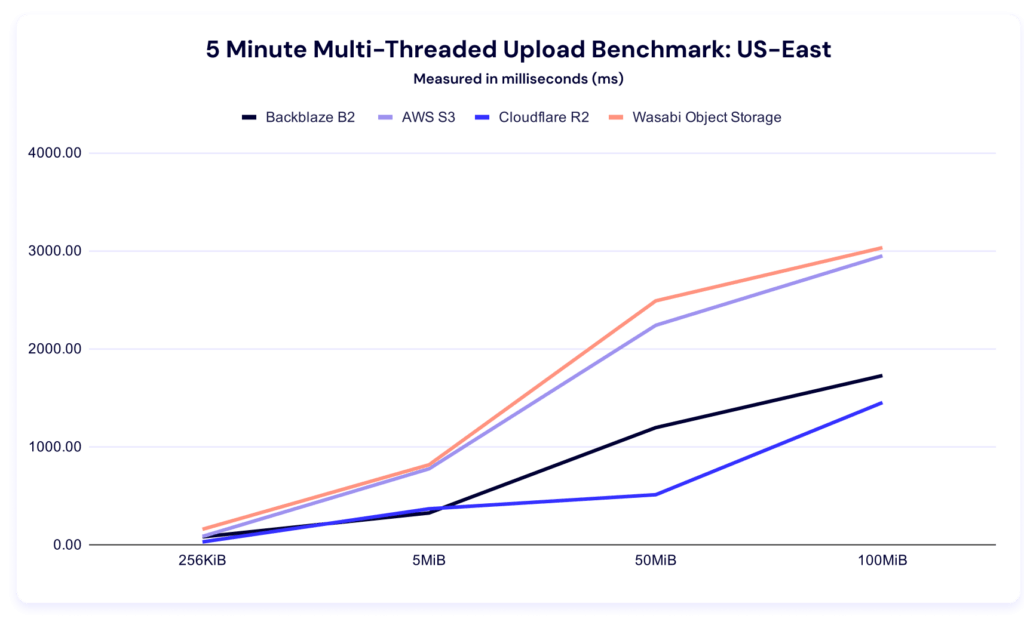
For 50MiB files, Backblaze B2 was listed at 1,194.80, versus 544.70 for the rate-limited account. For 100MiB files, it was 1,726.10 versus 563.50. Backblaze says these larger-size results reflect bandwidth caps encountered during testing and notes that other providers may apply different limits under their own policies.
Across the same test, Wasabi posted the highest figures in all four file-size categories shown: 157.30 for 256KiB, 815.80 for 5MiB, 2,488.50 for 50MiB, and 3,030.90 for 100MiB. AWS S3 was listed at 84.40, 774.70, 2,238.90, and 2,947.20, while Cloudflare R2 was listed at 28.40, 366.30, 510.10, and 1,450.40.
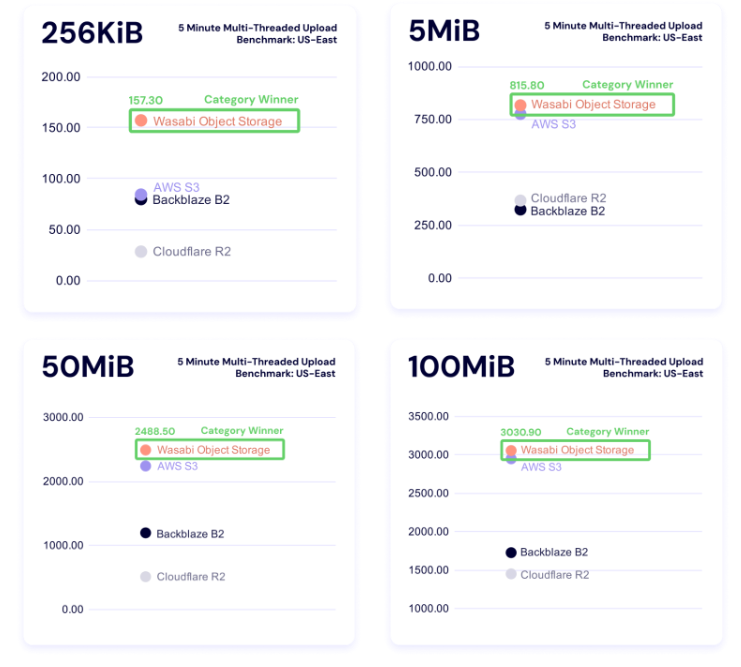
Backblaze also notes that quarter-over-quarter comparisons in this test are limited because the methodology changed, so these figures are best read as part of an early dataset produced under the company’s test setup.
US-East Five Minute Single-Threaded Upload Test
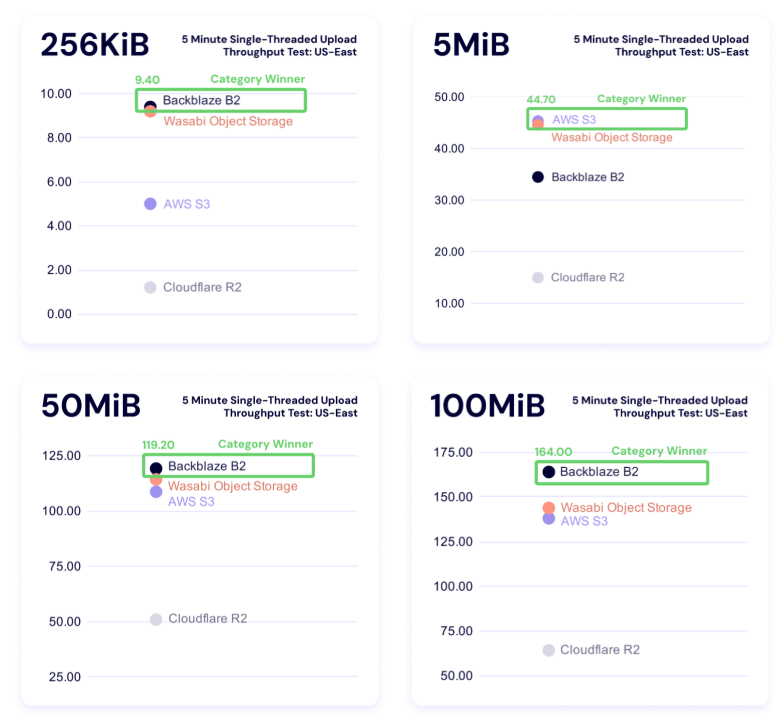
The five-minute single-threaded upload test measures sustained upload throughput with a single thread across four file sizes. In US-East, Backblaze posted the highest result for 256KiB at 9.40, 50MiB at 119.20, and 100MiB at 164.00. AWS S3 led the 5MiB category at 44.70, just ahead of Wasabi at 44.60. Cloudflare R2 trailed the other providers across all four sizes, with results of 1.20, 15.00, 50.90, and 64.20.
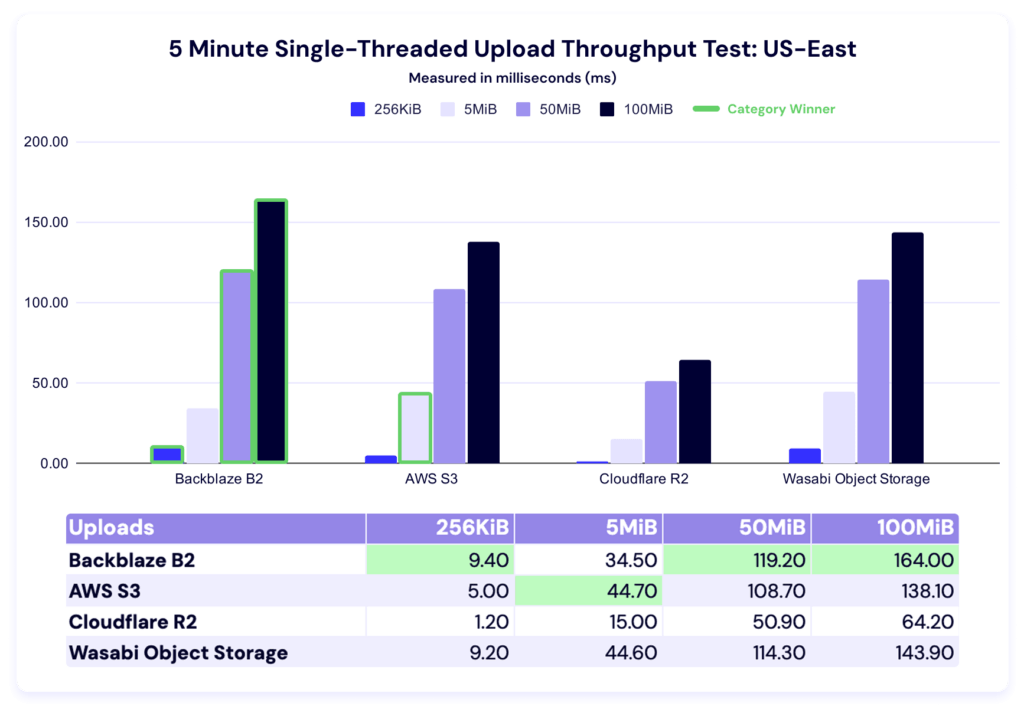
The spread between the highest and lowest results widened as file sizes increased. At 256KiB, the gap ran from 1.20 to 9.40. At 100MiB, it ranged from 64.20 to 164.00. Based on Backblaze’s test setup, the single-threaded results show a narrower contest among Backblaze, AWS, and Wasabi at 5MiB and above. At the same time, Cloudflare R2 posted materially lower figures in this set of US-East upload measurements.
US-East Download Testing
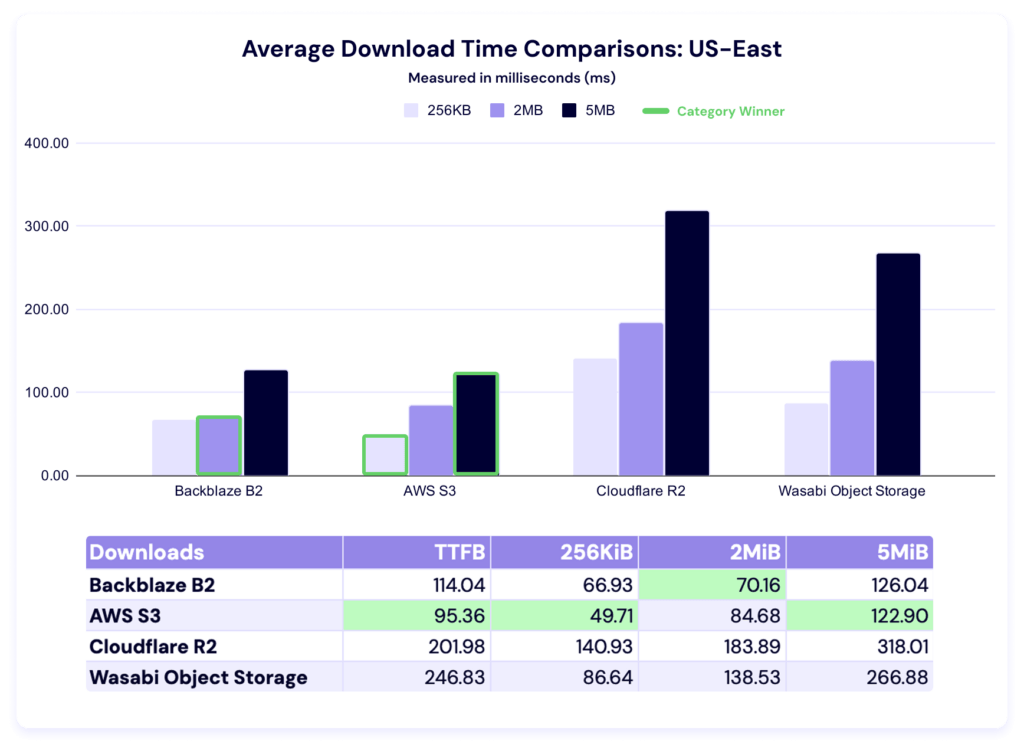
In US-East download testing, AWS S3 had lower average times and lower TTFB for 256KiB and 5MiB downloads, while Backblaze posted the lowest average download time for 2MiB files. The quarter-over-quarter view showed lower download times across many categories for providers with prior data, but the dataset remains limited, and Wasabi had no Q4 comparison in these charts.
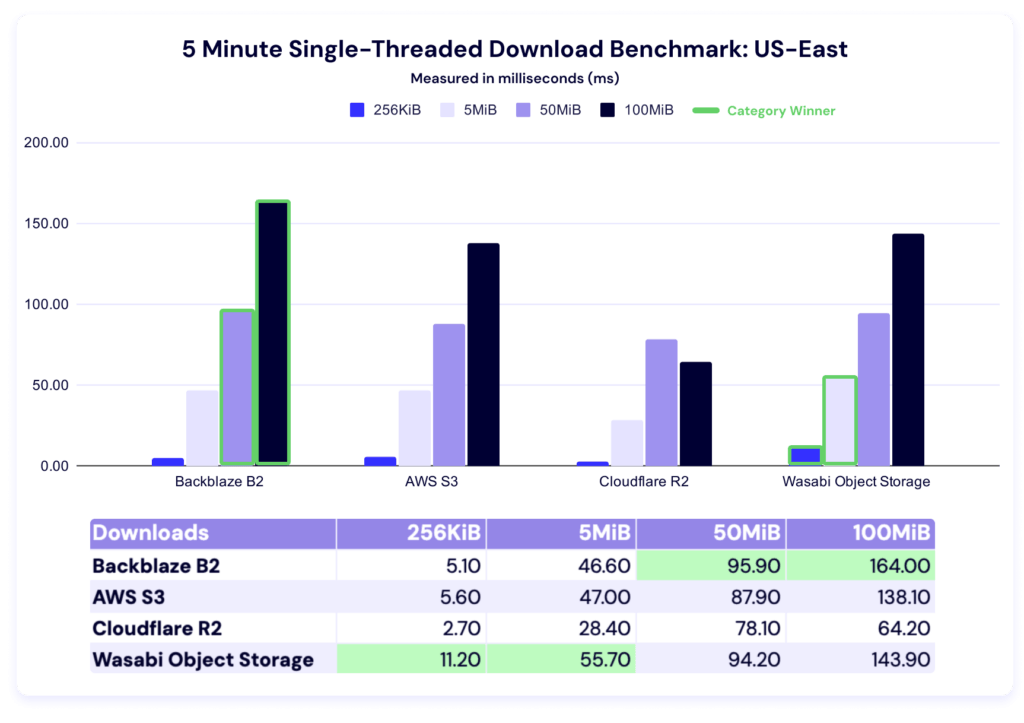
In the five-minute multithreaded download benchmark, Backblaze led at 256KiB; AWS S3 led at 5MiB and 50MiB; and Cloudflare R2 led at 100MiB, with Backblaze also reporting separate rate-limited results for its own service. In the five-minute single-threaded download test, Wasabi led at 256KiB and 5MiB, while Backblaze led at 50MiB and 100MiB. Across these download results, rankings varied by test type and file size, making the data more useful as a snapshot of the Backblaze test environment than as a definitive measure of overall provider performance.
Five-minute single-threaded download throughput
In US-East single-threaded download throughput over five minutes, Wasabi posted the top result for smaller files, leading at 256KiB with 11.20 and at 5MiB with 55.70. Backblaze led the larger file sizes, recording 95.90 at 50MiB and 164.00 at 100MiB. AWS S3 stayed close to the leaders in each category, with 5.60, 47.00, 87.90, and 138.10, while Cloudflare R2 trailed on all four file sizes at 2.70, 28.40, 78.10, and 64.20. The spread was narrower at the smallest file sizes and wider at 100MiB, where Backblaze posted the highest result.
Backblaze Cloud Storage Performance Results Q1 2026: EU-Central
Upload Averages
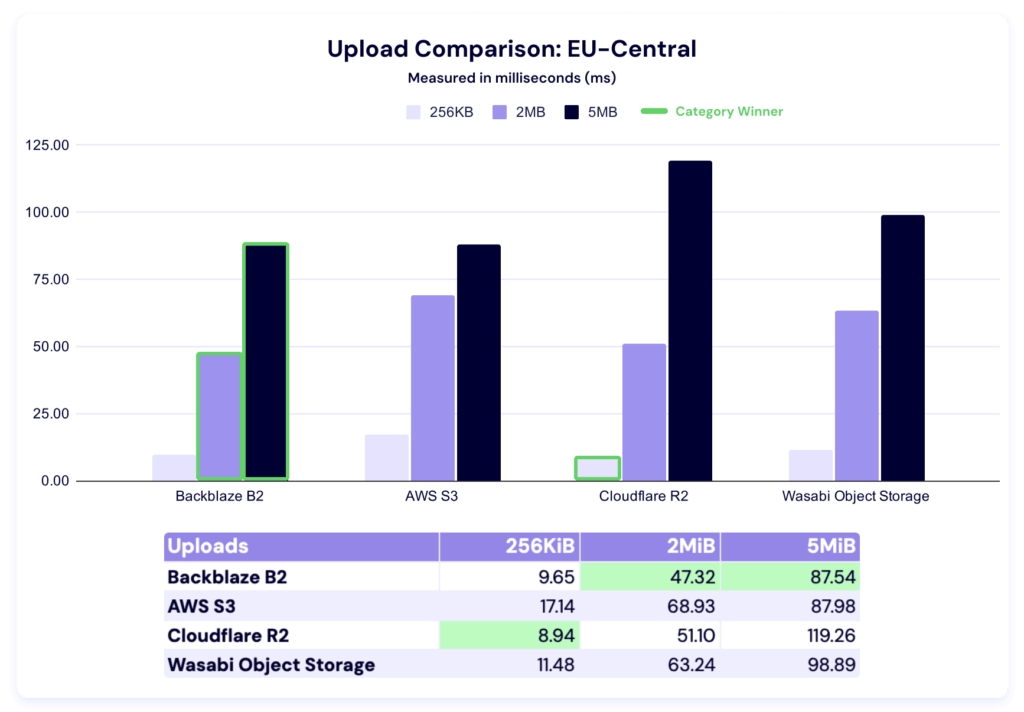
In the EU-Central average upload times, Cloudflare R2 posted the lowest results for 256KiB files at 8.94 ms, while Backblaze posted the lowest times for 2MiB at 47.32 ms and 5MiB at 87.54 ms. AWS S3 recorded 17.14 ms, 68.93 ms, and 87.98 ms across the three file sizes, and Wasabi posted 11.48 ms, 63.24 ms, and 98.89 ms. These results differed from the US-East pattern, with provider rankings changing by region in Backblaze’s test setup.
Upload Throughput
In the EU-Central five-minute multithreaded upload throughput, higher results favored Wasabi at 256KiB with 147.10 and at 100MiB with 2,990.60, while AWS S3 led at 5MiB with 848.10 and at 50MiB with 2,515.00. Backblaze listed 104.70, 216.40, 843.40, and 896.70 for its standard account, alongside separate rate-limited results of 104.70, 216.40, 561.00, and 500.70.
In the five-minute single-threaded upload test, Wasabi led all four file sizes at 8.20, 47.40, 113.60, and 169.60, ahead of Backblaze at the smallest size and AWS S3 at the larger sizes. Across both throughput tests, Cloudflare R2 trailed the other providers in EU-Central.
Download Averages and TTFB
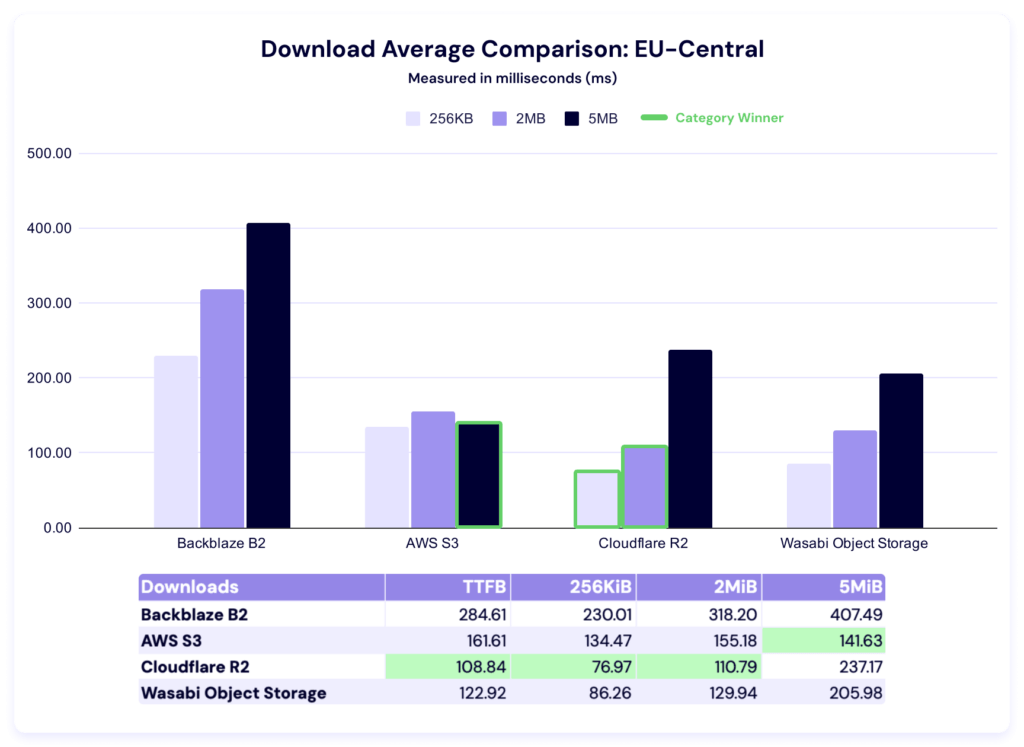
In the EU-Central average download testing, lower times favored Cloudflare R2 in three categories. It posted the lowest time to first byte at 108.84 ms, the lowest 256KiB average at 76.97 ms, and the lowest 2MiB average at 110.79 ms. AWS S3 led the 5MiB category at 141.63 ms. The spread across providers was wide in several categories. Backblaze recorded 284.61 ms for TTFB and 230.01 ms, 318.20 ms, and 407.49 ms for average downloads of 256KiB, 2MiB, and 5MiB, which were the highest figures in this EU-Central set.
Download Throughput
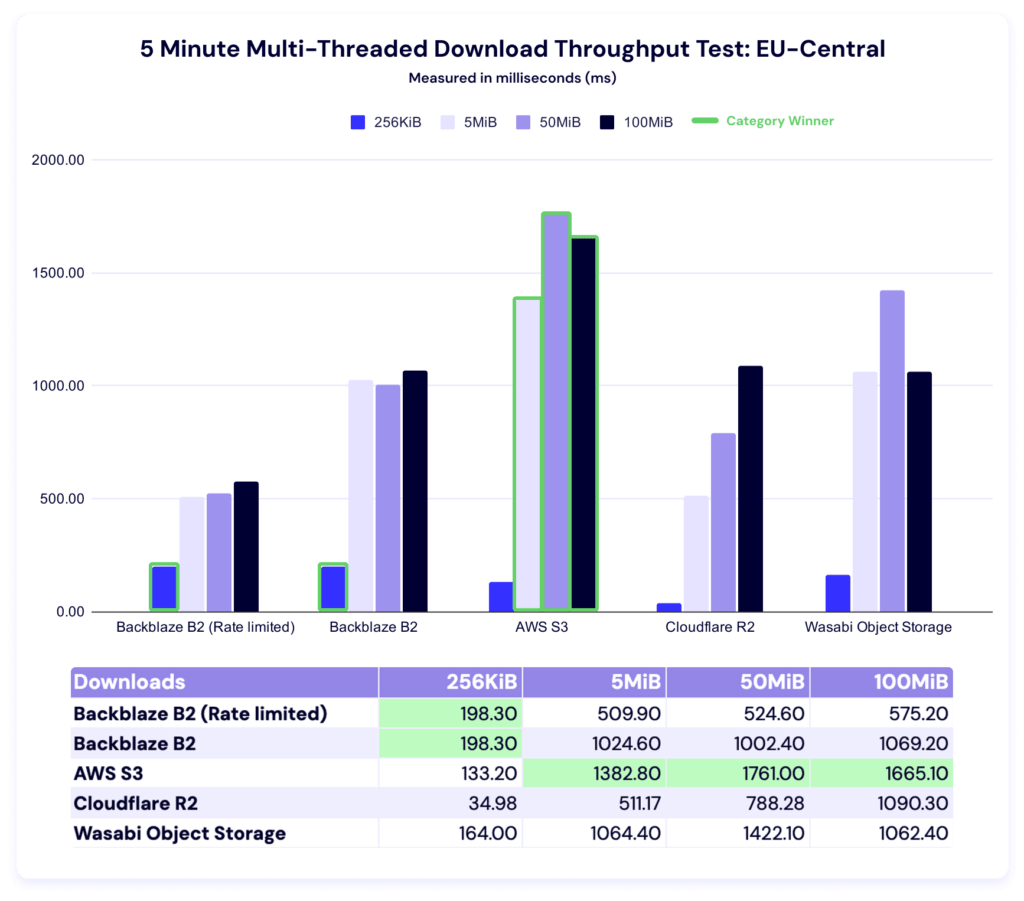
In the EU-Central five-minute multithreaded download throughput, Backblaze led the 256KiB category at 198.30, while AWS S3 led the 5MiB category at 1,382.80, the 50MiB category at 1,761.00, and the 100MiB category at 1,665.10. Backblaze also showed a separate rate-limited line for its own service, with materially lower figures at the larger file sizes.
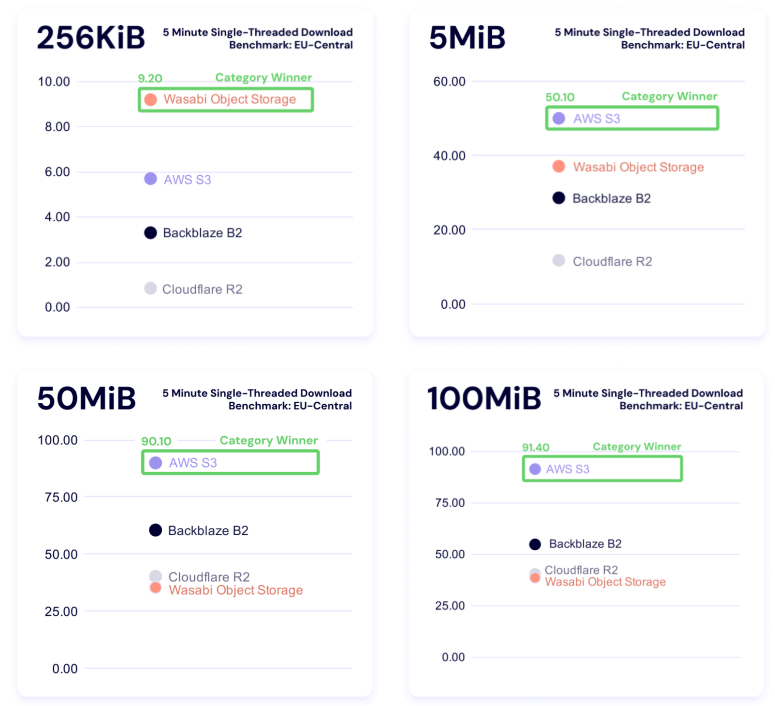
In the five-minute single-threaded download test, Wasabi led 256KiB at 9.20, while AWS S3 led 5MiB at 50.10, 50MiB at 90.10, and 100MiB at 91.40. Across these EU-Central download tests, the top result varied by file size and test type, while Cloudflare R2 was strongest in average download latency rather than sustained download throughput.
What to Make of the Data
Backblaze says it ran these benchmarks using repeatable synthetic tests from a Vultr-hosted Ubuntu virtual machine in each region, with traffic routed through Catchpoint to each provider’s object storage service. The testing looked at average upload times for 256KiB, 2MiB, and 5MiB files, along with download time to first byte and average download times for those same file sizes. It also ran separate five-minute throughput tests for uploads and downloads using both single-threaded and 20-thread workloads, with file sizes of 256KiB, 5MiB, 50MiB, and 100MiB. Since Backblaze designed and ran the tests itself, it’s important to note that the figures should be viewed as vendor-published benchmark data rather than as an independent third-party study.
Backblaze also lays out several limitations, noting that synthetic testing does not capture the full range of real production workloads, global network conditions, concurrency patterns, or data locality. Backblaze also said that they cannot control routing and peering once traffic leaves the test node, and that caching, traffic shaping, or rate limiting may have affected some results. Moreover, its current setup still has some limitations regarding large-file testing. It points to Wasabi temporarily blacklisting test IPs during high-volume testing as one example of how provider policies can influence the numbers.
The results also varied depending on region, file size, and test type, which is why they described the dataset as directional rather than definitive. Backblaze says it plans to expand the testing over time to cover more regions, workloads, and conditions.
For anyone comparing cloud storage options, these results are most useful as one reference point alongside testing in their own environment.


 Amazon