

At Cisco Live, Cisco introduced Cisco Cloud Control, a unified management platform intended to bring networking, security, compute, observability, and collaboration into a single operational plane. The company positions the platform as the foundation of its broader AgenticOps model, in which human operators and AI agents work from the same data, telemetry, and policy context while maintaining human oversight.
Cloud Control is designed around a single-login experience that gives IT teams a consolidated view of Cisco infrastructure and services. Rather than splitting operations across separate consoles, the platform provides a unified system for monitoring, management, and response. Cisco said customers will also be able to build their own apps and AI agents inside the platform using natural-language workflows. The surrounding ecosystem includes integrations with AWS, Microsoft, Google Cloud, ServiceNow, PagerDuty, Slack, Linear, and Wiz.
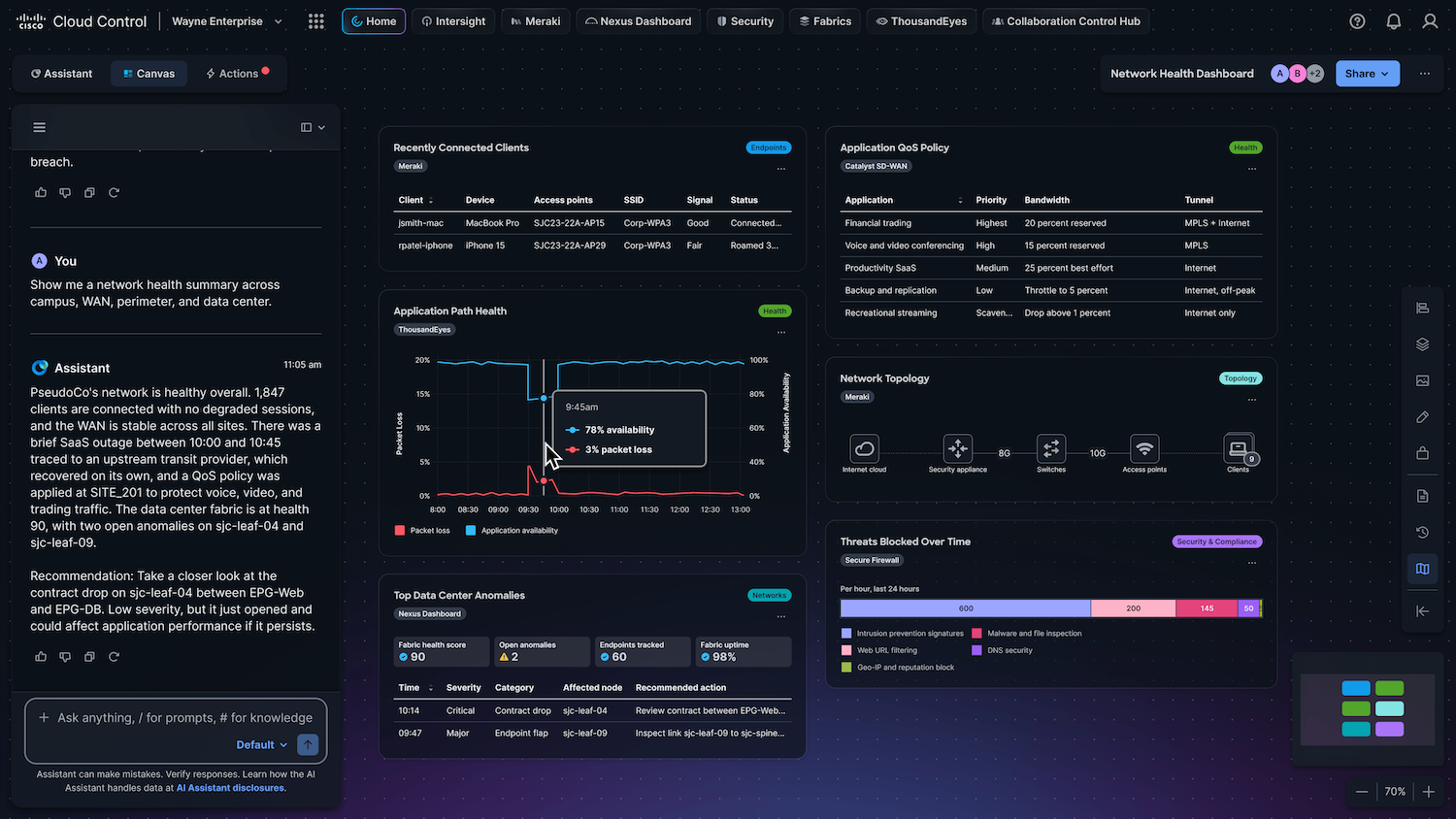
Cisco President and Chief Product Officer Jeetu Patel framed the launch around the operational impact of AI agents on enterprise infrastructure, describing Cloud Control as “a command center for agentic AI: a platform where your team and your AI agents work together, in the same environment, with the same information, and with humans in control.” The company’s view is that continuously operating agents will change how environments are scaled, monitored, and defended, but only if those agents operate within a unified and governed platform. Cloud Control is intended to serve as that shared command environment for both human teams and automated agents.
One Control Plane Across Domains
At the platform level, Cloud Control is meant to unify cross-domain telemetry from networking, security, observability, and collaboration systems. Cisco’s argument is straightforward: if operators and agents are acting on the same telemetry and context, they can respond more quickly and with less fragmentation across teams and tools. That cross-domain visibility is positioned as especially important for uptime, AI agent behavior, and cost control tied to token usage.
Cisco also said Cloud Control uses a mix of purpose-built and frontier AI models, including its Deep Network Model, which the company says is grounded in 40 years of Cisco operational networking data. The emphasis here is on model specialization rather than relying on a single large general-purpose model, with Cisco describing the result as system intelligence that scales with the complexity of the problem rather than the size of the model alone. In practice, Cisco is presenting this as a way to improve problem-solving across infrastructure operations without sacrificing domain-specific accuracy.
A key part of the announcement is Cisco’s plan to introduce trusted agents within Cloud Control. These agents are expected to move through a structured workflow: detect an issue, determine the likely cause, recommend or apply remediation, test the proposed change, and verify that service quality has recovered. Cisco said these capabilities will draw on telemetry, digital twin technology, expanded experience metrics, deep reasoning, and agentic workflows. The larger goal is closed-loop automation that remains visible and governed rather than opaque.
AI Canvas and Studio Extend Customization
Cisco also introduced Cisco AI Canvas, described as a collaborative workspace where operators and agents can investigate and resolve issues together using shared live context. The feature is built to preserve operational history across handoffs, shifts, and escalations so teams do not have to reconstruct the same troubleshooting trail multiple times.
On the customization side, Cloud Control Studio adds two development environments: Agent Builder and App Builder. Agent Builder is intended for customers who want to create agents aligned to internal workflows, policies, and toolchains. Cisco said it supports connections to more than 50 third-party platforms through native connectors or the Model Context Protocol. App Builder is designed to let customers build applications and workflows from natural-language prompts, with OpenAI Codex integrated into the experience. Cisco said customer-built apps and agents, along with ecosystem-developed extensions, can be published through a Cloud Control Marketplace.
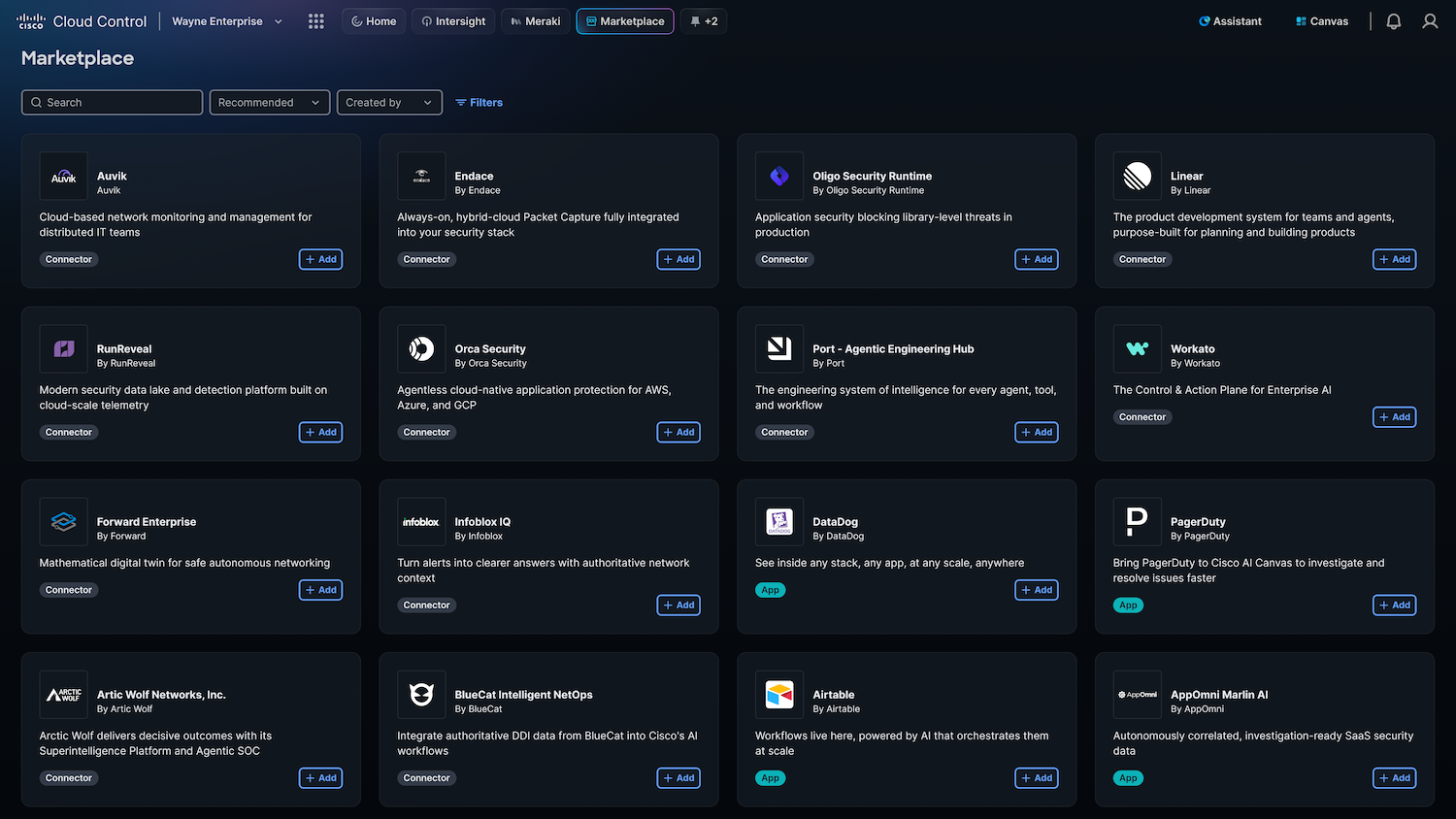
Cisco said Cisco Cloud Control is entering Controlled Availability in the United States as of June 2, with global availability to follow.
Security Posture Shifts Toward Runtime Protection
Security was a second major pillar of the announcement. Cisco’s premise is that the time between vulnerability disclosure and exploitation has compressed to the point where traditional reactive defenses are no longer sufficient. The company said it is a charter member of Anthropic’s Project Glasswing and OpenAI’s Daybreak, using the latest frontier AI models to stress-test its own products and uncover weaknesses before adversaries can. It also highlighted the open-sourced Foundry Security Spec as a way to make that evaluation rigor more broadly available.
At the infrastructure layer, Cisco is expanding Live Protect, which it describes as a runtime protection capability that shields supported platforms from newly discovered vulnerabilities without requiring reboots, software upgrades, or maintenance windows. Live Protect is now available on Cisco Nexus 9000 series switches and included with Nexus One entitlement. Cisco said it plans to extend the technology to campus and branch smart switches next, followed by secure routers later this year.
The company also highlighted the Hybrid Mesh Firewall, which extends policy enforcement across networks and applications, as well as Cisco and third-party firewalls. The goal is to reduce blast radius and maintain consistent protection as infrastructure becomes more distributed and hybrid.
More Controls for AI Agents
Cisco used the event to further expand on the security framework around enterprise AI agents. Building on prior announcements at RSAC, the company said it is adding new capabilities spanning AI Defense, Zero Trust for agents, and an Agentic SOC model. The broader message is that organizations will need to secure both sides of the AI equation: protecting agents from external manipulation and constraining what agents themselves can do inside production environments.
Quantum-safe Roadmap Becomes More Explicit
Cisco outlined a more concrete quantum-safe infrastructure roadmap. The company said it plans to enable quantum-safe communications capabilities across most of its core portfolio by December 2026, extending post-quantum protections to platforms carrying sensitive enterprise traffic.
Starting immediately, Cisco said any newly introduced campus, branch, and data center routers, switches, and firewall series will ship with quantum-safe secure boot enabled by default. This extends earlier work already in production on campus smart switches.
Cisco is also adding two assessment and planning tools. Quantum Ready Assessments, available through Cisco IQ, are designed to identify assets most exposed to harvest-now-decrypt-later risk and help organizations prioritize remediation. Global availability is planned for July 2026. Cisco also introduced a Quantum Resilience Framework, which organizes enterprise preparation into two broad areas: quantum-safe communications and quantum-safe products.
Cisco Services and IQ Add Resilience Focus
To support the operational model behind these announcements, Cisco is also rolling out Resilient Infrastructure Services through Support and Professional Services. The services framework includes three stages: exposure assessment, infrastructure modernization, and defense resiliency. Cisco is positioning this as a structured path for customers who need to evaluate the risks posed by AI-era threats and modernize their infrastructure in parallel.
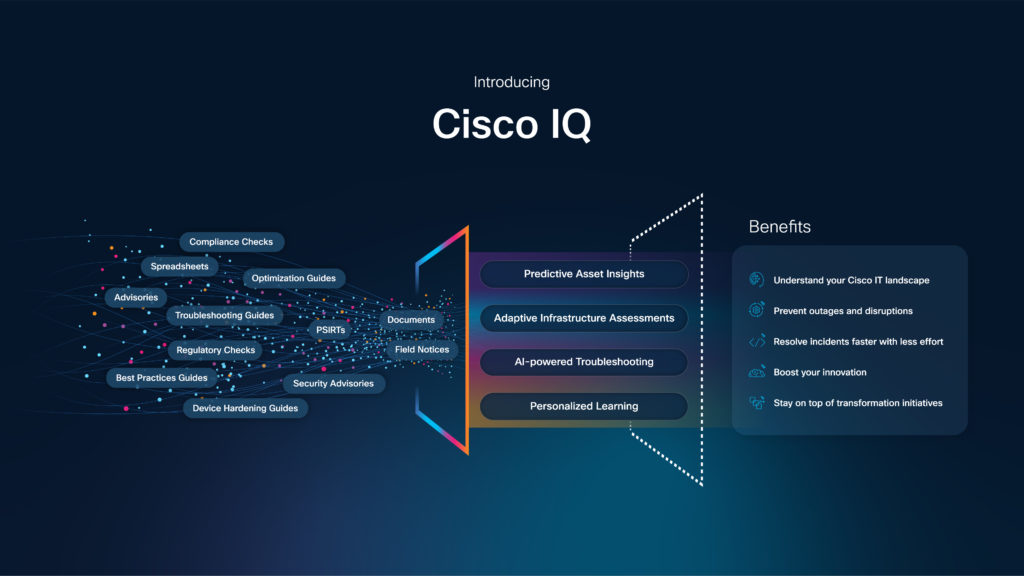
Cisco IQ, now integrated with Cloud Control, acts as the company’s AI-driven delivery interface for support and professional services. Cisco said it is intended to help customers build a longer-term resilience plan using AI-driven insights and Zero Trust principles. For organizations with sovereignty and residency requirements, Cisco will also offer on-premises deployment options for Cisco IQ.
Another addition is Peer Benchmarking in Cisco IQ, which uses anonymized data to show how an organization compares with similar environments in areas such as last-day-of-support exposure and vulnerability rates. Cisco said that the feature is planned for global availability in July 2026.


 Amazon