

Autonomous networks, once seen as a distant goal for telecom, are now a pressing priority. According to NVIDIA’s latest State of AI in Telecommunications report, network automation is the top AI use case for investment and actual returns, showing where operators find immediate value from AI.
Although many telcos already automate set workflows, achieving true autonomy requires more. Autonomous networks must understand operator intent, weigh options, and determine the best actions within complex infrastructures. This change relies on reasoning models and AI agents specifically trained on telecom data and operational patterns.

Agentic Systems for Telco
Shifting to autonomous operations needs more than just isolated AI models. Telcos require complete agentic systems that include:
- Telco-specific network models that grasp domain language and structure
- AI agents that can communicate and coordinate with one another
- Network simulation tools that confirm proposed changes before they impact live environments
Ahead of Mobile World Congress Barcelona, NVIDIA unveiled several elements targeting this framework: an open, Nemotron-based large telco model (LTM), a guide for building reasoning agents for network operations, and new NVIDIA Blueprints for energy savings and network configuration using multi-agent orchestration. These components help operators gradually transition to autonomous networks while maintaining control of their infrastructure.
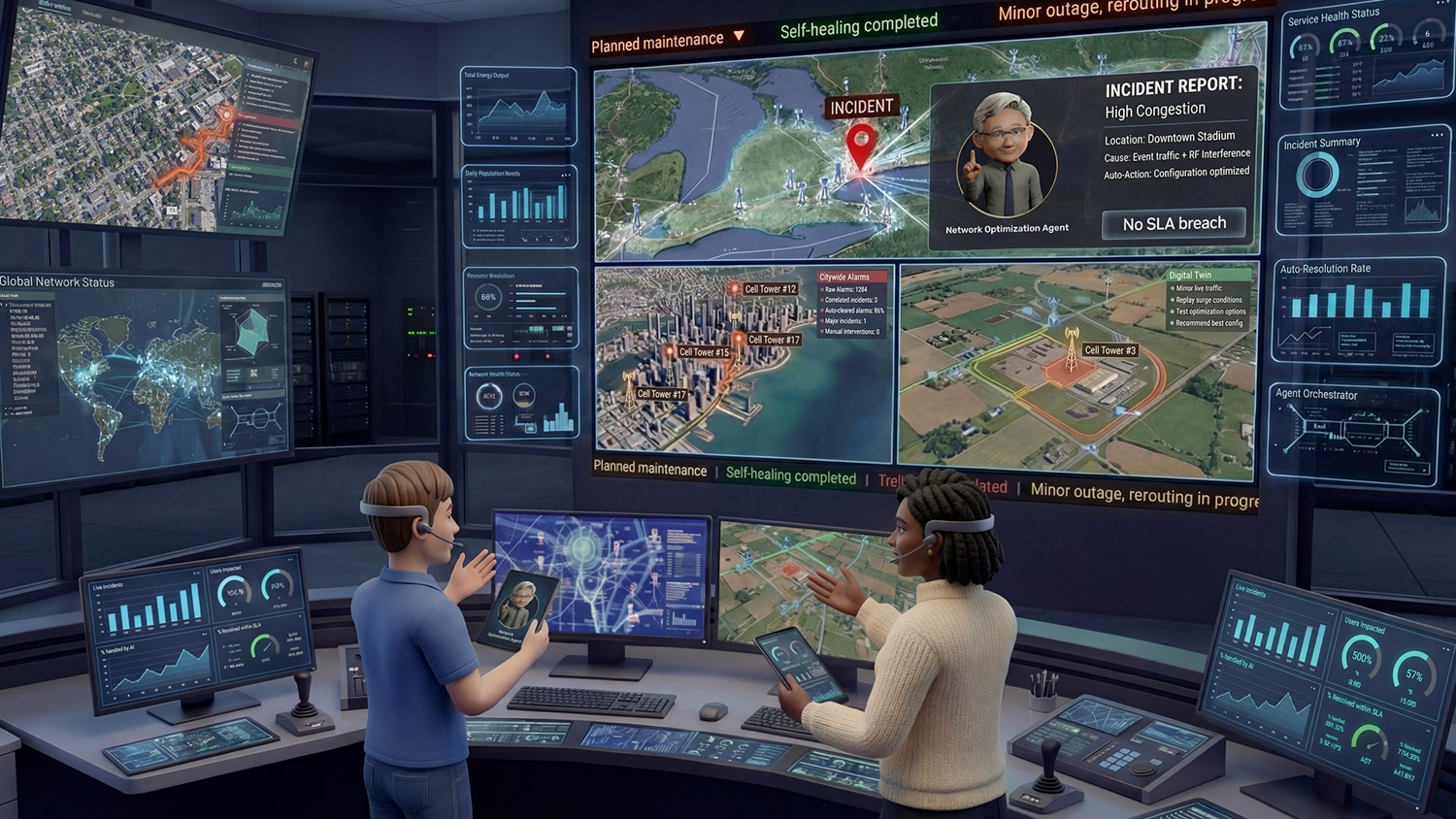
As part of GSMA’s new Open Telco AI initiative, NVIDIA is making the LTM, the guide, and the related agentic AI blueprints available as open resources through GSMA. This approach provides the broader mobile ecosystem with common building blocks rather than proprietary solutions.
Open, Telecom-Tuned Reasoning Model
To implement generative and agentic AI in production telco environments, models must understand telecom language and reason through actual network processes. NVIDIA, in collaboration with consulting firm AdaptKey AI, has introduced an open source, 30-billion-parameter Nemotron LTM that global operators can use as a foundation for autonomous networks.
The LTM builds on the NVIDIA Nemotron 3 family of foundation models and is fine-tuned by AdaptKey AI using open telecom datasets, including industry standards and synthetic network logs. This fine-tuning centers on key telco tasks such as:
- Identifying faults across multi-layer and multi-vendor environments
- Planning for remediation, including decision paths and rollback procedures
- Validating changes and assessing impacts before and after updates
Since the Nemotron LTM is open, operators gain full visibility into its training process and data sources. This transparency supports secure deployment within telco environments, enabling operators to build and run agents within their own security boundaries. It also allows telcos to adjust the telecom-tuned reasoning using internal network and operational data, tailoring the model to their specific architectures and policies without compromising sensitive information.
Open Guide for Building Telco Reasoning Agents
NVIDIA and Tech Mahindra have released an open-source guide for operators that shows how to transform domain-specific reasoning models into agents capable of executing network operations center (NOC) workflows safely.
The guide outlines a framework that helps models reason like NOC engineers. It instructs them to:
- Pinpoint high-impact, high-frequency incident types where automation benefits operations quickly.
- Convert expert engineer solutions into clear, step-by-step procedures.
- Turn those procedures into structured reasoning traces that document each action, tool use, observed outcome, and decision point.
These traces serve as “thinking examples” for the model, detailing the actions to take and reasons behind specific checks, escalation paths, and solutions considered safe and effective. With the NVIDIA NeMo-Skills pipeline, operators can fine-tune a reasoning model using these traces and create telco-specialized agents that tackle troubleshooting and operations, much like experienced network engineers.
Closed-Loop Autonomy and RAN Energy Optimization
Autonomous networks rely on closed-loop operation. Models must understand the network’s state, agents must act on operator intent and simulation results, and feedback must continually refine future decisions.
NVIDIA’s new Blueprint for intent-driven RAN energy efficiency illustrates this principle in 5G radio access networks. The blueprint aims to help operators systematically cut RAN power use while maintaining service quality.
The reference architecture incorporates VIAVI’s TeraVM AI RAN Scenario Generator (AI RSG), which generates synthetic RAN data like cell usage, user throughput, and traffic patterns. AI RSG transforms this data into a format that AI agents can query.
An energy planning agent analyzes the synthetic data to create energy-saving policies, which are then tested in AI RSG. This closed-loop arrangement allows operators to evaluate how power-saving strategies might work in realistic scenarios before affecting live configurations, offering a safer approach to achieving energy-efficiency goals without harming subscriber experience.
Blueprint for Telco Network Configuration in Live Use
NVIDIA’s Blueprint for telco network configuration has transitioned from concept to real-world application, with operators using it to introduce agentic AI into production settings.
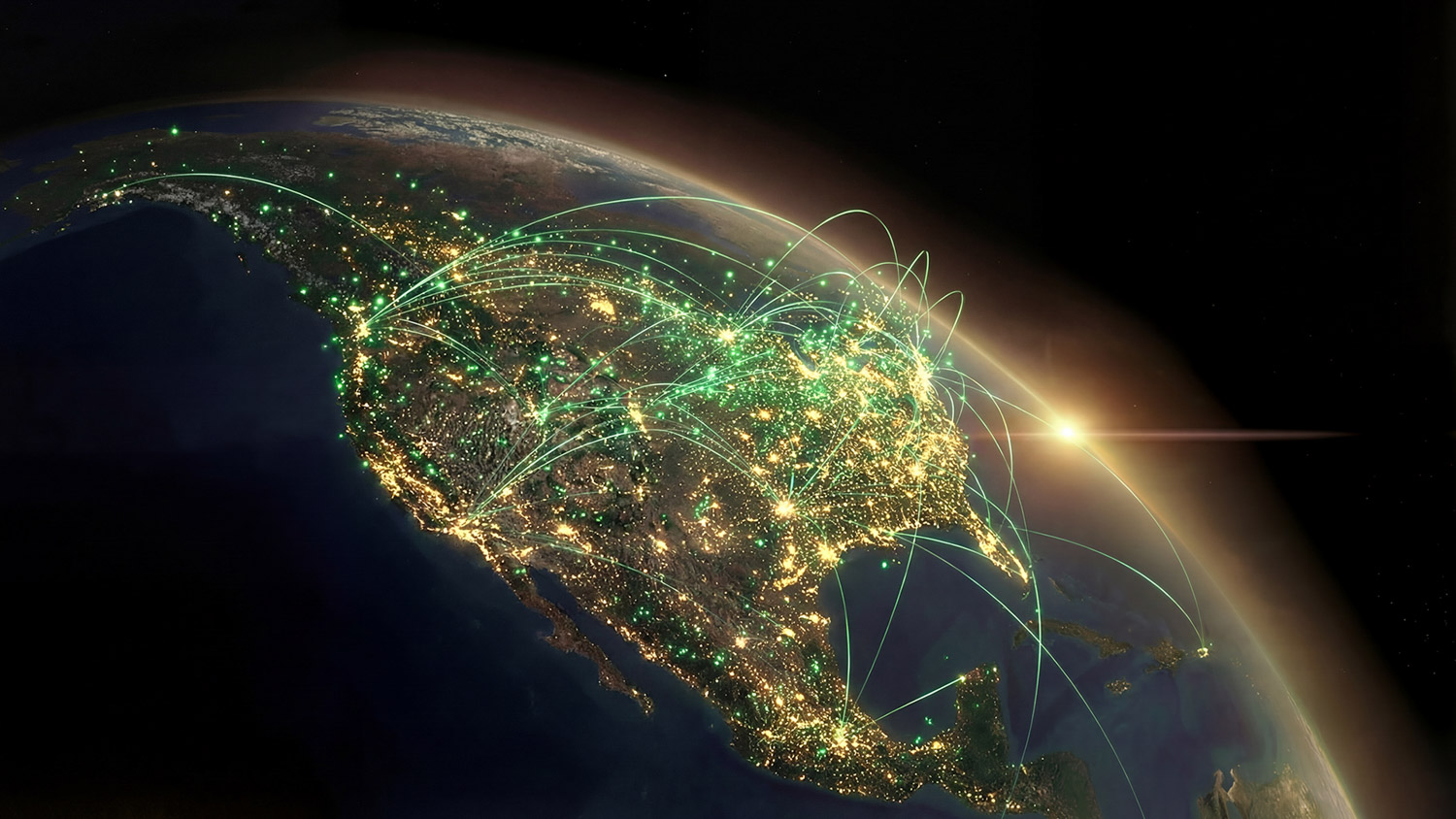
Cassava Technologies is applying the configuration blueprint as the base for Cassava AI RAN, an agentic platform for Africa’s diverse multi-vendor mobile network landscape. The platform features three specialized agents:
- A monitoring and recommendation agent that tracks network conditions and suggests configuration changes.
- An execution agent that implements approved changes while ensuring thorough documentation and governance.
- A validation and rollback agent that assesses the impact of changes and reverts them if they cause unintended consequences.
This multi-agent approach promotes safer, faster configuration cycles across various radio and vendor setups.
NTT DATA is using the same blueprint to enhance traffic regulation, especially when users reconnect after outages and networks experience sudden spikes in demand. Deployed with a tier-1 operator in Japan, an AI agent monitors real-time demand across cells and makes admission-control decisions, determining when and how to admit new users to specific cells. As demand returns to normal, the agent adjusts its actions, transforming manual traffic management into a data-driven optimization loop that seeks to improve resiliency during surges.
Multi-Agent Orchestration
To assist operators in designing, tracking, and optimizing multi-agent workflows within the RAN, NVIDIA and BubbleRAN are updating the NVIDIA Blueprint for telco networks with two integrated frameworks:
- NVIDIA NeMo Agent Toolkit (NAT) for creating and coordinating AI agents.
- BubbleRAN Agentic Toolkit (BAT) for orchestrating those agents in telco-grade environments.
BubbleRAN is incorporating NAT and BAT into its Opti-Sphere platform, which handles monitoring, configuration, and validation agents across containers and workloads. Opti-Sphere links agents to tools that reveal network metrics and traffic status, allowing them to continuously suggest configuration changes, simulate or validate them, and adjust accordingly.
Telenor Group will be the first telco to implement this updated blueprint with BubbleRAN, improving its 5G network for Telenor Maritime, the group’s global connectivity provider for maritime customers. This deployment will test agentic orchestration and closed-loop operations in a challenging connectivity environment, where changing conditions and high uptime requirements emphasize the need for robust, autonomous network behavior.


 Amazon