

QNAP Systems has introduced the QAI-h1290FX, an edge AI storage server designed for organizations that want to run large language models, retrieval-augmented generation search, and other generative AI workloads on their own infrastructure. The system is designed for enterprises that balance AI adoption with requirements for data privacy, low latency, governance, and operational control, enabling teams to deploy AI applications locally rather than sending sensitive data to public cloud platforms.
Organizations can use the QAI-h1290FX to deploy internal AI assistants for employee training, policy questions, and knowledge lookup, keeping the underlying data within the business. Legal, finance, HR, and operations teams can build private RAG pipelines to search contracts, reports, and internal records, providing more context than traditional keyword searches. Creative teams can run image-generation tools such as Stable Diffusion or ComfyUI for design and content workflows. In contrast, IT teams can use automation tools such as n8n to trigger inference tasks, generate content, or route alerts across business systems.
QNAP QAI-h1290FX Components, Expansion, and I/O
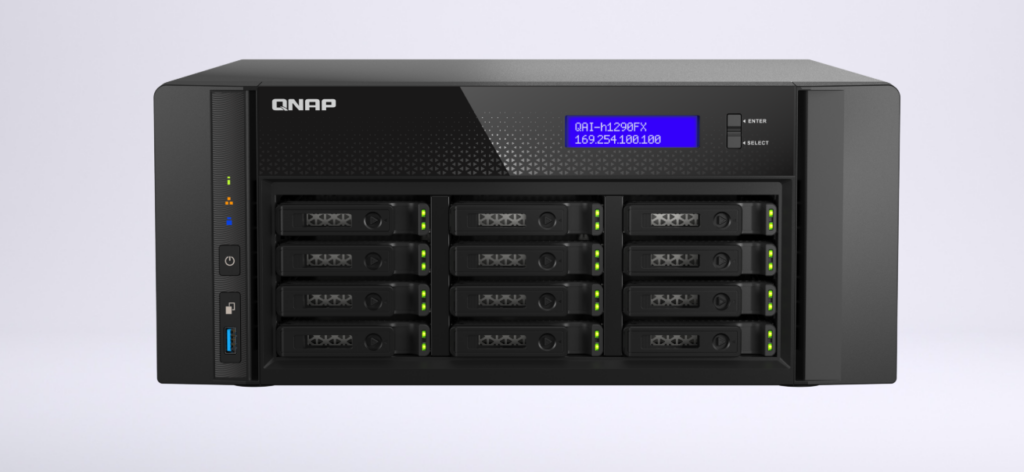
Built around an AMD EPYC 7302P processor and twelve U.2 NVMe/SATA SSD bays, the QAI-h1290FX combines server-grade compute with an all-flash storage design tailored for AI workloads requiring fast data access. The 16-core, 32-thread processor supports inference, virtualization, and parallel workloads. At the same time, the SSD architecture is designed for frequent model execution, high-speed data streaming, and responsive access to datasets, embeddings, documents, and generated content.
The system also supports optional NVIDIA RTX PRO 6000 Blackwell Max-Q Workstation GPU acceleration, providing up to 96GB of GPU memory for more demanding local AI workloads. Support for CUDA, TensorRT, and Transformer Engine acceleration enables teams to run large language model inference, image generation, and deep learning applications on-premises without building a separate GPU workstation from scratch.
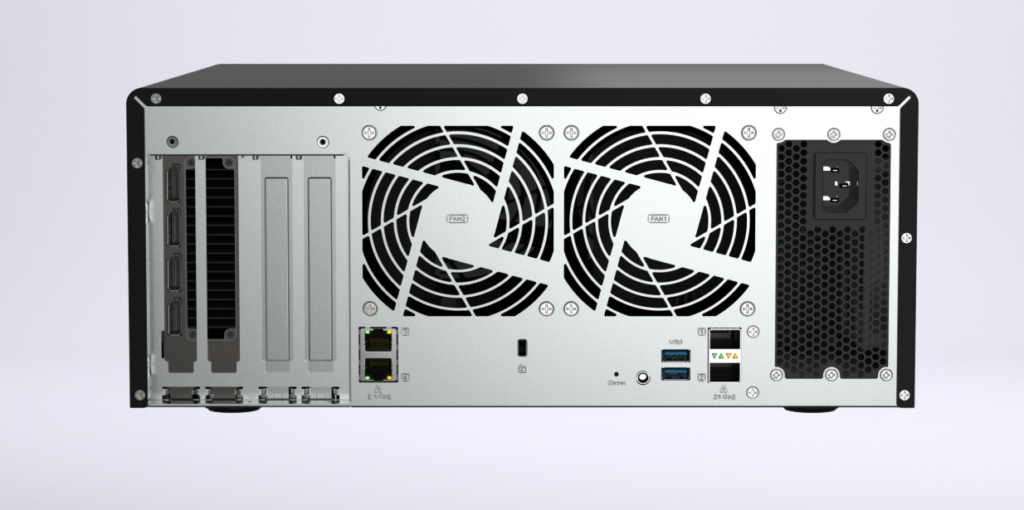
The QAI-h1290FX offers built-in high-speed networking with two 25GbE SFP28 SmartNIC ports and two 2.5GbE ports, and supports Wake-on-LAN via the 2.5GbE ports. For expansion, it includes four PCIe slots, with three PCIe Gen 4 x16 slots and one PCIe Gen 4 x8 slot, providing room to add higher-speed networking, a GPU, or other compatible expansion cards. Additional I/O includes three USB 3.2 Gen 1 ports, jumbo frame support, SR-IOV, GPU pass-through, and compatibility with 2.5-inch SATA SSDs and U.2 NVMe PCIe Gen4 x4 SSDs across its twelve drive bays.
QNAP QAI-h1290FX Specifications
| Specification | QNAP QAI-h1290FX |
|---|---|
| Overview | |
| Model | AI-h1290FX-7302P-128G |
| Processor and Memory | |
| CPU | AMD EPYC™ 7302P 16-core/32-thread processor, up to 3.3 GHz |
| CPU Architecture | 64-bit x86 |
| Encryption Engine | (AES-NI) |
| System Memory | 128 GB RDIMM DDR4 ECC |
| Maximum Memory | 1 TB (8 x 128 GB) |
| Memory Slot | 8 x RDIMM DDR4 |
| Flash Memory | 8GB (Dual boot OS protection) |
| Storage | |
| Drive Bay | 12 x 2.5-inch U.2 PCIe NVMe / SATA 6Gbps The system is shipped without SSDs. For the SSD compatibility list, please visit https://www.qnap.com/compatibility/ |
| Drive Compatibility | 2.5-inch bays: 2.5-inch SATA solid state drives 2.5-inch U.2 NVMe PCIe Gen4 x4 solid state drives |
| Hot-swappable | Yes |
| SSD Cache Acceleration Support | Yes |
| GPU and Virtualization | |
| GPU pass-through | Yes |
| SR-IOV | Yes |
| Networking | |
| 2.5 Gigabit Ethernet Port (2.5G/1G/100M) | 2 (2.5G/1G/100M/10M) |
| 25 Gigabit Ethernet Port | 2 x 25GbE SFP28 SmartNIC port |
| Wake on LAN (WOL) | Only the 2.5GbE port |
| Jumbo Frame | Yes |
| Expansion and Ports | |
| PCIe Slot | 4 Slot 1: PCIe Gen 4 x16 Slot 2: PCIe Gen 4 x16 Slot 3: PCIe Gen 4 x8 Slot 4: PCIe Gen 4 x16 Card dimensions for PCIe slot 1 & Slot 2:185 x 111.15 x 18.76 mm / 7.28 x 4.38 x 0.74 inches. Card dimensions for PCIe slot 3 & Slot 4:280 x 111.15 x 18.76 mm / 11.02 x 4.38 x 0.74 inches. Wider cards can be installed if the next PCIe slot will not be used. |
| USB 3.2 Gen 1 port | 3 |
| Physical Design | |
| Form Factor | Tower |
| LED Indicators | Power/Status, LAN, USB, SSD1-12 |
| LCD Display/ Button | Yes |
| Buttons | Power, Reset, USB Auto Copy |
| Dimensions (HxWxD) | 150 × 368 × 362 mm Dimensions do not include the foot pad (foot pad may be up to 10mm / 0.39 inches high, depending on model) |
| Weight (Net) | 10.4 kg |
| Weight (Gross) | 11.3 kg |
| Environment and Power | |
| Operating Temperature | 0 – 40 °C (32°F – 104°F) |
| Storage Temperature | -20 – 70°C (-4°F – 158°F) |
| Relative Humidity | 5-95% RH non-condensing, wet bulb: 27˚C (80.6˚F) |
| Power Supply Unit | 750W, 100-240V |
| Fan | 2 x 92mm, 12VDC |
| System Warning | Buzzer |
| Kensington Security Slot | Yes |
| Warranty and Connections | |
| Standard Warranty | 5 |
| Max. Number of Concurrent Connections (CIFS) – with Max. Memory | 10000 |
Built Around Fast Storage, GPU Acceleration, and Local Control
Running on QNAP’s ZFS-based QuTS hero operating system, the QAI-h1290FX includes enterprise-grade storage features such as data integrity protection, extensive snapshot support, and inline deduplication. These capabilities are relevant to AI deployments because organizations often handle large volumes of repeated or related data across documents, embeddings, model files, training materials, and generated outputs.
Developers and IT teams can run AI tools in containerized environments with native GPU access via QNAP Container Station. At the same time, Virtualization Station supports GPU pass-through for virtual machines. This gives organizations more control over how compute resources are assigned, whether workloads are deployed in containers for speed and portability or in virtual machines for separation, testing, and administrative control.
The QAI-h1290FX also includes preloaded AI tools such as AnythingLLM, OpenWebUI, and Ollama, enabling teams to set up private LLM workflows and local chat interfaces more quickly. Additional applications (including Stable Diffusion, ComfyUI, n8n, and vLLM) are being integrated to support text generation, image creation, workflow automation, and inference use cases on the same local platform.
A Local Infrastructure Option for Enterprise AI Teams
QNAP says the platform can reduce the manual work typically involved in building local AI infrastructure, including assembling a GPU workstation, installing AI tools, and configuring separate environments. Users can deploy supported AI models and applications directly on the system while retaining control over their data and avoiding reliance on cloud services.
It’s also compatible with QNAP JBOD expansion enclosures, providing organizations with a path to scale storage capacity as AI datasets, internal knowledge bases, model files, and generated content continue to grow.


 Amazon