

If you follow StorageReview regularly, you know that we push storage hardware hard. Across our lab, we test everything from consumer SSDs to massive enterprise systems. For any product that relies on flash storage, there’s a critical but unglamorous step we always perform before benchmarking: preconditioning.
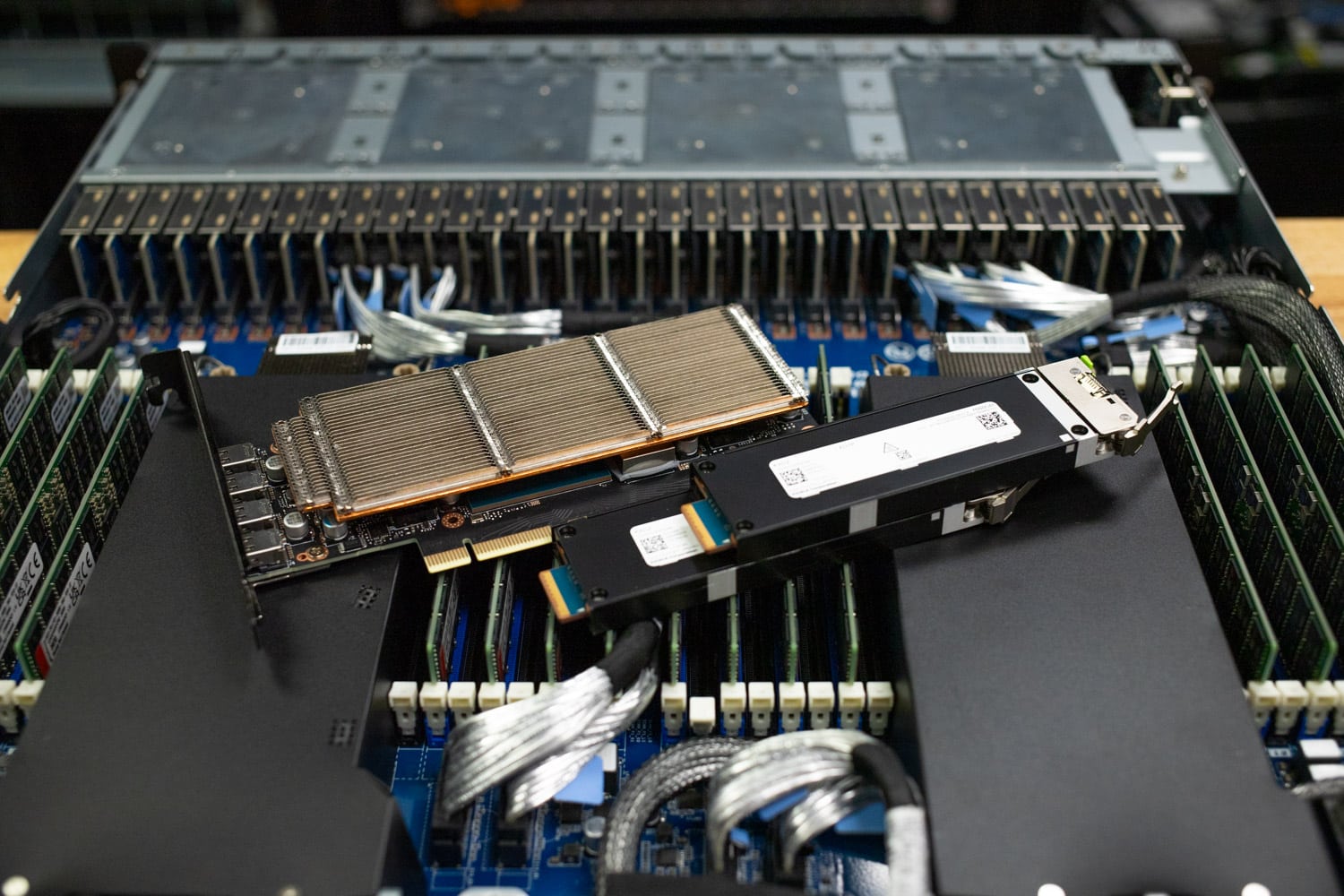
KIOXIA 7.68TB XD7P SSDs
Preconditioning is the process of preparing a drive so it behaves as it will in the real world—not as a brand-new, empty device straight out of the box. Modern SSDs constantly juggle tasks like garbage collection, wear-leveling, background trimming, and NAND block management. Until those background processes reach a steady state, performance can look deceptively good or wildly inconsistent. To avoid surprises and measure sustained performance, we precondition drives using workloads that mimic real-world conditions. This is not just nice to have; it is essential for meaningful benchmarks and compliance with the SNIA Solid-State Storage Performance Test Specification (PTS).
The Preconditioning Problem at Massive Scale
That traditional approach has worked well for years, but SSDs are changing. Capacities that were once the domain of data centers, 128TB, 256TB, and beyond, are rapidly becoming the new normal. While these massive capacity drives unlock new possibilities for AI, analytics, and hyperscale storage, they also expose a painful bottleneck: time.
Conventional preconditioning is painfully slow at these capacities. Filling, cycling, and driving an SSD into an actual steady state can take 144 hours or more on a 128TB drive. That’s six full days of continuous, heavy I/O per drive before a single “real” performance test even begins.
For hyperscale customers, qualifying fleets of drives that delay slows everything:
- Product evaluation
- Deployment timelines
- Firmware and feature validation
- Ongoing quality and regression testing
For us at StorageReview, it adds days to our review cycle when testing the latest ultra-high-capacity SSDs.
Enter Sprandom: A New Approach from Sandisk
To attack this bottleneck head-on, Sandisk has introduced Sprandom, an open-source contribution to the widely used Flexible IO Tester (FIO) tool. Instead of relying on long, brute-force write cycles and multiple passes, Sprandom takes a more targeted approach.
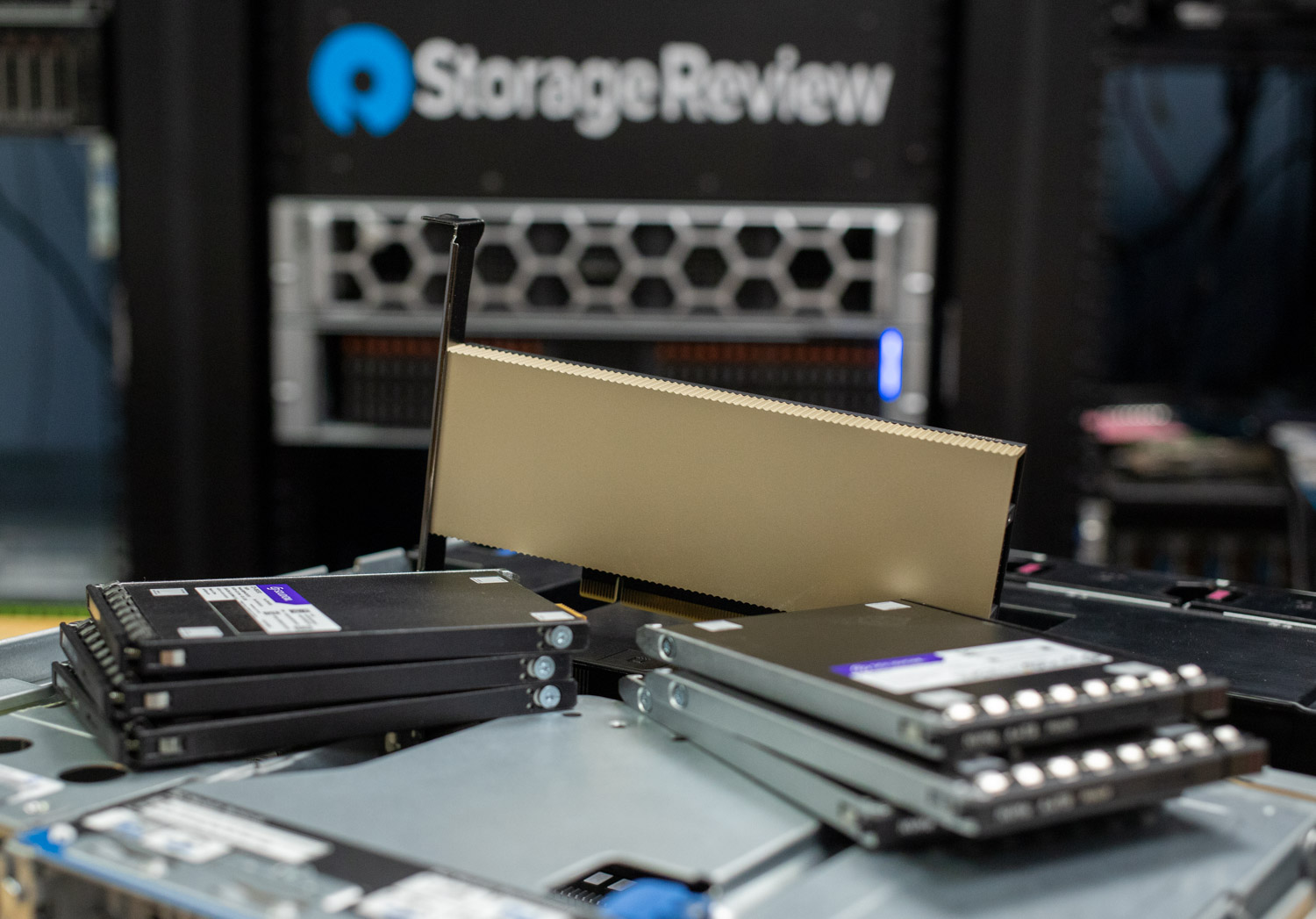
Sprandom uses a calculated pseudo-random write pattern engineered to drive the SSD into the desired internal state in a single pass at near-maximum speed. In other words, it doesn’t just fill the drive; it fills it intelligently, creating the same kind of internal conditions (fragmentation, garbage collection activity, metadata distribution, etc.) that you’d expect after real-world use, without wasting days getting there.
In our testing and in the numbers shared by Sandisk, the impact is dramatic:
- Up to 90% less time: A process that previously took 144+ hours on a 128TB SSD can now be completed in just over 6 hours.
- Higher throughput, less waiting: By driving the SSD near its maximum write speed with a highly efficient pattern, Sprandom turns a multi-day chore into something that fits within a typical workday.
Why This is Significant for AI and Data-Intensive Workloads
This isn’t just a “nice engineering trick.” It’s a meaningful change for anyone living in a world of dense flash and AI-scale datasets.
- AI training and inference: Demand predictable, sustained performance from storage. A poorly prepared drive can show inflated or erratic performance numbers that don’t hold up under production conditions.
- Data-intensive workloads —analytics, streaming, log processing, and large-scale backups—require stable performance characteristics to size systems and avoid over- or under-provisioning.
- Rapid qualification cycles: This is becoming the norm; infrastructure teams don’t have the luxury of losing nearly a week per drive to preconditioning.
By shrinking preconditioning time by up to 90%, Sprandom helps the entire pipeline keep pace with the rapid growth of SSD capacity and workload complexity.
Key Benefits of Sandisk’s Sprandom
Sandisk’s Sprandom approach delivers several essential advantages:
- Saves time: Precondition drives up to 90% faster, turning a multi-day preconditioning job into something that completes in a few hours.
- Standardized approach: Works across NVMe, SAS, and SATA SSDs, enabling labs, vendors, and enterprises to adopt a single consistent methodology rather than juggling multiple custom scripts and processes.
- Future-ready: Designed with 128TB, 256TB, and higher-capacity SSDs in mind. As drive sizes continue to grow, Sprandom scales with them rather than letting preconditioning time spiral out of control.
- Industry integration: Since Sprandom integrates with FIO, a leading storage performance testing tool, it is well positioned for widespread adoption among drive vendors, hyperscalers, OEMs, and independent test labs like ours.
A Rare Rethink of a Decades-Old Process
SSD preconditioning has largely remained the same for decades: write large amounts of data, wait a long time, then start testing. Sprandom represents one of the first significant improvements to this process in years, and it arrives at precisely the right moment—when AI workloads, dense flash, and petabyte-scale systems are pushing the limits of what “traditional” testing can keep up with.
By embracing a more innovative, pattern-driven approach to preconditioning, Sprandom helps align testing methodology with modern SSD design and usage patterns. It acknowledges that capacity has grown by orders of magnitude, and the tools need to evolve accordingly.
What This Means for StorageReview (and for You)
From our perspective at StorageReview, Sprandom is more than a clever optimization; it’s a practical accelerator for everything we do around SSD testing:
- We can bring reviews to you faster because we’re not spending days just getting drives into a usable test state.
- We get more consistent, realistic performance data since the internal drive state more accurately mirrors steady-state conditions.
- We can test more drives and configurations, particularly massive 100TB+ class SSDs, which would otherwise clog our lab schedule with week-long preconditioning jobs.
Zooming out, Sprandom is a strong example of what the storage industry needs more of: open, practical tools that solve real problems at data center scale, not just incremental tweaks on the margins.
As SSDs continue to grow and workloads become more demanding, preconditioning can’t stay stuck in the past. With Sprandom, Sandisk has taken a meaningful step toward modernizing this foundational piece of the testing and qualification pipeline—and that ultimately benefits everyone from drive vendors to enterprises to reviewers and, of course, the end users who rely on accurate performance data.


 Amazon