

During VAST Forward 2026, VAST Data introduced multiple updates, ranging from a full-stack agentic computing platform to a secure, scalable thinking machine.
The VAST Data PolicyEngine and VAST Data TuningEngine are two new computing services that will enable the next generation of the VAST AI OS to meet key requirements for organizations looking to scale their mission-critical AI initiatives.
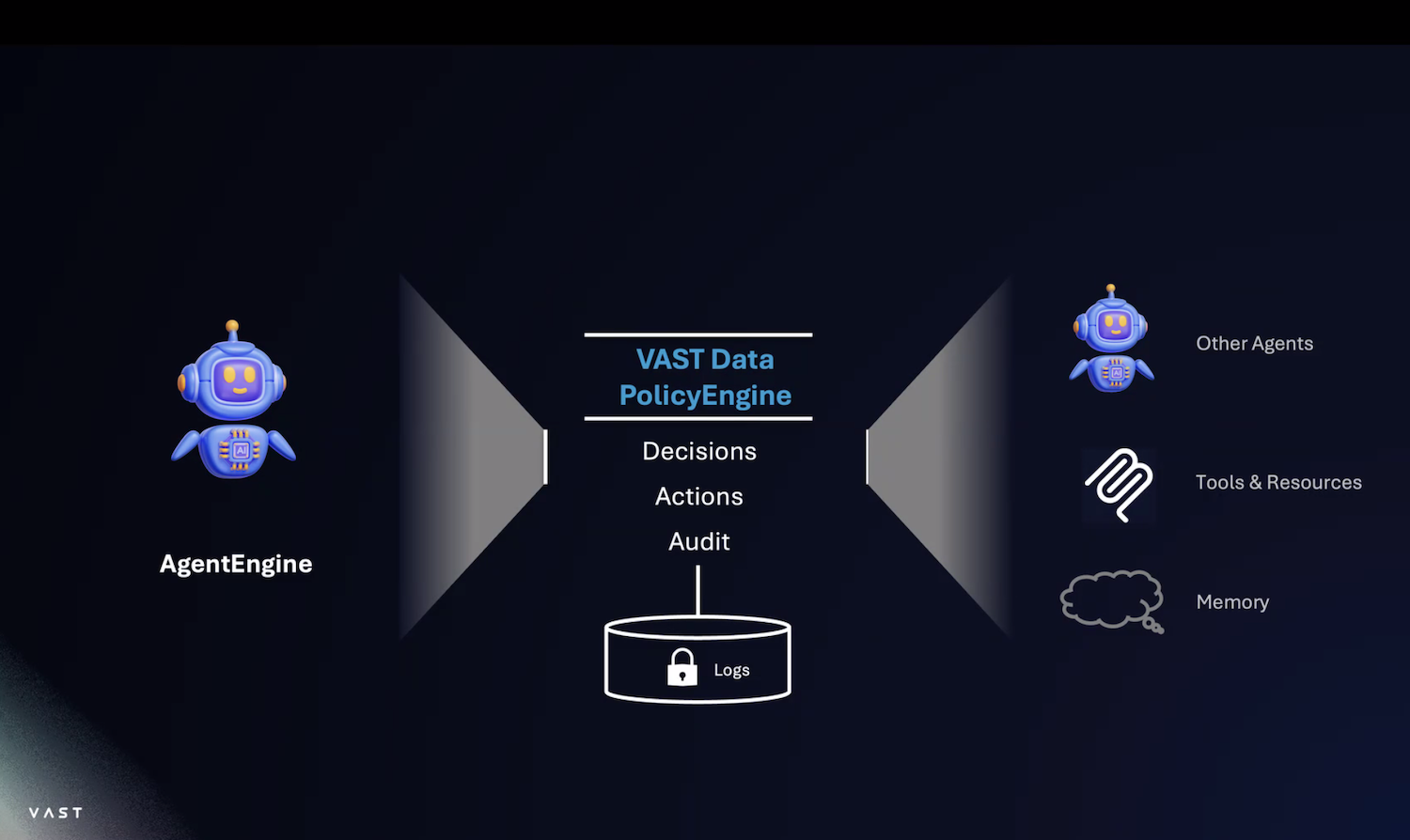
PolicyEngine and TuningEngine work together to create AI systems and interactions that are trusted, explainable, and continuously learning. PolicyEngine governs agentic activity, while the TuningEngine manages model tuning. Together, they power automatic learning loops that remain aligned with organizational expectations.
Jeff Denworth, VAST Data co-founder, emphasized the evolving nature of applications, highlighting the introduction of PolicyEngine and TuningEngine within the VAST AI Operating System. He described it as a ‘thinking machine’ capable of safeguarding interactions and learning from outcomes, thereby making advanced AI capabilities accessible to organizations across different computing environments.
Introducing the VAST Data PolicyEngine
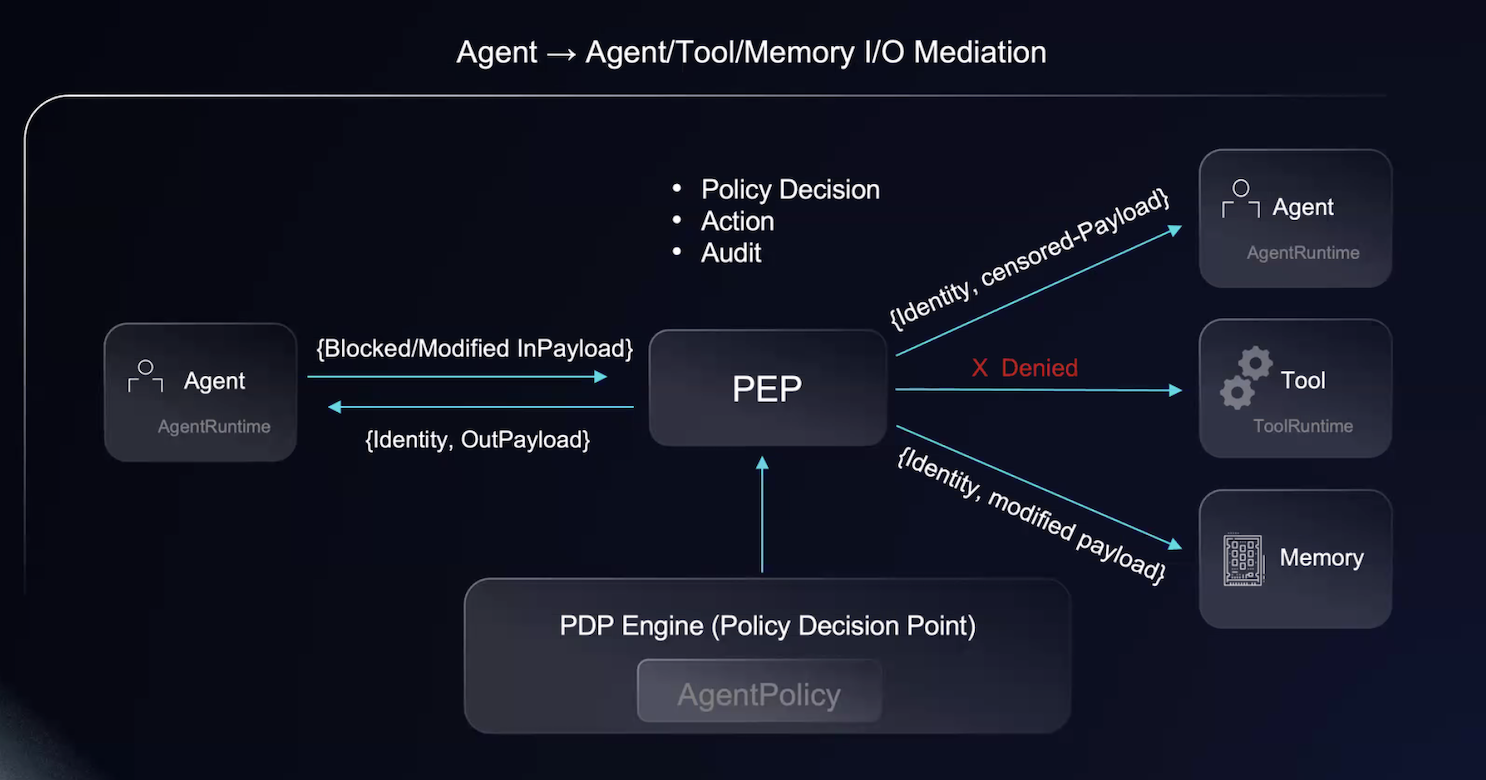
AI workflows and agents increasingly access organizational data to generate responses, communicate with other agents, and log events. Without fine-grained controls over data access, communication, and comprehensive logging, the risk of data leakage grows. Strict controls and tools for monitoring agent activities are essential for trust. The VAST PolicyEngine addresses these concerns with inline policy enforcement, regulating agents’ access to shared resources based on explicit, fine-grained permissions and context. Enforcement occurs before actions are executed, complemented by tamper-proof logs, enabling a zero-trust posture that keeps decisions and actions observable, explainable, and auditable.
Introducing the VAST Data TuningEngine
VAST AgentEngine is the serverless, agentic runtime of the AI OS, simplifying programming and coordinating multi-agent workflows, model invocation, and tool usage within the platform. While suitable for static models, its full stack supports learning loops that leverage telemetry, agent, and model feedback for fine-tuning and reinforcement learning. Enter the TuningEngine, which captures outcomes from agentic pipelines, leverages curated feedback to improve models, and employs methods such as LoRA, supervised fine-tuning, and reinforcement learning. It automatically processes data, suggests new models, and facilitates evaluation and deployment, initiating ongoing learning to enhance performance.
A Big Step Toward VAST’s Thinking Machine Vision
These new capabilities mark significant progress in developing systems that automatically adapt through interactions with real-world data. VAST Data has been developing such a system since 2016 and fully revealed its vision in 2023. The recent announcement of VAST AI OS introduces a closed operational loop that observes, reasons, acts, evaluates, and improves, while enhancing security and explainability by consolidating all activities within a single system.
The VAST PolicyEngine and TuningEngine are slated for release by the end of 2026.
Leveraging NVIDIA Libraries
VAST Data unveiled an end-to-end accelerated AI data stack, delivered through an expanded collaboration with NVIDIA. With the VAST AI Operating System now running directly on GPU-accelerated servers, customers can eliminate data bottlenecks across the AI pipeline and deliver ingestion, retrieval, analytics, and inference on a single unified platform.
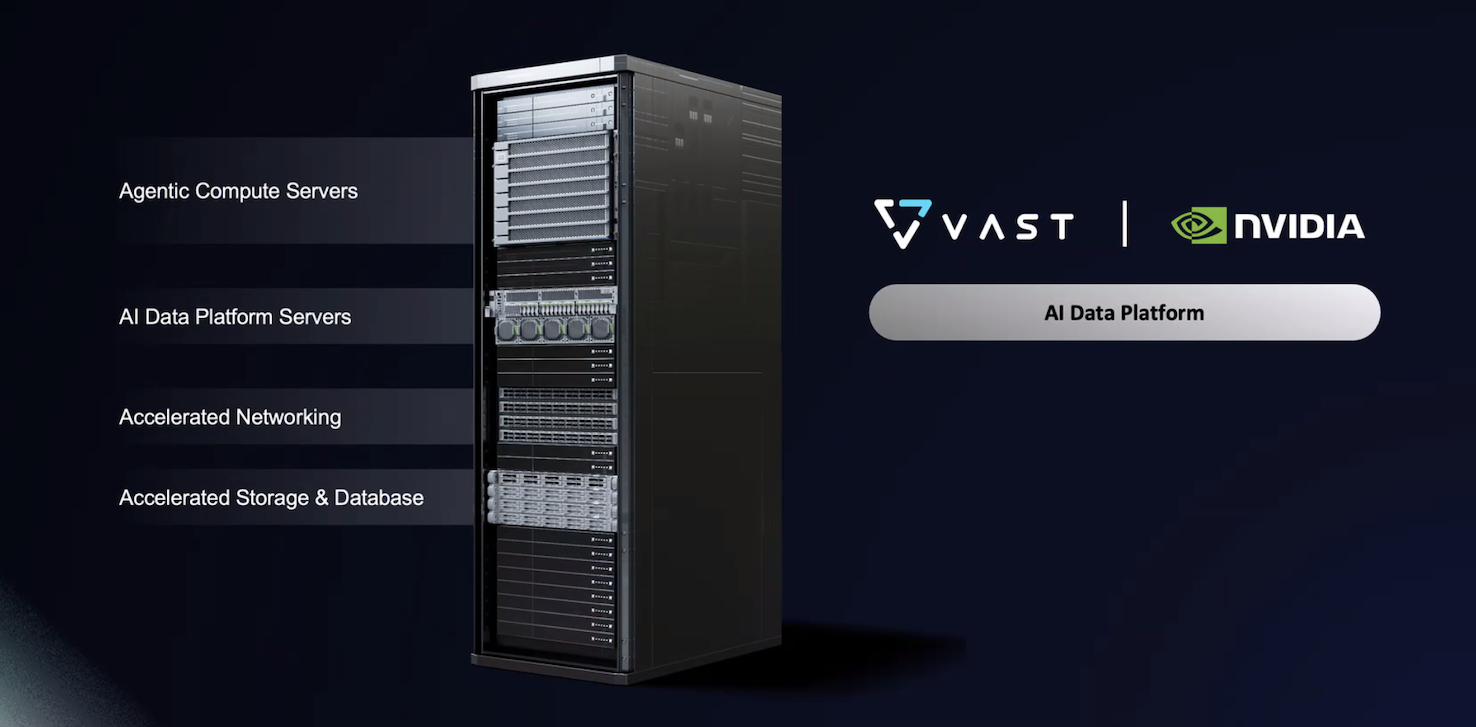
VAST CNode-X
The VAST CNode-X, developed with NVIDIA, introduces NVIDIA-certified systems that revolutionize AI infrastructure. It provides high-performance storage for GPU clusters and runs directly on GPU servers, seamlessly integrating with the VAST platform. This shift enables VAST to manage AI pipelines, analytics, vector search, RAG systems, and agent runtimes as a unified software stack.
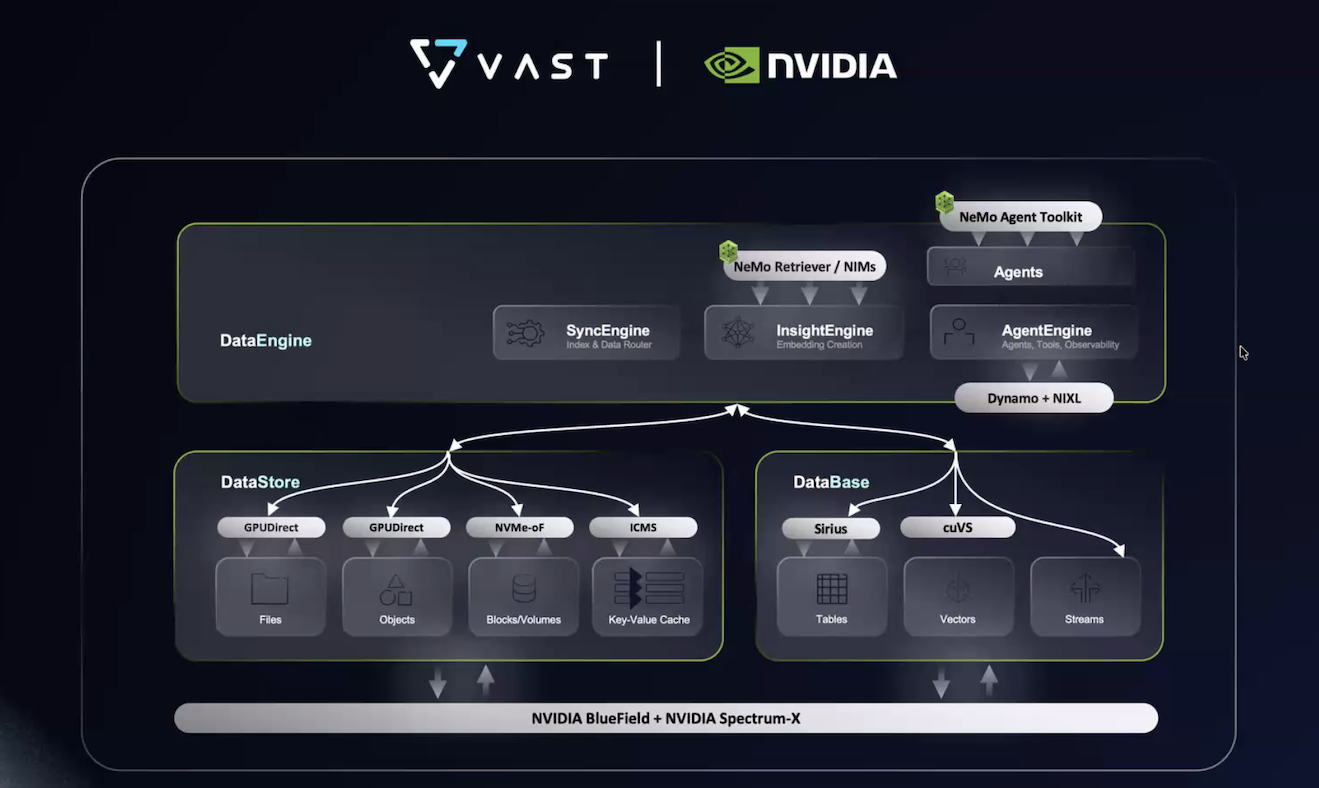
New CNode-X servers provide the computing foundation for the VAST AI OS to leverage a wide variety of NVIDIA libraries and APIs directly within core VAST software services, including the VAST DataEngine and VAST DataBase. These accelerations are embedded deep inside the platform, delivering higher performance, lower latency, and improved efficiency across real-time SQL analytics, vector search and retrieval, and a wide range of AI inference workflows.
The VAST AI OS streamlines operations by integrating data services and computing into a single system, simplifying the transition from experimentation to production for AI workflows like RAG pipelines and agent systems.
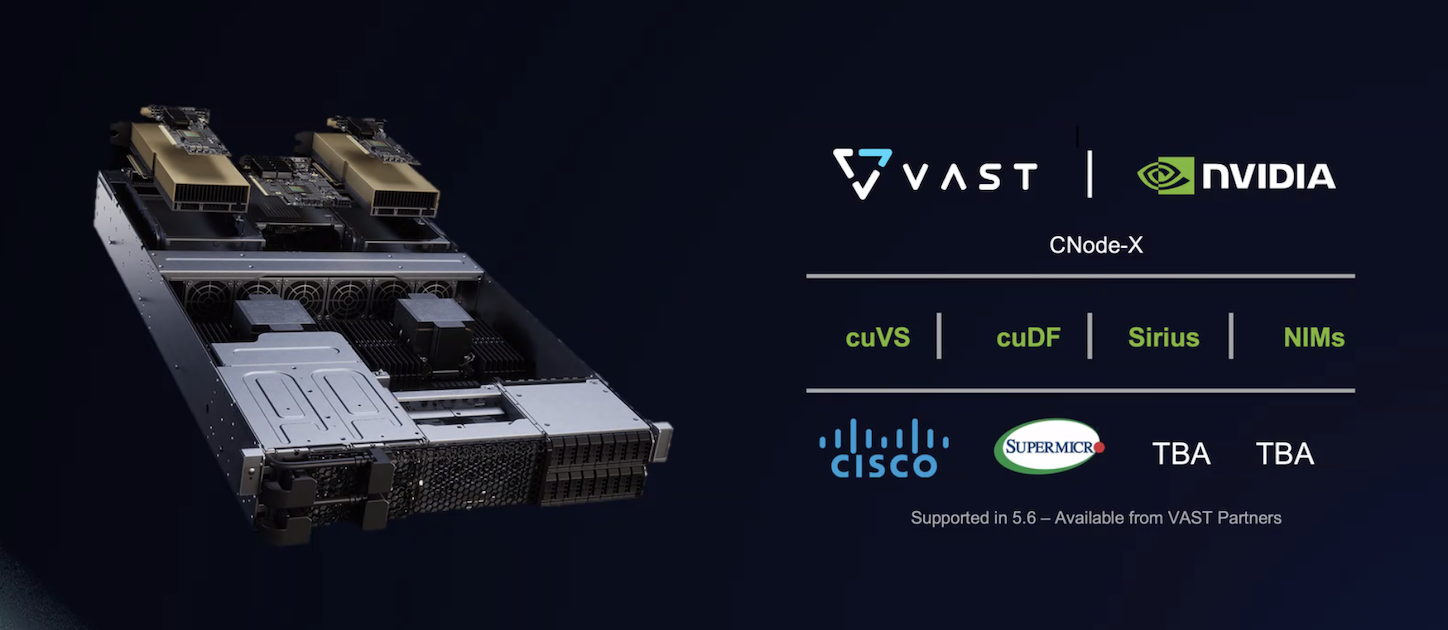
VAST leverages new GPU-accelerated VAST CNode-X servers integrated with the VAST AI OS to support a comprehensive software platform for AI pipelines, vector search, and deployment. Key features include:
- Sirius integration with VAST DataBase enhances analytics by combining storage intelligence with GPU-accelerated SQL, resulting in up to 44% faster queries and 80% lower costs.
- NVIDIA’s cuVS library accelerates vector search and clustering in VAST’s scalable database and RAG pipelines, reducing retrieval latency.
- Support for NVIDIA NIM microservices enables scalable AI pipelines, with open-source VAST DataEngine blueprints for applications like video, documents, and genomics.
- NVIDIA CMS accelerates inference at scale using BlueField-4 DPUs and Spectrum-X networking, improving access to KV caches and reducing time-to-first-token, with optional enterprise data services without affecting KV retrieval.
Accelerating the VAST AI Operating System
VAST plans to deliver CNode-X servers through OEM partners such as Cisco and Supermicro, enabling customers to access GPU-accelerated infrastructure through their preferred vendors while maintaining consistent VAST software, support, and operations. Certified OEM configurations offer a quicker, more supportable path to AI deployment. As enterprise AI pipelines evolve into continuous systems, VAST combines its data platform with NVIDIA’s accelerated stack to provide high-performance retrieval, analytics, and vector search across RAG, real-time analytics, and large-scale AI workloads.
Introducing Polaris
VAST unveiled Polaris, a global control plane that helps provision, operate, and manage distributed AI infrastructure across public clouds, neoclouds, and on-premises data centers. Polaris changes VAST deployments into a unified platform, enabling businesses to manage AI data and infrastructure consistently for both training and inference workloads.
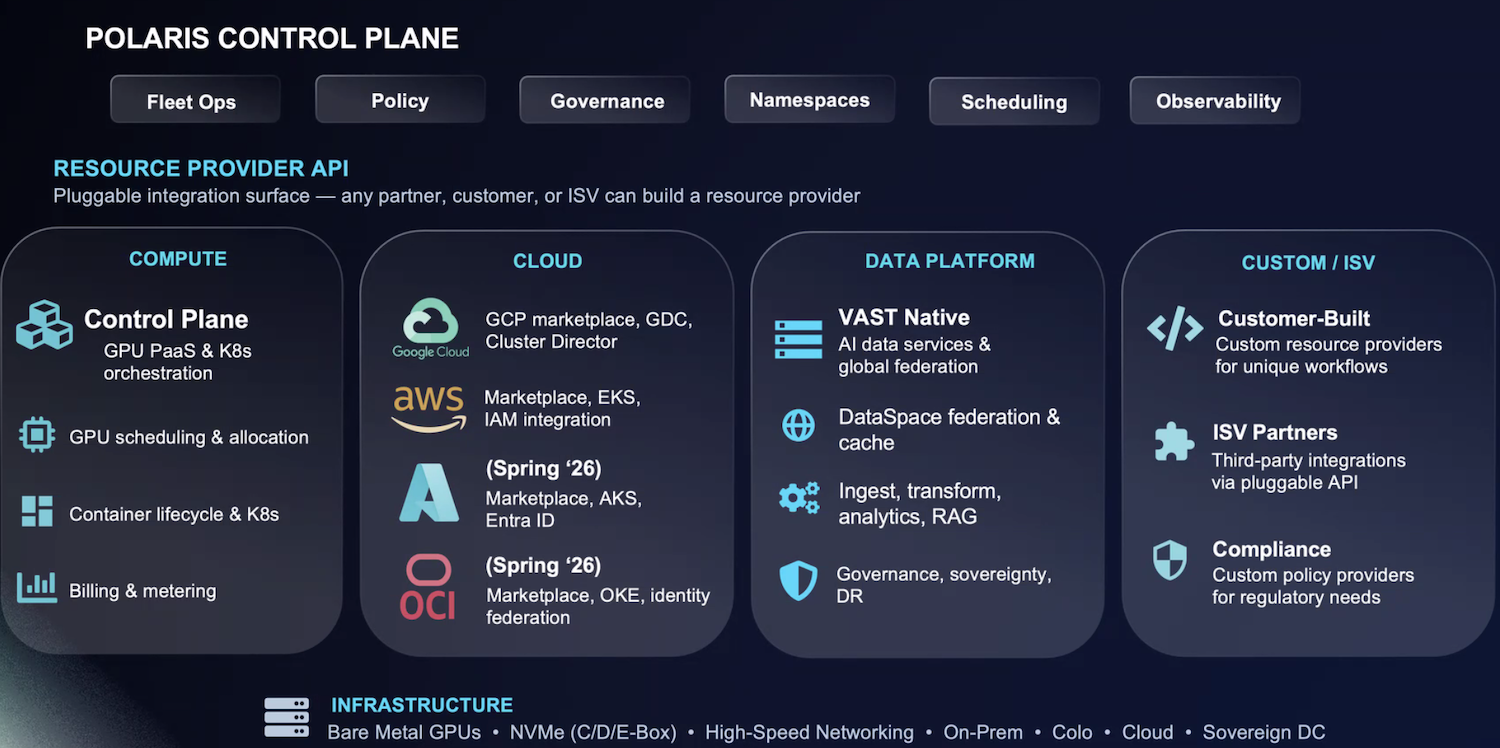
Since AI infrastructure spans multiple regions and providers, operations need to reach beyond a single cluster. Training, inference, and edge data collection often take place in different locations but still require unified management and cost control. Polaris solves this by offering a centralized service layer that automates deployment and lifecycle operations. This approach turns distributed resources into a single operational platform, regardless of physical location.
Polaris is available at no extra cost and complements the VAST AI Operating System by coordinating VAST environments across diverse infrastructures. While VAST DataSpace unifies data with a global namespace and distributed fabric, Polaris governs the deployment and management of those clusters. DataSpace abstracts data location, and Polaris abstracts infrastructure location, enabling applications to operate within a single logical environment.
VAST sees Polaris as a response to the trend of AI stacks becoming globally distributed systems. The company notes that Polaris builds a global control plane that enables distributed AI deployments to work together across cloud and on-premises resources. This architecture enables businesses to deploy, scale, and manage VAST clusters as one system.
Infrastructure Orchestration and Governance
Polaris is a secure, multi-tenant control plane built on Kubernetes that uses a lightweight agent on every VAST node. This setup automates provisioning across customer cloud accounts, integrates with marketplaces to manage entitlements, and centralizes upgrades and node replacements. It features enterprise identity integration, role-based access control, and audit logging to ensure consistent operations across hybrid and multicloud environments.
The platform supports VAST-, partner-, or customer-managed models and accommodates cloud service providers and regional deployments. Polaris serves as an intent-driven management layer where administrators specify a desired state, and the software coordinates cloud-native services to maintain it. Infrastructure is managed through a single API and interface, ensuring consistent configuration and policy enforcement across all regions.
By integrating global data services with fleet-scale orchestration, the VAST AI Operating System transitions AI pipelines from isolated clusters to continuous systems. Organizations can align compute placement with GPU availability and compliance requirements without altering application behavior.
Polaris is available now for VAST cloud deployments, with plans for expanded multi-cluster orchestration capabilities in future releases.
New Partner Program Within VAST’s Cosmos Community
VAST Data launched a unified, global partner program within VAST’s Cosmos Community, uniting resellers, service providers, system integrators, advisory partners, technology alliances, distributors, cloud providers, and hyperscalers under a consistent framework. Designed for flexibility, the program allows partners to engage with VAST in ways that suit their business and customers, while offering a clear path for growth.
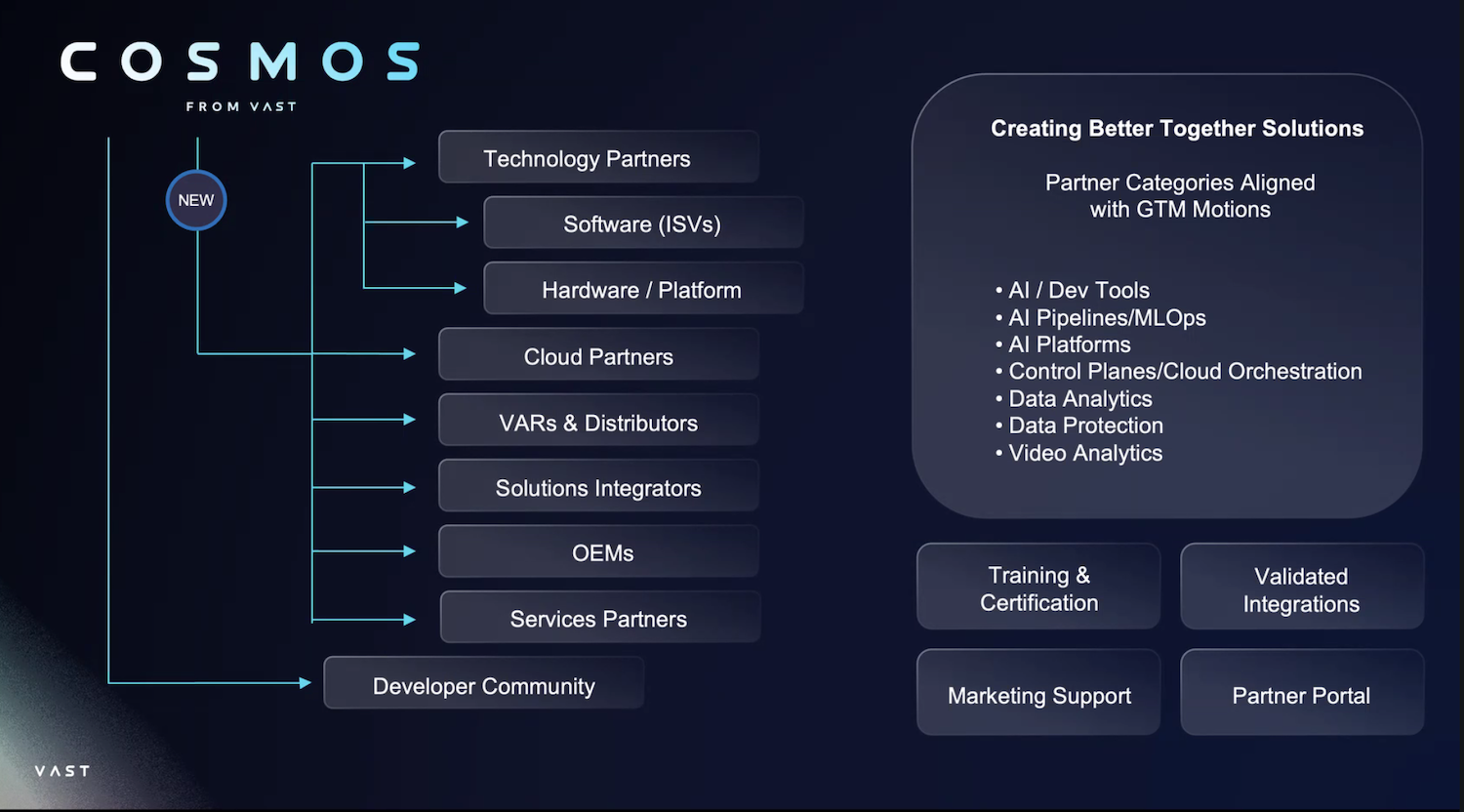
VAST Cosmos now formalizes how partners can participate in one or more routes to market and aligns around common training, enablement, governance, and go-to-market resources through a centralized partner portal.
John Mao, Vice President of Global Technology Alliances at VAST Data, explained that Cosmos was designed to revolutionize AI development by creating a collaborative community for practitioners that fosters innovation and growth. He highlighted that the new formal partner program extends this mission by providing a unified framework for technology, cloud, and channel partners to develop, validate, and differentiate solutions, and to deliver the VAST AI Operating System across data centers, cloud environments, and edge locations.
John Cedillo, Vice President of the Global Partner Organization at VAST Data, emphasized the importance of clarity and consistency for partners engaging with VAST. He highlighted how Cosmos consolidates these elements into a unified program, offering structured onboarding, tiered benefits, and a partner portal that integrates training, deal registration, and joint go-to-market strategies to facilitate repeatable execution.
Cosmos integrates various partner tracks into a unified ecosystem and engagement framework, enabling partners to develop, validate, deliver, and scale customer solutions on the VAST AI Operating System.
Combining VAST’s Native Security Controls with CrowdStrike’s Enterprise Detection and Response
VAST Data and CrowdStrike have formed a strategic partnership to enhance security for the VAST AI Operating System. The integration embeds CrowdStrike’s threat detection and automated response capabilities into AI environments, improving protection at the data layer and during runtime workflows.
As companies transition from AI experimentation to deployment, securing the AI lifecycle becomes critical, requiring advanced detection that works alongside platform controls. Benefits of the partnership include continuous monitoring of AI data pipelines, seamless security within AI workflows to prevent threats like malware and data breaches, and coordinated threat response across platforms. This collaboration aims to strengthen enterprise AI security at scale, enabling organizations to deploy AI with greater confidence.
VAST Data and TwelveLabs Partner to Expand Video Intelligence
VAST Data and TwelveLabs, a developer of video foundation models for advanced video intelligence, are partnering to help organizations analyze extensive video archives and sensitive data beyond public clouds. The collaboration introduces TwelveLabs’ first customer-managed deployment on the VAST AI Operating System, designed to handle unstructured data at exabyte scale for video search, analytics, and reasoning with governance, sovereignty, and control.
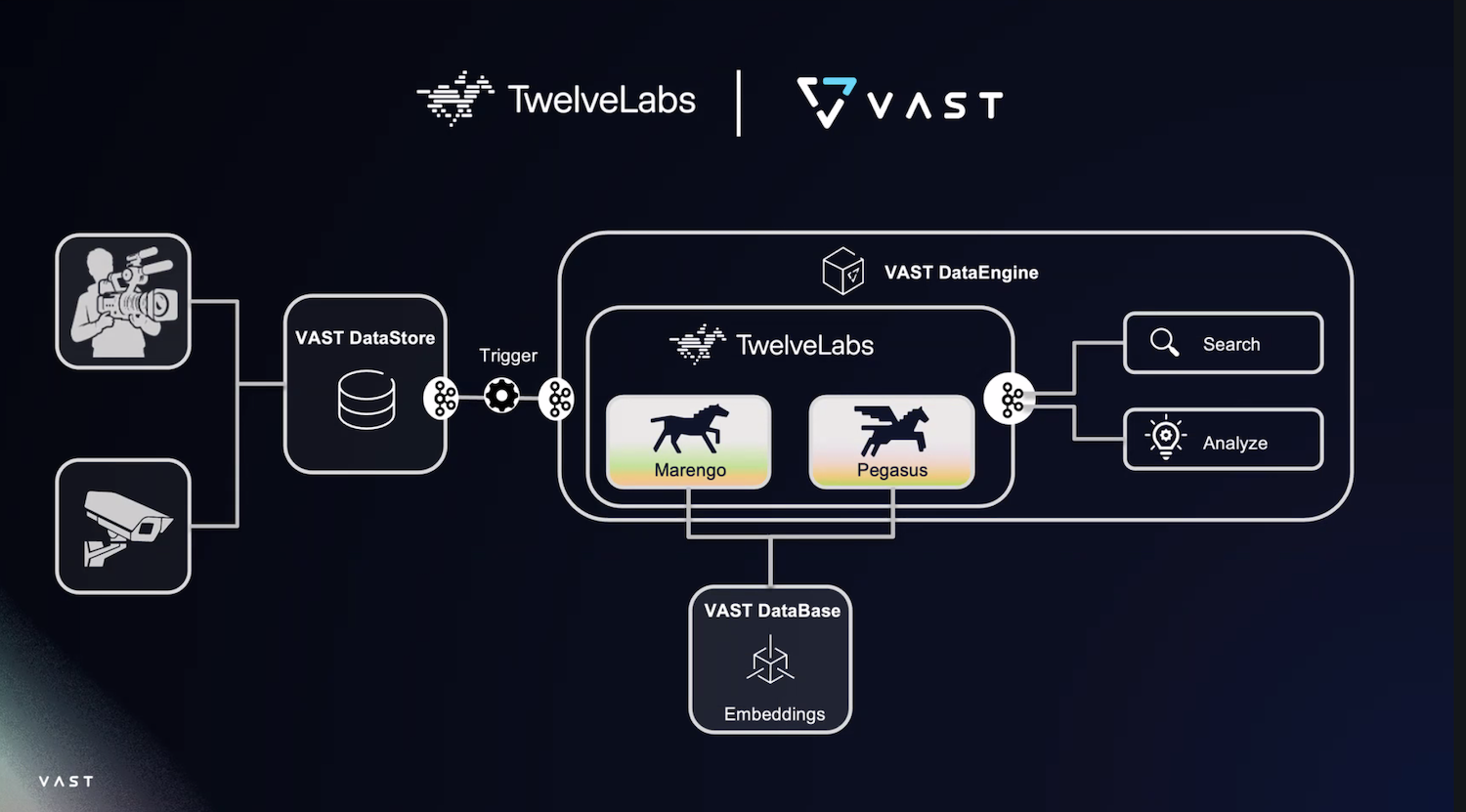
Enterprises rely on valuable video assets across media, smart spaces, and safety, but scaling operationalization is challenging due to size, complexity, and governance. TwelveLabs’ models, deployed for large-scale video understanding, include Marengo for multimodal search and Pegasus for deep understanding and text generation, enabling natural language search and analysis. This partnership supports the deployment of video intelligence closer to data sources. The VAST AI OS unifies video data for real-time processing across on-premises, cloud, and neocloud environments, addressing data sovereignty, regulatory, security, and cost considerations.
According to Danny Nicolopoulos, Head of Global Strategic Partnerships, TwelveLabs aims to enable machines to interpret video as humans do, covering visuals, speech, sound, and timing. He highlights that their collaboration with VAST broadens the deployment of video intelligence, accommodating on-premises, AI, and neocloud settings, while meeting the scale needs of large video archives. Additionally, Nicolopoulos said this partnership enhances video search and analytics capabilities, particularly in sectors with stringent governance and data control requirements.
The VAST collaboration with TwelveLabs enables customers to operationalize AI pipelines seamlessly through the VAST AI OS, which provides a unified global namespace for easy access and management of extensive video archives across hybrid multicloud environments. It includes built-in vector storage and real-time similarity search optimized for large-scale video workloads, as well as data and compute orchestration via the VAST DataEngine to efficiently handle embeddings and metadata. This solution addresses growing industry demand for media content search and reuse, finance video-based fraud detection and compliance, and public-sector faster investigations and situational awareness through secure, on-premises data deployment.


 Amazon