

As organizations reevaluate their virtualization strategies, ensuring that proven backup and recovery tools remain compatible with new platforms has become a top priority. Veeam Data Platform now delivers agentless, image-based backup support for HPE Morpheus VM Essentials Software, allowing enterprises to adopt HPE’s KVM-based virtualization (HVM) stack without disrupting established data protection workflows. The integration extends the long-standing partnership between Veeam and Hewlett Packard Enterprise while helping IT teams maintain consistent resiliency standards during infrastructure transitions.
Addressing Modern Virtualization Challenges
The current IT landscape is defined by escalating virtualization costs, rapid data growth, and persistent ransomware threats, all while staffing levels remain flat. Organizations are constantly looking to reduce reliance on vendors while maintaining operational stability across critical virtual machine workloads. HPE Morpheus VM Essentials addresses these needs by offering a streamlined, KVM-based virtualization platform that can operate as a standalone deployment or as part of broader HPE Private Cloud solutions. By providing native host-based protection, Veeam allows customers to leverage familiar backup and recovery features without the overhead of installing and managing agents on each VM.
Technical Capabilities of the HVM Integration
The integration is facilitated through the HPE Morpheus plug-in for Veeam Backup & Replication version 13.0.1 or later. By interacting directly with the HVM hypervisor and the HPE Morpheus control plane, Veeam captures image-level backups that remain compatible even if a customer scales to the more advanced HPE Morpheus Enterprise control plane. This purpose-built architecture supports several high-performance features designed for enterprise efficiency.
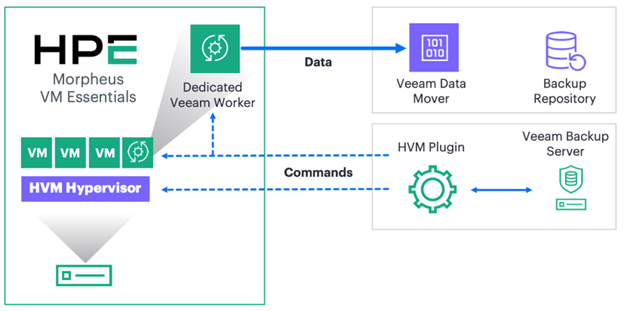
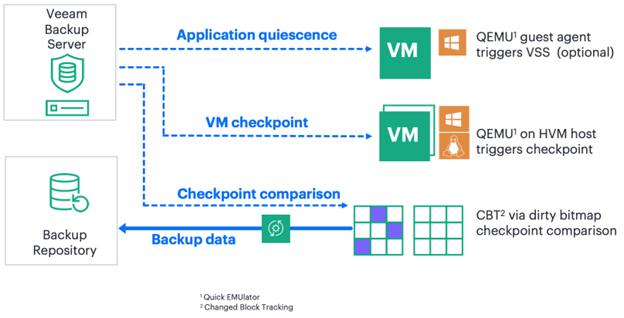
Changed Block Tracking (CBT) accelerates incremental daily backups by significantly reducing read I/O on source volumes. The platform also supports full VM restores to VME from backups taken on other supported hypervisors, enabling seamless cross-hypervisor recovery. For application consistency, the solution includes VSS integration and provides granular recovery for Microsoft Exchange, SQL Server, Active Directory, and Oracle. Transport flexibility is maintained through NBD and HotAdd modes, while datastore support extends to GFS2 and NFS, with integration via the HPE Alletra Storage MP plug-in.
For organizations moving toward cloud-native architectures, Veeam Kasten can be deployed to extend protection to HPE Morpheus Kubernetes services, ensuring a unified protection strategy as infrastructure evolves.
Enhancing Cyber Resilience and Business Outcomes
The technical integration between Veeam and HPE is designed to deliver specific operational outcomes, such as shorter backup windows and minimal impact on production. Application-aware image protection ensures that restored VMs are immediately usable, which reduces troubleshooting time during service recovery. From a security perspective, combining image-based backups with encryption and verification supports the 3-2-1-1-0 principle. This model emphasizes three copies of data on two different media types, with one off-site copy, one immutable copy, and zero verified errors.
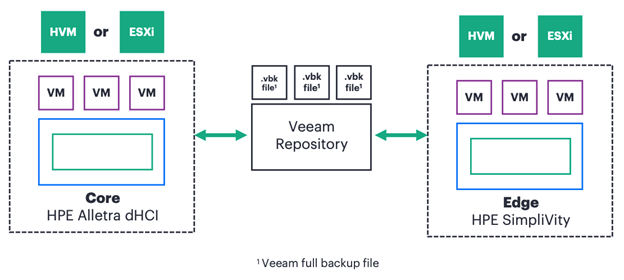
This layered immutability is a critical component in defending against modern ransomware. By aligning HPE’s private cloud infrastructure and HVM hypervisor with the Veeam Data Platform, the two companies provide a validated foundation for hypervisor migration. Organizations deploying HPE Morpheus VM Essentials can now maintain proven backup and portability standards from the initial stages of deployment.


 Amazon