

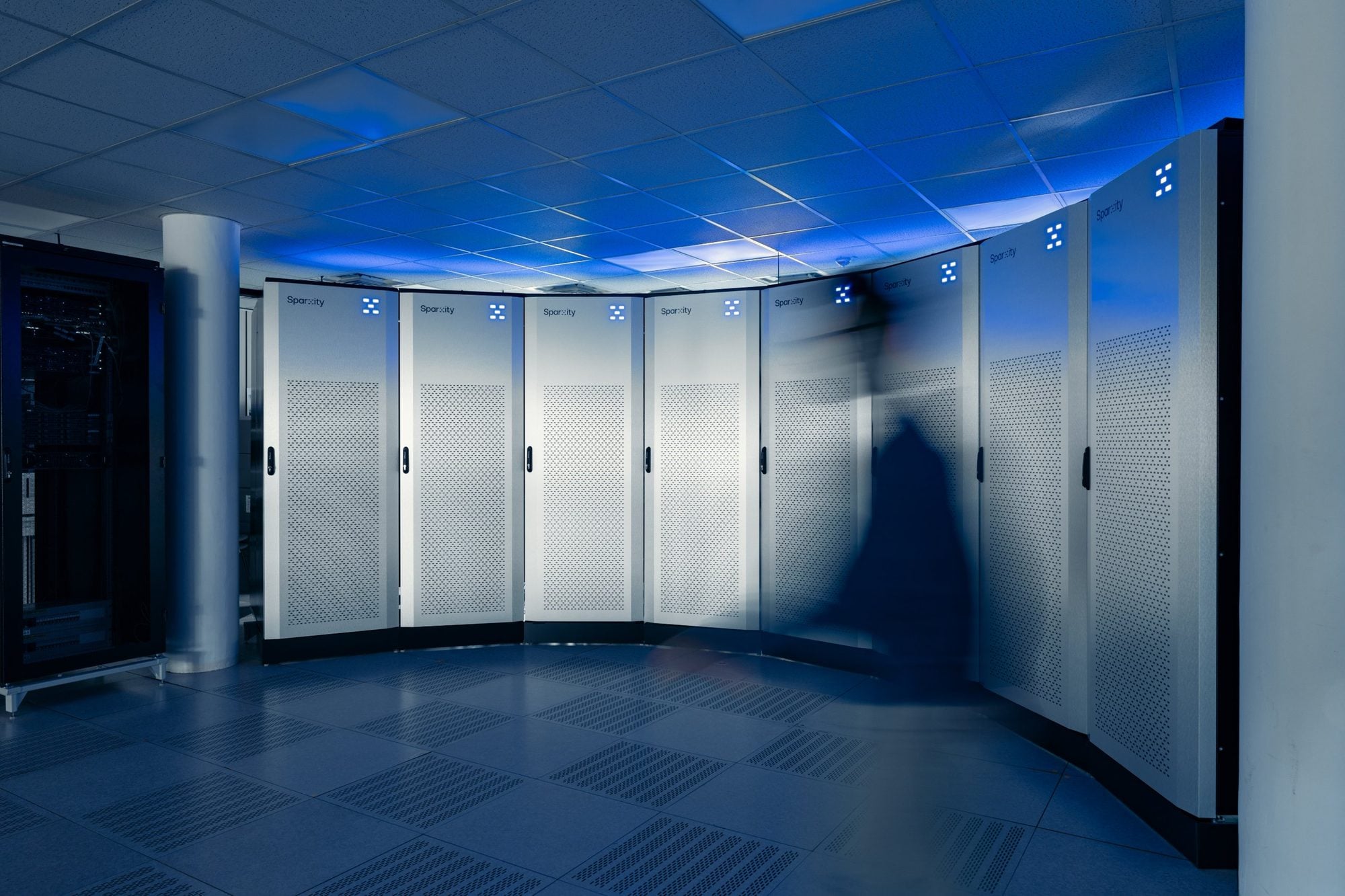
Sparxity, the Dresden company that until today was SpiNNcloud, announced the deployment of a sparse-native computing rack system at the Jülich Supercomputing Centre (JSC), an institute of Forschungszentrum Jülich and home of JUPITER, Europe’s first exascale machine. The system is named JUBIS, the installation is described as multi-million-dollar, and JSC will use it to run sparse machine learning models and large-scale HPC simulations next to its conventional CPU and GPU systems. The announcement doubles as the launch of the new company name.
Event-Based Execution and the Numbers Sparxity Puts on It
The hardware is event-based: execution units run only when an input changes, so idle parts of a model consume no cycles and move no data. Sparxity frames that as sparsity in practice. The company says JUBIS is designed to deliver 10x faster sparse solver execution, 18x lower energy consumption for event-based machine learning workloads, and 20x shorter time to an acceptable solution in optimization problems. Those are vendor figures with no published baseline system, workload, batch size, or precision, and we did not run or audit them.
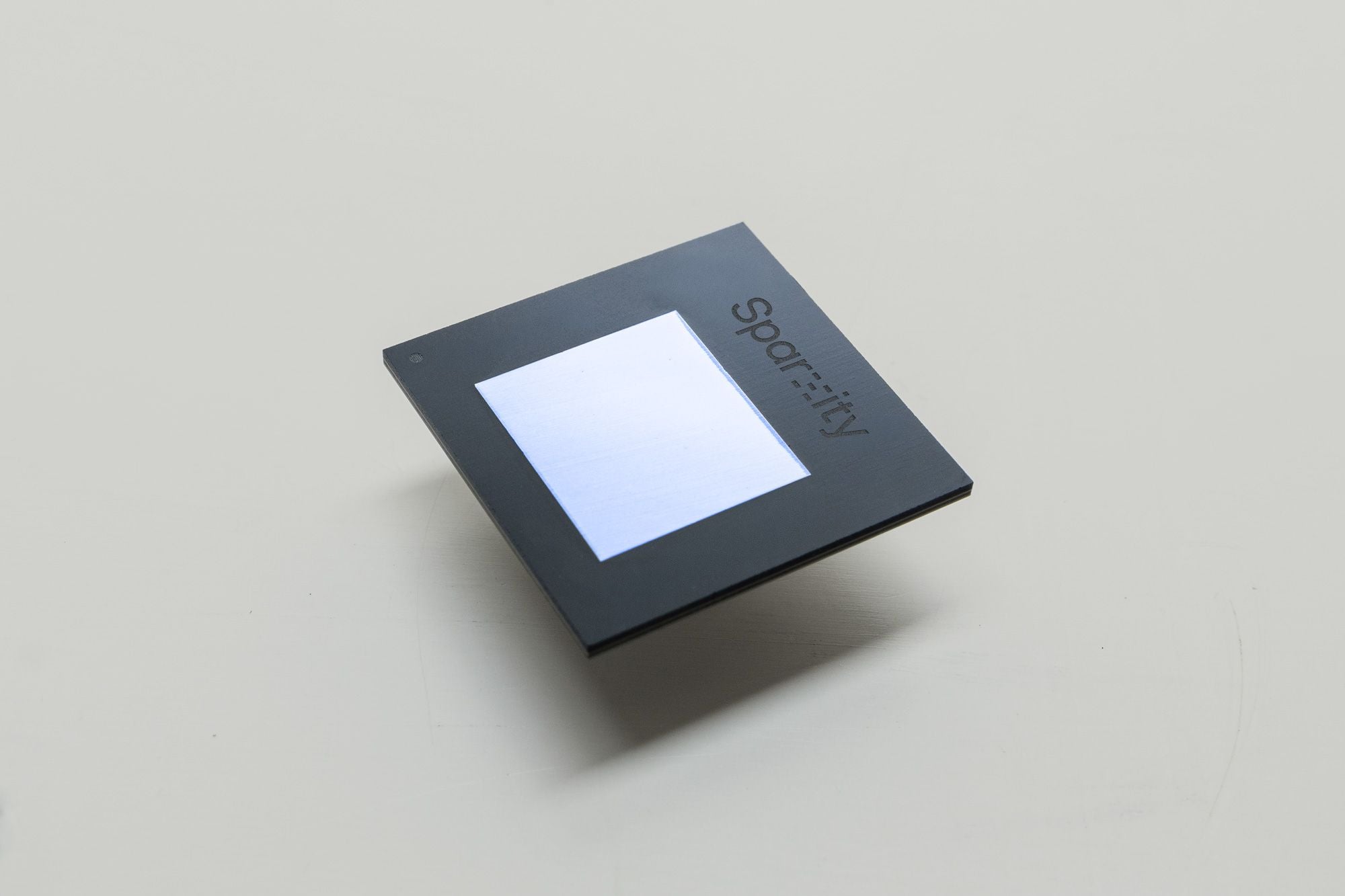
The silicon is SpiNNaker2, the Arm-based chip descended from the SpiNNaker research line started by Steve Furber, designer of the original Arm architecture. The company describes its server board as 48 SpiNNaker2 chips, each with 152 Arm cores and dedicated accelerators, and the same board family went into the system Sandia National Laboratories brought up in 2025, which it rated at 150 million to 180 million simulated neurons. Sparxity has not said how many boards are in the Jülich rack. Across its installed base, it counts three tape-outs, more than 70,000 chips produced, more than 12 racks deployed, and more than 30 customers.
“Sparse machine learning represents one of the biggest opportunities to fundamentally improve the efficiency of AI,” said Dr. Guido Trensch, Simulation and Data Lab Neuroscience, Jülich Supercomputing Centre. “By adopting Sparxity, we’re able to complement our globally unique HPC infrastructure with a fundamentally new approach, opening up new research opportunities so that we can further develop advancements in neuroscience.”
Where JUBIS Fits at Jülich
JSC describes the project behind the purchase, ESAB (Event-based Supercomputer for AI and Beyond), as a three-year infrastructure effort that started in 2026 to add an energy-efficient, event-based SpiNNaker2 compute module to its Modular Supercomputing Architecture, the same framework that pairs a CPU cluster with a GPU booster in JUPITER. The targets JSC lists are AI workloads, real-time neuroscience simulation, and other fields for a broad scientific community, building on its Simulation and Data Lab Neuroscience, the Human Brain Project, and its earlier Advanced Computing Architectures pilot. Funding comes from the European Regional Development Fund and the State of North Rhine-Westphalia under the EFRE/JTF-Programm NRW 2021-2027.
JSC also operates the JUPITER AI Factory, which Sparxity notes is one of 19 AI factories in Europe and the only one built around an exascale system, so JUBIS lands in a facility that already runs dense GPU inference at scale, which is the comparison the company is inviting. Its position is that models are getting sparser faster than dense hardware can exploit, with mixture-of-experts routing, memory layers, and block-sparse attention as the examples, and that an event-based machine turns that sparsity into speed where a GPU adds routing overhead.
The rebrand draws the line between the two product generations. Sparxity says its current systems serve both HPC and AI, while the next generation commits fully to sparsity for AI inference, aimed at model builders who want finer, more dynamic sparsity and at data centers and neoclouds that want more tokens per second at lower cost. CEO and co-founder Hector Gonzalez said the Jülich collaboration shows the value of that approach at supercomputer scale. SpiNNcloud’s site lists the successor chip, SpiNNext, at 78x the energy efficiency of GPUs against 18x for SpiNNaker2, with availability marked as coming soon.


 Amazon