

The PowerEdge R5715 is the second part of Dell’s SMB-focused extension to the 17th Generation PowerEdge family, starting with different priorities than its 1U sibling. Where the R4715 optimizes for compute density and core-per-rack-unit efficiency, the R5715 is built around storage capacity and I/O expandability in a 2U single-socket footprint. Readers coming from our R4715 review will find the platform fundamentals familiar: the same 5th Generation AMD EPYC processor family, the same 24-slot DDR5 memory architecture, and the same iDRAC 10 management stack. What changes slightly is the task the R5715 is asked to perform.
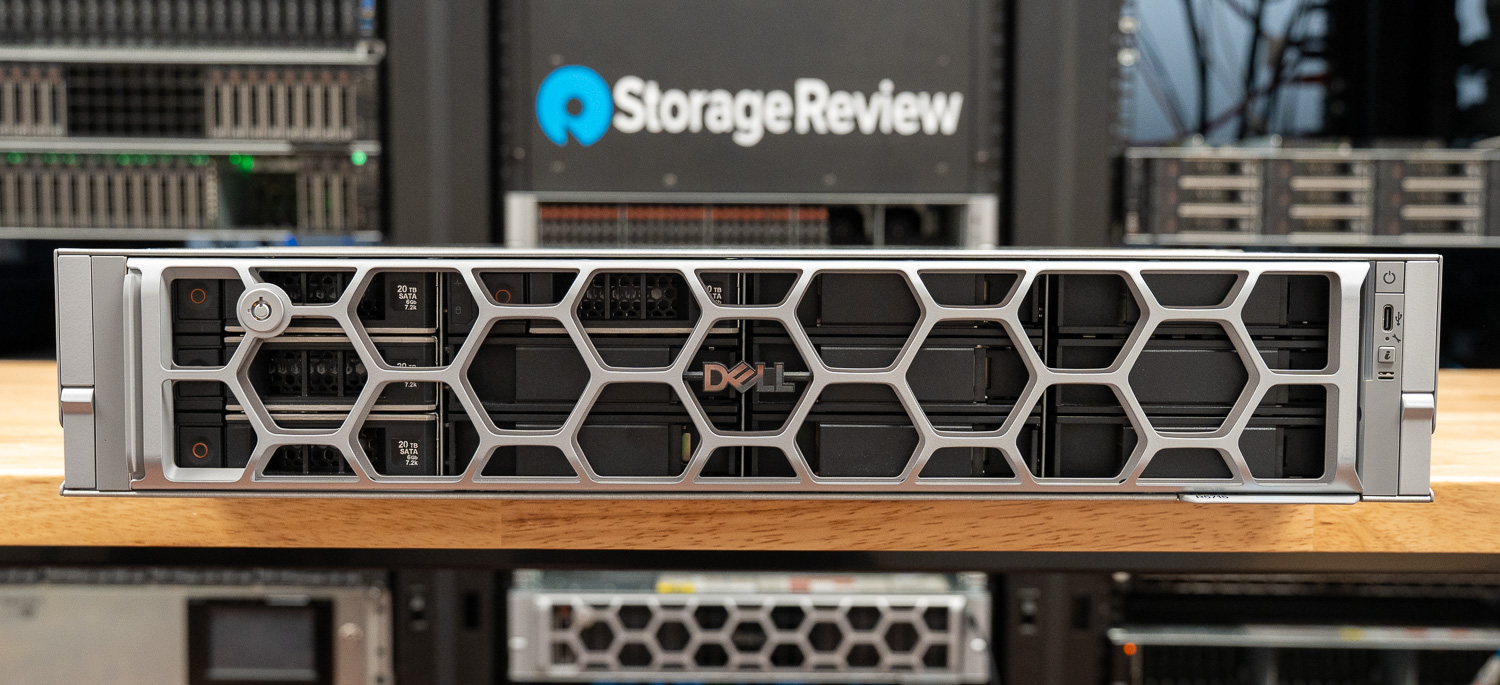
Our review unit was configured with a single AMD EPYC 9015, the 8-core entry in the Turin lineup, paired with 384GB of DDR5 and a BOSS RAID1 boot configuration. The R5715’s 12-bay 3.5-inch storage backplane was the focus of our testing, which is exactly where the 9015 makes sense. Workloads like file serving, backup targets, and retail video surveillance don’t need 32 cores; they need drive density, sustained throughput, and a reliable management story. The 9015 keeps power consumption and licensing costs low, while the platform delivers up to 288TB of raw storage capacity in a single 2U node.
The R5715 also increases the PCIe Gen5 slots to four, up from the R4715’s three, and adds support for an extra OCP 3.0 networking slot, providing more room to grow as I/O demands rise. Both platforms support 100 GbE and 400 GbE via PCIe AIC, making them a capable fit for environments with high-bandwidth networking requirements; however, neither platform officially supports Fibre Channel connectivity. Also neither platform supports GPUs or DPUs. They run on the same 800W and 1100W PSU options in Platinum or Titanium efficiency grades, with fault-tolerant redundancy supported and air cooling throughout.
Dell PowerEdge R5715 Specifications
The table below highlights the physical and hardware specifications for the Dell PowerEdge R5715 platform.
| Specification | Dell PowerEdge R5715 |
|---|---|
| Processor | |
| Processor | One 5th Generation AMD EPYC 9005 Series processor, up to 32 cores |
| Form Factor | 2U rack server |
| Memory | |
| DIMM Slots | 24 DDR5 DIMM slots |
| Maximum Memory | 1.5 TB (up to 64 GB per DIMM) |
| Memory Speed | Up to 5200 MT/s |
| Memory Type | Registered ECC DDR5 RDIMMs only |
| Storage | |
| Internal Controllers (RAID) | PERC H365i, H965i |
| Internal Boot | BOSS-N1 DC-MHS |
| External HBAs | N/A |
| Front Drive Bays | 12x 3.5-inch SAS/SATA 16x 2.5-inch SAS/SATA |
| Power | |
| Power Supplies | Platinum 800 W, 1100 W Titanium 800 W, 1100 W FTR supported |
| Cooling & Fans | |
| Cooling Options | Air cooling |
| Fans | Up to six hot plug fans |
| Dimensions | |
| Height | 86.8 mm (3.41 inches) |
| Width | 482.0 mm (18.97 inches) |
| Depth (with bezel) | 802.4 mm (31.59 inches) |
| Depth (without bezel) | 801.51 mm (31.55 inches) |
| Bezel | Optional metal bezel |
| Networking & Expansion | |
| OCP Network Options | 2x OCP NIC 3.0 (optional), 1GbE, 10GbE, 25GbE Slot 4: 1×16 Gen5 OCP 3.0 Slot 10: 1×16 Gen5 OCP 3.0 |
| Embedded NIC | 1 Gb dedicated BMC Ethernet port |
| PCIe AIC NIC | 100 GbE and 400 GbE; NDR VPI (400 GbE) |
| PCIe Slots | Up to 4 Gen5 PCIe slots (x16 connectors) Slot 2: 1×16 Gen5 Full Height Slot 3: 1×16 Gen5 Full Height Slot 7: 1×16 Gen5 Full Height Slot 9: 1×16 Gen5 Full Height |
| GPU Options | N/A |
| Ports | |
| Front Ports | 1x USB 2.0 Type-A (optional LCP KVM) 1x USB 2.0 Type-C (HOST/BMC Direct) 1x MiniDisplayPort (optional LCP KVM) |
| Rear Ports | 2x USB 3.1 Type-A 1x VGA 1 Gb dedicated BMC Ethernet port |
| Internal Ports | 1x USB 3.1 Type-A |
| Management | |
| Embedded Management | iDRAC10, iDRAC Direct, iDRAC RESTful API with Redfish, RACADM CLI, Quick Sync 2 wireless module |
| OpenManage Software | OpenManage Enterprise (OME), OME Power Manager, OME Services, OME Update Manager, OME APEX AIOps Observability, OME Integration for VMware vCenter, OME Integration for Microsoft System Center, OpenManage Integration for Windows Admin Center |
| Tools | IPMI |
| Integrations | OpenManage Integrations: Red Hat Ansible Collections, Terraform Providers |
| Change Management | Dell Repository Manager, Dell System Update, Enterprise Catalogs, Server Update Utility (SUU) |
| Security | |
| Security Features | Cryptographically signed firmware, Data at Rest Encryption (SEDs with local or external key mgmt), Secure Boot, Secured Component Verification (hardware integrity check), Secure Erase, Silicon Root of Trust, System Lockdown (requires iDRAC10 Enterprise or Datacenter), TPM 2.0 FIPS/CC-TCG certified, Chassis Intrusion Detection, AMD Secure Encrypted Virtualization (SEV), AMD Secure Memory Encryption (SME) |
| Operating Systems & Hypervisors | |
| Supported OS / Hypervisors | Canonical Ubuntu Server LTS, Microsoft Windows Server with Hyper-V, Red Hat Enterprise Linux, SUSE Linux Enterprise Server, VMware ESXi |
The Dell PowerEdge R5715 is a 2U single-socket rack server built around AMD’s 5th Generation EPYC 9005 Series platform. Positioned as a storage-forward platform for organizations that need high capacity and solid I/O without the cost overhead of a dual-socket design, the R5715 targets workloads such as databases, file shares, backup targets, and virtualization, where a single powerful EPYC processor can handle the load more efficiently than a pair of older-generation CPUs. We also used this chassis for our Micron 6600 ION HDD-to-flash power comparison, swapping eight 30TB hard drives for one 245TB SSD. With support for up to 288 TB of raw storage and four PCIe Gen5 expansion slots, the R5715 punches well above its price class
Exterior and Front Panel
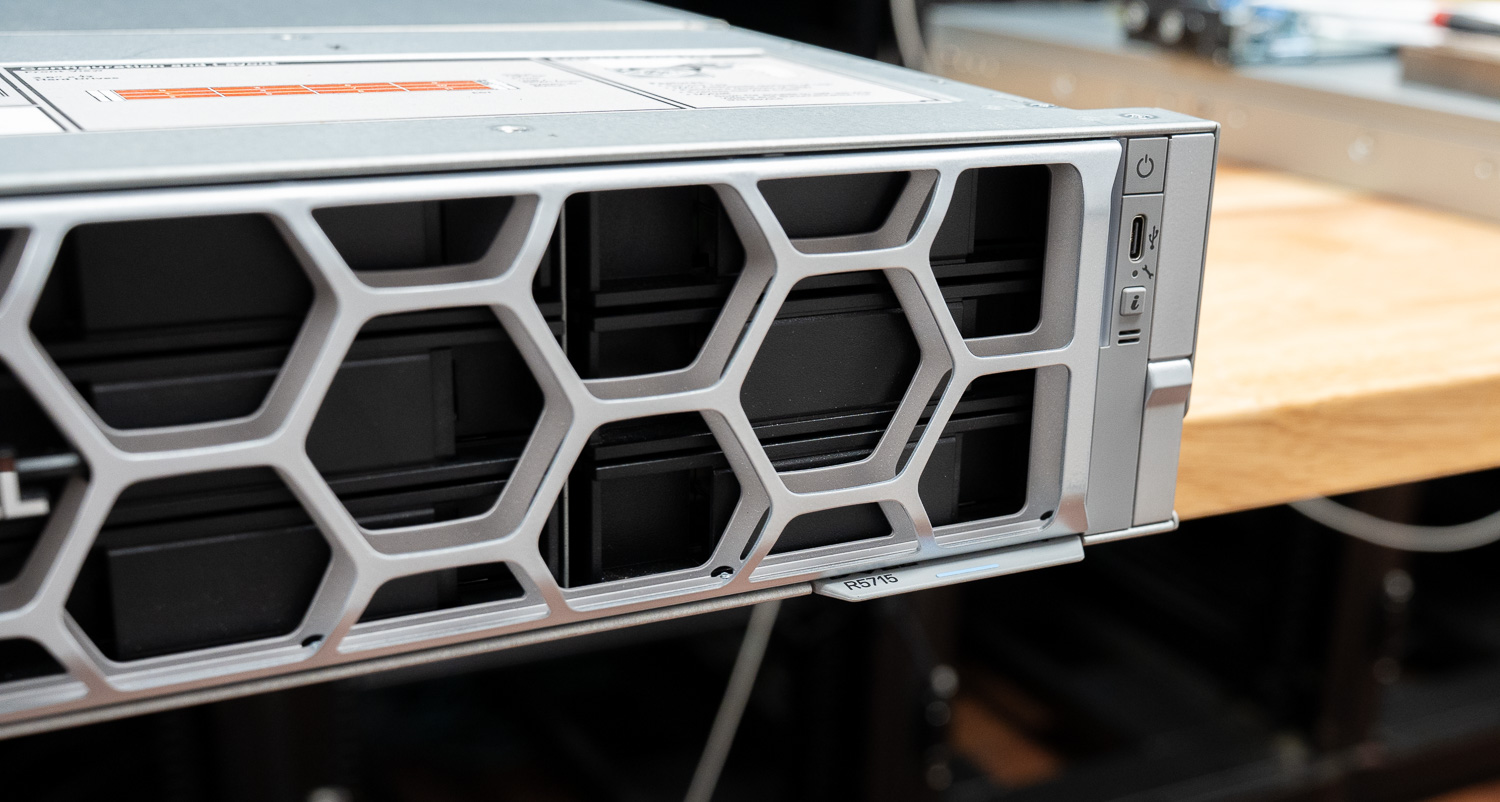
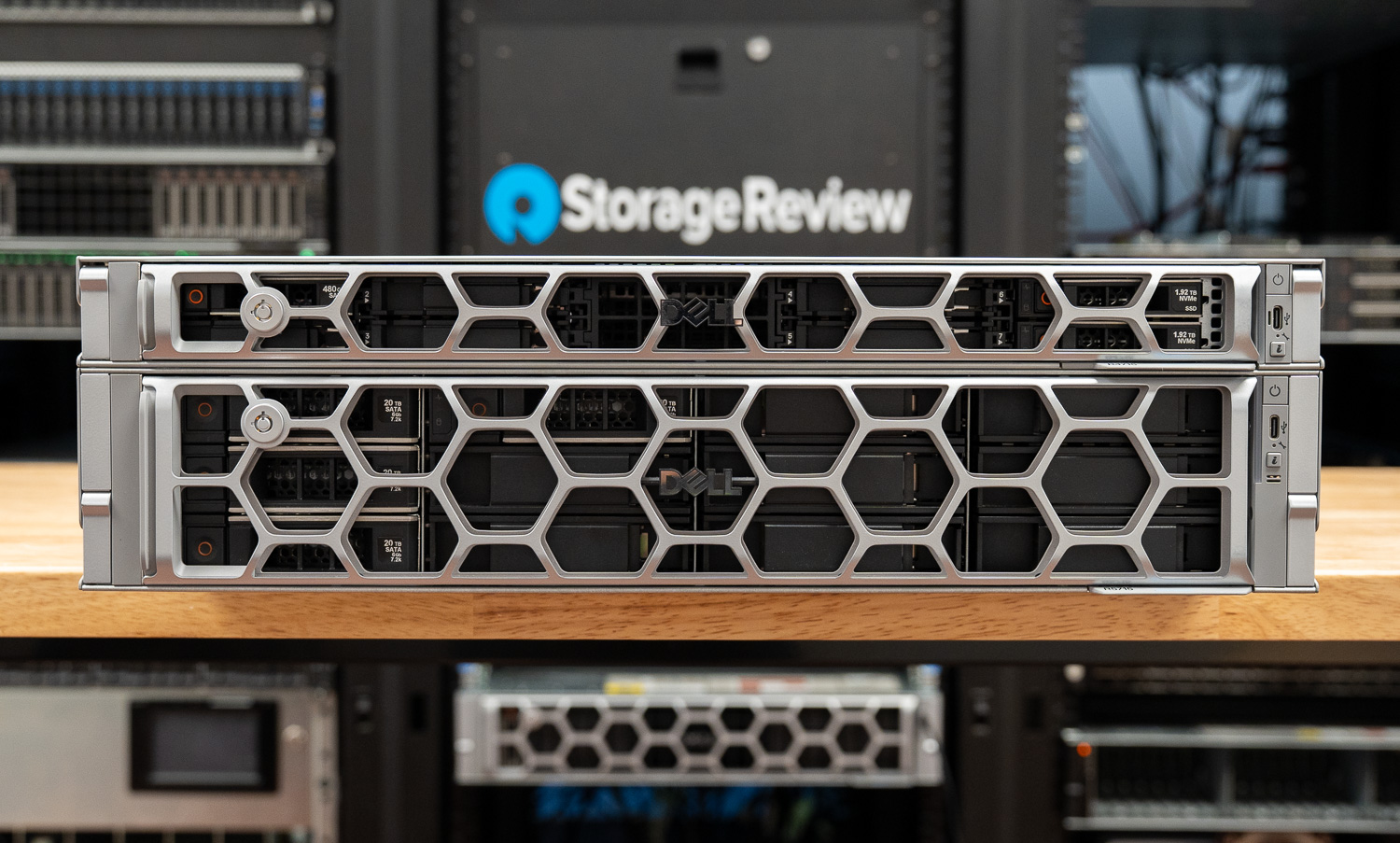
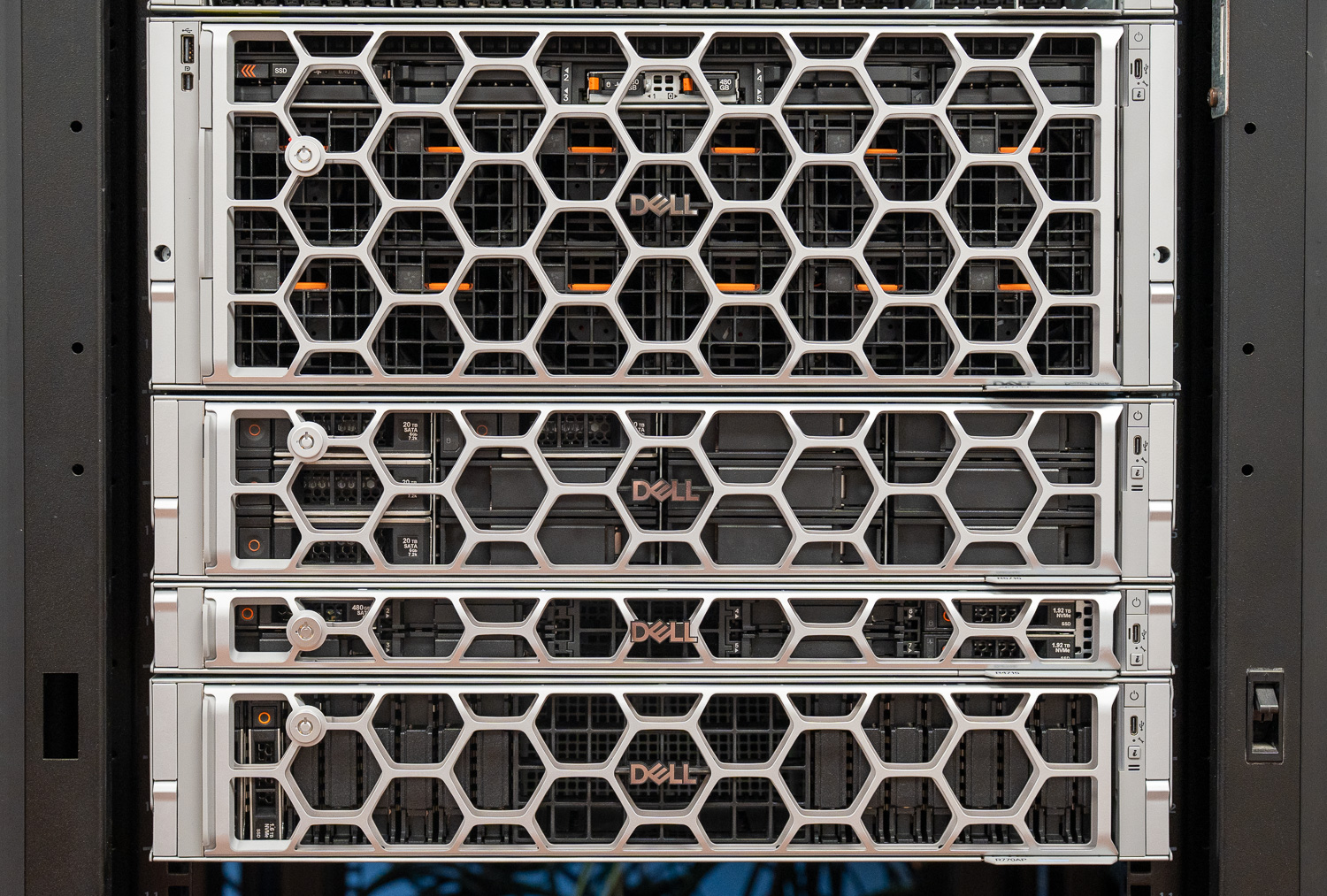
The R5715 ships with an optional metal bezel featuring Dell’s signature hexagonal mesh pattern. The bezel snaps cleanly onto the chassis and exposes the front-panel controls on the right-hand side: a power button, a USB 2.0 Type-C port for direct BMC access, an iDRAC Direct port, and a system ID button. The chassis itself measures 3.41 inches tall, 18.97 inches wide, and 31.55 inches deep without the bezel, fitting standard 2U rack positions. Build quality is enterprise-grade throughout, with tool-less drive-bay latches and blue retention clips used consistently across internal components to enable quick-release access.
Storage Configuration
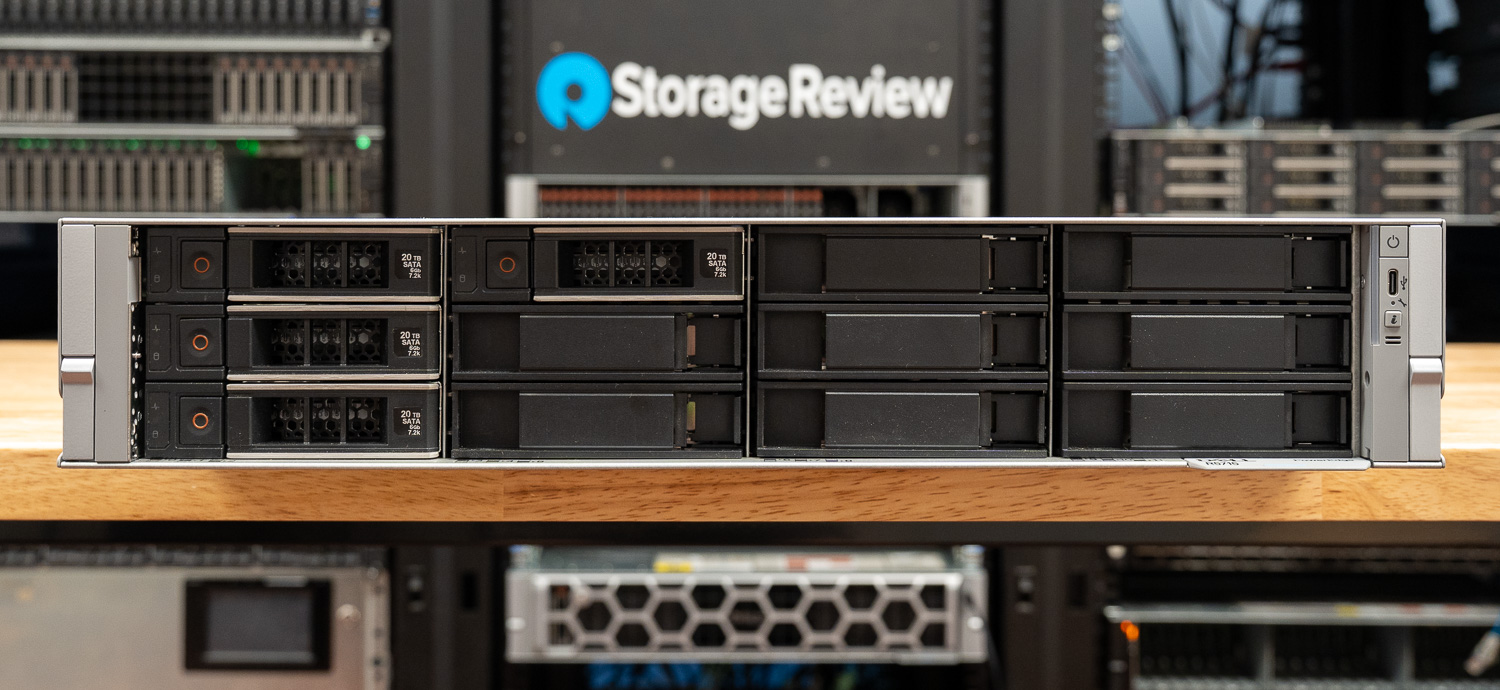
The review unit comes with a 12x 3.5-inch SAS/SATA front-bay setup, featuring four bays filled with 20 TB SATA 6 Gb/s 7.2k large-form-factor HDDs and eight bays left empty for future upgrades. An alternative 16x 2.5-inch SAS/SATA backplane configuration is also available, depending on workload requirements. RAID duties are managed by either the PERC H365i or the higher-tier PERC H965i internal controller. Boot is handled separately through a dedicated rear BOSS-N1 DC-MHS module, isolating the OS from the data pool. This clean design choice prevents the common mistake of running OS and workload storage on the same array.
Processor and Cooling
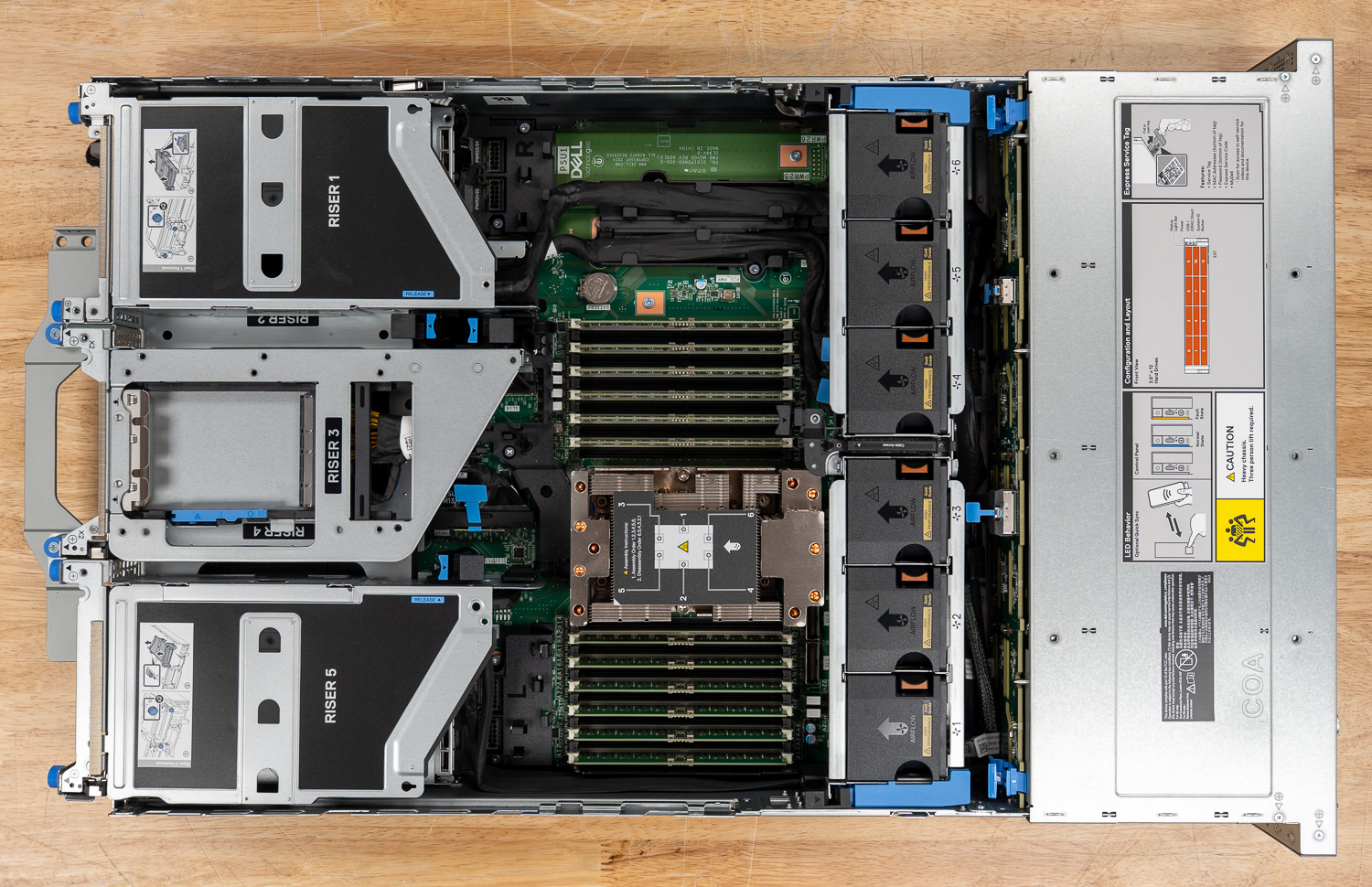
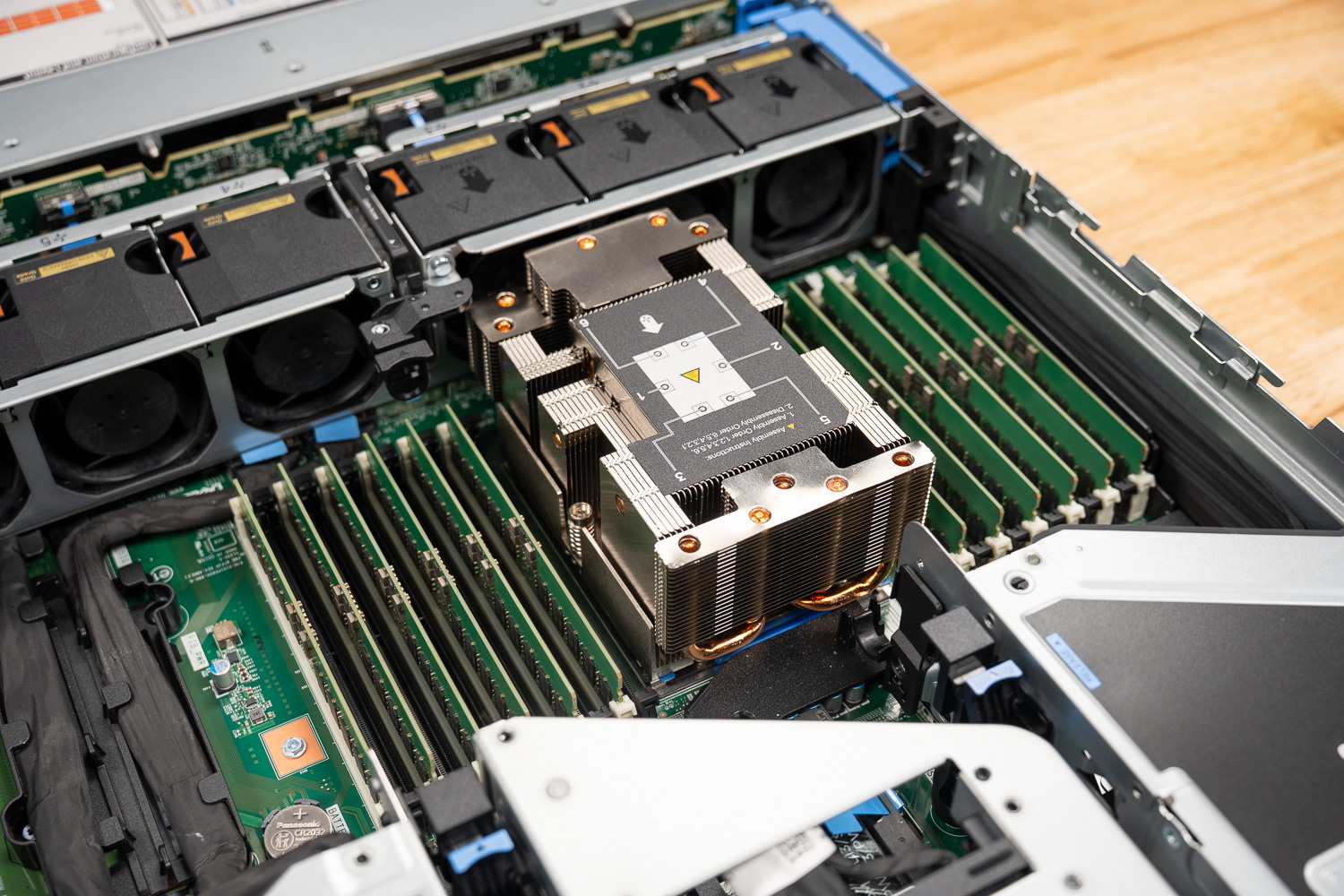
The R5715 is a single-socket platform built around AMD’s EPYC 9005 Series, supporting up to 32 cores. The large heatsink is a finned tower cooler with embedded copper heat pipes, mounted via six captive screws to the SP5 socket. Cooling is all-air; up to six hot-plug fans move airflow front-to-back through the chassis. Liquid cooling is not available on this platform.
Memory
The R5715 carries 24 DDR5 DIMM slots arranged in two banks flanking the CPU socket. The platform is RDIMM-only; no support for UDIMMs or LRDIMMs. Maximum capacity tops out at 1.5 TB using 64 GB RDIMMs per slot, running at up to 5200 MT/s. The review unit ships with several slots populated, leveraging EPYC’s multi-channel memory architecture to deliver high aggregate bandwidth across the memory subsystem.
PCIe Expansion and Networking
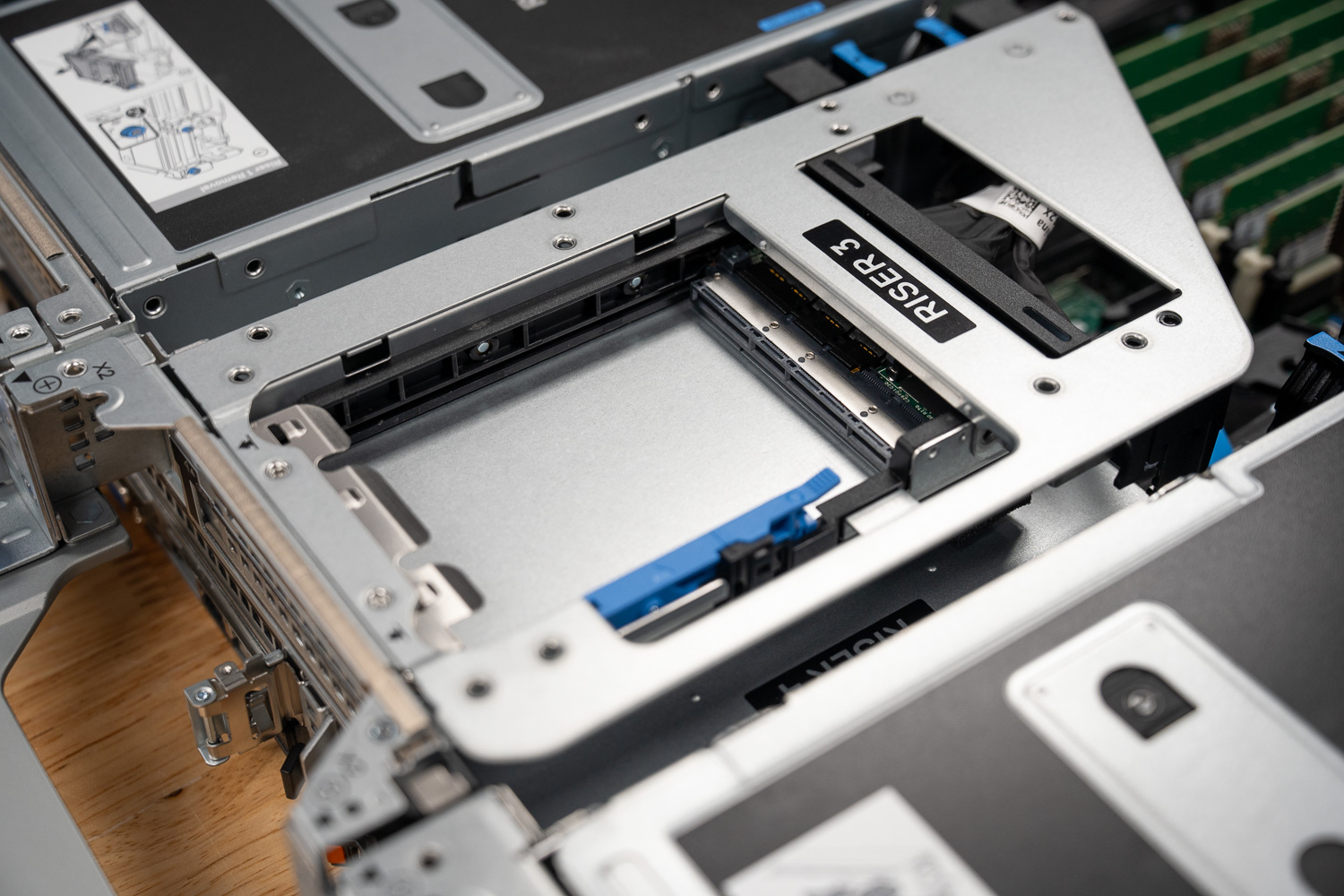
The R5715 offers up to four full-height PCIe Gen5 x16 slots across slots 2, 3, 7, and 9, distributed across five labeled riser positions (Risers 1 through 5) visible throughout the chassis interior. Two additional OCP NIC 3.0 slots (slots 4 and 10, Gen5 x16) support 1GbE, 10GbE, or 25GbE OCP network adapters. For high-bandwidth connectivity, PCIe AIC NICs support up to 100 GbE and 400 GbE, with NDR VPI (400 GbE). A dedicated 1 Gb BMC Ethernet port is embedded on the rear panel for out-of-band iDRAC management. There are no GPU options on the R5715; this is a storage and compute platform, not an accelerator chassis.
iDRAC10 Management
Remote management for the R5715 is handled by iDRAC10, the same platform Dell ships as standard across its entire 17th-generation PowerEdge lineup, including the PowerEdge R770 and PowerEdge R7725 we previously reviewed. The interface is consistent across the portfolio, meaning administrators already familiar with iDRAC on other PowerEdge platforms will feel at home immediately.
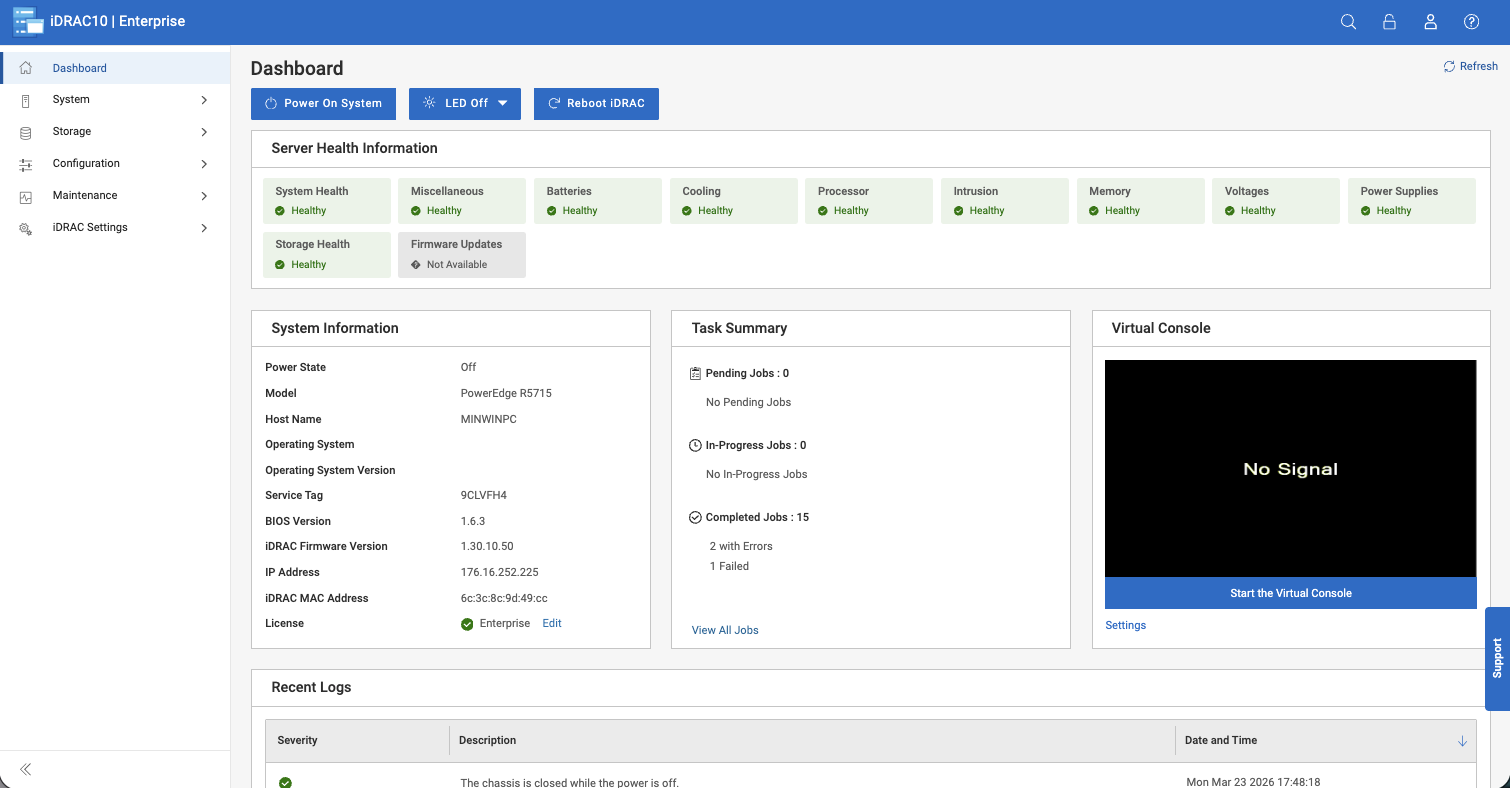
The iDRAC10 dashboard provides a full, at-a-glance health summary of every major subsystem: System Health, Processor, Memory, Cooling, Storage, Voltages, Power Supplies, Batteries, and Intrusion Detection. The review unit shows that all subsystems were reporting as healthy at the time of testing. System information and firmware version details are displayed directly on the dashboard alongside license status, which, on the review unit, is confirmed as Enterprise. The Task Summary panel tracks pending, in-progress, and completed jobs, with the review unit showing completed jobs from an initial provisioning cycle, including a small number with errors and one failed, typical of a fresh deployment.
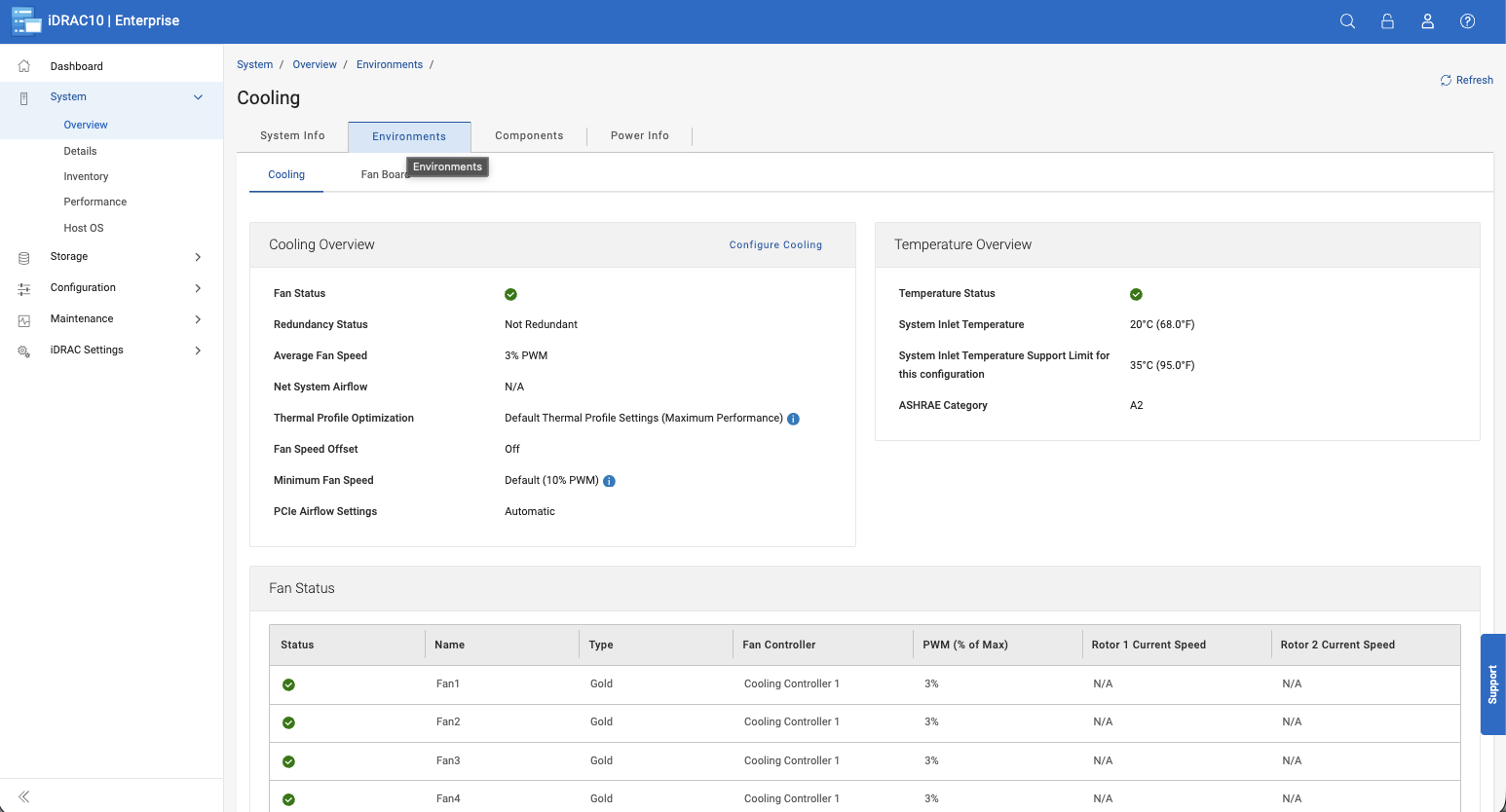
Drilling into the System Environments section reveals cooling details, including individual fan status, PWM speeds, thermal profile settings, and inlet temperature readings, all in real time. This is especially useful for validating airflow in dense rack configurations or troubleshooting thermal issues without needing physical access to the server.
Power visibility follows the same pattern. The Power Info section breaks down PSU health, current draw, and capacity utilization alongside a rolling historical trend graph. Administrators can quickly see average and peak wattage over time, which is valuable for capacity planning and identifying workload-driven power spikes without needing a separate power monitoring tool.
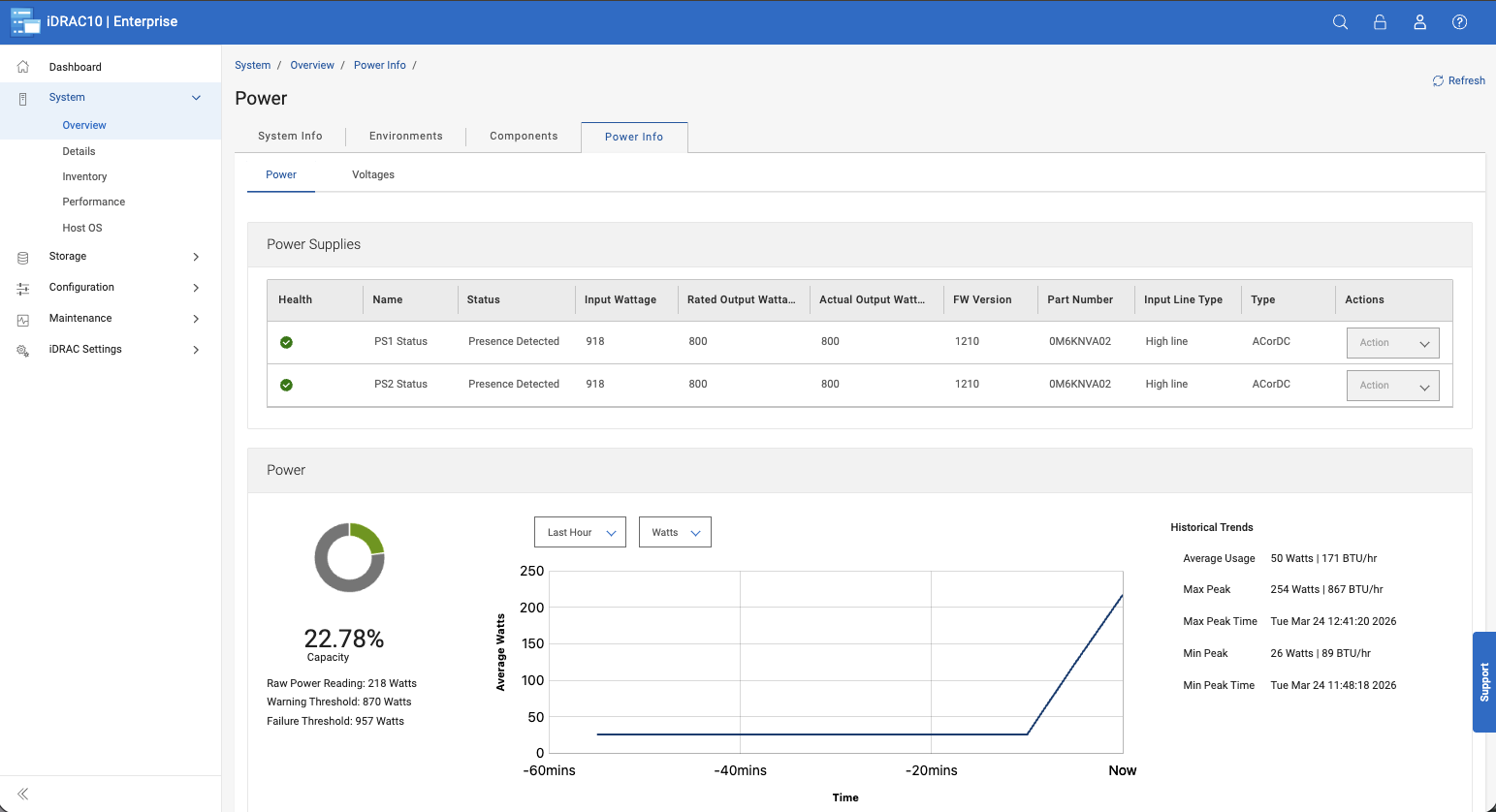
Together, these views make iDRAC10 a capable out-of-band management solution that covers the full operational lifecycle of the R5715, from initial deployment through day-to-day monitoring, all accessible remotely via browser or the RESTful Redfish API.
Dell PowerEdge R5715 Performance
For performance testing of the Dell PowerEdge R5715, we paired it against its 1U sibling, the Dell PowerEdge R4715. The two platforms share identical memory configurations and the same overall PowerEdge architecture, making them a natural point of comparison. The key differentiator between the two review units is processor selection. The R4715 shipped with an AMD EPYC 9335 32-core processor, while the R5715 arrived with an AMD EPYC 9015 8-core processor.
It is worth noting that both platforms support the same EPYC 9005 Series processor lineup and can be configured with either chip depending on workload requirements. The core count delta between these two units will be reflected in the numbers, but the results reflect how each platform performs as shipped rather than a ceiling comparison between platforms.
To stress the CPUs across both systems, we used a focused set of compute benchmarks. y-cruncher was used to evaluate raw arithmetic throughput and multithreaded floating point performance. Blender provided a real-world rendering workload that scales with available cores and memory bandwidth. Phoronix Test Suite rounded out the benchmark set with a broader collection of CPU-bound workloads, giving a more complete picture of sustained compute performance across both platforms.
Test System Specifications
- Platform: Dell PowerEdge R5715
- CPU: Single AMD EPYC 9015
- Memory: 384GB DDR5
- Storage: Boss RAID1
y-cruncher
y-cruncher is a multithreaded, scalable program that can compute Pi and other mathematical constants to trillions of digits. Since its launch in 2009, it has become a popular benchmarking and stress-testing application for overclockers and hardware enthusiasts.
The R5715 tracked predictably against the R4715 across all workload sizes. At 1 billion digits, the R5715 finished in 14.537 seconds against 5.305 seconds on the R4715, and the gap extended consistently from there. At 50 billion digits, the R5715 reached 1,273.734 seconds while the R4715 finished in 445.440 seconds, with the R4715 completing runs roughly 2.8 to 2.9 times faster across the full 1 billion to 50 billion range. Despite running only 8 cores, the EPYC 9015 is purpose-built server silicon with significantly higher memory bandwidth and larger cache than a typical desktop CPU, and it still runs well ahead of what most consumer processors can sustain on the same workloads.
| Y-cruncher (lower duration is better) | Dell PowerEdge R4715 (AMD EPYC 9335 32-Core | 384 GiB RAM) | Dell PowerEgde R5715 (AMD EPYC 9015 8-Core | 384 GiB RAM) |
|---|---|---|
| 25 Million | 0.11 seconds | 0.25 seconds |
| 50 Million | 0.23 seconds | 0.51 seconds |
| 100 Million | 0.46 seconds | 1.08 seconds |
| 250 Million | 1.22 seconds | 3.00 seconds |
| 500 Million | 2.49 seconds | 6.60 seconds |
| 1 Billion | 5.30 seconds | 14.53 seconds |
| 2.5 Billion | 14.58 seconds | 41.32 seconds |
| 5 Billion | 32.38 seconds | 92.99 seconds |
| 10 Billion | 71.54 seconds | 202.87 seconds |
| 25 Billion | 203.40 seconds | 576.87 seconds |
| 50 Billion | 445.44 seconds | 1,273.73 seconds |
Blender 4.5
Blender 4.5 is an open-source 3D modeling application. This benchmark was run using the Blender Benchmark CLI utility. The score is measured in samples per minute, with higher values indicating better performance.
The Blender results follow a similar pattern to y-cruncher, with the R4715’s core-count advantage translating directly into rendering throughput. On the Monster scene, the R4715 posted 523.29 samples per minute against 135.21 on the R5715. The Junkshop scene came in at 355.43 versus 88.61, and Classroom landed at 264.70 against 68.48 on the R5715. Across all three scenes, the R4715 delivered roughly 3.8 to 4 times the rendering throughput of the R5715, a slightly wider margin than in Y-Cruncher, reflecting how heavily Blender’s CPU renderer scales with core count when parallelizing ray-tracing workloads across a scene.
| Blender 4.5 CPU Benchmark (higher samples per minute is better) | Dell PowerEdge R4715 (AMD EPYC 9335 32-Core | 384 GiB RAM) | Dell PowerEdge R5715 (AMD EPYC 9015 8-Core | 384 GiB RAM) |
|---|---|---|
| Monster | 523.29 samples/min | 135.21 samples/min |
| Junkshop | 355.43 samples/min | 88.61 samples/min |
| Classroom | 264.70 samples/min | 68.48 samples/min |
Phoronix Benchmarks
Phoronix Test Suite is an open-source, automated benchmarking platform that supports over 450 test profiles and 100+ test suites via OpenBenchmarking.org. It handles everything from installing dependencies to running tests and collecting results, making it ideal for performance comparisons, hardware validation, and continuous integration. We will focus on comparing the R5715 and R4715 against Stream, 7-Zip, Linux kernel build, Apache, and OpenSSL tests.
In Apache web serving throughput, the R4715 reached 177,839.86 requests per second, compared to 123,710.75 on the R5715, one of the closest results across the entire suite. Apache’s ability to achieve reasonable performance even with a lower core count, given sufficient memory bandwidth, keeps the gap narrower here than in more heavily parallelized workloads.
OpenSSL transfer rate showed a wider margin, with the R4715 posting 533,318,299,283 bytes per second compared to 148,168,050,733 bytes per second on the R5715. Cryptographic throughput is one of the workloads that scales most aggressively with thread count, and the separation clearly reflects that.
The Linux kernel compile test produced one of the most pronounced gaps in the suite, with the R4715 finishing in 379.53 seconds compared to 1,244.86 seconds on the R5715. Kernel compilation is among the more direct measures of how many threads a system can bring to bear simultaneously.
7-Zip compression came in at 260,124 MIPS on the R4715 versus 98,555 MIPS on the R5715, consistent with results across the rest of the suite.
Stream memory throughput was 370,228.9 MB/s on the R4715, compared to 230,123.6 MB/s on the R5715.
| Phoronix Benchmarks | Dell PowerEdge R4715 (AMD EPYC 9335 32-Core | 384 GiB RAM) | Dell PowerEdge R5715 (AMD EPYC 9015 8-Core | 384 GiB RAM) |
|---|---|---|
| Apache Requests Per Second | 177,839.86 | 123,710.75 |
| OpenSSL Transfer Rate (byte/s) | 533,318,299,283 | 148,168,050,733 |
| Kernel Compile Time Taken (seconds) (lower is better) | 379.531 | 1,244.86 |
| 7-ZIP MIPS | 260,124 | 98,555 |
| Stream Throughput (MB/s) | 370,228.9 | 230,123.6 |
Conclusion
The Dell PowerEdge R5715 is a well-executed storage-focused 2U platform that makes a clear case for single-socket design in the right workload context. Organizations running file services, backup targets, video surveillance, or database workloads that prioritize drive density and I/O expandability over raw compute headroom will find the R5715 a compelling fit. The 12-bay 3.5-inch backplane supporting up to 288 TB of raw capacity, paired with four PCIe Gen5 slots and dual OCP NIC 3.0 support, gives the platform meaningful room to grow without requiring a move to a more expensive dual-socket chassis.
The performance results tell a straightforward story. Tested as shipped with the EPYC 9015, the R5715 trails the 32-core R4715 by a predictable margin across every benchmark, but that comparison is somewhat beside the point. The R5715 is not positioned as a compute workhorse, and the EPYC 9015 is not the processor Dell expects most customers to pair with this chassis. Configuring the R5715 with a higher-core-count EPYC 9005 processor significantly closes that gap, and the platform architecture is fully capable of supporting it.
Where the R5715 consistently delivers is in the areas that matter most for its target use cases: storage density, expansion flexibility, power efficiency, and management. iDRAC10 Enterprise provides a mature and consistent out-of-band management experience that carries over directly from the broader 17th-generation PowerEdge portfolio, reducing operational overhead for teams already invested in Dell’s management stack.
For SMB and midmarket buyers looking to consolidate storage workloads into a right-sized single-socket platform without overbuying compute, the R5715 is a strong choice and a natural complement to the R4715 in Dell’s current AMD-based lineup.


 Amazon