

Infrastructure for cyber resilience occupies a position in the enterprise stack that primary storage does not. When a system fails, data becomes corrupted, or ransomware locks an organization out of its environment, recovery ultimately depends on the backup platform. That reality has sustained strong demand for purpose-built backup appliances even as cloud-based alternatives have expanded. According to IDC’s 4Q25 Purpose-Built Backup Appliance (PBBA) Tracker, Dell holds the top revenue position in the category, a standing built on the strength of the Dell PowerProtect Data Domain portfolio (based on the Intel® Xeon® processor) and its more than 15,000 active customer deployments worldwide.
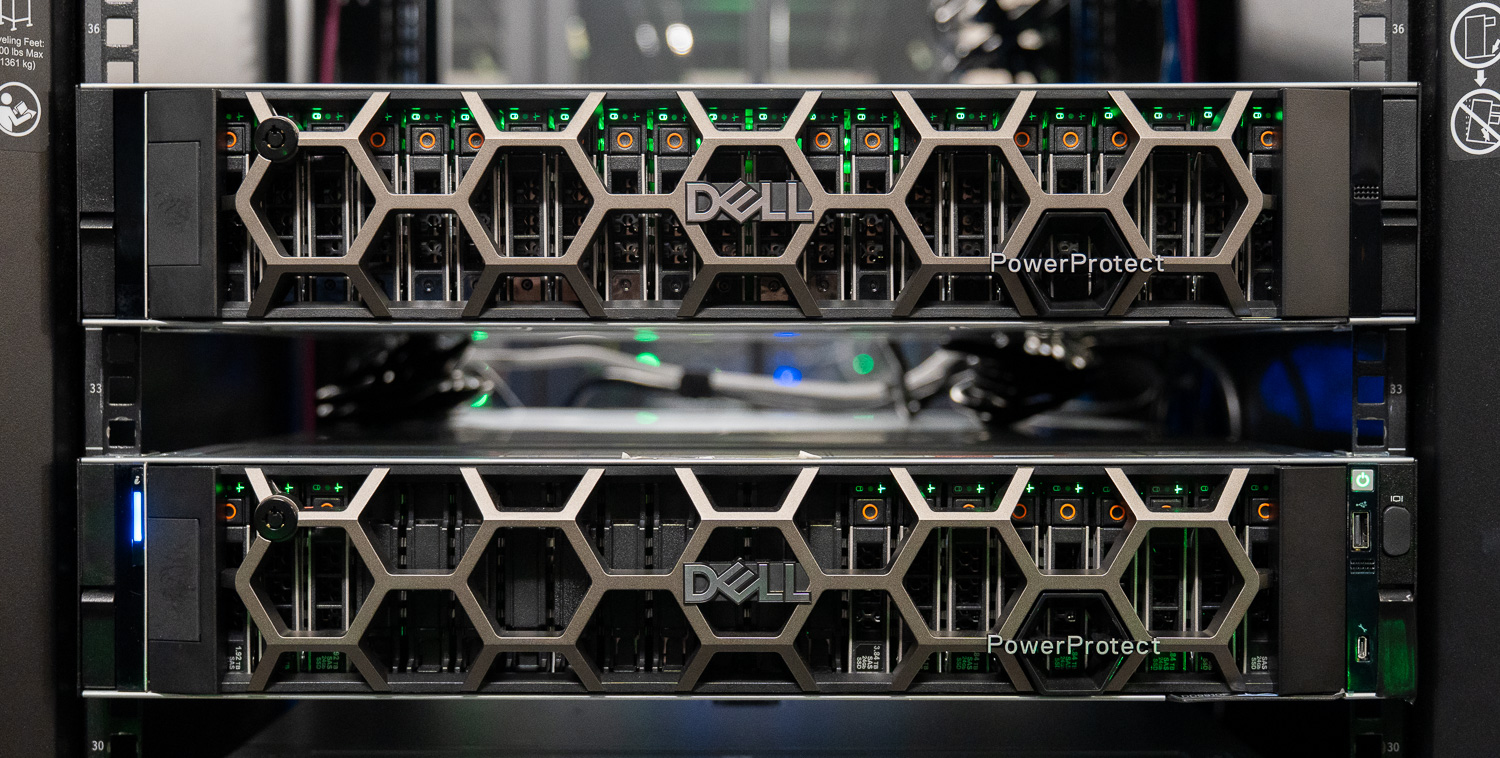
We covered the Dell PowerProtect Data Domain DD9410 and DD9910, both utilizing the Intel Xeon Scalable processor, in depth when those systems launched, examining the Data-Less Head architecture, the DDOS software stack, the Hardware Root of Trust and Secure Boot chain, and the performance improvements over the prior Data Domain DD9400/DD9900 generation. The Dell PowerProtect Data Domain DD9910F All-Flash appliance builds on that same foundation without redesigning it. The software architecture, deduplication engine, Data Domain Boost (DD Boost) ecosystem, and security capabilities remain consistent across the family. What changes is the storage medium: the All-Flash appliance replaces spinning disk with flash across the entire appliance, targeting the workflows where that transition has the most direct operational impact.
The case for flash in a platform for cyber resilience differs from that in primary storage. Where flash changes the equation is in restore and replication throughput, and the speed of analytics-driven integrity validation in isolated cyber-recovery vaults. Those are the areas where enterprise recovery SLAs are tightening most aggressively, and they are the focus of this analysis.
We examine the All-Flash appliance, starting with the hardware build, including how Intel’s QAT enables hardware-accelerated compression, then turning to how flash concretely changes restore, replication, and cyber recovery workflows, how the appliance’s data reduction reduces storage footprint and TCO, and where the appliance sits within Dell’s current PowerProtect cyber resilience portfolio.
Inside the Data Domain DD9910F All-Flash Appliance
The PowerProtect Data Domain All-Flash appliance follows the architectural model introduced with the current PowerProtect Data Domain generation, pairing a 2U controller with external storage shelves. Dell refers to this design as a Data-Less Head architecture, in which the controller handles compute, metadata services, and system orchestration while backup data resides on externally attached storage. Separating the compute layer from the storage capacity layer allows the system to scale while maintaining consistent performance characteristics across the Data Domain portfolio.
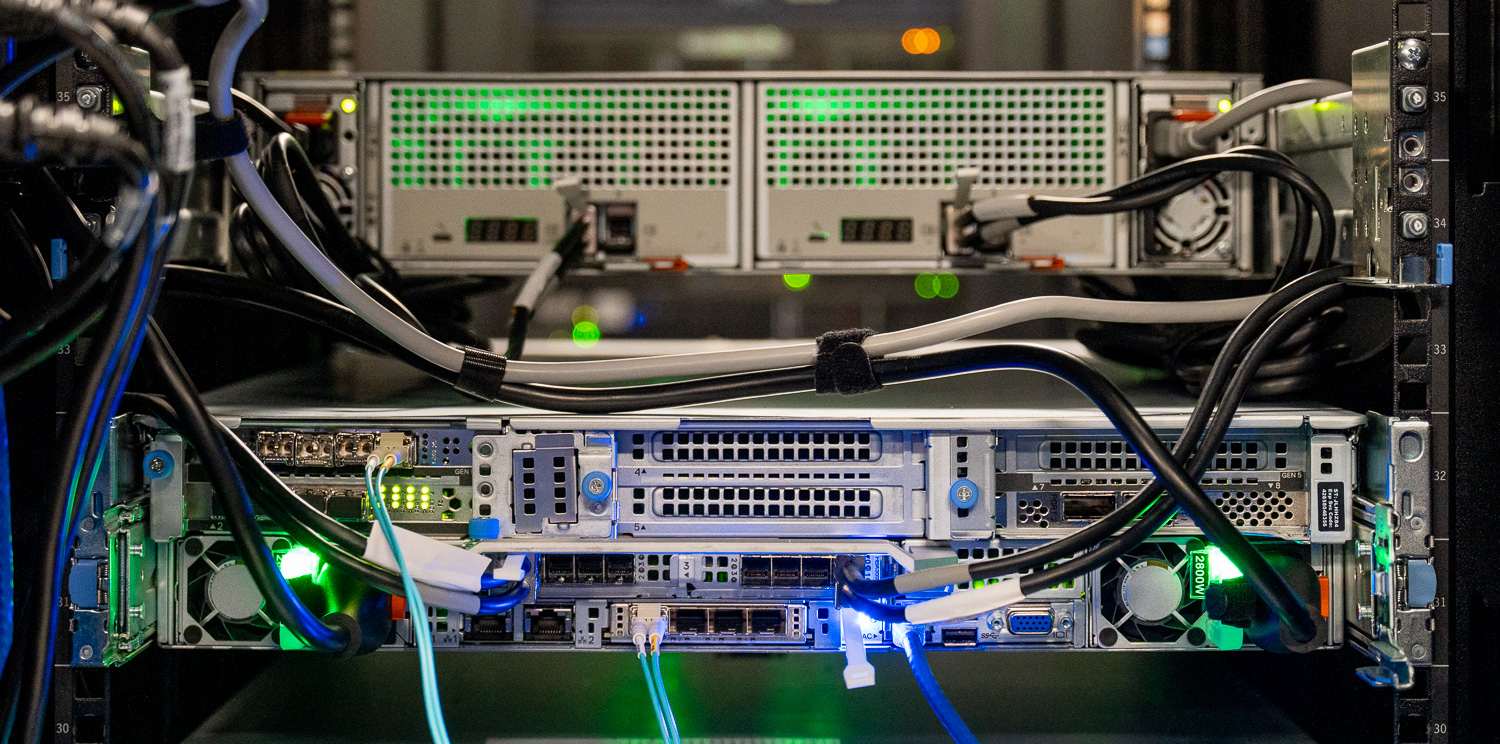
The controller occupies a 2U chassis powered by dual 5th Gen Intel Xeon Scalable processors, which drive the Data Domain file system and inline deduplication engine. Large DDR5 memory pools support the platform’s metadata and data reduction workloads. Intel Quick Assist Technology (QAT) is integrated directly into the 5th Gen Xeon silicon, enabling hardware-accelerated compression within DDOS without consuming a PCIe slot or requiring a dedicated add-on card. By offloading compression to Intel QAT’s on-die accelerators, the Intel Xeon processor platform keeps cores available for deduplication metadata processing and data path operations that directly affect restore throughput and replication speed. It can incur increasingly high compute costs as throughput scales. PCIe Gen5 connectivity in the rear expansion slots provides the bandwidth headroom needed to support high-density networking configurations at the top end of the portfolio.
From the rear of the chassis, the system exposes the networking and expansion capabilities required for large enterprise backup environments. Multiple PCIe slots support high-bandwidth networking adapters, including configurations supporting 10GbE, 25GbE, and 100GbE connectivity. These options allow the appliance to scale network throughput depending on deployment requirements, while dedicated connectivity links the controller to the external storage shelves. Power is delivered through dual redundant power supplies configured to maintain operation if a single PSU fails.
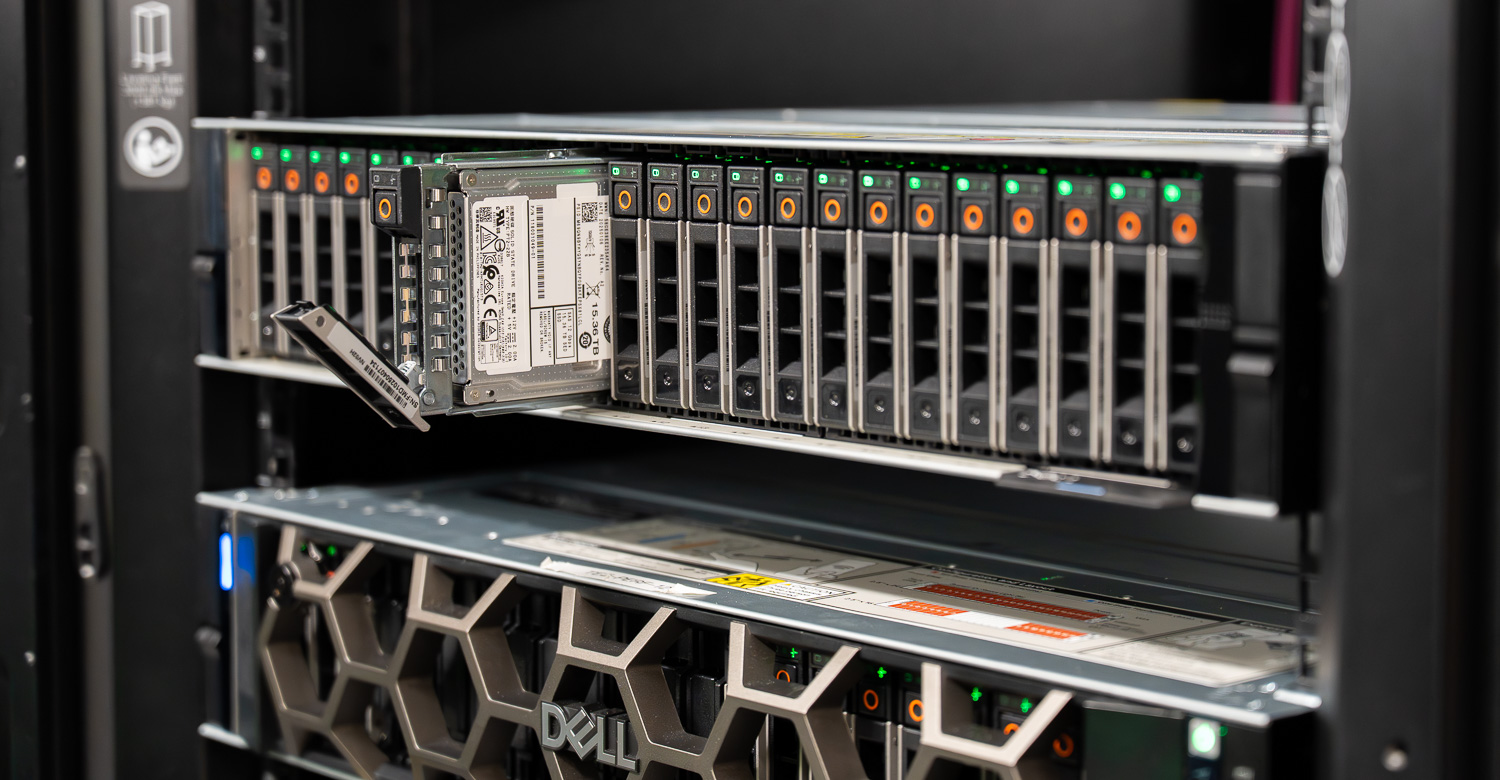
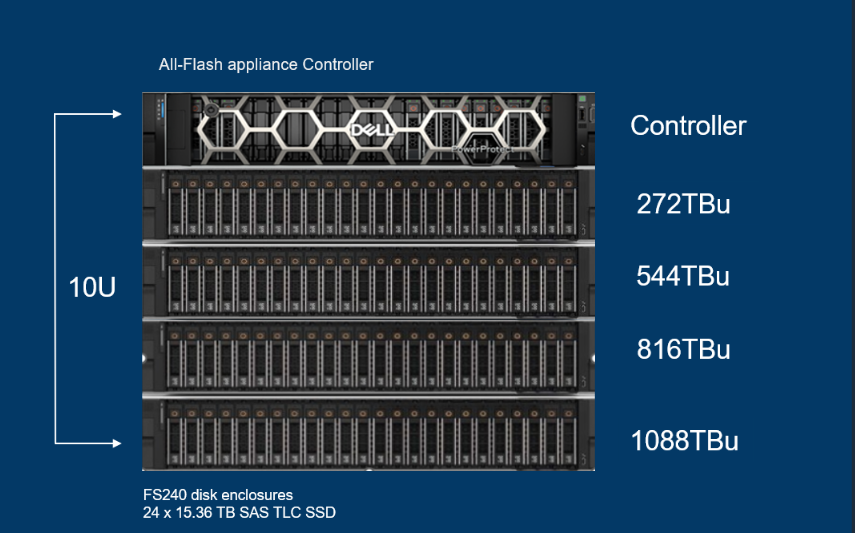
Backup capacity for the All-Flash appliance is provided by the FS240 flash enclosure, a 2U storage shelf populated with enterprise SSDs. Each shelf provides high flash capacity in a form factor that is consistent with the controller chassis. The platform supports up to four FS240 shelves, allowing the system to scale from 272TB to 1.1PB of usable capacity depending on configuration. Each enclosure includes redundant power and cooling components consistent with enterprise availability expectations.
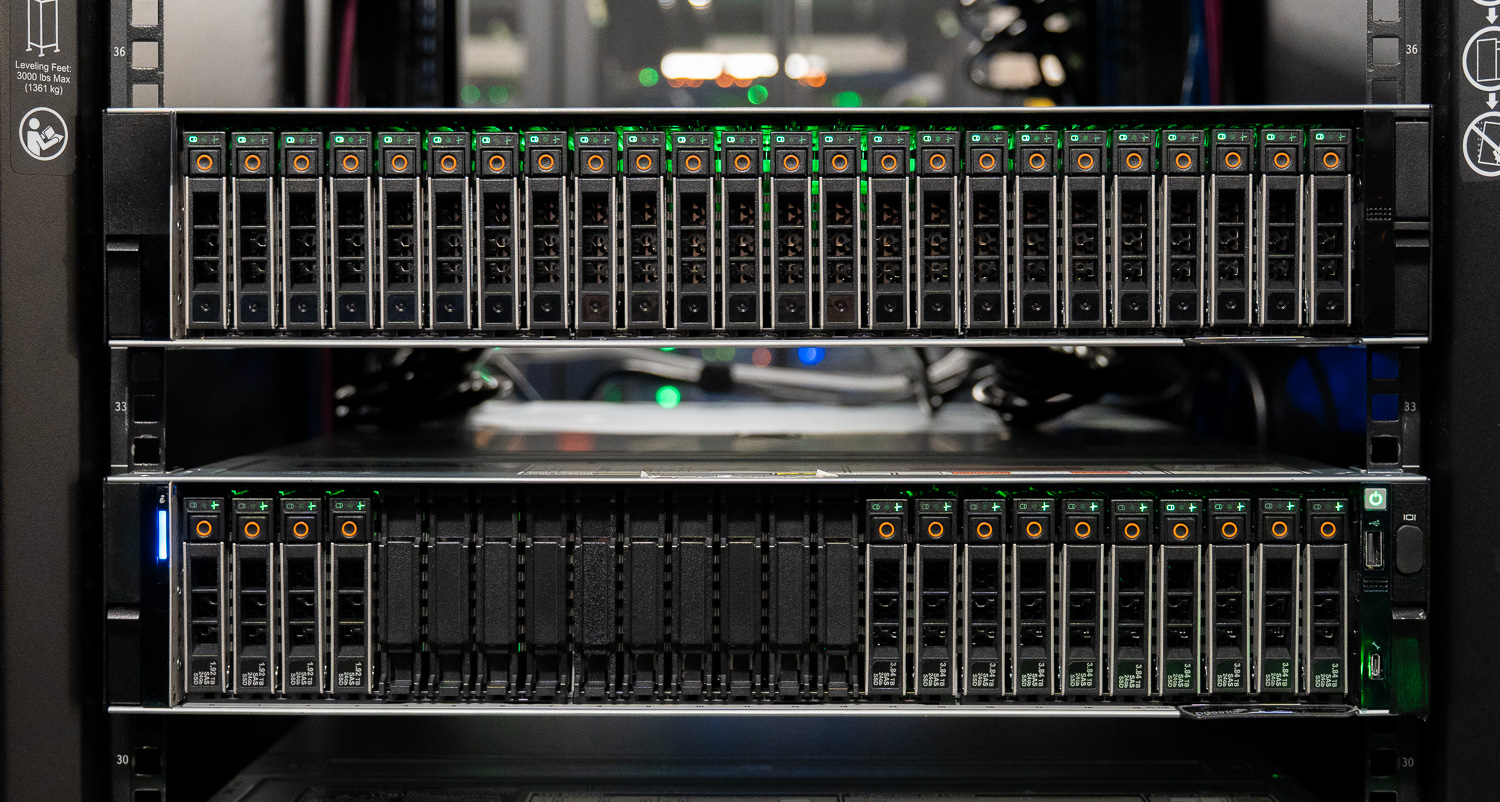
At a 544TB configuration, the platform consists of the 2U controller and two 2U flash shelves, for a total footprint of 6U. An equivalent HDD-based Data Domain DD9910 deployment occupies roughly 10U of rack space. This difference helps explain Dell’s claims around improved rack efficiency and reduced power consumption with the all-flash design.
Flash Changes the Recovery Equation
Restore operations, replication throughput, and analytics-driven integrity validation in cyber recovery vaults all rely heavily on read performance and rapid access to deduplication metadata. These are the use cases where performance matters most in practice. The proprietary architecture of the All-Flash appliance for the file system, along with performance tuning, optimizes drive performance.
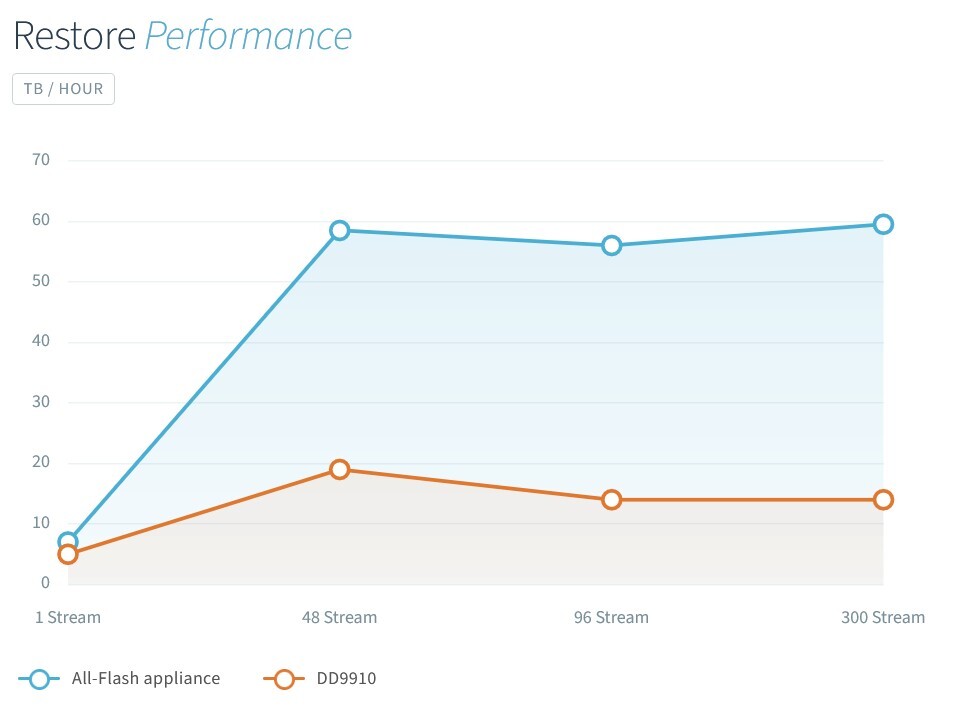
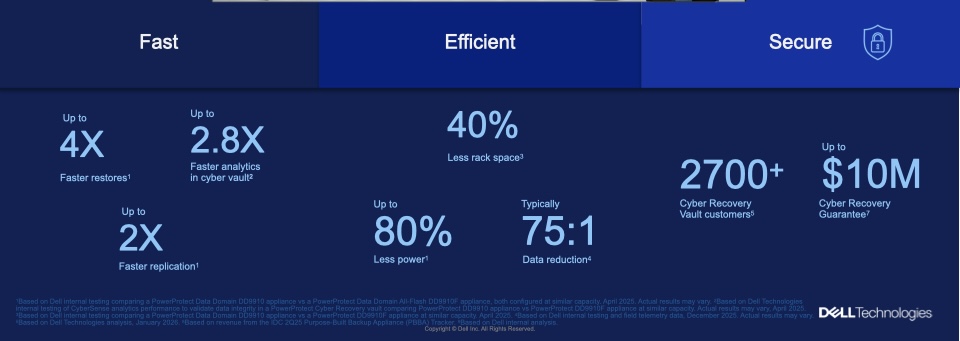
Dell cites up to 4x faster restore performance for the All-Flash appliance compared with the disk-based DD9910 when configured at equivalent capacity. This performance advantage is a system-level outcome, driven by both the flash storage tier and Intel Xeon scalable processor technology, which manages the metadata-intensive workload required by recovery operations.
Since both arrays share the same controller hardware, all gains are directly attainable in the all-flash configuration of the All-Flash appliance. In testing presented during the platform briefing, the restore workload consisted of multiple data streams and successive backup generations with realistic change rates applied between cycles.
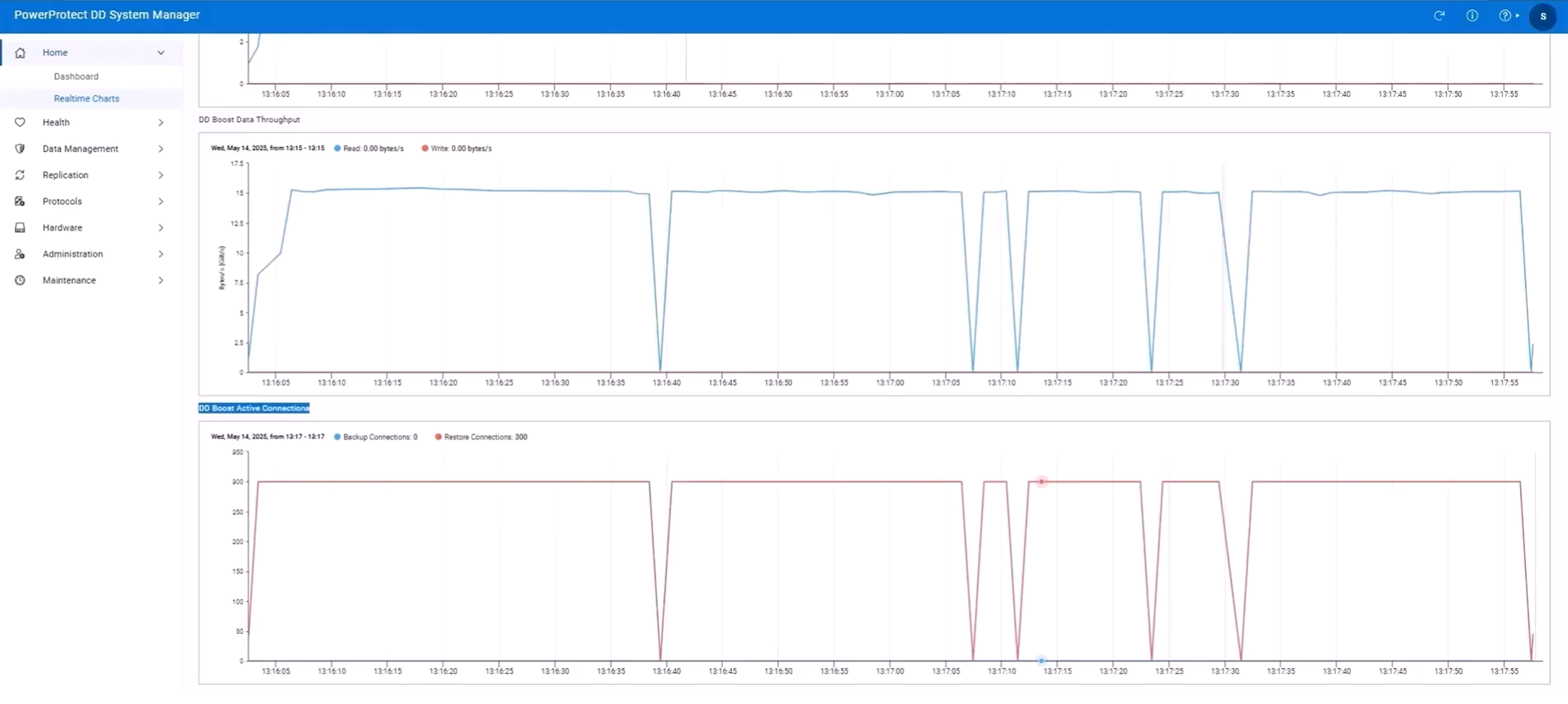
In the test scenario shared by Dell and Intel, restore throughput climbs rapidly, then stabilizes at roughly 60 TB per hour and remains at that level throughout the restore operation. The HDD-based DD9910 exhibits a more gradual performance ramp and lower sustained throughput under equivalent workloads. The difference reflects how flash handles read-intensive operations compared with a spinning disk, particularly when a restore workload requires rapid access to many deduplicated data segments across the storage pool. Data Domain systems store unique data segments once and reference them through metadata pointers for subsequent backups. During a restore, the system must locate and reassemble those segments to reconstruct the requested dataset. Because this process involves numerous read operations and metadata lookups, lower-latency flash storage can significantly accelerate the reconstruction of large backup images.
Replication throughput also benefits from faster reads on the flash storage tier. Dell reports up to 2x faster replication for the All-Flash appliance compared with the DD9910 at similar capacity levels. Replication in Data Domain environments typically involves reading data from the source appliance and transferring it to a secondary system, often located at a disaster recovery site or within a cyber recovery vault.
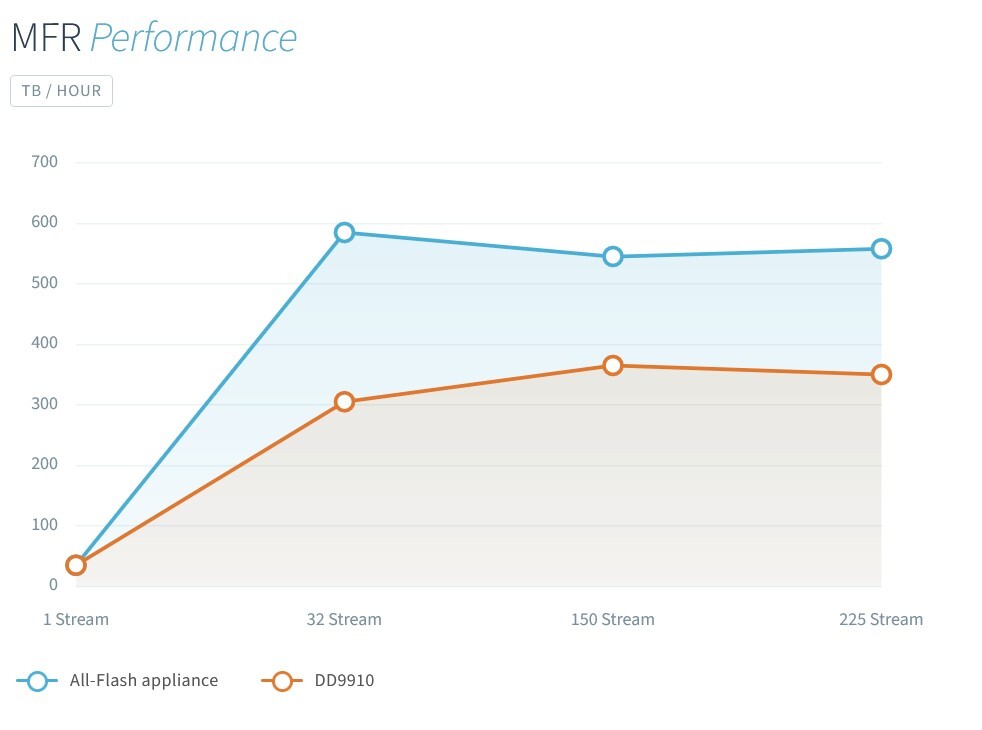
Reducing replication time carries operational implications beyond raw throughput. In cyber recovery architectures, backup data is replicated into an isolated vault environment designed to protect against ransomware. The vault is exposed to production systems only during tightly controlled replication windows. Shorter replication windows reduce the period during which the vault must be accessible to the production environment, narrowing the potential exposure window.
Dell also reports improvements in analytics-driven validation workloads performed within cyber recovery vaults. Using CyberSense analytics in internal testing, the company cites up to 2.8x faster analytics performance on the All-Flash appliance compared with the disk-based DD9910.
CyberSense analytics workflows scan backup data to verify integrity and detect potential signs of corruption or ransomware activity before recovery operations begin. Because the validation process involves scanning large volumes of backup data, the improved read performance of flash media reduces the time required to confirm that a recovery point is clean before initiating a restore.
Power, Space, and the Operational Case for Flash
Performance improvements are the most visible benefit of replacing disks with flash in a cyber resilience platform. Still, the efficiency gains carry independent weight for enterprise buyers managing infrastructure at scale. The Dell internal testing comparing the Intel-powered DD9910F against the disk-based, Intel-powered DD9910 at equivalent capacity indicates up to 80% lower power consumption and a 40% reduction in rack space. In isolation, those figures read as spec sheet claims. Across a multi-site data protection deployment, they translate into a different kind of conversation.
A large enterprise running Data Domain appliances at a primary site, a disaster recovery site, and an isolated cyber recovery vault operates three distinct infrastructure footprints. Power and cooling costs at each of those locations are real line items, and rack density affects what fits in a given facility without additional build-out. The shift from roughly 10U to 6U per fully configured system, combined with significantly lower power draw, changes the infrastructure math for organizations that are either constrained on data center capacity or actively managing energy costs as part of their total cost of ownership calculations.
The cyber recovery vault use case is worth calling out specifically. Vault infrastructure is, by design, isolated and purpose-built, often deployed in a dedicated cage or colocation environment, where power and space are billed directly. Reducing the physical and power footprint of vault infrastructure without sacrificing recovery performance is a meaningful operational benefit in that context, and one that compounds as retention requirements grow and vault capacity scales over time.
Data Reduction and Effective Capacity
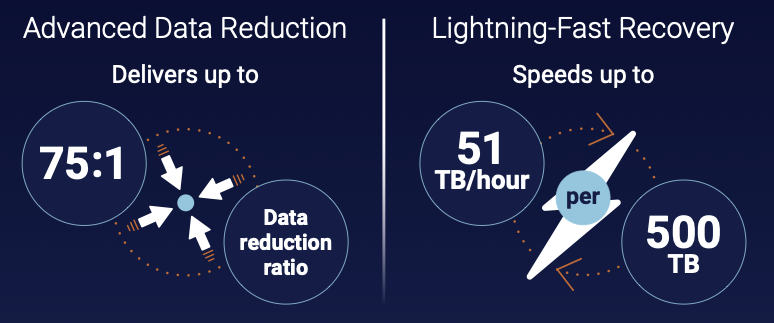
While the introduction of flash changes the performance profile of the All-Flash appliance, the underlying efficiency model remains rooted in the Data Domain deduplication engine. Dell now cites data reduction ratios of up to 75:1 for the current Intel Xeon-based PowerProtect Data Domain generation, extending the platform’s long-standing focus on capacity efficiency.
This figure is not purely theoretical. In testing conducted by Prowess Consulting using a representative VMware backup workload, the Data Domain All-Flash appliance achieved approximately 75:1 data reduction, while competing systems required up to 3.8× more physical capacity to protect the same dataset. Over time, as additional backup copies accumulated and redundancy increased, the effective reduction ratio continued to improve, reaching 78:1 after seven days and exceeding 100:1 after two weeks in that test environment.
The behavior reflects how deduplication operates in backup environments. Initial backup copies contain a higher proportion of unique data, while subsequent backups introduce incremental changes that can be efficiently deduplicated against existing data sets. As a result, effective data reduction improves over time as retention periods extend.
From a practical standpoint, this reduction capability is central to how the All-Flash appliance balances flash economics with large-scale backup requirements. While the All-Flash appliance’s raw usable capacity ranges from 272TB to 1.1PB, the disk-based Data Domain DD9910 scales to higher raw capacity levels, up to 2.1PB. Effective capacity in both cases can be significantly higher depending on data characteristics, change rates, and retention policies. Dell positions this efficiency as a key factor in reducing overall infrastructure footprint, power consumption, and long-term storage costs.
Management and the Data Domain System Manager Interface
Management of the All-Flash appliance is handled through the Data Domain System Manager, the same web-based interface used across the Data Domain family. DDOS 8.7 runs identically across the portfolio, so the management experience carries over without retraining, and the All-Flash appliance drops into existing workflows without introducing a new operational model.
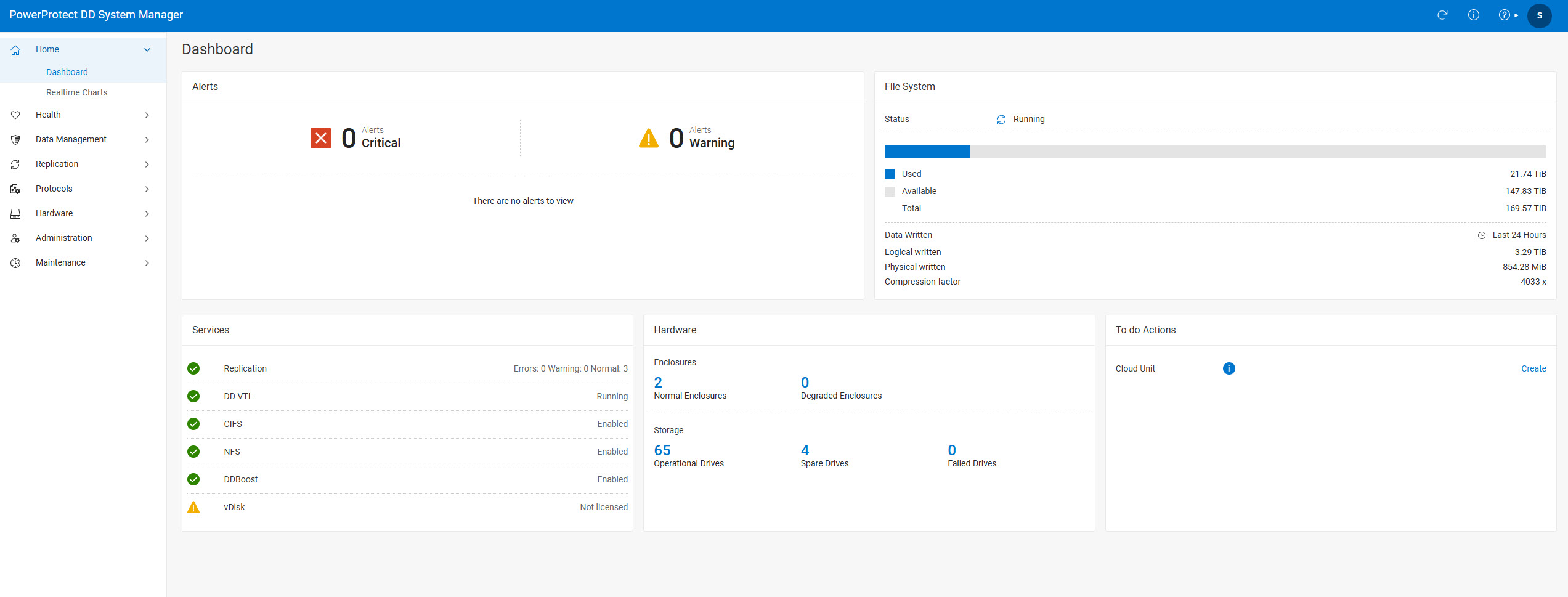
The dashboard surfaces what administrators reach for most often without requiring navigation: filesystem capacity, used and available space, compression factor, last write time, active alerts, and licensed services status.
Real-time performance charts are one click away, covering CPU utilization, DD Boost throughput, active connections, filesystem operations, and network activity. In active environments receiving backup and replication traffic simultaneously, those charts give administrators an immediate read on whether the platform is performing within expected parameters.
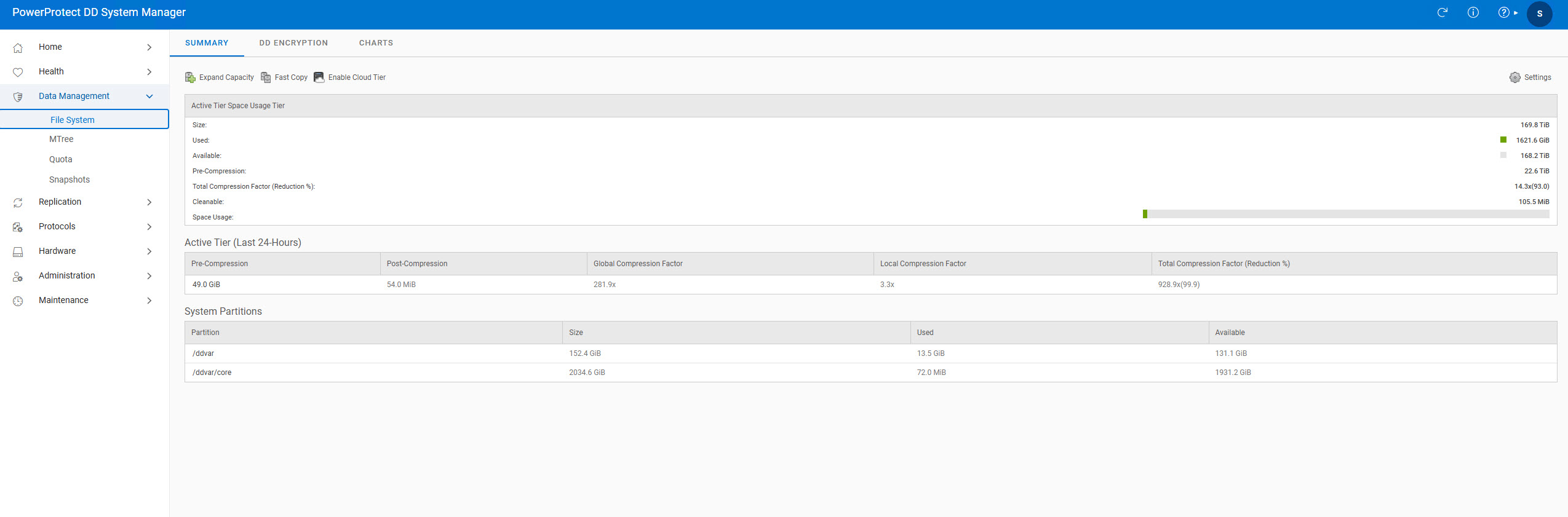
The Data Management section organizes the operational details below the dashboard. The filesystem view covers capacity, usage, and compression at the system level, while M-trees provide a granular layer. Every backup policy from each connected application creates a unique M tree, logically separating workloads within the system. Per-M tree views show space utilization, daily write patterns, and pre- and post-compression breakdowns over configurable time windows, which matter when diagnosing whether a specific workload is compressing as expected or consuming capacity faster than anticipated.
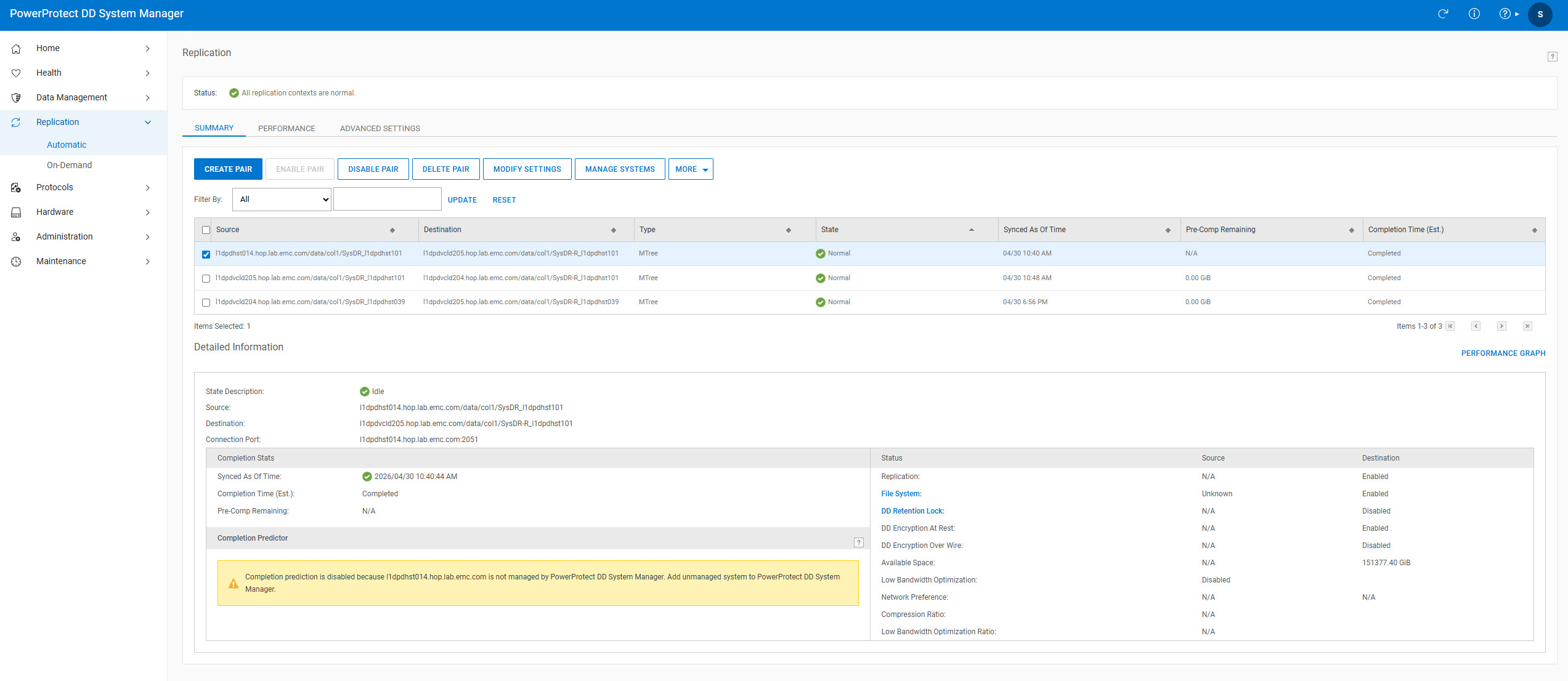
Replication, protocols, hardware, and administration each have dedicated sections in a layout consistent with prior Data Domain generations. The Replication section consolidates pair status, sync state, and job health across connected systems, with both scheduled and on-demand replication managed from the same screen. Protocol configuration covers DD Boost, CIFS, NFS, and VTL in a single section, with DD Boost serving as the primary path for enterprise backup applications and exposing active connections, client lists, plugin versions, and authentication settings in a single view.
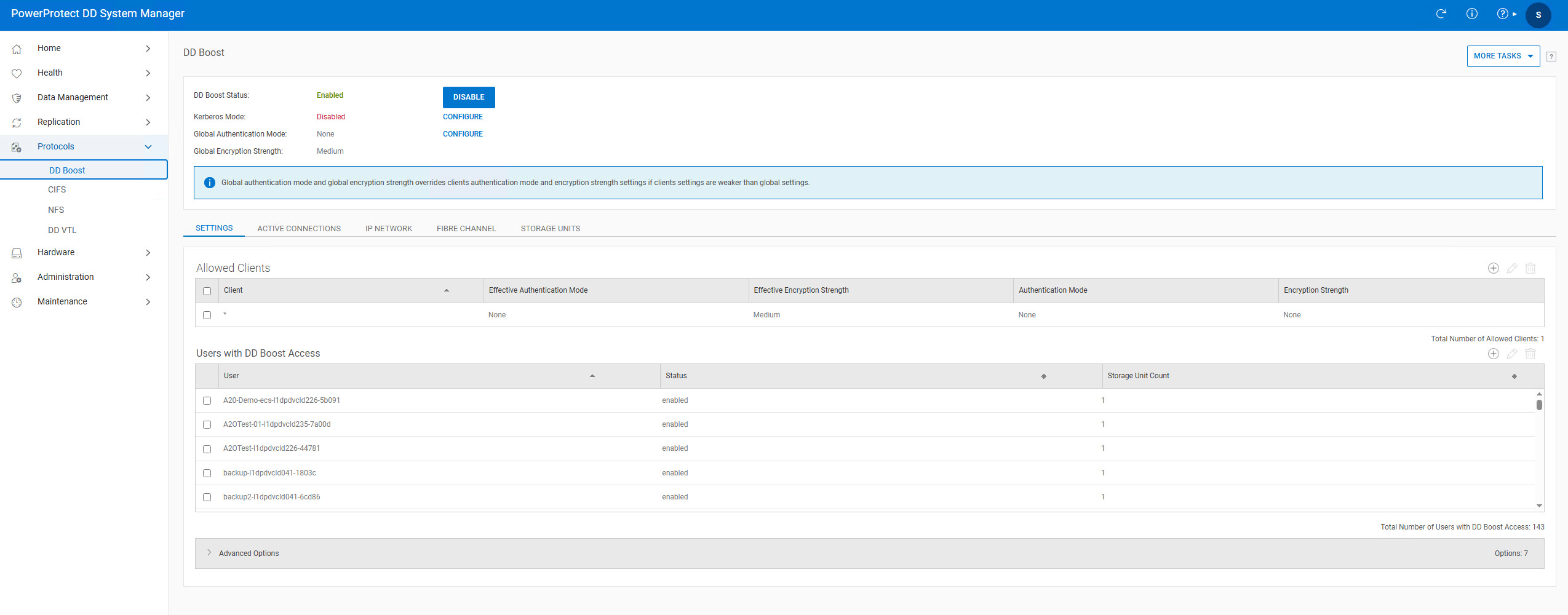
The interface reflects a platform designed for use by people who are not exclusively backup specialists. The backup administrator role has contracted meaningfully over the past decade as infrastructure teams consolidate and generalists take on broader responsibilities. The DD System Manager has been refined to remain accessible in that environment, with logical structure, clear real-time reporting, and short paths from alert to diagnosis.
Where the Data Domain All-Flash Appliance Fits in the PowerProtect Portfolio
The current Data Domain lineup spans five hardware models. The Data Domain DD3410 serves small and medium businesses and the Data Domain DD6410 serves medium businesses. At the same time, the Data Domain DD9410 and DD9910 address larger environments, where capacity and throughput requirements scale accordingly. The All-Flash appliance and the All-Flash Ready Node bring flash into the portfolio at different points and for different deployment scenarios.
The All-Flash appliance targets large enterprise environments where recovery SLAs are aggressive, and the operational cost of slow restores or extended replication windows is measurable. It sits alongside the disk-based Data Domain DD9910 rather than replacing it, with the two systems sharing the same software stack and integration ecosystem while differing primarily in storage medium and the performance and efficiency characteristics that follow from that choice. Organizations with large retention requirements and cost-sensitive capacity economics will likely continue to find the Data Domain DD9910 a better fit. Those prioritizing restore speed, vault analytics performance, and power and space efficiency at the high end of the portfolio have a direct path to the All-Flash appliance.
The All-Flash Ready Node is a separate product category for organizations building software-defined or hyperconverged environments, in which Data Domain capabilities are delivered through a customer-supplied server platform rather than a purpose-built appliance. It is not a like-for-like alternative to the DD9910F.
For most large enterprise evaluations, the practical decision point is between the Data Domain DD9910, which uses Intel Xeon Scalable processors, and the All-Flash appliance at an equivalent capacity. The all-flash model carries a higher acquisition cost. Still, Dell positions the reductions in power, cooling, and rack space as meaningful offsets when evaluated against the total cost of ownership over a multi-year deployment.
Conclusion
The Intel-powered Dell PowerProtect Data Domain All-Flash appliance makes a clear case for where flash belongs in data protection. Backup ingestion is largely sequential and throughput-bound, and flash does not fundamentally change that equation. Recovery is where flash matters, and the All-Flash appliance applies it precisely there: up to 4x faster restores, up to 2x faster replication, and up to 2.8x faster CyberSense analytics versus the disk-based DD9910 at equivalent capacity. Each of those translates into a concrete operational outcome, shorter recovery windows, narrower cyber vault exposure periods, and faster integrity validation before data returns to production.
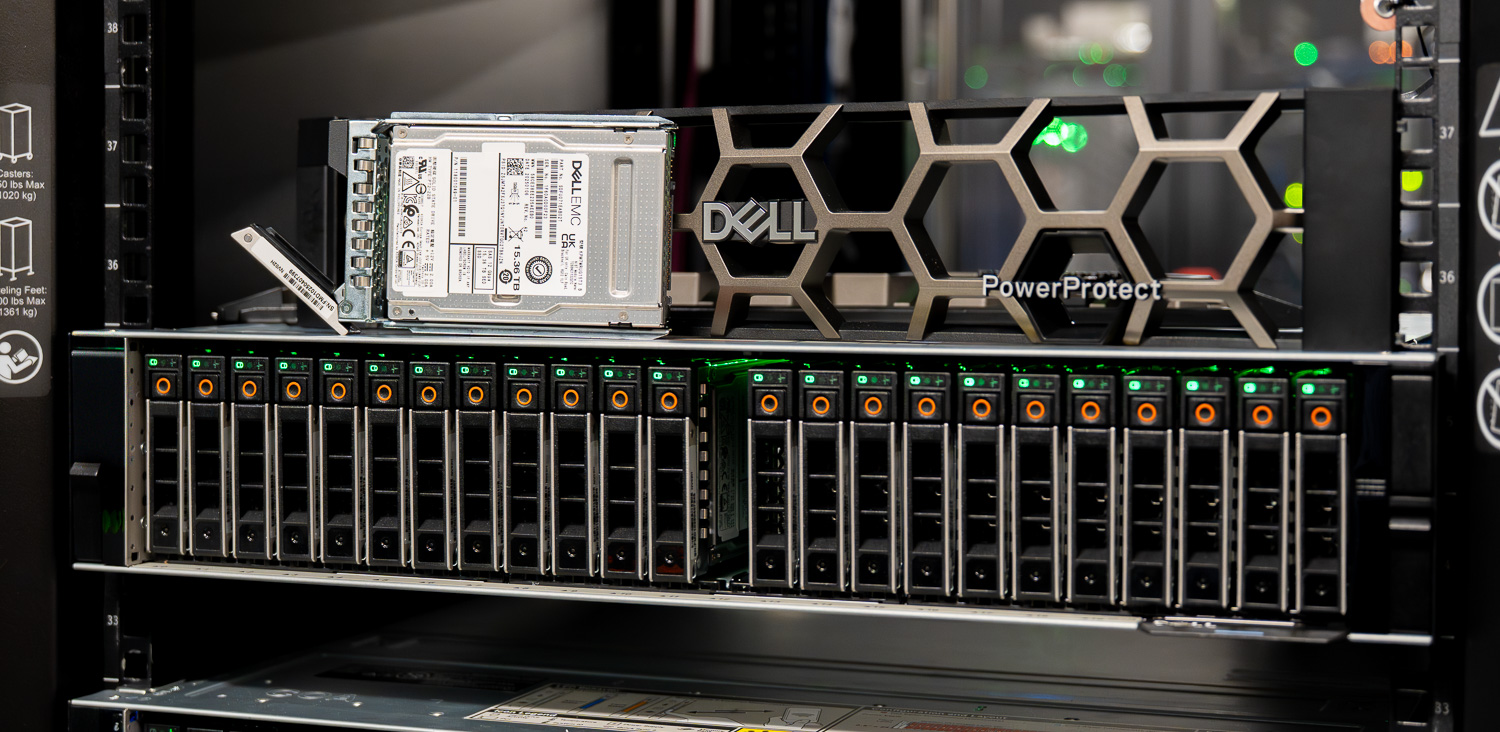
The efficiency story is the second half of the argument. A 6U all-flash footprint replacing roughly 10U of disk-based infrastructure, combined with up to 80% lower power consumption, changes the math for organizations running data protection across primary, DR, and cyber vault sites. In vault deployments specifically, where power and rack space are billed directly, and isolation requirements make every rack unit count, those reductions compound into deep operational savings over a multi-year deployment. The data reduction engine reinforces the economics from the other direction, with effective ratios reaching 75:1 and continuing to improve as retention increases.
What makes the All-Flash appliance work well is that none of this comes at the cost of operational continuity. The architecture has defined Data Domain for years. The DDOS software stack, the DD Boost ecosystem, the security model, and the System Manager interface all carry over unchanged. For the more than 15,000 organizations already running Data Domain, the All-Flash appliance is an easy decision for mission-critical workloads.
For enterprise environments evaluating where flash fits in their data protection strategy, the All-Flash appliance answers that question directly. Dell did not redesign Data Domain to accommodate flash. It applied flash where the architecture benefits most, delivered measurable gains in the workflows where recovery SLAs are tightening fastest, and held the operational model steady.
Dell Technologies Cyber Resilience
This content was produced in partnership with Dell Technologies and Intel. All analyses and conclusions are based on StorageReview’s independent evaluation.
Intel® Xeon® is a trademark of Intel® Corporation or its subsidiaries



 Amazon