

Storage refreshes usually come in two flavors. There’s the quiet uplift, where a vendor rolls in a new CPU, claims a few percentage points of performance, and ships the same chassis with a different sticker. And then there’s the generational reset, where the chassis, drives, interconnect, cache architecture, and management plane all move at once. Dell PowerStore Gen 3, branded at launch as PowerStore Elite, is the second kind, and it’s not even close. Every major subsystem in the platform has changed, and most of them have done so in ways that materially redefine what a unified array is supposed to look like in 2026.
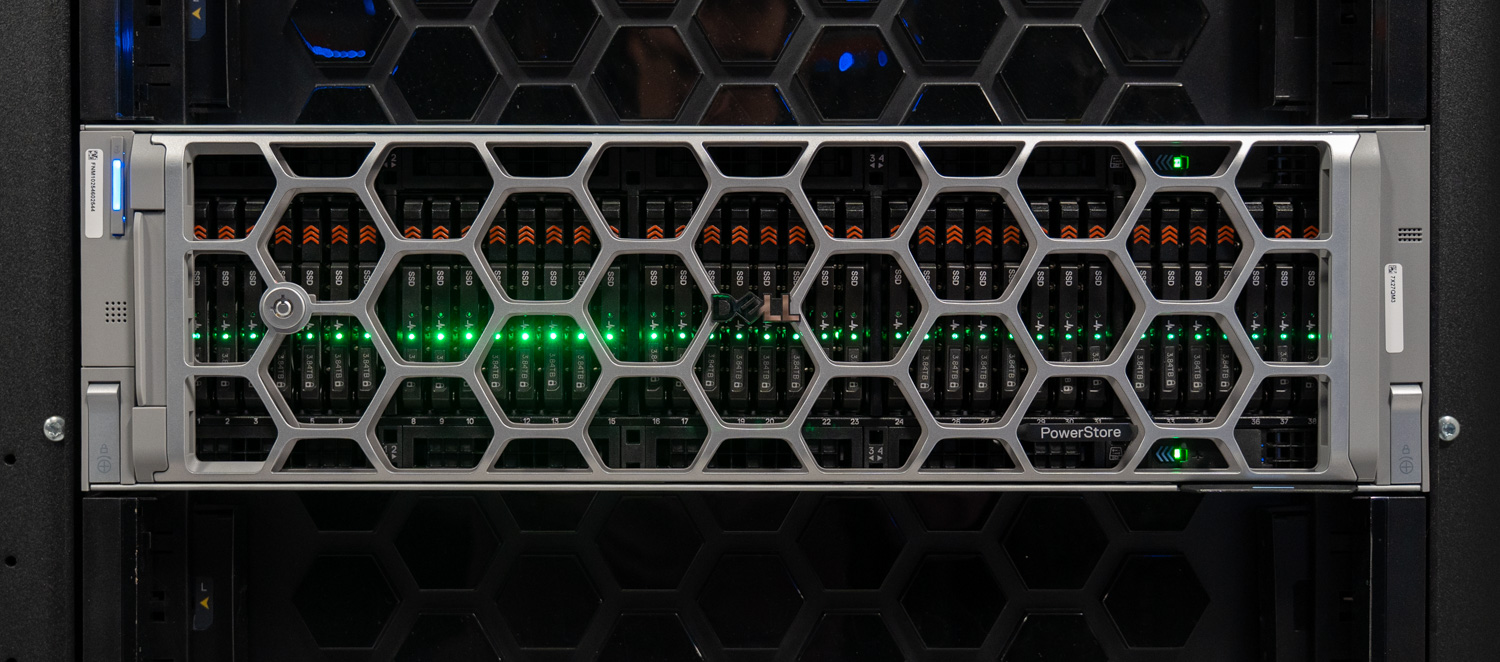
Dell PowerStore Gen3 Fully Populated w/ Bezel
We’ve been watching PowerStore since the beginning. In our view, this is the most consequential release since the original launch in 2020, and arguably the most aggressive storage platform reset any major vendor has shipped in years. Dell didn’t simply iterate on Gen 2. They rebuilt the platform from the chassis up, made bets on form factors and architectural choices that most of the industry hasn’t yet committed to, and engineered the result for a ten-year service life with multiple in-place controller upgrades. To explore these new models, Dell invited us out to Hopkinton, MA.
Storage density is a key selling point of the new Dell PowerStore, and Dell doesn’t disappoint on that front. The platform supports up to 40 E3.S NVMe drives in a 3U chassis, with planned support for E3.L drives, while keeping every bay user-addressable for data instead of reserving slots for cache SSDs. Dell has also significantly modernized the underlying hardware platform, moving to next-gen Intel processors, alongside DDR5 memory, end-to-end PCIe Gen5 connectivity, and OCP 3.0 modules that replace the older Dell-specific SLIC carrier design.
Connectivity between controllers scales up to 200GbE RDMA today, with a path to even faster speeds via a future I/O card upgrade. On the software side, PowerStoreOS 5.0 introduces new autonomous data path intelligence and log-structured metadata to optimize performance and endurance for high-capacity QLC flash, I/O-level telemetry to lay the groundwork for future inline ransomware detection, and dynamic resource sharing between block and file services. All PowerStore appliances are now unified out of the box, providing enhanced support for file- and block-scale-out and non-disruptive data mobility across clusters.
Dell has also added unaligned deduplication and enhanced compression offloads, a key factor behind the company’s decision to increase its data reduction guarantee from 5:1 in previous generations to 6:1 with the new platform.
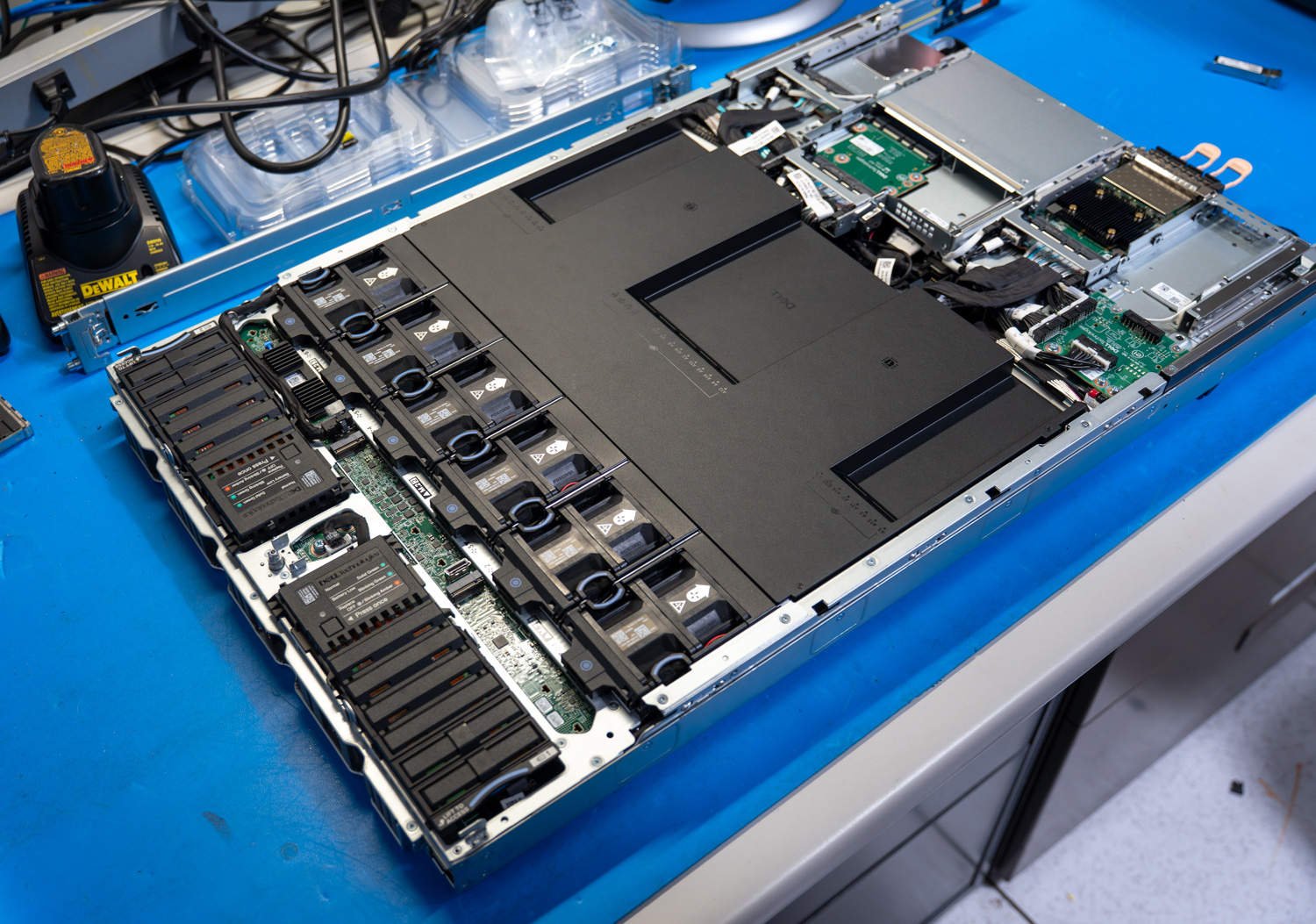
Dell PowerStore Gen3 Internal Controller View with Fan Shroud
The hardware changes and software updates don’t tell a complete story, though. The architectural decisions Dell made beneath them are material because they determine whether the platform will hold up over the next decade or look dated in a few years. The shift to E3.S/L drives, the larger chassis, the move to Software-Defined Persistent Memory, the cable-free midplane interconnect, and the decoupling of the inter-node fabric from CPU generation are all decisions that look forward rather than sideways. Taken together, they’re what make the Gen 3 chassis a credible foundation for the multi-generational upgrade story Dell is telling with Lifecycle Extension.
There are three new appliance models in the family. The PowerStore 1500 is the single-socket platform with 24 drive bays at launch and a 100 GbE RDMA inter-node fabric. The 5500 and 9500 are dual-socket on the same 3U chassis, with 40 drive bays and 200 GbE RDMA inter-node connectivity; the 9500 offers twice the memory and higher core counts than the 5500. A future controller-swap upgrade will enable the 1500 to scale to 40 drives and 200GbE RDMA. All three run the same PowerStoreOS 5.0 image, share the same OCP 3.0 I/O architecture, and support TLC or QLC media in the same model, with no performance penalty for switching to QLC. This eliminates the need to choose between separate model tiers for different use cases or performance requirements.
The Gen 2 platforms remain available, and existing PowerStore customers have a clear path forward with intelligent clustering. Gen 1, Gen 2, and Gen 3 appliances can coexist in a single cluster with non-disruptive workload mobility, which is the right answer for an install base that doesn’t want to shift platforms every few years.
Dell PowerStore Gen3 Specifications
All three Gen 3 models share a 3U dual-node chassis, the same OCP 3.0 I/O architecture, and a unified PowerStoreOS that supports scale-out block or file out of the box. They differ in CPU socket count, DRAM capacity, drive count, and inter-node bandwidth.
| Specification | PowerStore 1500 | PowerStore 5500 | PowerStore 9500 |
|---|---|---|---|
| Overview | |||
| Positioning | Mid | Mid / high-end | Flagship high-end |
| Chassis | 3U, dual-node | ||
| Compute & Memory | |||
| CPU platform | Intel single-socket | Intel dual-socket | Intel dual-socket |
| CPU per appliance | 2× 24-core @ 1.9 GHz | 4× 24-core @ 1.8 GHz | 4× 32-core @ 2.2 GHz |
| Memory per appliance | 512 GB (16 × 32 GB) | 1,024 GB (32 × 32 GB) | 2,048 GB (64 × 32 GB) |
| Storage | |||
| Drives per base appliance | Up to 24 EDSFF | Up to 40 EDSFF | Up to 40 EDSFF |
| Drives per expansion (post-RTS) | 44 EDSFF | ||
| Drive support | TLC: 3.84 / 7.68 / 15.36 TB · QLC: 30.72 TB | ||
| Min. drive config | TLC 6× 3.84 TB · QLC 7× 30.72 TB | TLC 6× 3.84 TB · QLC 11× 30.72 TB | TLC 6× 3.84 TB · QLC 11× 30.72 TB |
| Max raw capacity (base) | ~737 TB (24 × 30.72 TB) | ~1.2 PB (40 × 30.72 TB) | ~1.2 PB (40 × 30.72 TB) |
| I/O & Networking | |||
| OCP 3.0 line cards per node | 3 (+1 reserved) | 5 (+1 reserved) | 5 (+1 reserved) |
| Cross-node interconnect | 100 GbE RDMA | 200 GbE RDMA | 200 GbE RDMA |
Dell PowerStore Gen 2 vs. Gen 3
Every major hardware subsystem in Gen 3 series PowerStore appliances has advanced by at least one generation. The most consequential changes for capacity planning are the 3U chassis, the E3.S drive bays, and the jump from 2× 10 GbE to up to 200 GbE on the inter-node fabric.
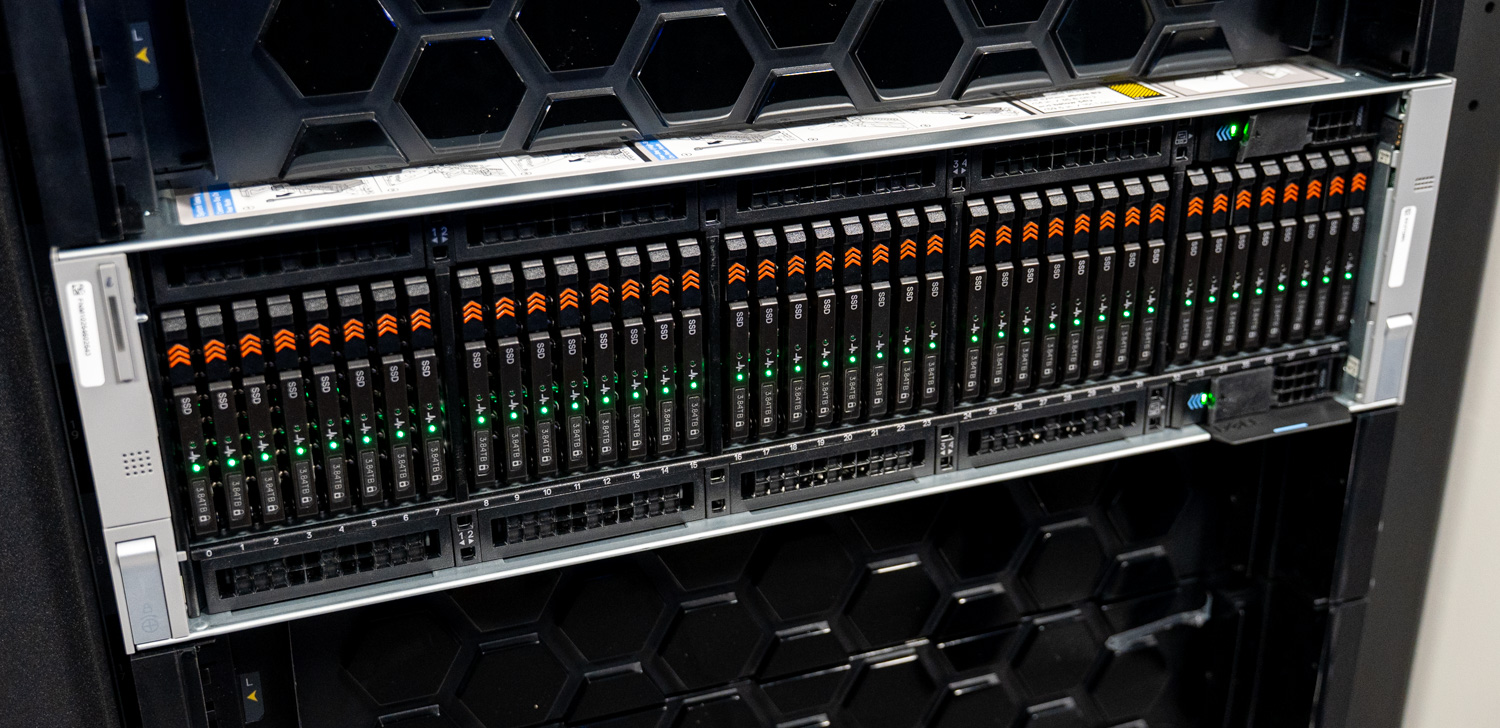
Dell PowerStore Gen3 Fully Populated Front View
The base 3U chassis has 40 drive slots on the 5500 and 9500. The 1500 ships with 24 populated bays, and an additional 16 bays unlocked via a future Data-In-Place upgrade. That works out to 13.3 drives per rack unit, up from 10.5 on Gen 2, or roughly 40% more drives per RU in the base appliance and 83% greater density on the post-RTS 44-drive expansion shelf. The drives themselves are standard E3.S 1T NVMe SSDs from multiple vendors, with no proprietary carrier, which reduces exposure to supply chain constraints or single-source dependencies. Capacities run 3.84 TB, 7.68 TB, and 15.36 TB in TLC, plus 30.72 TB in QLC, and the same set of options is supported across all three models (1500, 5500, and 9500) with no performance trade-off between media types.
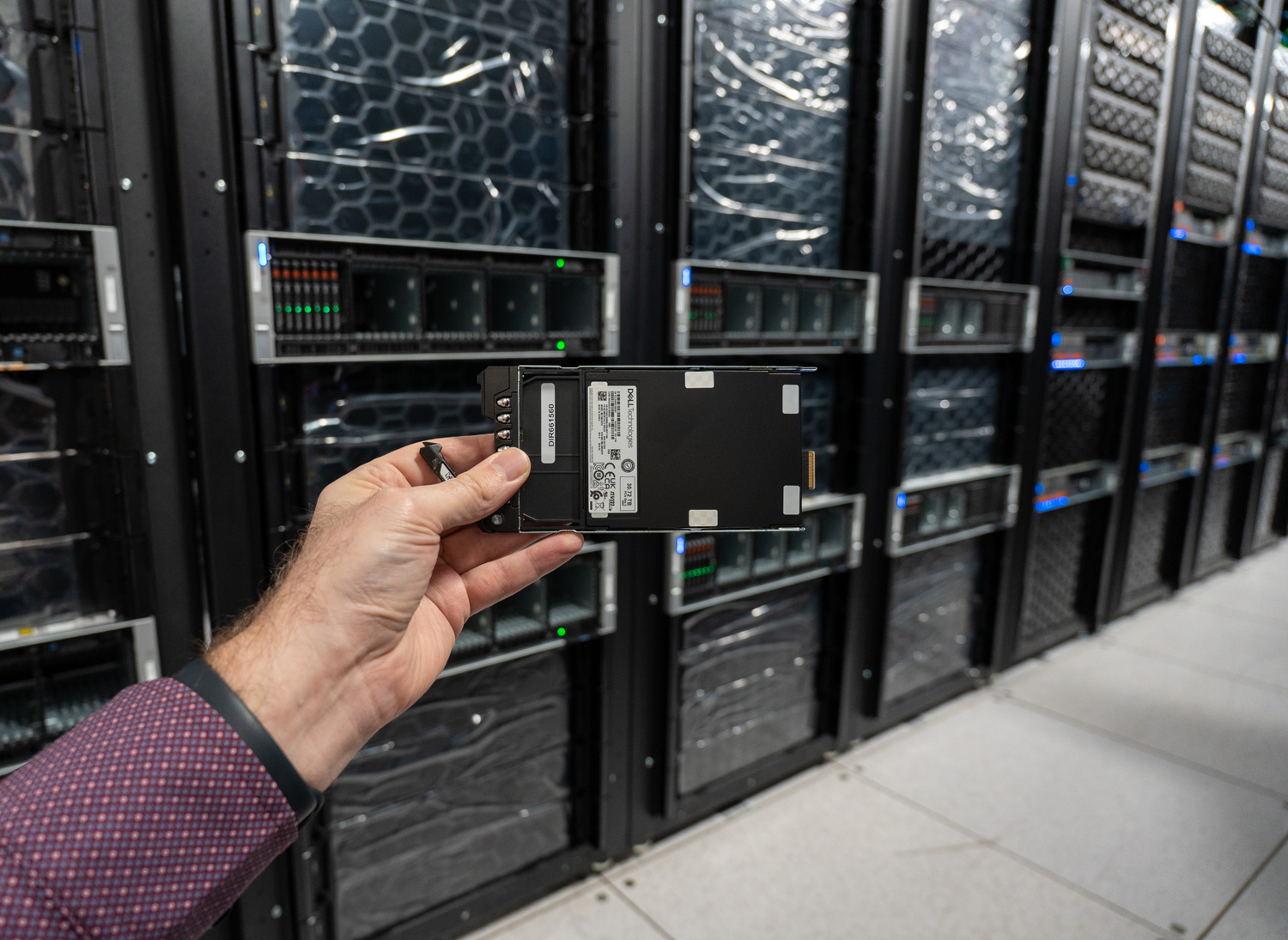
Dell PowerStore Gen3 30TB SSD
The choice between TLC and QLC comes down to $/GB and density rather than performance tier. Minimum drive configurations vary slightly by model: TLC starts at 6× 3.84 TB across the lineup, while QLC starts at 7× 30.72 TB on the 1500 and 11× 30.72 TB on the 5500 and 9500. All drives are SED or FIPS-validated, and the platform supports +1 and +2 Data Resiliency Engine (DRE) configurations. Thermals improve as well, with Dell citing roughly 50% lower cooling requirement than an equivalent 2.5″ deployment, helped by the EDSFF airflow geometry. All 40 bays are also user-addressable for data, since the cache is now handled via Software-Defined Persistent Memory rather than by NVRAM drives that consume front bays, as on Gen 2.
| PowerStore Gen 2 | PowerStore Elite (Gen 3) | |
|---|---|---|
| Chassis & Platform | ||
| Base chassis | 2U, 2-node | 3U, 2-node |
| I/O Bus | PCIe Gen 3 | PCIe Gen 5 |
| Memory | DDR4 | DDR5 |
| Storage | ||
| Drive form factor | Up to 25× 2.5″ U.2 NVMe (dual-ported) | Up to 40× E3.S/L 1T NVMe (dual-ported) |
| Expansion shelf | Up to 24× 2.5″ U.2 NVMe | Up to 44× E3.S/L NVMe (post-RTS) |
| Cache strategy | U.2 NVRAM drives | Cache to local flash (SDPM) |
| I/O & Networking | ||
| I/O slots | 3× SLIC / OCP 2.0 (PCIe Gen 3 x16) | Up to 5× OCP 3.0 (PCIe Gen 4/5 x16) |
| Cross-node connect | 2× 10 GbE, RDMA | Up to 200 GbE, RDMA (400 GbE-ready) |
| Management & Power | ||
| Out-of-band mgmt (BMC) | EMC GEM | iDRAC (storage version) |
| Power | EMC BBUs / custom PSUs | PowerEdge BBU / PSUs |
Inside the PowerStore Gen 3 Hardware Platform
Looking at the front of the new 3U PowerStore Gen 3 unit compared to the previous Gen 2, the updated design carries the same look and feel as the 17th-generation PowerEdge servers we have previously reviewed. It ships in Dell’s newer grey colorway with the matching honeycomb bezel that has become a visual signature across the company’s current enterprise hardware lineup.
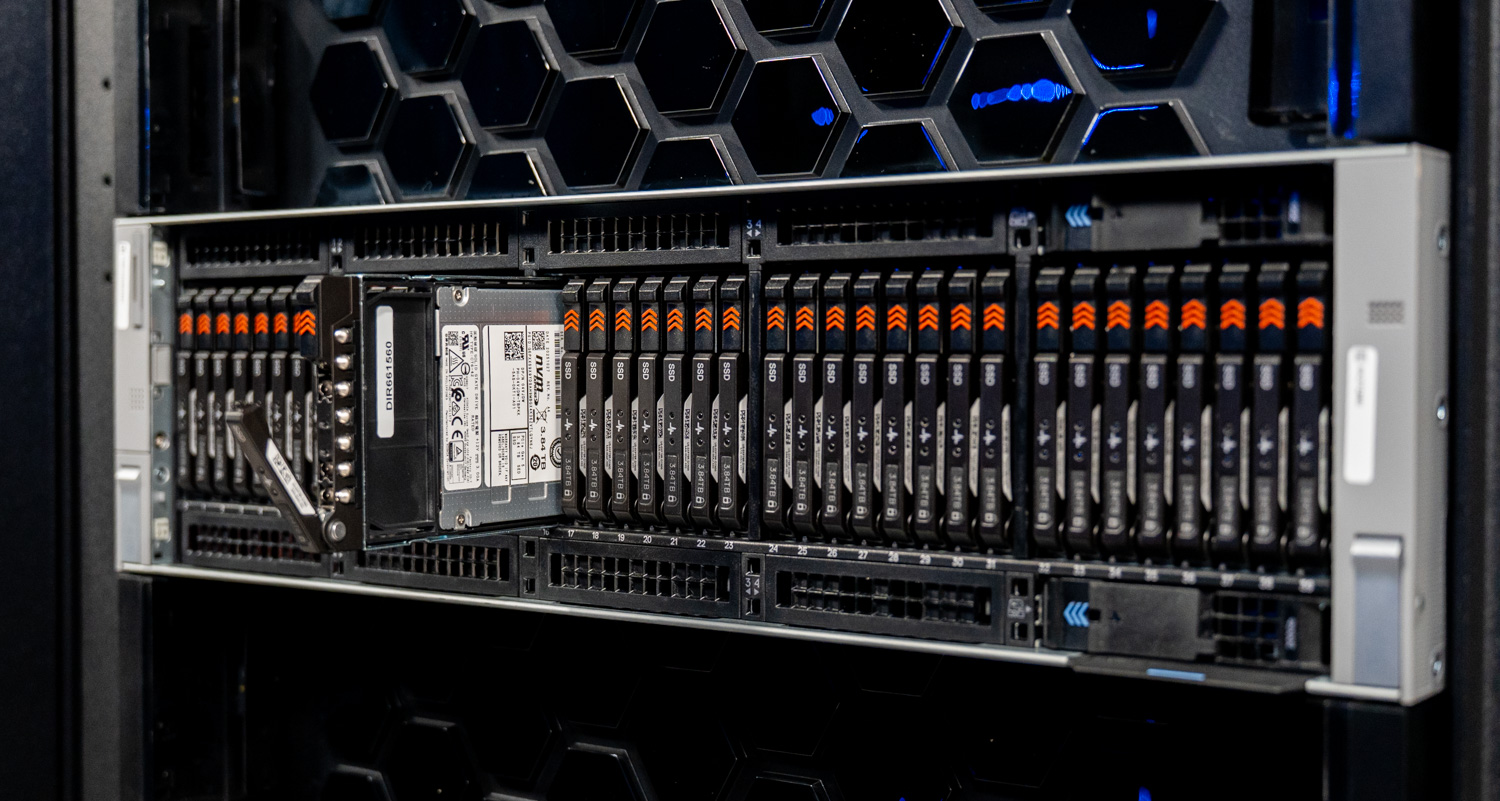
Dell PowerStore Gen3 With Drive Partially Ejected
Compute & Memory
On the compute side, Intel CPUs power the system, with per-CPU TDP ranging from 165W to 270W and up to 32 cores per CPU on the 9500. Dell quotes up to 50% more cores per node. Memory moves to DDR5 throughout, with the 9500 shipping with 2 TB per appliance (64 × 32 GB DIMMs), the 5500 with 1 TB, and the 1500 with 512 GB. Dell’s shift to DDR5 also significantly increases memory throughput, offering 2x higher bandwidth than previous DDR4 generations.
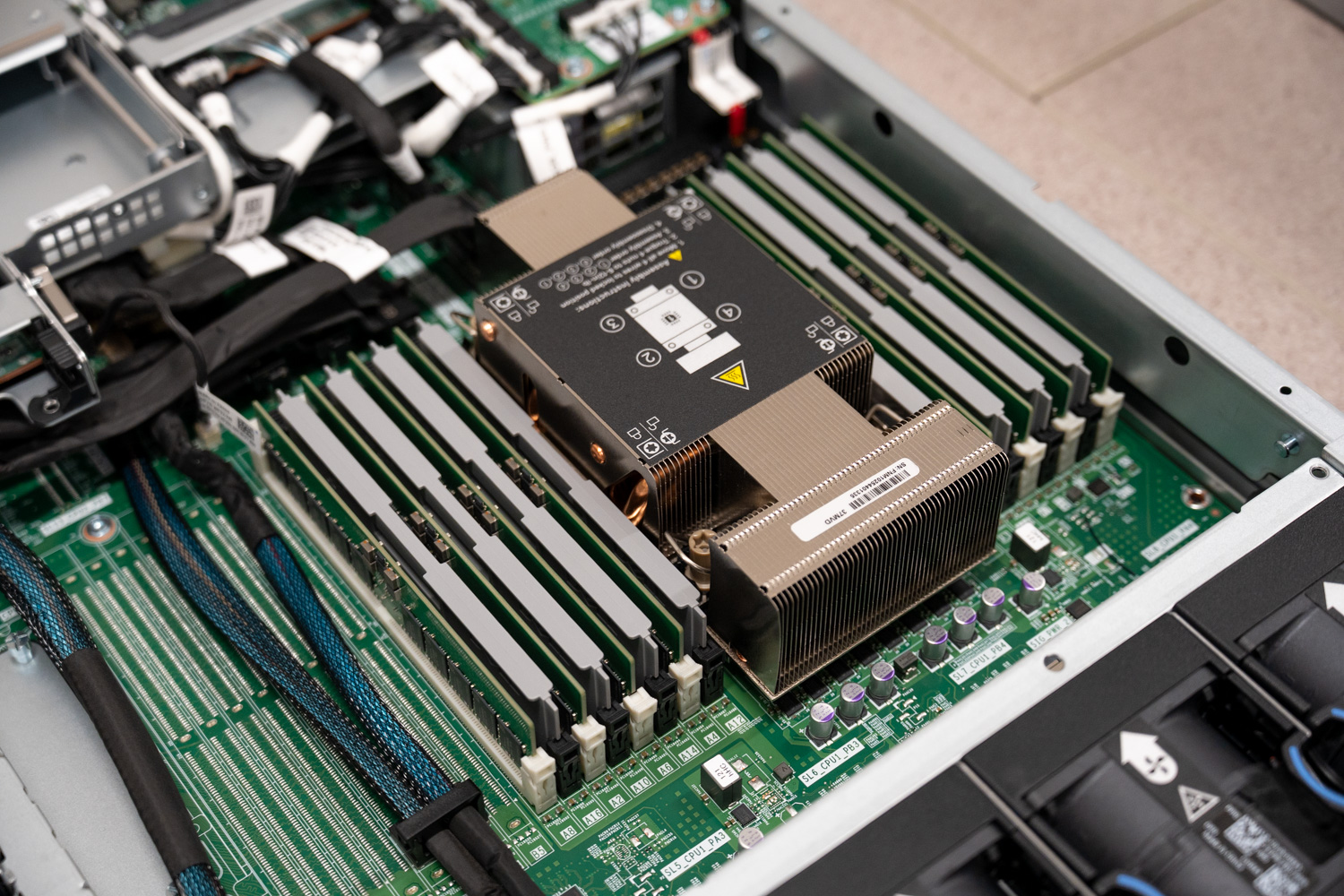
Dell PowerStore Gen3 1500 Controller CPU Heatsink
The internal fabric jumps to PCIe Gen 5, four times the per-lane bandwidth of the Gen 3 fabric used in Gen 2 PowerStore. Socket layout is the main differentiator across the lineup: the 1500 is single-socket, while the 5500 and 9500 are dual-socket, all running the same chassis and the same PowerStore OS software image, with core count and memory as the levers for right-sizing.
Chassis Cooling
Cooling on the 9500, pictured below, is an impressive design. The two CPU coolers on a single controller are connected via heat pipes and extended into a wide, conjoined fin stack, which is a smart move given how much heat a dual-socket controller has to dissipate. An earlier design choice comes into play for cooling: the 3U chassis. Each controller is now 1.5U tall, giving air a longer path to flow through than a 1U tray. This gives each model plenty of cooling headroom throughout the platform’s lifespan. The 1500 uses a more traditional-looking CPU cooler but retains all the airflow benefits of the 5500 and 9500 models. Regardless of the model, cooling across the family is handled by six fans per controller, giving the unit a total of 12 fans that keep the drives and the rest of the unit within their thermal envelope.
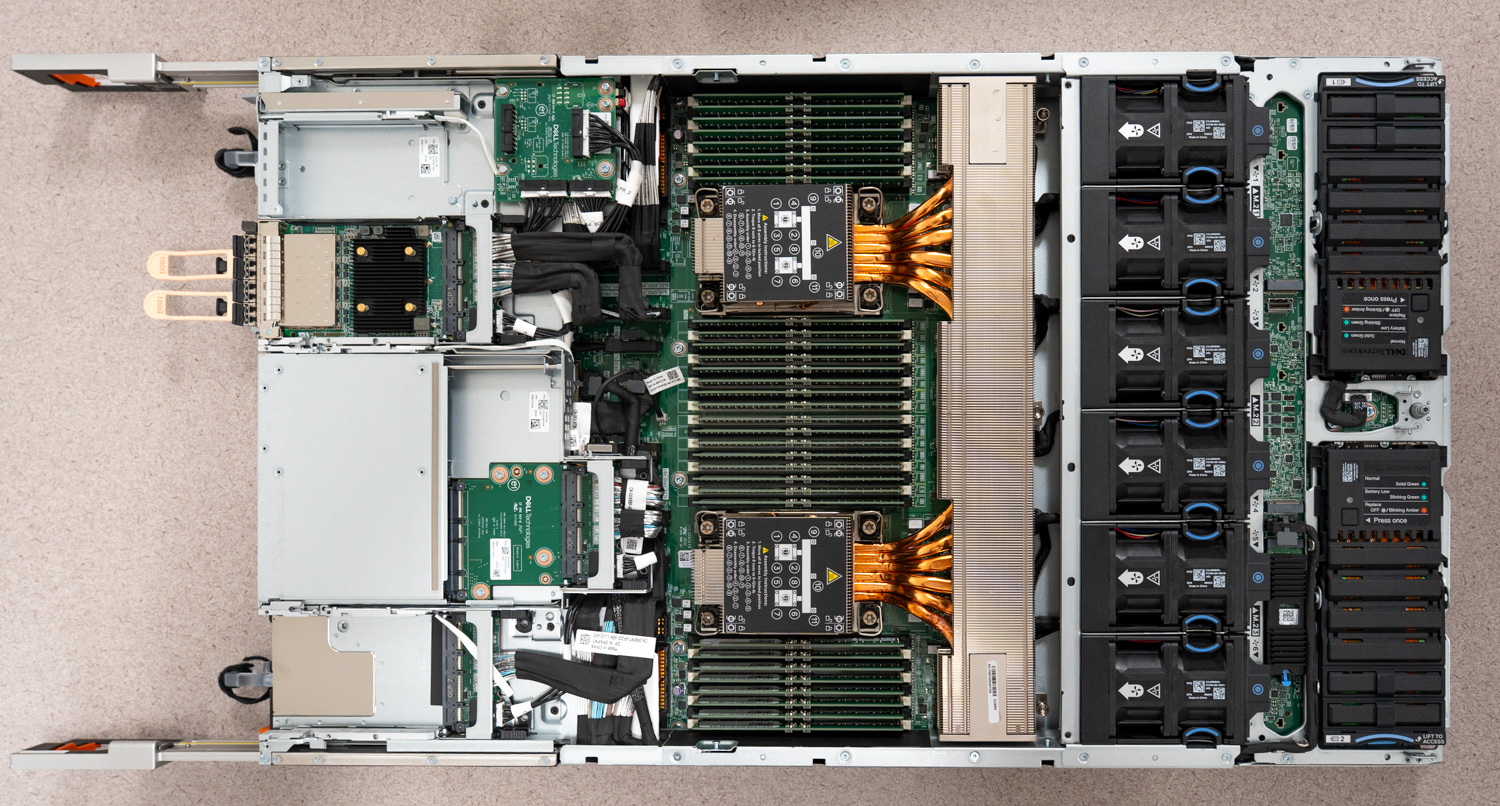
Dell PowerStore Gen3 9500 Controller Open
Networking and Storage
Compared to previous generations, the new models move to a modular, standardized I/O plane built on OCP 3.0 slots across the family, with up to 5 slots per node on the 5500 and 9500 (+1 reserved for expansion) and 3 per node on the 1500 (+1 reserved). The modules are tool-less hot-swap and replace the proprietary SLIC carrier used in Gen 2. Just as importantly, the I/O fabric jumps to PCIe Gen 5 on the newer models, substantially increasing the per-lane bandwidth available to each card and dramatically raising the networking ceiling. At launch, card options include 4× 32/64 Gb FC, 4× 1/10 GbE, 4× 10/25 GbE, and 2× 100 GbE, with 200/400 GbE Ethernet and 128 Gb FC listed as future I/O card releases. Dell is also strengthening network security, as all Fibre Channel cards will support EDIF (Encrypted Data-in-Flight) through a forthcoming non-disruptive software release. The net result is up to 40 network ports per appliance, double the previous generation and roughly 11% more port density than the Gen 2 controller layout.
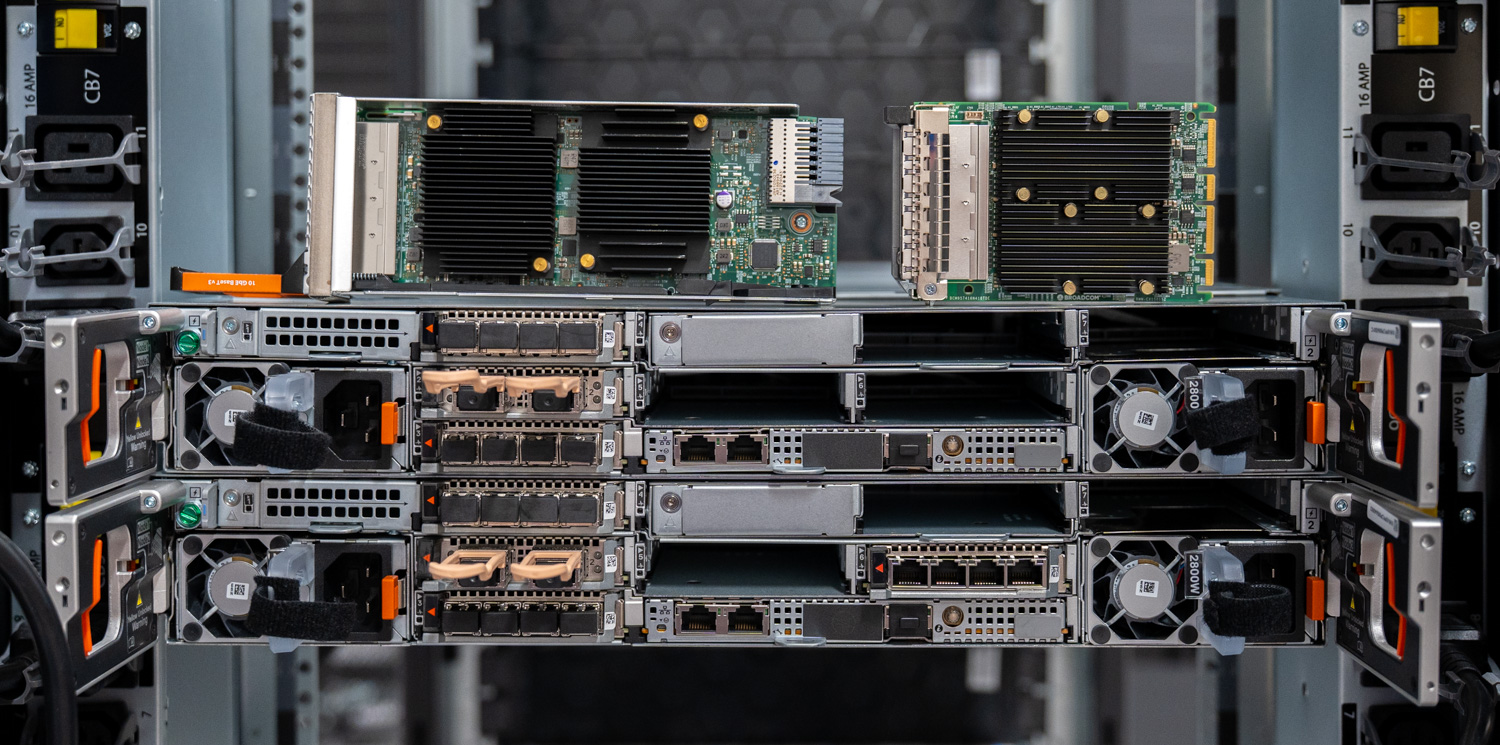
OCP Gen 2 and Gen 3 Cards on the Rear of the 9500 model with a Quick Latch for Removal.
The controller layout has also been rethought. On Gen 2, the top controller was inverted relative to the bottom one, which made servicing awkward and increased the risk of pulling the wrong controller or grabbing the wrong component during a hot swap. On Gen 3, both controllers are oriented the same way, and either controller can be released using the two handles and levers at the sides of the chassis, sliding out as a single 1.5U tray. The change is small on paper but meaningful for serviceability, particularly in racks where access from above is constrained or where a tech is working under pressure.
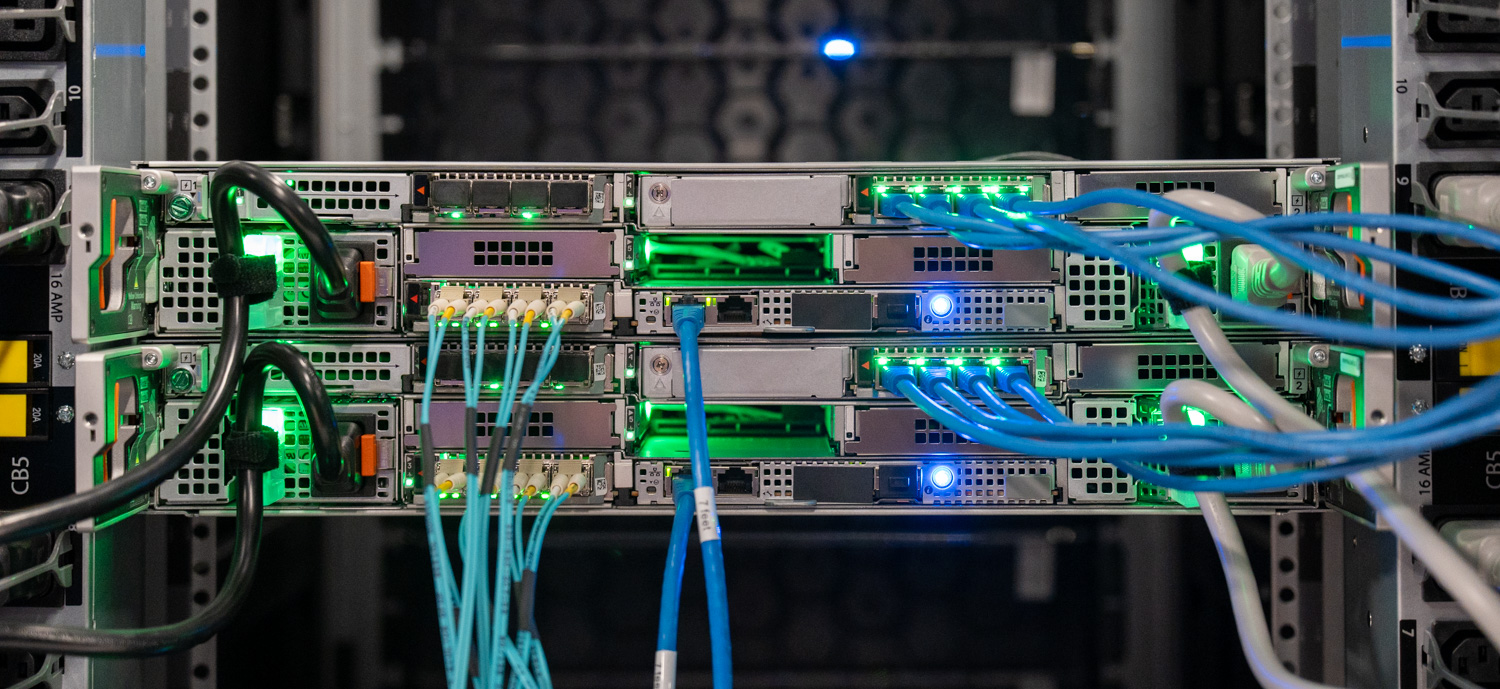
Dell PowerStore Gen3 9500 Rear View With FC and Ethernet Cabling
PCIe signaling plays an important role in the new PowerStore Elite, drawing on design elements from current-generation PowerEdge servers. When Dell started offering Gen5 E3.S support on platforms such as the PowerEdge R770 or PowerEdge R7725, it was decided to discontinue the use of PCIe switches on the drive backplane. Older models, such as the PowerEdge R760 with a 24-drive backplane, used a PCIe switch to enable all drive lanes, which increased complexity and cost and reduced drive performance. On models using E3.S, configurations with up to 16 SSDs allocated 4 PCIe lanes per drive, while configurations with up to 40 bays allocated 2 PCIe lanes per drive. Dell applies the same philosophy to the new PowerStore Gen 3 models, with each controller using just 2 PCIe lanes to communicate with each dual-ported E3.S SSD. The remaining PCIe Gen5 lanes are then used for inter-node communication and rear I/O connectivity. Nearly every PCIe lane inside the chassis is utilized, down to the remaining PCIe Gen4 lanes off the CPU chipset, which feed OCP slots that don’t require high bandwidth.
Inter-Node Interconnect
The inter-node fabric is one of the bigger jumps from Gen 2. The 5500 and 9500 run up to 200 GbE RDMA between controllers (the 1500 uses 100 GbE RDMA), compared to just 2× 10 GbE on Gen 2. The links are cable-free, midplane-routed point-to-point connections dedicated to write ingest. Pictured below is one of the 200GbE internal interconnect modules on the 9500.
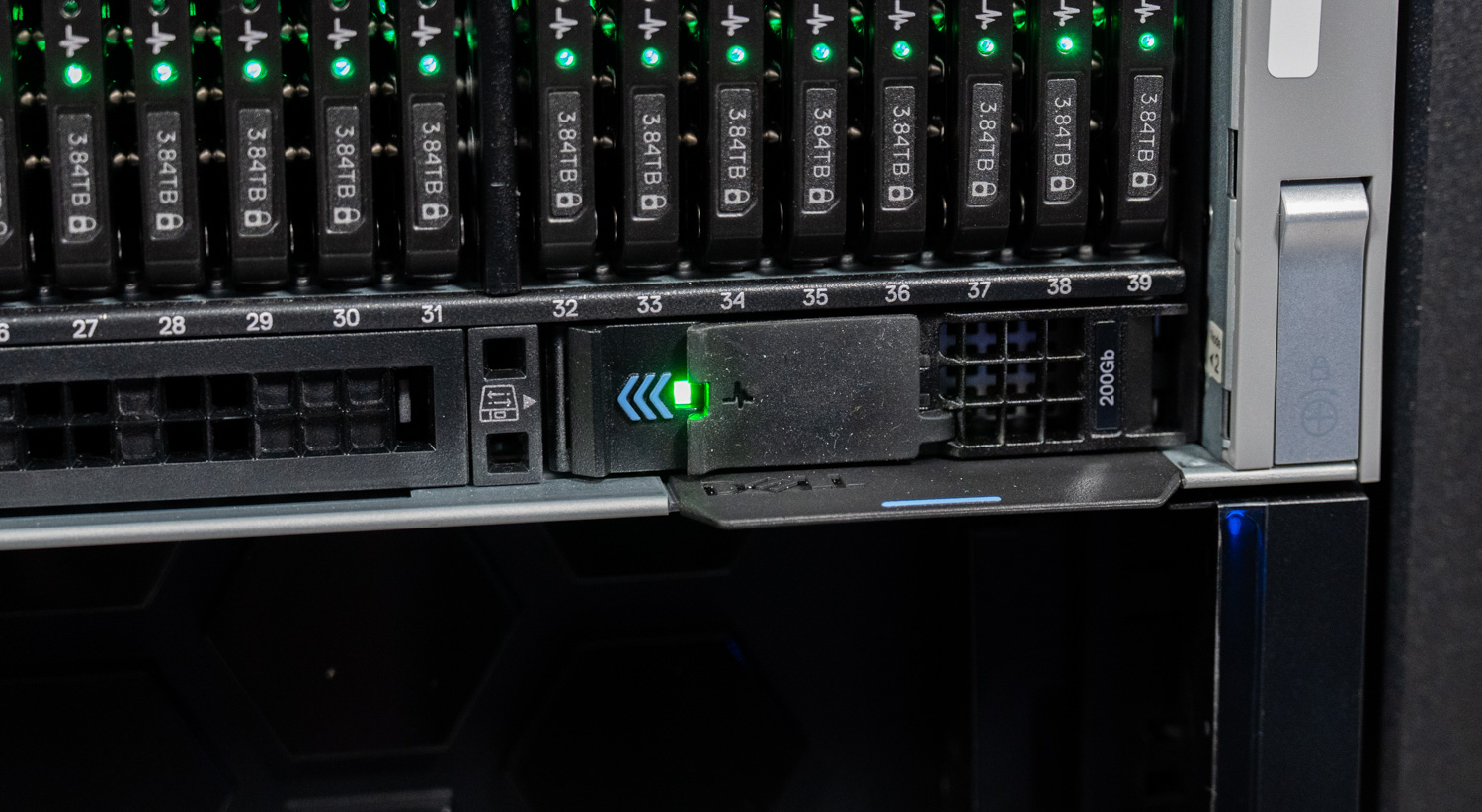
Dell PowerStore Gen3 9500 Front Interconnect Card
Importantly, the new interconnect layer is CPU-agnostic and decoupled from processor generations and vendors, positioning the chassis to accept upgrades to future CPU platforms across the unit’s lifecycle without disturbing the drives or re-engineering the fabric.
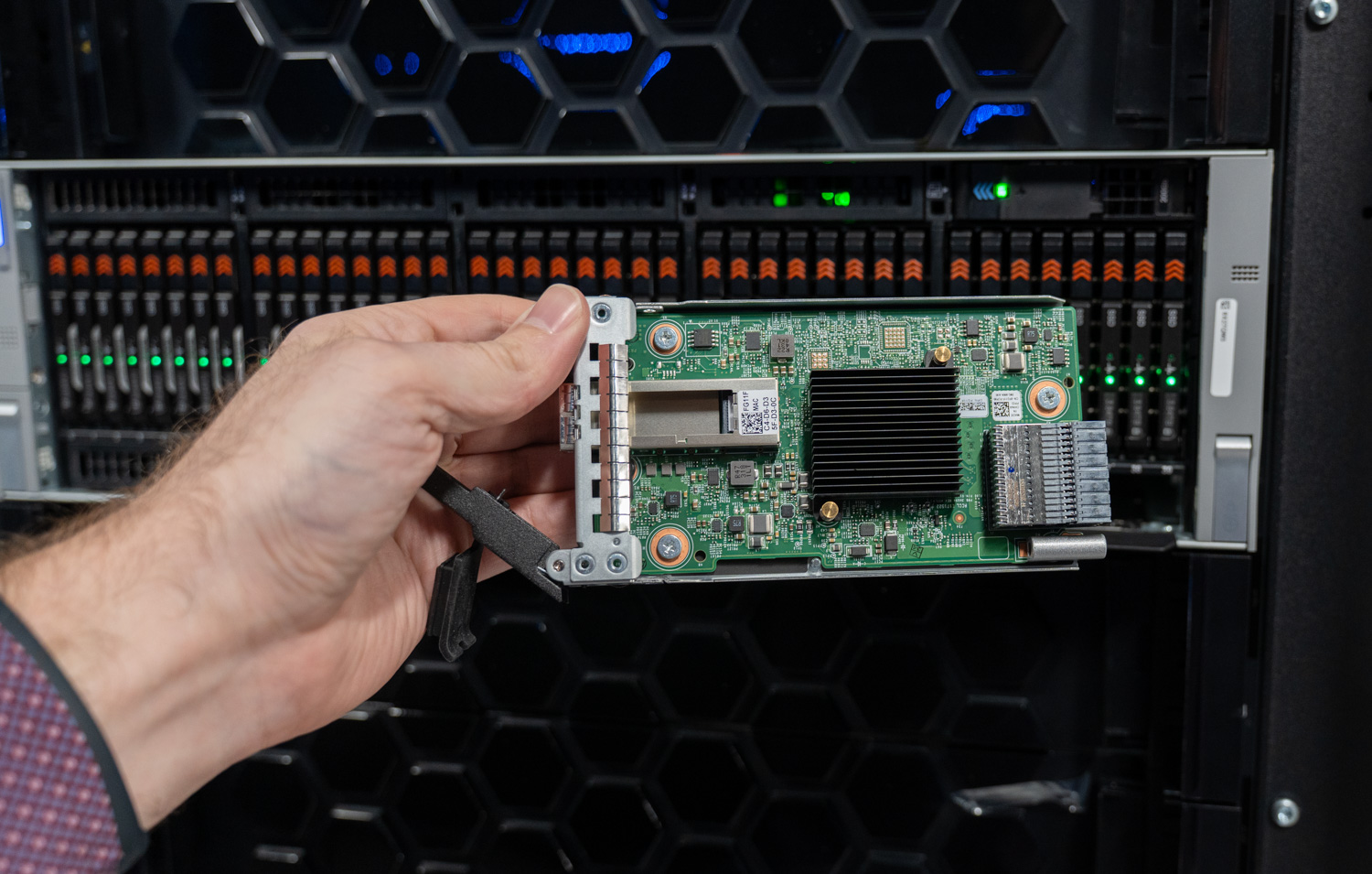
200 GbE RDMA Controller Interconnect Card Removed
Cache and persistent memory
PowerStore Gen 2 uses front U.2 NVRAM drives for write cache persistence, reducing storage capacity by 4 slots. Gen 3 introduces Software-Defined Persistent Memory (SDPM) instead: standard DDR5 DRAM is presented to the OS as an ACPI-compliant NVDIMM-N, and on power loss, a BIOS SMI handler de-stages the volatile state to the M.2 SSD drive, backed by a hold-up battery subsystem. Each PowerStore Gen 3 array offers substantial lithium-backed power. On the 5500 and 9500 models, each controller has two 54Wh batteries (216Wh total per chassis) while the 1500 model has one per controller (108Wh total per chassis).
Pictured below is the PowerStore 9500 controller with its M.2 boot drive and two battery packs that keep the system powered long enough to commit the state to disk in the event of a power loss.
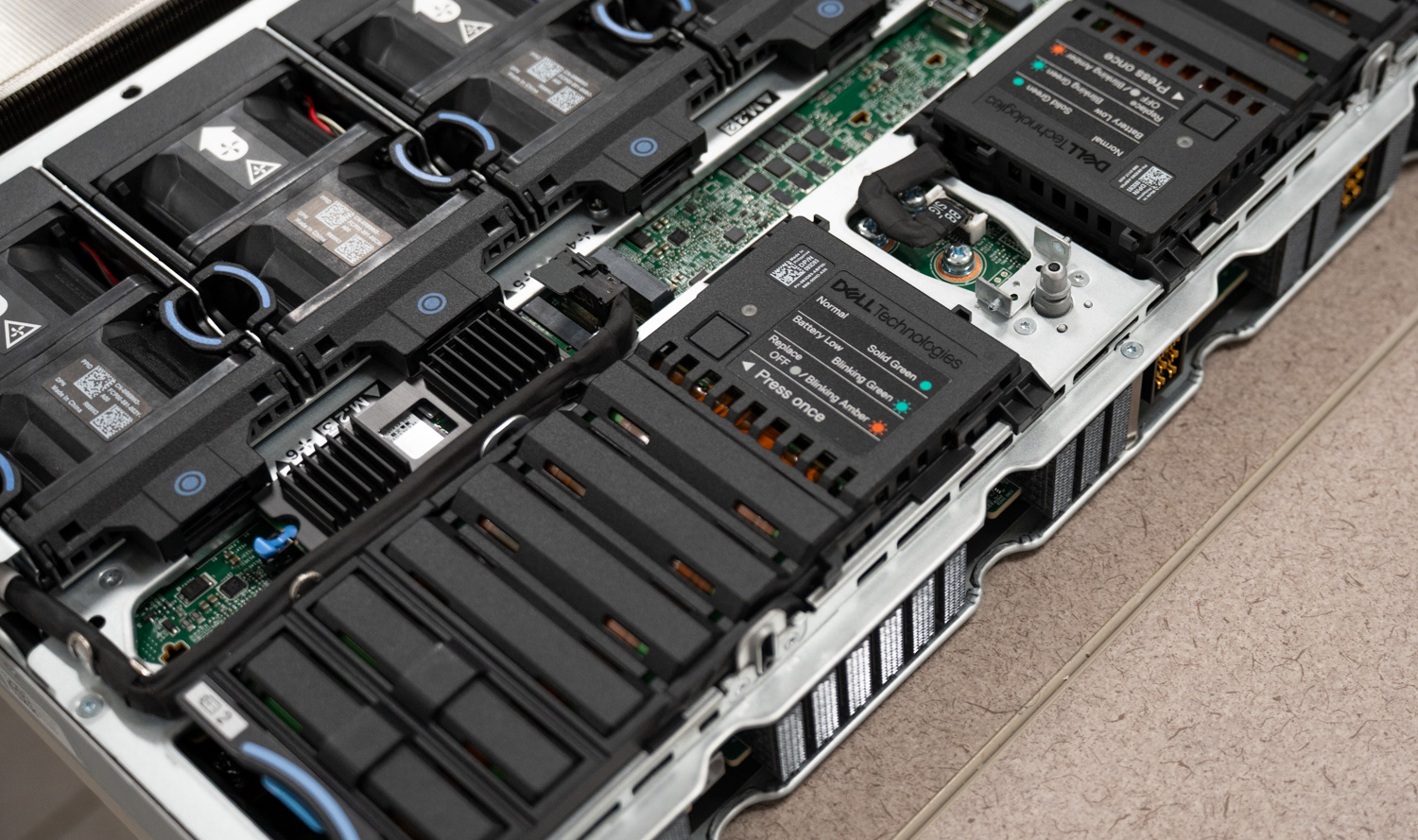
Dell PowerStore Gen3 Battery Packs
On the PowerStore 1500, we can see the single-socket layout and a single battery pack to match. The same SDPM architecture is in play, just sized appropriately for the smaller controller.
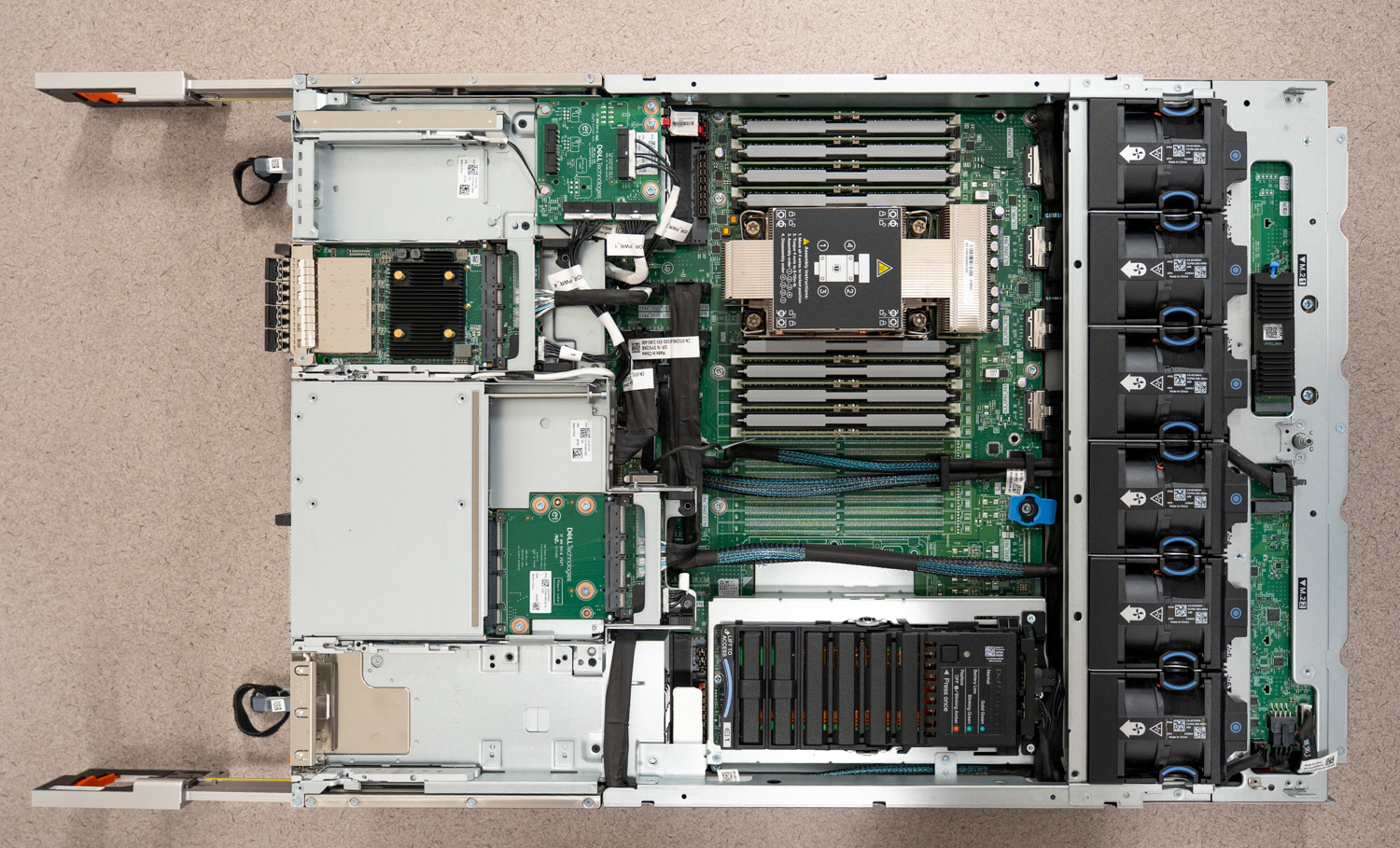
Dell PowerStore Gen3 1500 Internal Controller View
Power and Management
Power and management have been re-platformed onto Dell’s standard server components. The BMC moves from the legacy EMC GEM controller to a storage-tuned iDRAC, aligning PowerStore with the rest of the Dell server portfolio in terms of serviceability. PSUs and battery backup units are now standard PowerEdge parts rather than custom EMC hardware, which should mean better support operations, less downtime, and broader supply. The hold-up power subsystem covers CPUs, DIMMs, drives, fans, and the iDRAC itself, keeping them powered long enough to de-stage the volatile state to disk on a power loss.
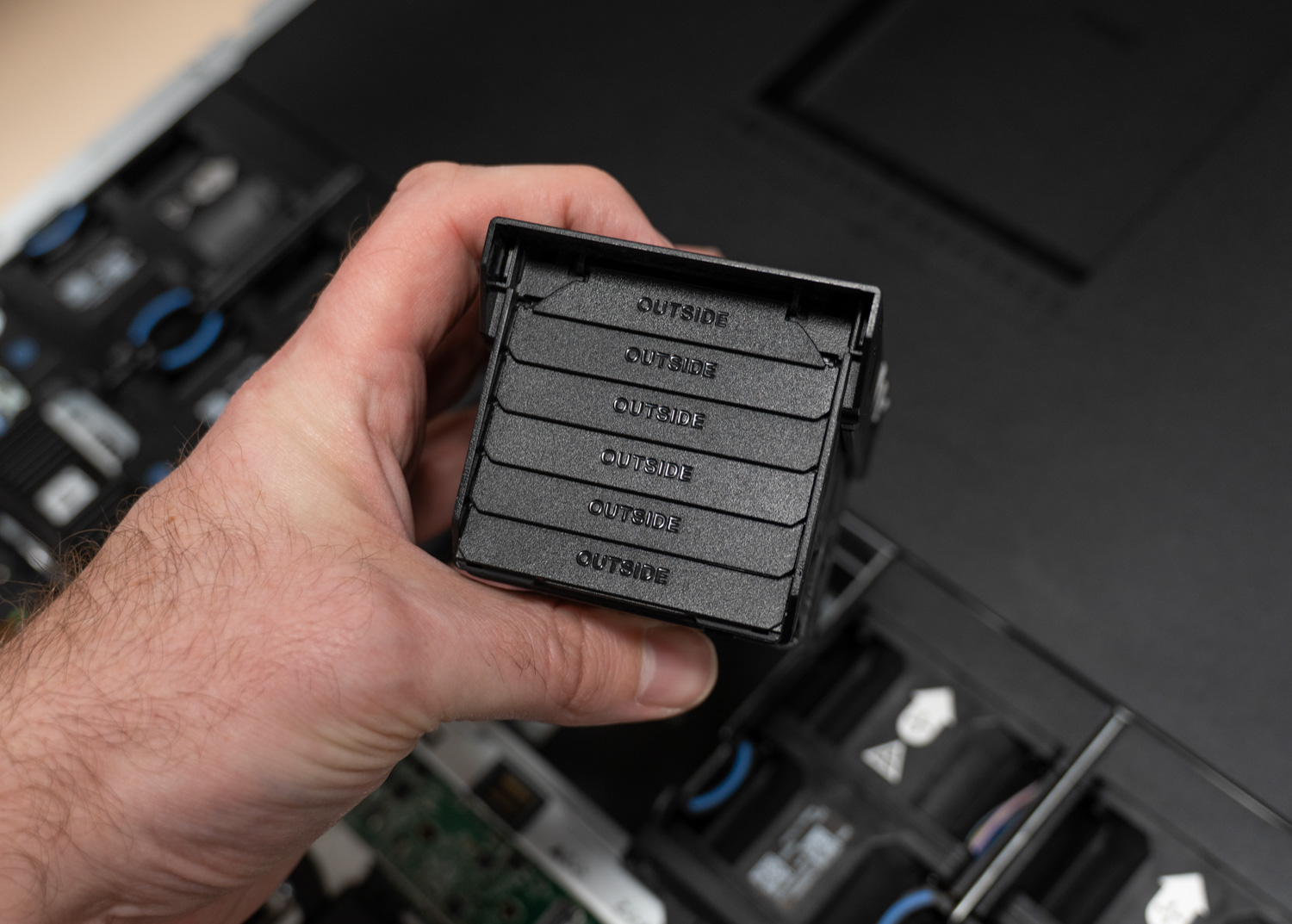
Dell PowerStore Gen3 Cooling Fan
PowerStore Gen 3 Performance
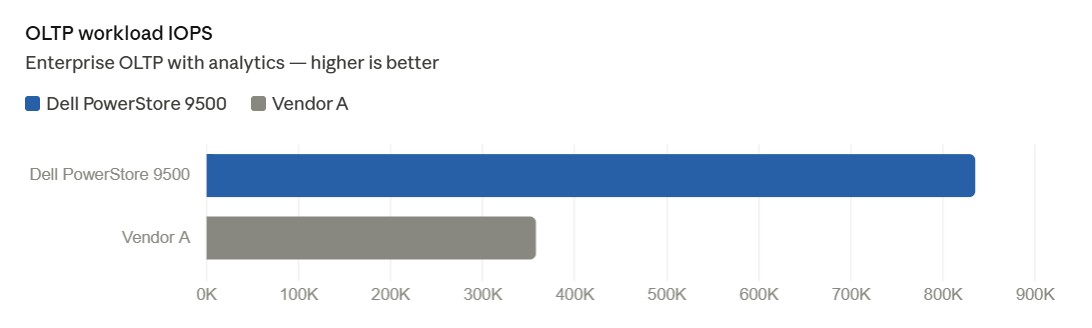
Dell shared preliminary numbers comparing Gen 3 to Gen 2. Treat them as directional, but they line up with what the hardware uplift would suggest, given the move to the latest Intel x86, DDR5, PCIe Gen 5, and the 200GbE RDMA fabric between controllers. Compared to the prior generation, Dell targets up to 3x higher IOPS on 8K mixed workloads, up to 3x higher throughput on 1MB sequential reads, and up to 3x higher throughput on 1MB sequential writes, with meaningful latency improvements on both reads and writes. For an independent comparison, Principled Technologies ran the 9500 against a comparable all-NVMe competitor (unnamed in the report) using Vdbench. On an enterprise OLTP-with-analytics workload, the 9500 delivered 834,558 IOPS, compared to the competitor’s 357,427, a 2.33x advantage.
The latency picture is the same shape. At a 310,000 IOPS target for a mixed small-block database workload, the 9500 held at 0.44ms while the competitor sat at 1.22ms, a roughly 64% reduction.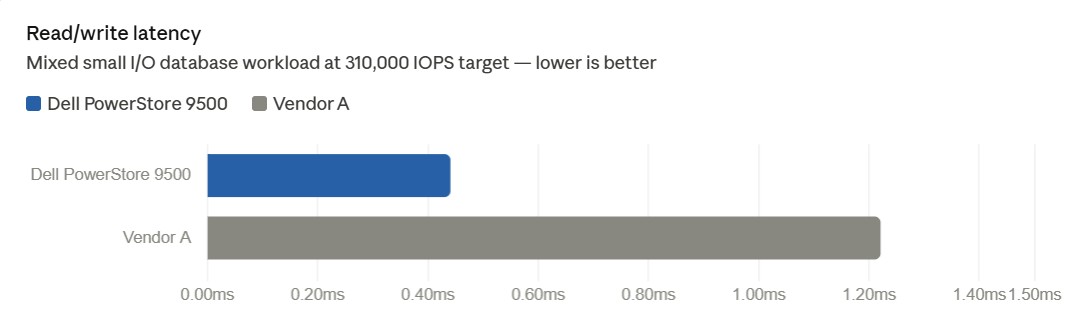
Data efficiency rounds out the comparison and is the one that matters most as NAND pricing climbs. On a dataset built for 2:1 compression and 2.5:1 deduplication at an 8KB dedupe unit, the 9500 hit 6.6:1 overall reduction. The competitor came in at 2.76:1 on the same data.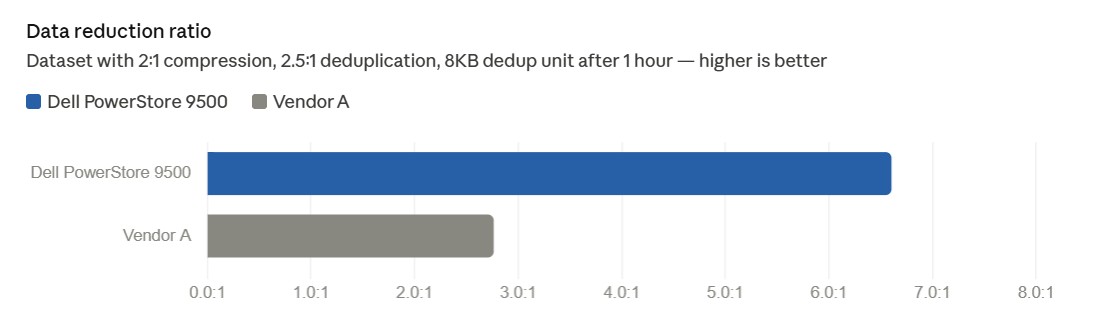
Conclusion
PowerStore Gen 3 is the most significant release since the platform debuted in 2020, and it’s the kind of generational reset that will force the rest of the enterprise storage array market to respond. Dell rebuilt the chassis and modernized the drive form factor, cache architecture, inter-node fabric, I/O plane, and management stack in one massive step. Every one of those choices is forward-looking, which is what makes the ten-year Lifecycle Extension story credible rather than aspirational.
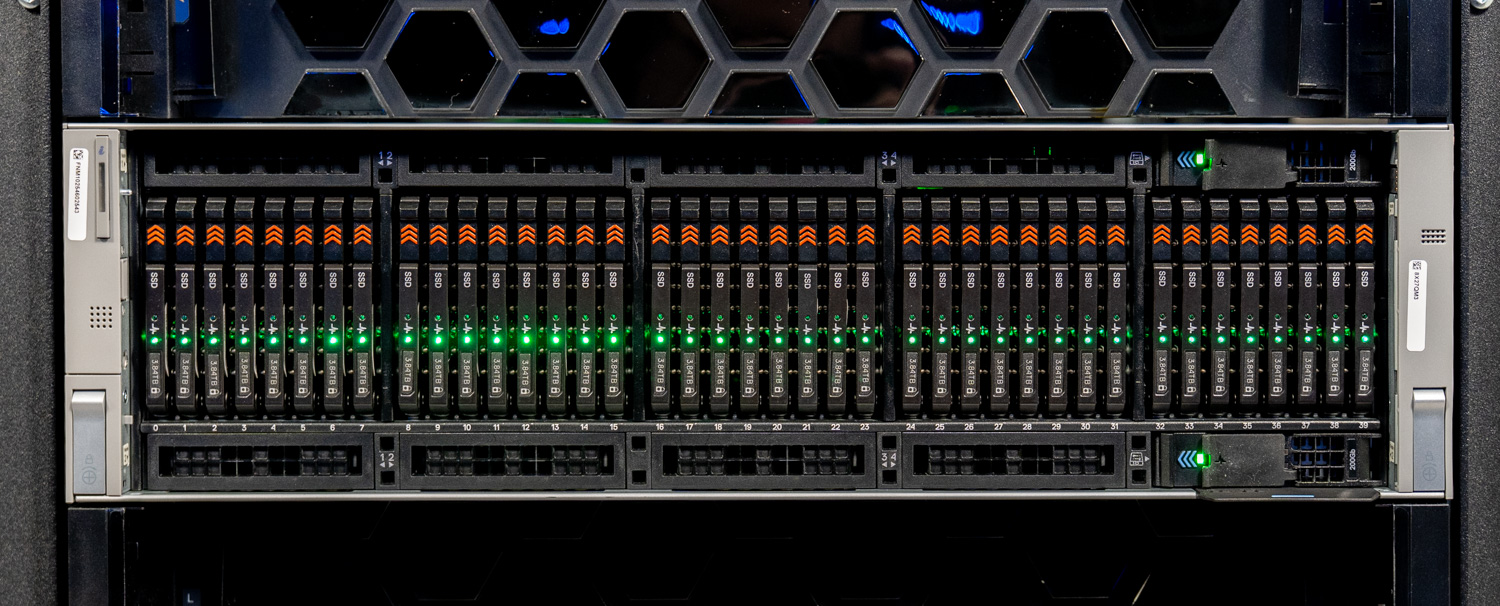
Dell PowerStore Gen3 9500 Front View
The design wins are easy to enumerate. Forty E3.S bays in 3U with no slots burned on cache. A 200 GbE RDMA midplane that’s CPU-agnostic and ready for whatever silicon comes next. SDPM in place of NVRAM drives, which both frees front bays for data and removes the dependency on a single persistent memory technology. iDRAC, PowerEdge PSUs, and Dell battery backup units in place of legacy EMC parts, which means PowerStore now benefits from the same serviceability and supply chain as the rest of the Dell enterprise portfolio. And the unified-by-default approach, paired with the ability to support TLC or QLC media in a single model without a performance penalty, simplifies the buying decision in ways that matter for platforms that must serve diverse workloads in the same stack.
We’re looking forward to spending more time with the platform in our lab and seeing how the Gen 3 hardware comes together with everything PowerStoreOS 5.0 brings on the software side. That software is now GA, and our PowerStoreOS 5.0 deep dive covers what it adds. The autonomous data path work, log-structured metadata for high-capacity QLC, I/O-level telemetry, and dynamic block-and-file resource sharing are all the types of enhancements that compound over time on a chassis with this much headroom. It’s that combination, hardware and software moving forward together, that earns this release the Elite name.
PowerStore Product Page
This report is sponsored by Dell Technologies. All views and opinions expressed in this report are based on our unbiased view of the product(s) under consideration.



 Amazon