StorageReview.com
Enterprise  ◇  Server

AMD EPYC Rome VMware Review (7702P, 7402P, and 7302P)

Last month AMD launched its second generation of its EPYC Processors, AMD EPYC 7002, also known as EPYC Rome. The new CPUs are being heavily embraced by the industry as they bring the promise of much more performance compared to Intel, even single socket Rome versus dual socket Intel. We did a review for release day

WD SN630 vSAN
Enterprise  ◇  Hyperconverged

Western Digital Ultrastar DC SN630 VMware vSAN Review

Western Digital launched the Ultrastar DC SN630 in February of this year, as part of a refresh and rebranding of their Ultrastar line (formerly HGST) of data center drives. Within this portfolio Western Digital has several enterprise NVMe SSD offerings with the SN200 taking the throne as the performance leader and the new SN630 replaces the SN620 in the mainstream

Microsoft Azure Stack HCI Review DataON
Enterprise  ◇  Hyperconverged

Microsoft Azure Stack HCI Review (DataON HCI-224 with Intel Optane NVMe)

So far we’ve dived deep into the Microsoft Azure Stack HCI, the on-premise implementation of Microsoft’s Azure cloud service. Azure Stack HCI can be seen as a best-of-both-worlds type of platform. It has all the management tools from Azure like Azure Monitor, Azure Security Center, Azure Update Management, Azure Network Adapter, and Azure Site Recovery,

Enterprise  ◇  HDD

Seagate IronWolf Pro 16TB NAS HDD Review

The IronWolf Pro is an NAS family of HDDs designed for 24×7 performance in a multi-drive environment. For this review, we will be looking at the new 16TB model, which expands on the 14GB Pro from earlier this year. This makes for a whopping 384TB inside an 24-bay NAS, allowing users to store a huge

Enterprise  ◇  HDD

Seagate Exos X16 16TB HDD Review

Seagate continues to expand the capacity of their HDDs with the launch of the Exos X16 family earlier this year. As the second name implies, the capacity of these drives runs up to 16TB. The massive capacity in a 3.5” form factor can supply up to 33% more petabytes per rack, compared to 12TB drives.

Enterprise  ◇  Server

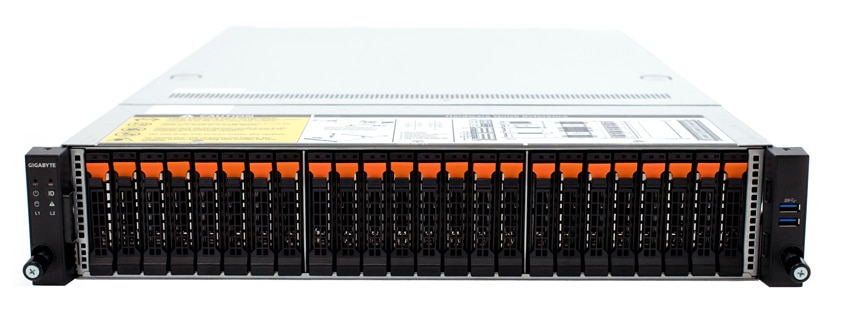
GIGABYTE R272-Z32 AMD EPYC Rome Server Review

As AMD rolled out their new EPYC Rome 7002 CPU series today several vendors have announced servers that support the new technology, including GIGABYTE. In fact, GIGABYTE has released an entire series of rack servers that support the EPYC Rome, the R-Series. The R-series is a general-purpose server family with a balance of resources. The

Enterprise  ◇  Medium NAS

Synology DiskStation DS2419+ Review

The DiskStation DS2419+, launched in mid-February, is the latest edition of the 12-bay tower Plus Series family. Providing 192TB (384TB with expansion unit) or raw storage capacity, the DS2419+ is designed for small- to medium-sized businesses looking for an economical data storage solution that provides the option of expanding as their storage needs grow.

Data Protection  ◇  Enterprise

Dell EMC Integrated Data Protection Appliance (IDPA) DP4400 Review

Launched in the summer of last year, the Dell EMC Integrated Data Protection Appliance (IDPA) DP4400 is designed to bring several Dell EMC backup and recovery technologies into a single converged solution. The DP4400 leverages a 2U Dell EMC PowerEdge server chassis that delivers two capacity options. DP4400 systems come fully populated in either 24-96TB or

Enterprise  ◇  In the Lab

In the Lab: Odake BladeX Pro 4K Battery Powered Monitor

Managing a lab requires quite a bit of work in person and remote; deploying new hardware as well as managing devices once they are up and running. Deploying hardware still requires a crash cart and when it comes to managing multiple interfaces when configuring a new appliance, more screen real estate is never a bad

Enterprise  ◇  SSD

Kingston DC500M Enterprise SSD Review

Released in March of this year, the Kingston Data Center DC500M is a SATA enterprise SSD that leverages the latest 3D TLC NAND. Kingston's new SSD implements the company’s strict QoS requirements to ensure predictable random I/O performance as well as predictable low latencies over a wide range of read and write workloads. Where the DC500R (R