

KIOXIA America announced the LD4 Series today, its first E1.L SSD built with BiCS FLASH generation 8 QLC flash. The drive targets read-intensive storage in high-density 1U servers and is sampling to select customers now at 15.36TB and 30.72TB, on an architecture KIOXIA says it has already validated for capacities up to 122.88TB.
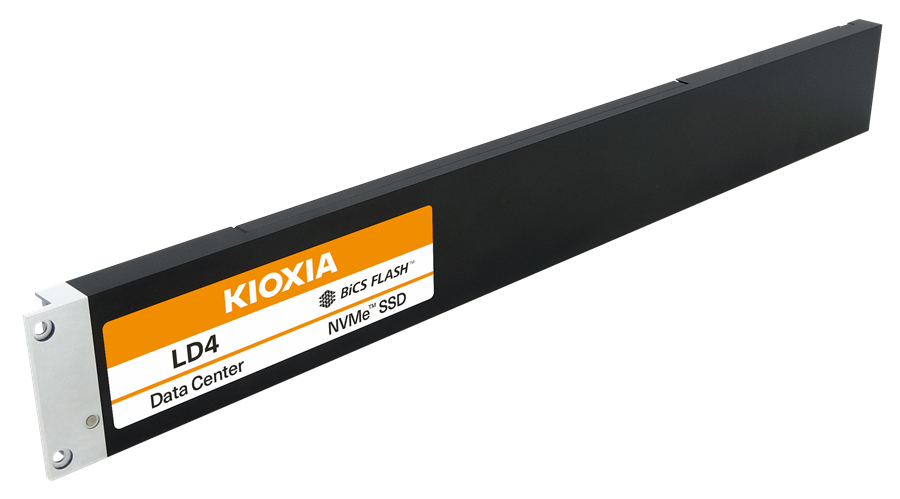
KIOXIA aims the LD4 at hyperscale and scale-out infrastructure, naming object storage and AI and machine learning repositories as the workloads the drive is optimized for. The single-port NVMe design fits that audience and separates the LD4 from KIOXIA’s LC9, the dual-port Gen5 QLC drive the company has pushed to 245TB, and from the E1.S NX1 시리즈 it introduced in July.
High-Capacity E1.L Design
The LD4 uses the 9.5mm E1.L form factor and measures 318.75mm long. Compared with the shorter EDSFF sizes, the long ruler gives KIOXIA far more board area for NAND packages, which is the reason E1.L exists: in a 1U server, the number of terabytes behind each slot typically matters more than the performance of any single drive.
KIOXIA is launching with 15.36TB and 30.72TB models, which puts the largest sampling configuration at a quarter of the 122.88TB the company says the architecture supports. KIOXIA has not said when higher-capacity LD4 models will sample.
KIOXIA lists the LD4 as compliant with the PCIe 5.0 specification at up to 16 GT/s across four lanes, though in execution it’s PCIe 5.0 (Gen4 x4). Sixteen gigatransfers per second is PCIe Gen4 signaling, which should cap the drive at about 7.9GB/s in each direction, roughly half of a Gen5 x4 drive’s 15.8GB/s.
For a read-heavy QLC drive spread across dozens of slots, the per-drive performance matters less than the server’s aggregate PCIe and network budget, so the Gen4 rate is a reasonable trade for this class. The LD4 also supports NVMe 2.0e and the OCP Datacenter NVMe SSD Specification 2.6, though KIOXIA notes the drive does not meet every OCP requirement.
KIOXIA LD4 Series Specifications
| 스펙 | KIOXIA LD4 Series |
|---|---|
| 드라이브 | |
| 폼 팩터 | EDSFF E1.L |
| 크기 | 두꺼운 9.5mm 318.75mm 길다. |
| 용량 | 15.36TB 30.72TB |
| Validated Architecture | 122.88TB까지 |
| Interface and Standards | |
| 인터페이스 | PCIe 5.0 specification compliant, up to 16 GT/s x4 (Gen4 x4) |
| NVMe | NVMe 2.0e |
| OCP 지원 | OCP Datacenter NVMe SSD Specification 2.6 (not all requirements) |
| 포트 구성 | 단일 포트 |
| Flash and Data Protection | |
| 낸드 | KIOXIA BiCS FLASH generation 8 QLC |
| Controller and Firmware | KIOXIA proprietary |
| 데이터 보호 | 전력 손실 보호(PLP) 종단 간 데이터 보호 |
| 대상 응용 프로그램 | |
| 워크로드 | Read-intensive hyperscale storage 개체 저장소 AI and machine learning repositories |
BiCS FLASH 8 QLC Targets Capacity-Heavy Workloads
Inside, the LD4 pairs BiCS FLASH generation 8 QLC with KIOXIA’s own controller and firmware. QLC stores four bits per cell, so a drive reaches a given capacity with fewer NAND packages than TLC would need, and the cost of that density shows up in write endurance and sustained write speed.

Neville Ichhaporia, senior vice president and general manager of the SSD business unit at KIOXIA America, tied the launch to that read-heavy profile: “QLC flash is particularly compelling for read-intensive applications, where high capacity and high read performance supports the vast data storage requirements of today’s AI workloads.”
The LD4 also carries power loss protection, which commits in-flight writes to flash if a server loses power, and end-to-end data protection, which checks data integrity along the path from the host interface to the NAND. Both are expected on a data center SSD, and both matter more in scale-out deployments, where large fleets of drives run continuously across many servers.
Sampling Starts with 15.36TB and 30.72TB Models
The company will show the LD4 at the 2026 OCP Global Summit in San Jose from October 12 through 15, and with the architecture validated to 122.88TB, the series has room to quadruple its top capacity as KIOXIA adds models.


 아마존
아마존