

The AMD EPYC Embedded 2005 Series is positioned for networking, storage, and industrial designs where power, thermal headroom, and board space are tightly constrained. The series focuses on high compute density and performance per watt in a compact 40 mm x 40 mm BGA package, targeting platforms that must operate continuously and deliver extended service lifetimes.
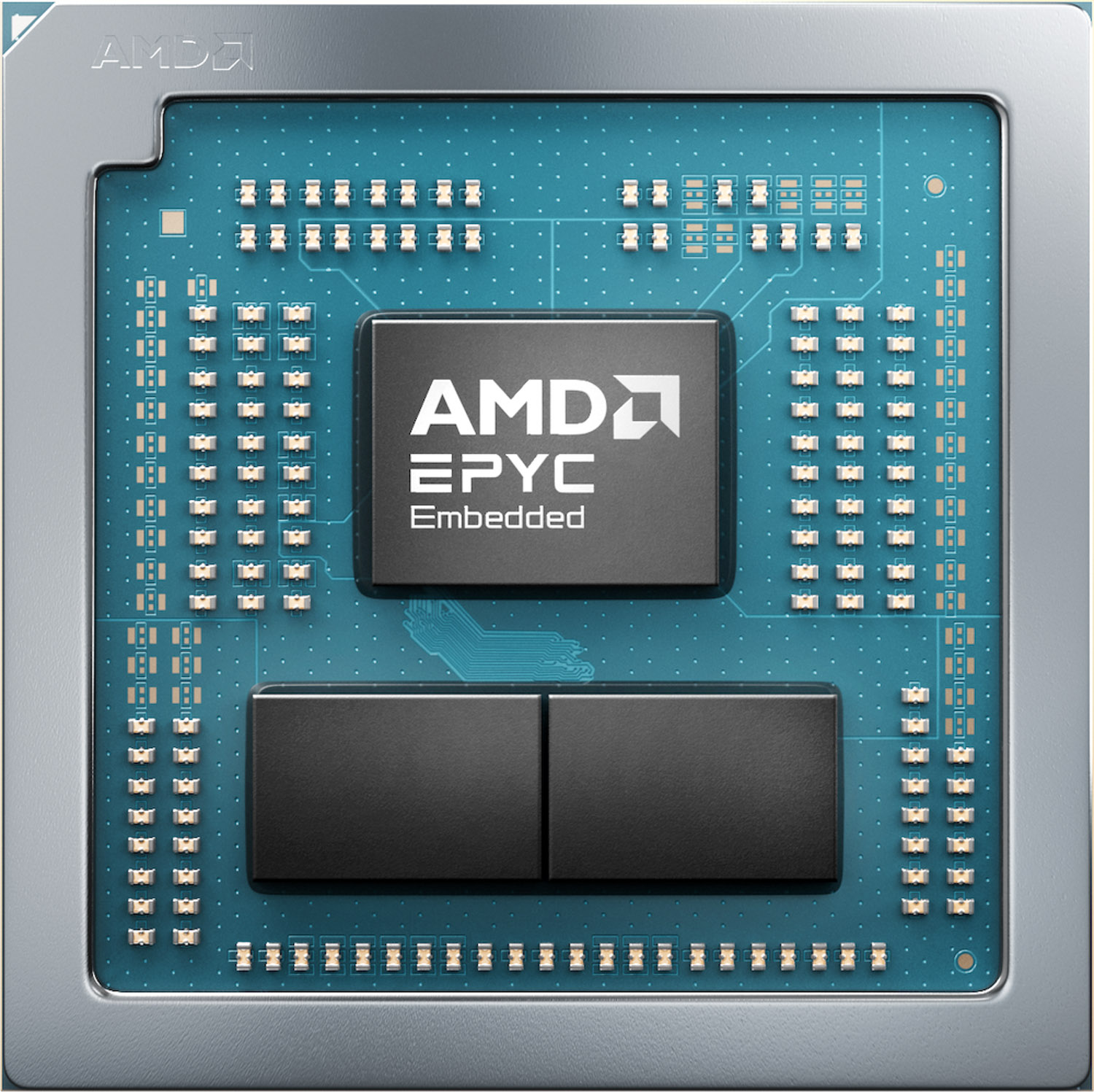
Embedded system designers working on AI‑driven, connected infrastructure such as network switches, security appliances, DPUs, cold storage, robotics, and aerospace systems increasingly need more cores, higher memory bandwidth, and modern I/O without the power budgets or physical space of traditional server platforms. The EPYC Embedded 2005 family is AMD’s response to those requirements, combining Zen 5 cores, PCIe Gen5, DDR5, and advanced RAS and security features in a single highly integrated SoC.
Compact BGA Design and Performance per Watt
The EPYC Embedded 2005 Series uses a 40 mm x 40 mm BGA package, which AMD states is roughly 2.4 times smaller in area than comparable Intel Xeon 6500P‑B solutions. The smaller package size enables higher component density on constrained boards and can simplify system thermals by bringing high‑speed interfaces physically closer to NICs, accelerators, and other peripheral devices.
The processors are based on AMD’s Zen 5 architecture and scale up to 16 x86 cores with 64 MB of shared L3 cache. Configurable TDP options, ranging from 45 W to 75 W, allow system architects to tune for different power and thermal envelopes while maintaining a consistent platform. According to AMD’s internal analysis, the EPYC Embedded 2655 12‑core model delivers up to 28 percent higher boost frequency and 35 percent higher base frequency than the Intel Xeon 6503P‑B, while operating at roughly half the TDP. For OEMs and integrators, that combination of higher frequency at lower power can translate into denser deployments, simpler cooling solutions, or additional power budget for accelerators and networking silicon.
The resulting balance of core density, I/O throughput, and energy efficiency is optimized for rack‑dense appliances and edge systems, where every watt and square millimeter must be justified.
Reliability, RAS, and Long‑Life Availability
The EPYC Embedded 2005 family is designed for 24/7 operation and extended field lifetimes. AMD specifies support for up to 10 years of continuous operation and aligns that with long‑term availability and support: up to 10 years of component ordering and technical assistance, plus 15 years of software maintenance. For OEMs building platforms that must stay in market and in service for a decade, this lifecycle model reduces redesign risk and supports consistent BOM planning.
The processors integrate Reliability, Availability, and Serviceability (RAS) capabilities to detect, prevent, and correct errors before they affect system availability. Features such as advanced error detection and correction, and robust memory protection are designed to keep systems online in always‑on infrastructures.
For embedded networking and storage designs, the platform also supports features like Baseboard Management Controller (BMC) integration, PCIe Hot Plug, and multi‑SPI ROM support. These capabilities give designers greater flexibility to implement remote management, high‑availability storage configurations, and multi‑image firmware schemes without requiring extensive external glue logic.
Security with AMD Infinity Guard
Security is anchored by AMD Infinity Guard, the company’s suite of on‑silicon security technologies. Key elements include:
- AMD Secure Processor: A dedicated on‑chip security processor that establishes a hardware‑rooted secure boot flow, initializes the SoC, and provides an isolated Trusted Execution Environment.
- AMD Platform Secure Boot: Hardware‑assisted secure boot that validates firmware and boot components to help prevent unauthorized code from running at startup.
- AMD Memory Guard: Memory encryption features intended to protect data in DRAM from physical attacks or unauthorized access.
In mission‑critical or multi‑tenant infrastructure, these capabilities are designed to protect data integrity and maintain system trust even under increasingly sophisticated threat models.
PCIe Gen5, DDR5, and I/O Flexibility
The EPYC Embedded 2005 Series exposes 28 lanes of PCIe Gen5, allowing designers the flexibility to attach a mix of high‑speed peripherals. Up to 16 lanes can be aggregated to connect bandwidth‑hungry devices such as high‑speed Ethernet NICs, FPGAs, custom networking ASICs, or storage controllers. The use of PCIe Gen5 provides ample bandwidth for next‑generation network fabrics and accelerators without oversubscribing the host interface.
Support for DDR5 memory delivers higher memory bandwidth and capacity scaling than DDR4, which is entering end‑of‑life on many product roadmaps. For embedded and industrial vendors that need roadmaps aligned with long lifecycles, DDR5 support offers a straightforward path to future memory configurations without requiring a new platform.
Combined, PCIe Gen5 and DDR5 give the platform the headroom to support evolving workloads, including AI‑augmented analytics at the edge, encrypted-traffic inspection, and high‑density object- or cold-storage nodes.
Software Ecosystem and Development Model
The EPYC Embedded 2005 Series is backed by an open software ecosystem that targets embedded and infrastructure developers:
- Upstream support for Yocto enables custom Linux distributions tailored for networking, storage, and industrial control.
- Kernel driver support helps align with the mainline Linux kernel, reducing maintenance overhead and easing the adoption of new kernel capabilities.
- EDK II (Extensible Firmware Interface Development Kit) support provides a standardized UEFI firmware development environment for OEMs that need to customize platform firmware.
This software stack reduces bring‑up complexity and can accelerate time to market by leveraging existing open‑source infrastructure and tooling.
Target Use Cases and Deployment Scenarios
The architectural and platform features of the EPYC Embedded 2005 Series line up with several key embedded infrastructure segments:
- Networking: Control planes for switches and routers, SD‑WAN and security appliances, and DPU host/control processors that need modern PCIe connectivity and robust RAS without the footprint of full server CPUs.
- Storage: Cold cloud storage, dense JBOD/JBOF enclosures, and object storage gateways where performance per watt and high‑speed PCIe for NVMe and networking are critical.
- Industrial and Robotics: Industrial PCs, robotics controllers, and ruggedized edge compute platforms that require 24/7 availability, extended temperature and lifecycle support, and integrated security.
Across these segments, the value proposition centers on delivering server‑class capabilities in a smaller, lower‑power, and longer‑life embedded package.


 Amazon