

At the RAISE Summit in Paris, DDN highlighted its ongoing collaboration with Nebul, a European sovereign-hybrid cloud provider, focused on improving the efficiency of large-scale AI inference deployments. Announced last week, the effort combines Nebul’s inference platform, DDN’s Infinia data intelligence architecture, and NVIDIA accelerated computing to address a growing production AI constraint: the cost and performance implications of moving data during inference.

DDN positions the work around key production metrics, including GPU utilization, token throughput, cost per token, and latency. The premise is that model training establishes the value of an AI asset, while inference determines its operational and commercial return. As agentic AI, retrieval-augmented generation, and high-concurrency inference become more common, storage and data infrastructure can directly affect accelerator utilization and response time.
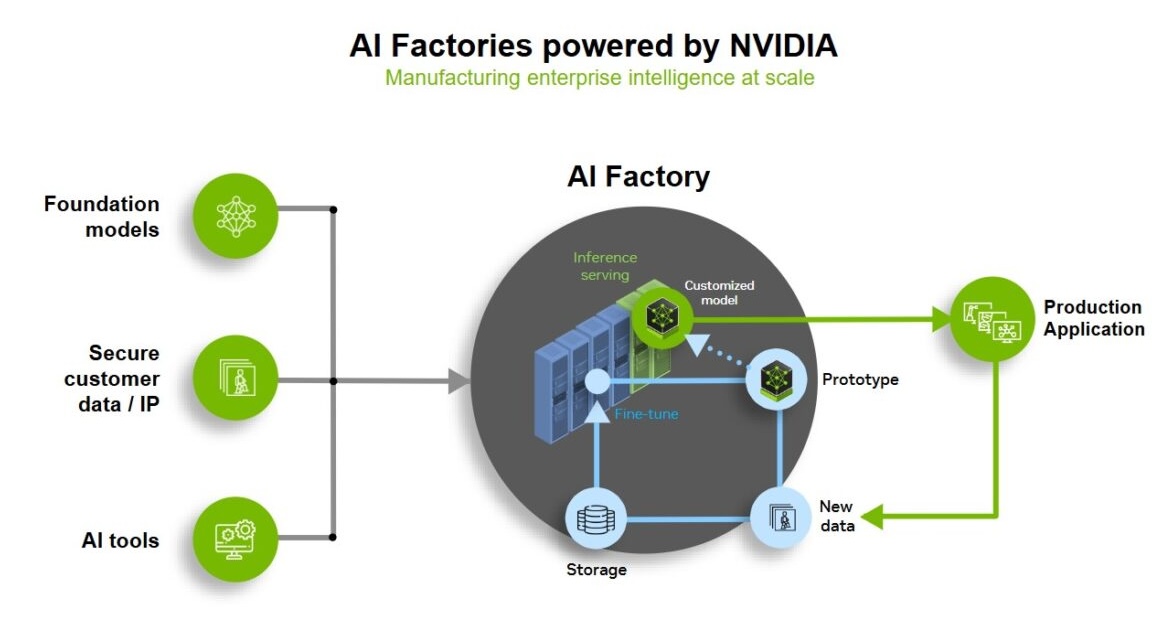
The work is an ongoing proof-of-concept engagement, and DDN characterizes the results so far as promising early data. The companies report measurable improvements in time to first token with KV cache enabled and have completed RoCE-based infrastructure validation, with benchmarking continuing across larger inference sequence lengths as they identify further optimization opportunities within the Infinia platform. The project has also expanded to include collaboration with NVIDIA on benchmarking methodologies, scalability validation, and future technical publications.
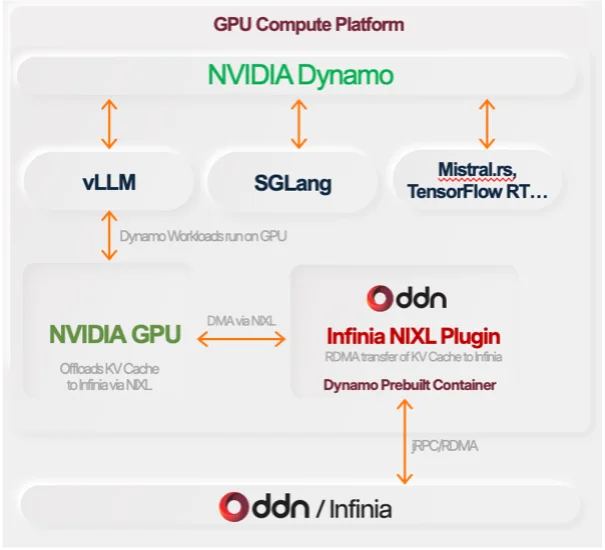
The platform uses distributed KV cache services, GPU-native data movement, data orchestration, and high-performance storage architectures. KV cache acceleration is particularly relevant for inference because it preserves and rapidly retrieves previously computed attention state, reducing repeated computation and limiting data delivery delays that can leave GPUs idle.
Leadership from DDN, Nebul, and NVIDIA signaled a fundamental industry shift from GPU acquisition to operational efficiency, with a focus on maximizing value from deployed accelerators. DDN CEO Alex Bouzari and Nebul CEO Arnold Juffer both emphasized that while model scale was the historical priority, the current challenge lies in inference economics and making production AI commercially viable through lower token costs. Rod Evans, Vice President of Cloud Infrastructure at NVIDIA, added that as organizations move toward large-scale agentic workloads, infrastructure success is increasingly measured by GPU utilization and latency rather than raw compute capacity.
DDN argues that AI infrastructure must evolve beyond conventional storage operations and become an active participant in AI execution. The company says its platforms support more than one million GPUs globally, spanning hyperscalers, cloud builders, enterprises, governments, and research institutions.
For infrastructure teams, the relevant production metrics increasingly include:
- GPU utilization, measuring how effectively expensive accelerators remain active during inference.
- Cost per token, connecting infrastructure efficiency to the cost of model output.
- Tokens per watt, measuring output efficiency against power consumption.
- Time to first token, which affects perceived responsiveness for interactive AI applications.
- Time to production reflects the operational effort required to move AI services from testing to scalable deployment.
As inference becomes the dominant AI operating workload, the ability to deliver cached context and enterprise data to GPUs with low, predictable latency will be increasingly important to sustaining utilization and controlling costs.


 Amazon