

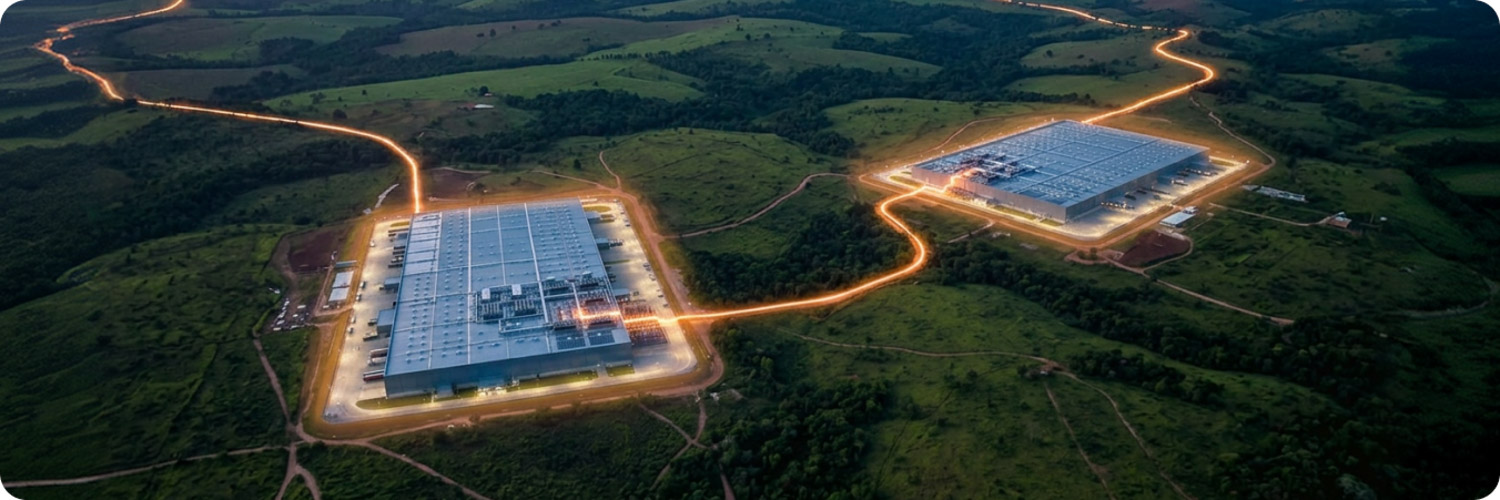
WhiteFiber has disclosed initial R&D results for Project Redwood, a distributed GPU supercluster architecture designed to operate across geographically separated data centers. Announced last week, the test delivered 111.2 Tbps of throughput over 83 km of dark fiber, with a guaranteed round-trip latency of 0.9 ms.
WhiteFiber said the latency is within 8% of the physical propagation limit for light traveling through fiber over that distance. The company used only part of the available fiber spectrum in the test, a result it says is already roughly double the capacity of comparable published full-spectrum field trials, and plans to light the full spectrum ahead of a targeted commercial launch in Q3 2026.
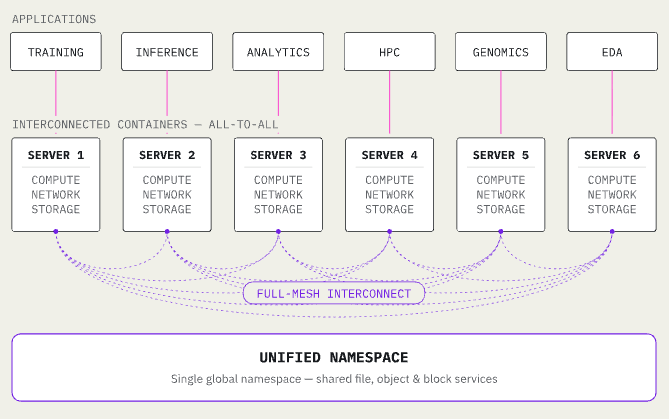
The work was completed with DriveNets and WEKA. DriveNets provides the Ethernet-based AI fabric between facilities, while WEKA NeuralMesh supplies the storage and memory infrastructure spanning the cluster. WhiteFiber has submitted patent applications related to the implementation.
Treating Multiple Sites as One GPU Cluster
The architecture is intended to make two data centers function as one logical GPU supercluster, rather than two independently operated clusters connected by a conventional DCI link. That distinction is important for AI training and inference workloads where GPU-to-GPU synchronization, collective operations, and access to shared data infrastructure can determine usable cluster scale.
WhiteFiber positions the platform for workloads that outgrow a single site’s available power, cooling, space, resilience design, or data-sovereignty requirements. The company also sees applications in edge computing, telecommunications, and sovereign AI deployments.
DriveNets’ companion announcement identifies the hardware: the fabric connects two WhiteFiber NVIDIA H200 GPU clusters located 52 miles apart, and DriveNets describes the deployment as the industry’s first commercial, long-distance scale-across AI supercluster, validated at production scale rather than in a lab. As part of validation, the companies compared rack-to-rack performance within a single site against rack-to-rack performance spanning the two sites, with methodology details in DriveNets’ white paper.
DriveNets Fabric Design
The inter-site environment uses redundant dark fiber and DriveNets AI Fabric to carry GPU and storage traffic. DriveNets characterizes the architecture as a scheduled Ethernet fabric built for predictable distributed AI communications, rather than a traditional long-haul Ethernet extension.

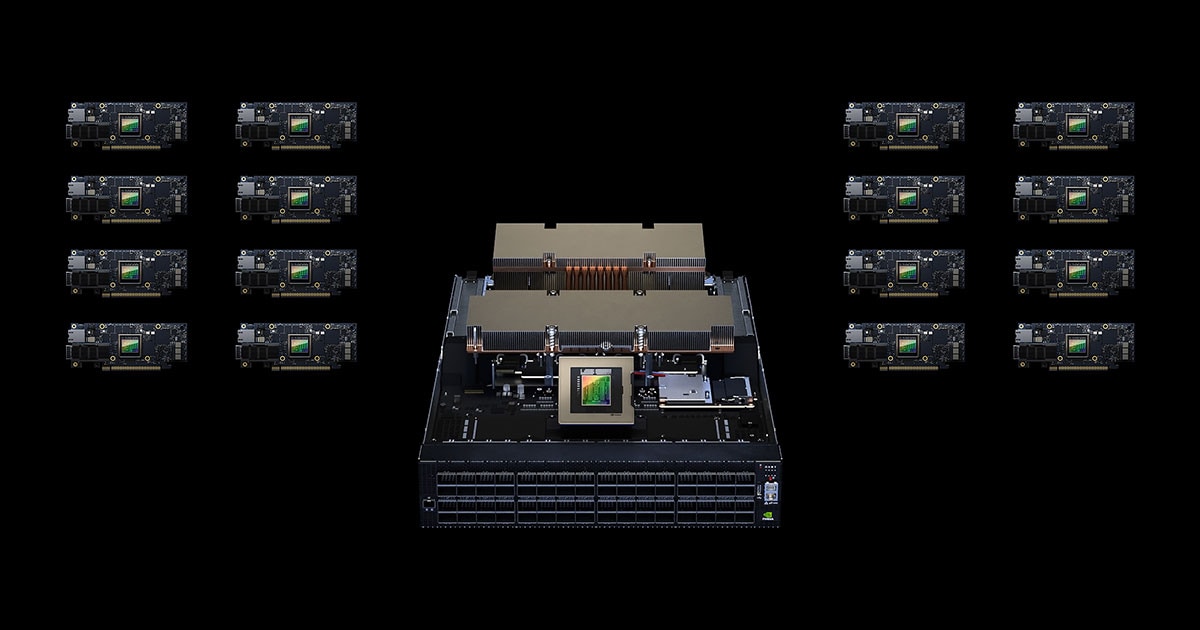
The design extends the AI fabric across sites using DriveNets’ Fabric Scheduled Ethernet technology running on its 9300F, 5300R, and 5301R switches. The approach combines cell-based load balancing, end-to-end Virtual Output Queuing, and deep-buffer interconnects that absorb synchronized AI traffic bursts before they cause congestion on the inter-site links. DriveNets says the result is predictable, lossless connectivity between sites that keeps GPU utilization high, as if the entire cluster were under one roof.
Together, these mechanisms aim to preserve predictable behavior for collective communications over distance while supporting a unified compute and storage fabric. Multi-tenant isolation is part of the stated design objective.
The result is an architecture that treats the fiber route as part of an AI fabric, not simply a transport connection between sites. The goal is to reduce the operational significance of the physical data-center boundary for workloads running across the cluster.
A Separate Approach From NVIDIA Spectrum-XGS
WhiteFiber’s test platform is distinct from NVIDIA Spectrum-XGS Ethernet. However, the work aligns with the broader industry push toward “scale-across” AI infrastructure.
At Hot Chips 2025, NVIDIA CEO Jensen Huang described the need to link data centers across cities, countries, and continents to form large-scale AI factories. NVIDIA’s Spectrum-XGS approach uses distance-aware congestion control, precision latency management, and telemetry to improve predictability for distributed GPU communication. CoreWeave is among the early adopters named by NVIDIA.
WhiteFiber has supplied more specific early field-test metrics than NVIDIA has publicly disclosed for Spectrum-XGS deployments. Its 83 km test delivered 111.2 Tbps and 0.9 ms round-trip latency, although the systems use different architectures and their results are not directly comparable.
Distributed Training Moves Beyond a Single Facility
WhiteFiber’s announcement arrives as other cloud and infrastructure providers investigate multi-site AI training and inference architectures.
Oracle Cloud Infrastructure and NVIDIA have published work using the NeMo Framework and Megatron-Core to run LLM training across data centers separated by approximately 1,000 km. NVIDIA reported more than 96% training scalability through hierarchical all-reduce and chunked inter-data-center communications. That work is primarily a software and systems demonstration, rather than a metro-scale transport benchmark.
Google has also developed TPU Multislice, allowing multiple TPU slices to operate as a larger distributed training environment across its data-center network and optical interconnects. Google has said that Gemini training used multiple data centers, with the platform designed to manage workload partitioning and resilience at scale.
WhiteFiber is aiming to bring a similar cross-site design to GPU cloud infrastructure, with a specific focus on high-bandwidth, low-latency metro connectivity. The company plans to provide further architectural and availability details as it moves toward commercial deployment in Q3 2026.


 Amazon