

Intel formally introduced Core Ultra Series 3 at CES 2026 as its first client compute platform built on the Intel 18A manufacturing process. The launch brings a shift in Intel’s client lineup, with Series 3 spanning high-end mobile processors, mainstream laptops, and, for the first time, edge and embedded-certified variants under a single platform.
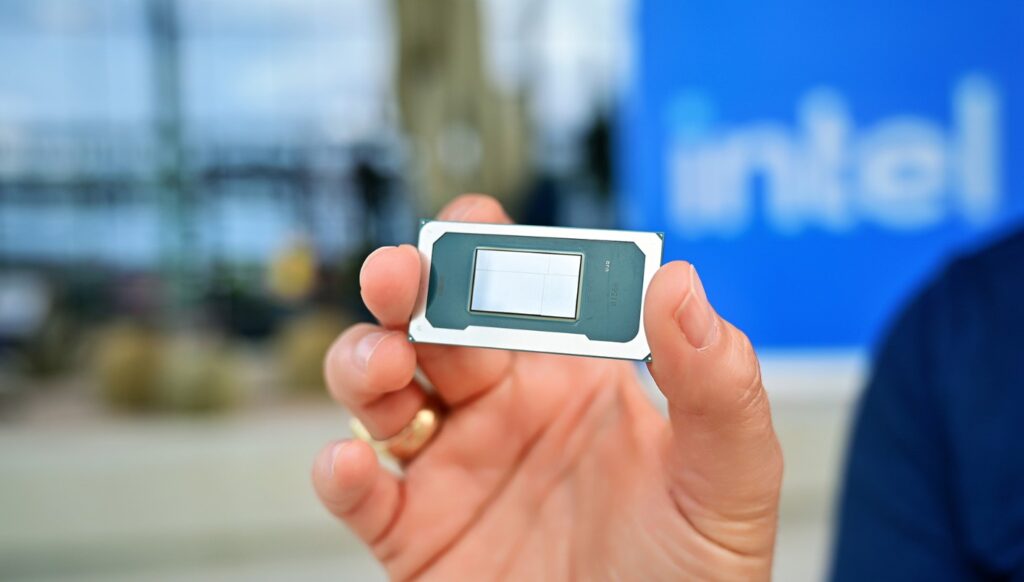
According to Intel, Series 3 is designed to scale across more than 200 PC designs worldwide, covering a wide range of price points and form factors while sharing a common architecture built around power efficiency, higher core counts, larger integrated graphics, and expanded on-die AI acceleration. All Series 3 processors are manufactured in the United States using Intel’s RibbonFET transistor design and PowerVia backside power delivery, which together underpin the Intel 18A node.
Intel Core UltraSeries 3 Processors Overview
Looking at the Core Ultra Series 3 lineup as a whole, the most significant differences center on core count, clock speeds, and cache size. At the top, the Core Ultra X9 388H and X7 models feature 16 total cores and the highest boost clocks in the table, with the X9 reaching up to 5.1 GHz and carrying an 18 MB Smart Cache. The regular Core Ultra 9 and Ultra 7 H-series chips retain the same 16-core layout but lower peak clocks, which helps differentiate them without changing the overall platform. Further down, the non-H Ultra 7 and Ultra 5 parts move to 8-core and 6-core designs, along with smaller cache sizes and slightly lower boost frequencies, making them a better fit for thinner, lower-power systems. Across the lineup, the 25 W base power stays consistent, and the real separation comes from how much frequency and cache each chip is allowed to use.
Here’s a full rundown of all the CPU models from the Ultra Series 3:
| Processor Number | CPU | NPU (TOPS) | GPU | Memory | Power | |||||||
| Total Cores | P-core Max Turbo (GHz) | Intel Smart Cache LLC (MB) | Brand | Total Xe-cores | Max Freq (GHz) | TOPS | Max Speed (MT/s) | Max Capacity (GB) | Processor Base Power | Maximum Turbo Power (W) | ||
| Intel Core Ultra X9 388H | 16 | 5.1 | 18 | 50 | Intel Arc B390 / Intel Arc Pro B390 | 12 | 2.5 | 122 | LP5/X 9600 | 96 (LP5/x) | 25W | 65,80 |
| Intel Core Ultra 9 386H | 16 | 4.9 | 18 | 50 | Intel Graphics | 4 | 2.5 | 40 | LP5/X 8533 DDR5 7200 |
96 (LP5/x) 128 (DDR5) |
25W | 65,80 |
| Intel Core Ultra X7 368H | 16 | 5.0 | 18 | 50 | Intel Arc B390 / Intel Arc Pro B390 | 12 | 2.5 | 122 | LP5/X 9600 | 96 (LP5/x) | 25W | 65,80 |
| Intel Core Ultra 7 366H | 16 | 4.8 | 18 | 50 | Intel Graphics | 4 | 2.5 | 40 | LP5/X 8533 DDR5 7200 |
96 (LP5/x) 128 (DDR5) |
25W | 65,80 |
| Intel Core Ultra 7 365 | 8 | 4.8 | 12 | 49 | Intel Graphics | 4 | 2.5 | 40 | LP5/X 6800 DDR5 6400 |
96 (LP5/x) 128 (DDR5) | 25W | 55 |
| Intel Core Ultra X7 358H | 16 | 4.8 | 18 | 50 | Intel Arc B390 | 12 | 2.5 | 122 | LP5/X 9600 | 96 (LP5/x) | 25W | 65,80 |
| Intel Core Ultra 7 356H | 16 | 4.7 | 18 | 50 | Intel Graphics | 4 | 2.45 | 40 | LP5/X 8533 DDR5 7200 |
96 (LP5/x) 128 (DDR5) |
25W | 65,80 |
| Intel Core Ultra 7 355 | 8 | 4.7 | 12 | 49 | Intel Graphics | 4 | 2.5 | 40 | LP5/X 6800 DDR5 6400 |
96 (LP5/x) 128 (DDR5) |
25W | 55 |
| Intel Core Ultra 5 338H | 12 | 4.7 | 18 | 47 | Intel Arc B370 / Intel Arc Pro B370 | 10 | 2.4 | 98 | LP5/X 8533 | 96 (LP5/x) | 25W | 65,80 |
| Intel Core Ultra 5 336H | 12 | 4.6 | 18 | 47 | Intel Graphics | 4 | 2.3 | 37 | LP5/X 8533 DDR5 7200 |
96 (LP5/x) 128 (DDR5) |
25W | 65,80 |
| Intel Core Ultra 5 335 | 8 | 4.6 | 12 | 47 | Intel Graphics | 4 | 2.45 | 40 | LP5/X 6800 DDR5 6400 |
96 (LP5/x) 128 (DDR5) |
25W | 65,80 |
| Intel Core Ultra 5 325 | 8 | 4.5 | 12 | 47 | Intel Graphics | 4 | 2.45 | 40 | LP5/X 6800 DDR5 6400 |
96 (LP5/x) 128 (DDR5) |
25W | 55 |
| Intel Core Ultra 5 332 | 6 | 4.4 | 12 | 46 | Intel Graphics | 2 | 2.3 | 18 | LP5/X 6800 DDR5 6400 |
96 (LP5/x) 128 (DDR5) |
25W | 55 |
| Intel Core Ultra 5 322 | 6 | 4.4 | 12 | 46 | Intel Graphics | 2 | 2.3 | 18 | LP5/X 6800 DDR5 6400 |
96 (LP5/x) 128 (DDR5) |
25W | 55 |
Intel 18A Moves into High-Volume Client Production
Series 3 is Intel’s first shipping client platform on Intel 18A, which combines RibbonFET gate-all-around transistors with PowerVia backside power delivery. Intel says the 18A node improves both power efficiency and chip density compared to earlier generations, citing gains in performance per watt and denser layouts at similar frequencies.
From a platform perspective, it focuses on larger integrated components within mobile power envelopes (rather than raw frequency increases). Intel says that 18A is already in high-volume production, rather than a limited or pilot node, which is important given the number of systems Series 3 is expected to power across consumer, commercial, and embedded markets.
A Broader Core Ultra Lineup, Including New X9 and X7 Tiers
In the mobile lineup, Intel added new Core Ultra X9 and X7 tiers above the existing Core Ultra 9, 7, and 5 branding. These parts are positioned as the highest-performance integrated solutions in the lineup, pairing higher CPU core counts with Intel’s largest integrated Arc graphics configurations to date.
Top Core Ultra X9 and X7 models scale up to 16 CPU cores, using a hybrid configuration built from Cougar Cove performance cores and Darkmont efficiency cores. On the graphics side, these processors integrate up to 12 Xe3-based Xe-cores, along with enhanced ray tracing units and XMX engines for graphics and AI workloads. Intel also lists up to 50 TOPS of NPU performance from its fifth-generation NPU block, contributing to a platform-level AI compute figure that spans CPU, GPU, and NPU resources.
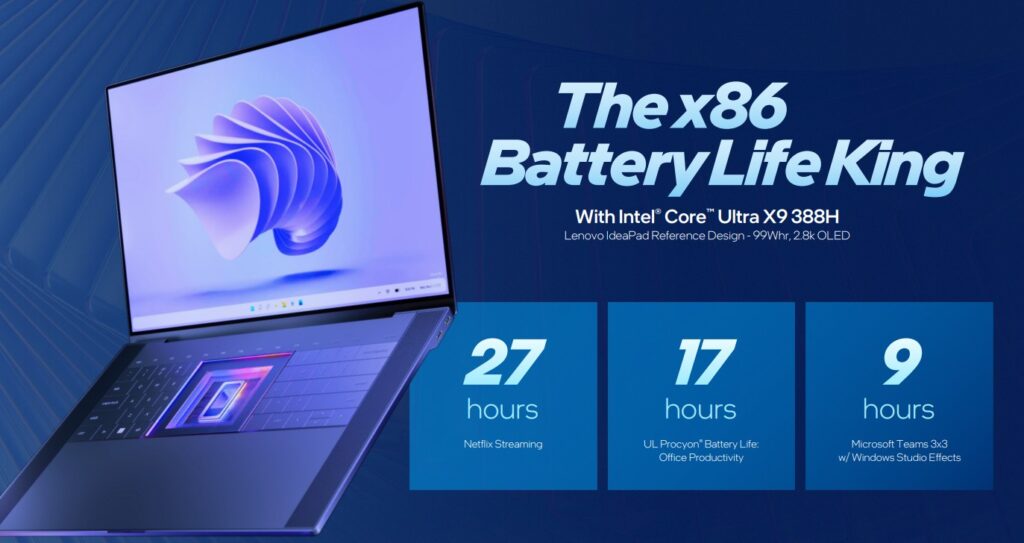
Intel states that these higher-tier parts target users who mix gaming, content creation, and productivity workloads on the same system, with battery life claims reaching up to 27 hours in specific reference configurations.
Beyond the higher-end Ultra models, the Series 3 lineup also includes more mainstream Intel Core mobile processors for lower-cost systems. These chips are built on the same Series 3 foundation, but step down core counts and graphics configurations to better fit thinner designs and tighter budgets. Instead of using different architectures for different price tiers, Intel is keeping everything on the same platform, which makes it easier for manufacturers to scale designs up or down without reworking the system.
Integrated Graphics and Media Capabilities Continue to Expand
Graphics play a larger role in Series 3 than in previous Core generations. Intel’s Xe3-based Arc graphics are integrated across the stack, with higher-end SKUs featuring Intel Arc B390-class graphics and scaled-down variants appearing in mainstream models. These GPUs support ray tracing, XeSS upscaling, multi-frame generation, and media acceleration through updated Xe media and display engines.

Intel reports higher gaming and creative performance compared with earlier Core Ultra platforms, based on results measured at defined mobile power levels.
AI Acceleration Across CPU, GPU, and NPU
Series 3 continues Intel’s push toward distributed AI compute, with workloads dynamically split across CPU vector units, GPU XMX engines, and the dedicated NPU 5 block. Intel lists up to 180 TOPS of total AI compute across the platform, depending on configuration.

This allows a range of local AI tasks to run directly on the system, including real-time transcription, image and video processing, and generative workloads, without relying on cloud acceleration. The platform supports Windows ML, OpenVINO, and a range of ISV frameworks, with Intel emphasizing compatibility rather than exclusivity in AI software enablement.
The Core Ultra Series 3 is not limited to traditional PCs this time. For the first time, Intel is qualifying select Series 3 processors for edge and embedded use, including industrial and commercial deployments that operate continuously. These processors are validated for extended-temperature operation, predictable performance, and continuous 24×7 workloads, which makes them suitable for applications such as robotics, automation, healthcare systems, and smart infrastructure. Intel also indicates gains in AI throughput and efficiency at the edge, along with the ability to handle workloads on a single system-on-chip rather than relying on separate CPU and GPU components.
Availability
Pre-orders for the first consumer laptops powered by Intel Core Ultra Series 3 processors begin on January 6, 2026. Intel expects global system availability to start on January 27, with additional designs launching throughout the first half of the year.
Edge and embedded systems based on Core Ultra Series 3 are scheduled to begin shipping in the second quarter of 2026.


 Amazon