

NVIDIA has dropped the subscription requirement for Omniverse. The platform is now free for development, production, and redistribution, with no NVIDIA AI Enterprise subscription required. For a product that carried a $4,500-per-GPU-per-year list price under NVIDIA AI Enterprise, and whose Nucleus server pricing prompted a developer forum thread titled “Pricing: $25,000 for the nucleus server!?”, this is one of the larger licensing resets NVIDIA has made. It’s great news for the community, but it was announced very quietly via a forum sticky.
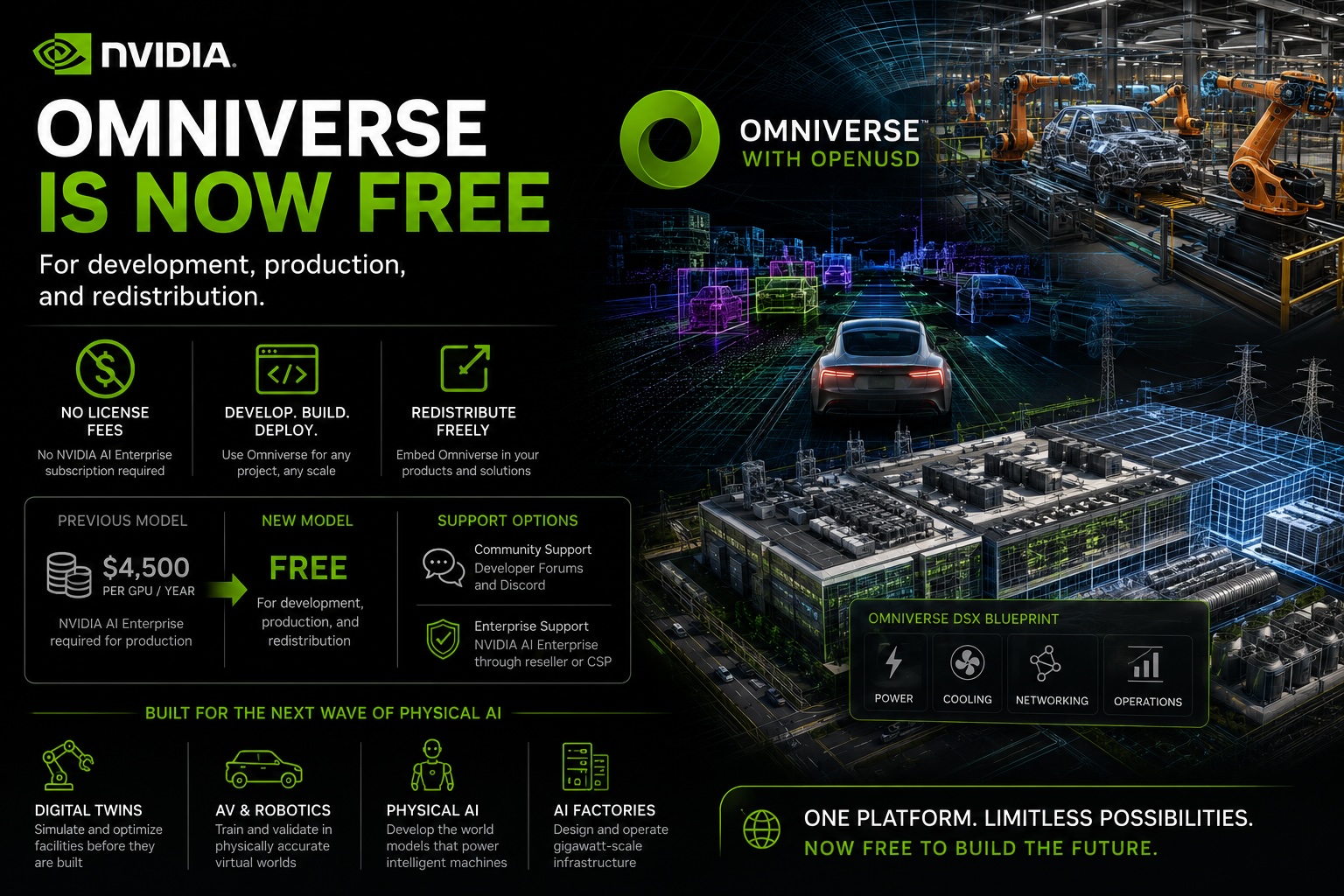
Licensing documentation was updated to read “As of May 2026, Omniverse is freely available for both development and production use,” and a short announcement was posted to the NVIDIA Developer Forums on July 1. Two days later, the announcement threads had zero replies, which says less about interest than about how few people know about them. The timing is intuitive though: SIGGRAPH 2026 runs July 19 to 23 in Los Angeles, and NVIDIA has a full slate of OpenUSD, neural rendering, and physical AI sessions on the schedule. Expect the licensing change to get a more formal introduction there.
What Changed?
Under the old model, Omniverse development was free, but production deployments required an NVIDIA AI Enterprise subscription, which lists at $4,500 per GPU per year, $22,500 per GPU perpetual, or $1 per GPU-hour on CSP marketplaces. The new terms remove that requirement entirely; anything built with Omniverse can also be redistributed under the same free terms, which is a substantive impact for ISVs and integrators who embed Omniverse applications inside their own products.
The catch, such as it is, sits in support. Without a subscription, support is limited to community channels, meaning the Developer Forums and Discord. Organizations that want enterprise support SLAs still buy NVIDIA AI Enterprise through a reseller or CSP marketplace. Partners who redistribute Omniverse within commercial products can use an embedded licensing model in which the partner handles front-line support, and NVIDIA provides back-line support. In practice, NVIDIA has moved Omniverse from a licensed product to a free platform with a paid support add-on, the same model as most open-source infrastructure businesses, minus the open source.
Omniverse Is Not Just a Rendering Tool
Omniverse is typically thought of as a CAD visualization and content creation platform, a way to import Rhino, Revit, and Maya scenes into a single physically based renderer. That framing undersells what NVIDIA has spent the last several years building. Omniverse paired with OpenUSD is the foundation for digital twin simulation, and digital twin simulation has become critical infrastructure for training physical AI: the world models that let robots and vehicles reason about environments they have never seen.
A great example is Alpamayo, the family of open autonomous vehicle models NVIDIA introduced at CES 2026. Alpamayo 1 is a 10-billion-parameter vision-language-action model, built on Cosmos, that generates driving trajectories along with chain-of-causation reasoning traces explaining why it acted. Models like that cannot be trained or validated on road miles alone; rare and dangerous edge cases are better off simulated than on busy streets. That is what the AlpaSim blueprint and NVIDIA’s neural reconstruction pipelines do, and the Omniverse with OpenUSD is the underlying simulation environment. The first production deployment, the Mercedes-Benz CLA on the DRIVE platform, reached the US market this year. Every developer who wants to work in that stack now gets the simulation layer without a license conversation.
Digital Twins, Up to and Including the AI Factory
A digital twin in this context is not a 3D model; it is a physically accurate, continuously updated simulation of a real facility, built from SimReady assets that carry mass, friction, and material properties, described in OpenUSD so that data from CAD, PLM, and simulation tools stays interoperable. The point is to run the facility in software before and during operation in the physical world: test a robot fleet’s routing on a virtual factory floor, validate camera placement, rehearse a production line change, and only then commit steel and concrete. BMW’s virtual factory work remains the canonical manufacturing example, and NVIDIA’s stated ambition is for every factory to have a digital twin before ground breaks.
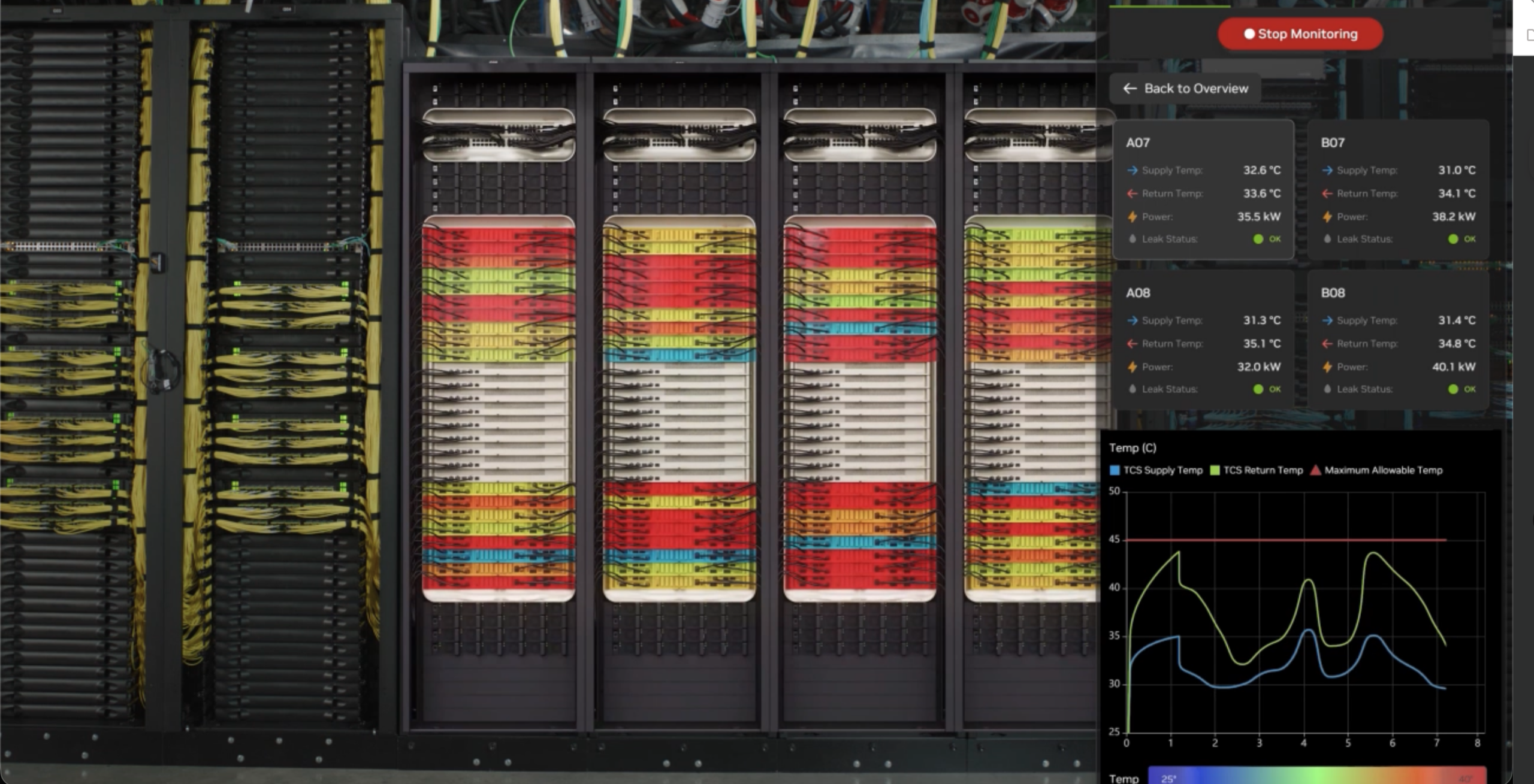
The most self-referential version of that ambition is the AI factory itself. In March, NVIDIA released the Omniverse DSX Blueprint alongside the Vera Rubin DSX AI factory reference design, a framework for building digital twins of gigawatt-scale GPU data centers. The blueprint unifies power, cooling, networking, and operations into a single simulated environment, with Cadence, Schneider Electric, Siemens, Vertiv, Eaton, Jacobs, and others contributing SimReady assets and integrating their design tools. The logic is the same as the factory floor, with larger numbers attached. These buildouts run into the billions of dollars; mistakes in power and cooling design surface too late, after the concrete is poured, and simulating the facility first is cheaper than discovering a thermal problem in production. NVIDIA is using digital twins of the factories that build tokens to sell the chips that fill them, and Omniverse is the tooling for it all.
Why Free, and Why Now?
Omniverse software subscriptions were never going to register next to a data center business now measured in the tens of billions per quarter, but as a licensed product, Omniverse was friction in front of the workloads NVIDIA most wants to exist. Digital twins, robot training, AV simulation, and AI factory design all consume RTX and data center GPUs at scale, and all of them start with a developer standing up Omniverse. Removing the license removes the reason to prototype on something else. The support-attach model keeps an enterprise revenue path open while the platform grows adoption.



 Amazon