

At SUSECON in Prague, SUSE introduced SUSE AI Factory with NVIDIA, a pre-validated enterprise AI software stack that simplifies deployment and operations from local development through production. Built on SUSE AI and NVIDIA AI Enterprise, the platform is designed for organizations seeking to build, govern, and scale AI workloads across edge locations, core data centers, and public cloud environments while maintaining tighter control over data and infrastructure.
The announcement positions SUSE AI Factory as a standardized software layer for enterprise AI rather than a standalone model or service. The stack integrates several NVIDIA components, including NIM microservices, open Nemotron models, NeMo for agent development and management, Run:ai for GPU orchestration, NVIDIA Kubernetes Operators, OpenShell for secure agent runtime support, and NemoClaw, which uses SUSE K3s as part of a reference architecture for more secure autonomous agent deployments.
SUSE said the offering is designed to address a common enterprise AI challenge: moving from experimentation to production without introducing excessive operational complexity or compromising governance. According to the company, development teams can build and validate workloads in sandboxed environments. In contrast, platform teams can manage deployments through a Rancher-based interface or GitOps workflows for large-scale rollouts and lifecycle management. The goal is to reduce the number of disconnected tools needed to stand up AI infrastructure and make deployments more repeatable across distributed environments, including air-gapped sites.
From a platform perspective, SUSE is emphasizing a few core areas. First, SUSE is promoting pre-validated blueprints for common AI deployment patterns, which should reduce integration work for enterprise teams assembling custom stacks. Second, SUSE is focusing on zero-trust security and observability, built around SUSE Rancher Prime and SUSE Linux Enterprise Server, with governance controls for NVIDIA-based AI services. Third, SUSE is prioritizing deployment and lifecycle consistency, providing a common operational model from developer workstations to edge clusters. SUSE is also framing the platform around digital sovereignty, supporting organizations that need to keep models, data, and operational control within their private infrastructure to meet internal policies or regulatory requirements, such as the EU AI Act.
Thomas Di Giacomo, Chief Technology and Product Officer at SUSE, discussed the challenges AI teams face. He emphasized the need for balancing rapid innovation with workload security and full auditability before deployment. He also highlighted SUSE AI Factory with NVIDIA as a comprehensive, secure, and sovereign solution supporting both current and future AI development.
John Fanelli, Vice President of Enterprise Software at NVIDIA, noted that Enterprise AI adoption is accelerating, underscoring the need for compliant, secure infrastructure. He explained that their collaboration with SUSE provides an open, comprehensive AI Factory on a secure, sovereign platform that meets technical and regulatory standards.
SUSE AI Factory with NVIDIA is expected later this year.
Digital Sovereignty and Resilience
The product launch was accompanied by new SUSE research on digital sovereignty and digital resilience. In a survey of 309 IT leaders across France, Germany, India, Japan, and the U.S., SUSE found that 98% of respondents consider digital sovereignty a priority. Yet, only 52% said they are actively implementing it. The data suggests that many enterprises now recognize sovereignty as strategically important, particularly as AI adoption accelerates, but execution remains uneven.
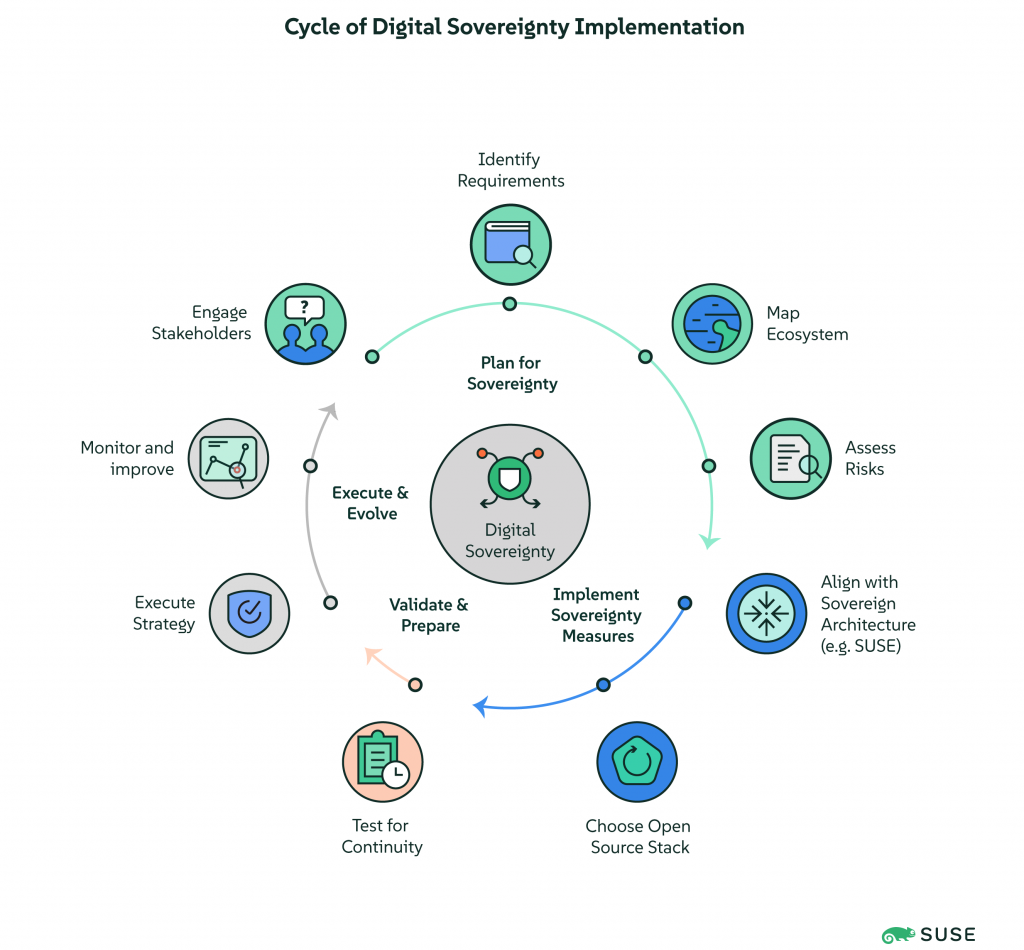
Regional differences were notable. Respondents in India reported the highest level of active investment in digital sovereignty at 62%, followed by Germany and Japan at 57%, the U.S. at 52%, and France at 39%. The survey also found that sovereignty is beginning to influence procurement, with 45% of respondents saying it was included in recent RFPs and 42% reporting that it ultimately affected vendor selection. Even so, 41% said action is typically driven only by customer requirements or regulatory pressure, suggesting that external mandates remain a stronger trigger than internal readiness.
SUSE’s survey also linked AI adoption directly to resilience planning. Sixty-four percent of respondents said AI transparency, including visibility into model training and provenance, will be the primary driver of digital resilience over the next five years. At the same time, SUSE found that when given an unexpected 20% budget increase, most organizations would prioritize AI initiatives over investments in sovereignty, underscoring a persistent gap between the urgency of deployment and governance maturity.
When asked how they define digital resilience, respondents consistently emphasized control over systems and infrastructure, as well as recovery posture. Cybersecurity and threat detection ranked highest at 63%, followed by multi-cloud or hybrid diversification at 52%. Backup and recovery at 45% and continuous monitoring at 44% were also key elements of the resilience strategy.
The survey also highlighted the ongoing role of hyperscalers in sovereign infrastructure planning. 65% of respondents said hyperscalers remain relevant for sovereign workloads, reflecting a practical tension between the scale and operational convenience of large cloud providers and the jurisdictional control many enterprises increasingly seek. That dynamic is likely to sustain high demand for open, portable infrastructure stacks that span private, hybrid, and hosted environments without locking customers into a single operational model.
SUSE said the findings reinforce the need for infrastructure that supports both AI adoption and sovereignty requirements, aligning with the positioning of its broader portfolio, including SUSE Linux, SUSE Rancher Prime, and SUSE AI.
The company’s Navigating Digital Resilience report was based on an independently conducted survey across 13 industries, and respondents were not informed that SUSE sponsored the research.
The full report is available from SUSE here.


 Amazon