

TrueNAS has introduced the V160, a new addition to its enterprise appliance portfolio designed to support larger, more dynamic workloads. The platform targets organizations that balance performance requirements with cost control, especially as flash pricing volatility continues to affect infrastructure planning.
The V160 is built on dual fifth-generation TrueNAS controllers powered by AMD EPYC processors, with PCIe 5.0 connectivity and up to 768GB of DDR5 memory per controller. The system uses a hybrid architecture that combines high-capacity HDD tiers with NVMe flash and a large adaptive cache layer. TrueNAS reports up to 60 GB/s of throughput, driven by memory bandwidth, and up to 24 TiB of cache.
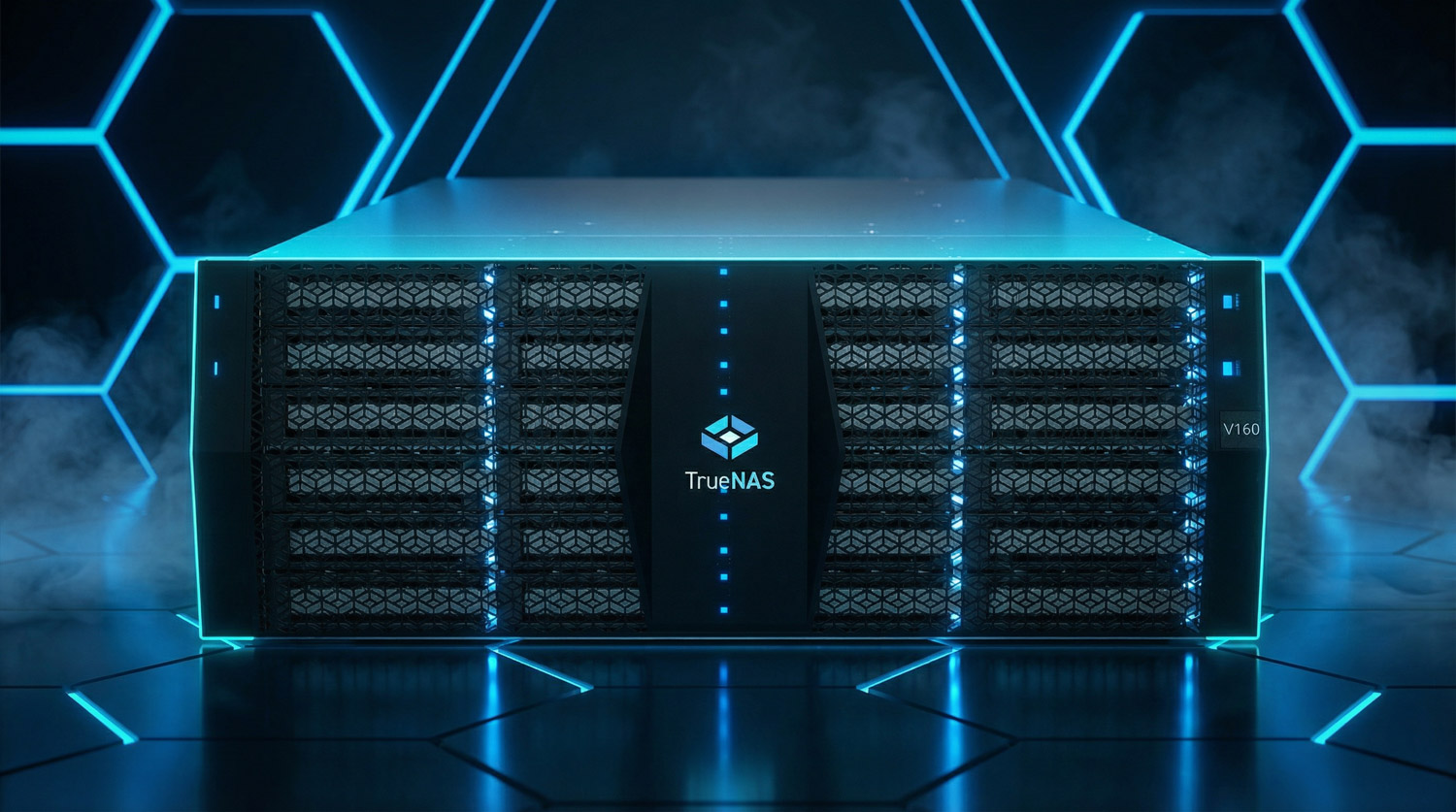
The hybrid design lets administrators tune the balance between NVMe and SAS HDD media across 24 internal bays and supports expansion to more than 1,400 drives in a single system. Additional scale-out options include up to six NVMe flash shelves or fourteen 102-bay SAS HDD shelves, enabling configurations with up to 20 PiB of flash or more than 35 PiB of HDD capacity. The platform does not impose capacity-based licensing, allowing organizations to scale storage without incremental software costs tied to capacity growth.
From a platform perspective, the V160 consolidates file, block, and S3-compatible object storage into a single system. This unified approach aims to reduce operational overhead from managing multiple storage silos, tools, and support models. The system supports a broad virtualization and container ecosystem, including VMware, Proxmox, Hyper-V, Xen, OpenShift, and Kubernetes. It includes high-availability and failover capabilities designed for large-scale virtual machine deployments.
| Capability | TrueNAS V160 |
|---|---|
| Raw Capacity | 20 PiB NVMe, 35PiB HDD |
| Throughput | Up to 60 GB/s |
| Network | 4x 100/200, 2×400 GbE, 4x16Gb FC, 2x32Gb FC |
| Hybrid Cache | 24 TiB |
| RAM | Up to 768GB DDR5 |
| High Availability | > 99.999% Uptime |
The system is also optimized for high-throughput workloads such as media production and AI pipelines. For media environments, including 4K and 8K video workflows, the platform supports real-time editing and ingest without relying on proxy workflows. In AI and machine learning use cases, NVMe tiers can be used for active model serving, while HDD tiers provide lower-cost capacity for training datasets and archival data.
| Access | Protocols |
|---|---|
| File | SMBv2, SMBv3, NFSv3, NFSv4 w/RDMA |
| Block | iSCSI, iSER, FC, NVMe-oF/RDMA |
| Object | S3-Compatible with Immutable Locking |
Data-efficiency features are built into the platform through TrueNAS Adaptive Compression and Fast Deduplication. Compression is applied selectively to reduce capacity consumption without affecting throughput on incompressible data, while deduplication targets redundant data before it is written to disk. These capabilities are included in the base system rather than as licensed add-ons.
The V160 runs TrueNAS Enterprise 25.10, with all major features enabled by default. These include snapshots, replication, multiprotocol access, and integration with TrueCloud backup. TrueNAS maintains a seven-year lifecycle for enterprise deployments, with no required hardware refresh cycles or additional feature licensing during that period. The company positions this as a predictable cost model driven by architecture and media flexibility rather than incremental licensing.
At the filesystem level, the V160 uses OpenZFS, enabling data portability across TrueNAS systems and other OpenZFS-compatible platforms. This approach avoids proprietary data formats and helps organizations retain control over data placement and migration strategies.
The TrueNAS V160 is available immediately. TrueNAS also indicated that its next major software release, TrueNAS 26, is currently in beta and expected to reach enterprise availability later in 2026.


 Amazon