

VAST Data introduced VAST Amplify, a capacity-optimization and customer-engagement program designed to help enterprises and service providers increase effective flash capacity by leveraging SSDs already deployed in their environments. Positioned for a market where storage lead times and allocation windows are tightening, the program focuses on identifying underutilized flash and rapidly qualifying existing hardware for reuse. It also consolidates capacity into the VAST AI Operating System, which is built on the company’s Disaggregated Shared Everything (DASE) architecture.
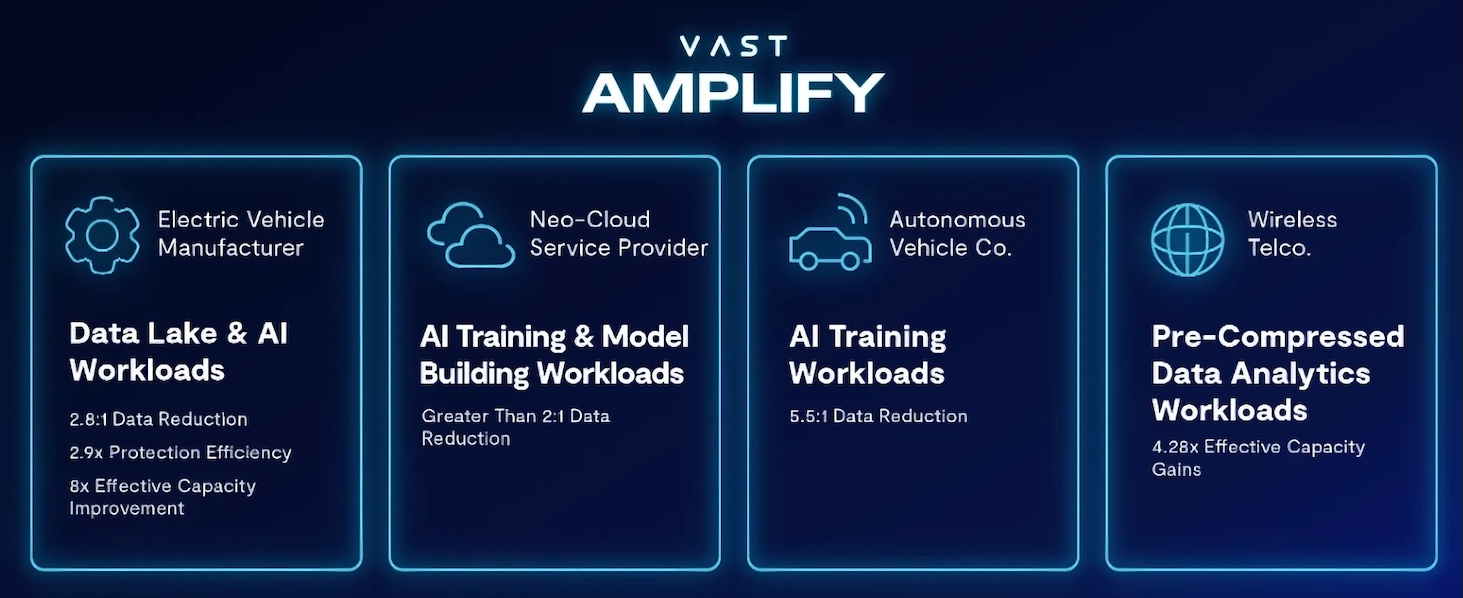
VAST claims customers can achieve up to 6× the effective capacity, depending on workload characteristics and the starting environment.
VAST frames the current SSD shortages as more than a procurement issue. Constrained supply is amplifying the cost of architectural overhead common in modern data platforms, including replication-heavy data protection, fragmented storage silos, and performance strategies that rely on overprovisioned flash. VAST Amplify is positioned as a structured approach to reclaim “stranded” SSD capacity and convert installed flash into a unified, globally accessible pool, sustaining AI and analytics growth without waiting for new hardware allocations.
Phil Manez, Vice President of GTM Execution at VAST Data, said the program is designed to help organizations avoid delays and capacity rationing by consolidating existing flash into a more efficient architecture that increases usable capacity and delivered performance. The message is that customers can extract more value from current SSD investments without being constrained by allocation timing.
AI Workloads Add Pressure, Including Inference-State Persistence
VAST also ties the program to evolving AI infrastructure requirements. As organizations shift from training to higher-volume inference, approaches that persist and reuse inference states, such as key-value (KV) caches, can increase demand for low-latency storage. In that context, maximizing effective capacity from existing flash becomes a strategic lever for keeping AI pipelines moving while controlling cost and procurement risk.
VAST Amplify is presented as a phased engagement aligned with measurable efficiency gains. The program begins with estate intelligence, where VAST analyzes the customer environment to identify underutilized SSD capacity, fragmentation across silos, and architecture-driven inefficiencies that reduce effective capacity. Rapid platform qualification accelerates the qualification of existing server and SSD configurations, enabling organizations to reuse installed flash with a defined path to production and reducing dependency on new allocation windows and long lead times.
Reclaiming SSD Investments
Capacity reclamation and pooling consolidate existing SSD investments into a unified VAST environment where capacity is globally accessible and dynamically allocated, removing constraints tied to server boundaries and legacy designs. Platform-level durability uses highly efficient erasure coding rather than replication-heavy approaches to increase usable capacity while maintaining resilience at scale. Global similarity-based data reduction applies continuous reduction across the namespace, eliminating redundant patterns wherever they occur rather than limiting reduction to individual volumes.
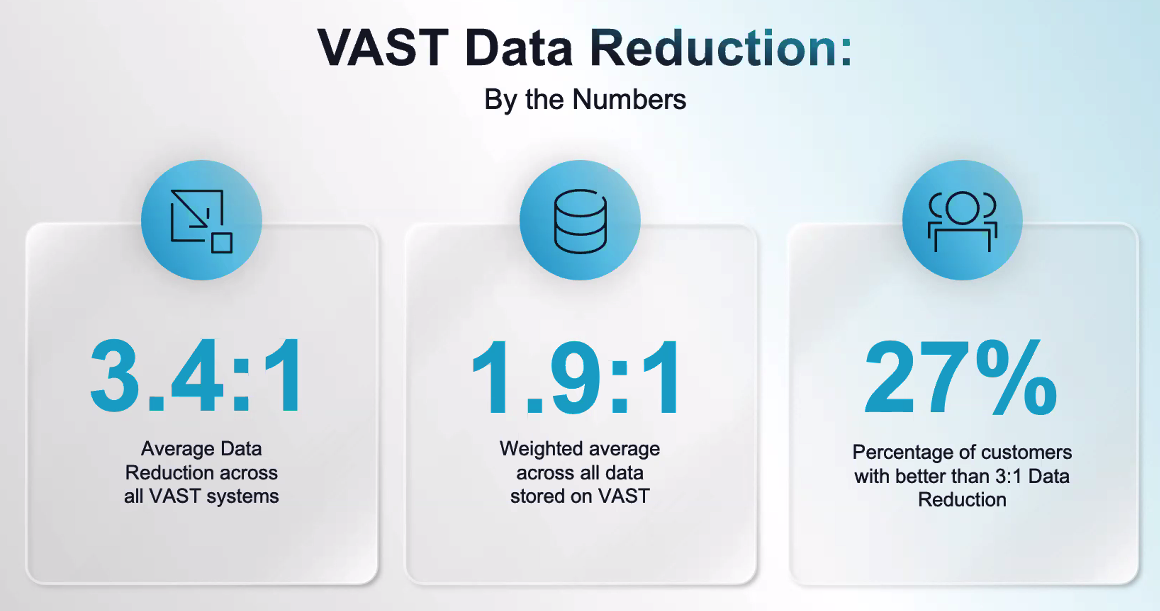
For write behavior, VAST describes an SCM-optimized write architecture that absorbs random and bursty writes in Storage Class Memory and writes to SSDs more efficiently in larger, sequential segments. This approach reduces write amplification, improves endurance, and sustains low-latency performance without heavy flash overprovisioning. By combining platform-level durability, global data reduction, and SCM-based write efficiency, VAST claims that VAST Amplify can deliver up to 6× or more effective capacity from existing SSD investments, with results dependent on workload and environment.
VAST stated that customers are already using VAST Amplify. The company indicates that the program is a way to keep AI and analytics initiatives on track during supply constraints by reclaiming existing flash capacity, consolidating it into the VAST AI OS, and maintaining performance without waiting for new procurement cycles.


 Amazon