

At VeeamON 2026 in New York City, Veeam Software introduced a set of coordinated announcements that extend its data resilience strategy into the emerging operational realities of AI. The company unveiled the Veeam DataAI Command Platform, previewed Veeam Data Platform v13.1 alongside a new DataAI Resilience Module, and launched a Data and AI Trust Maturity Model to help enterprises benchmark governance and operational readiness.
Together, these updates position Veeam to address a growing gap between the rapid adoption of AI and the ability to secure, govern, and recover the data those systems depend on.
A New Control Plane for Data, AI, and Identity
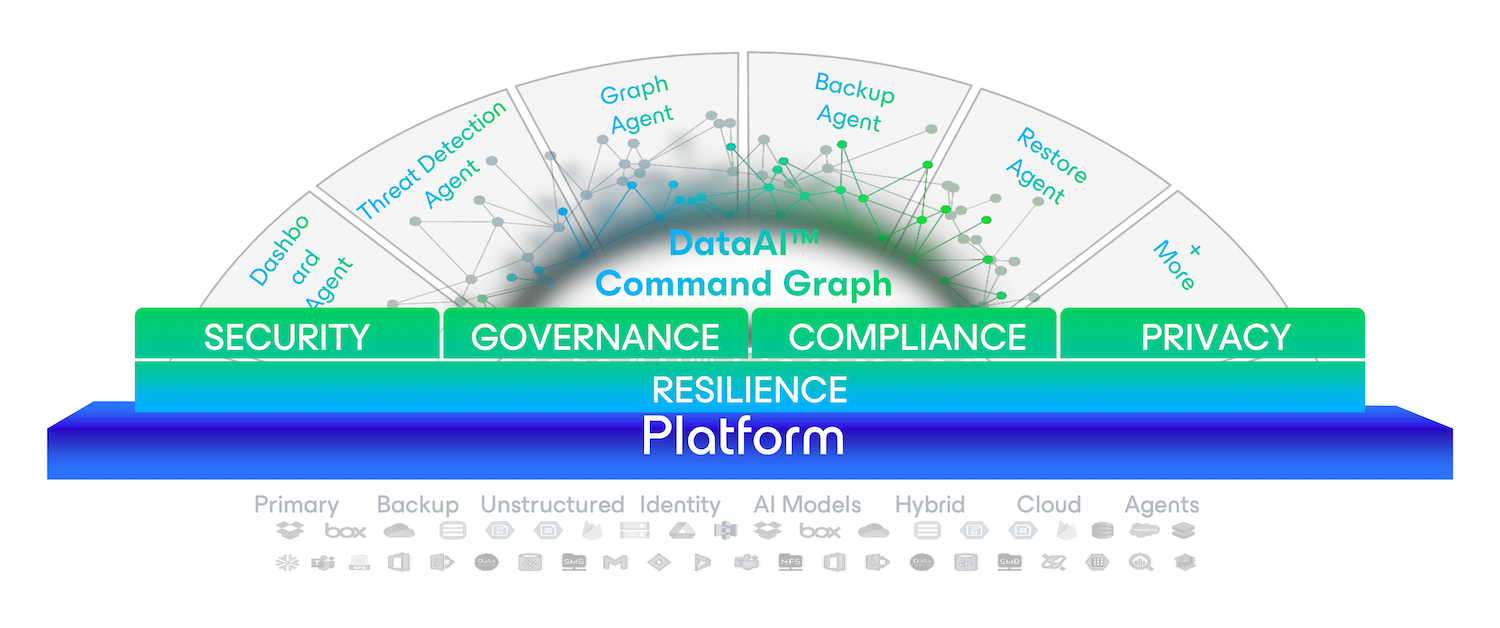
The Veeam DataAI Command Platform is a new architectural layer that unifies data protection, security, governance, and compliance for environments where autonomous AI agents operate at scale. The platform builds on Veeam’s acquisition of Securiti AI, integrating data security posture management with Veeam’s existing resilience stack.
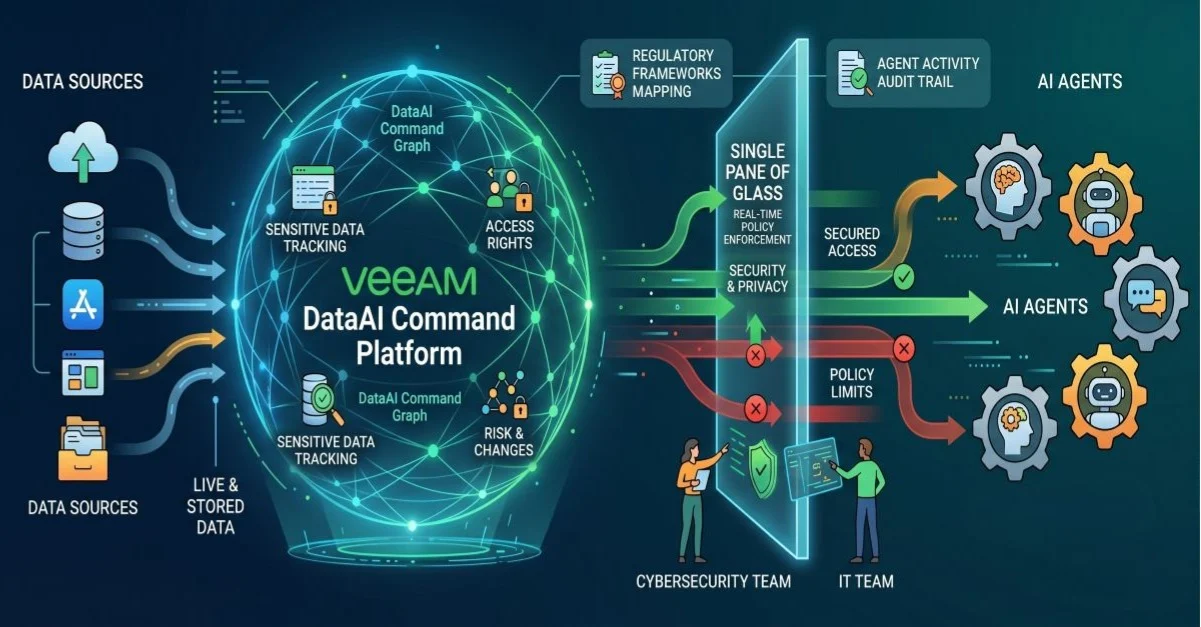
At its core is the DataAI Command Graph, an intelligence layer that maps relationships across data, identities, and access controls spanning cloud, SaaS, and on-premises environments. Unlike traditional inventory approaches, the graph operates at a granular level, identifying specific sensitive data elements, access paths, and changes that introduce risk. It also correlates production and backup data, enabling more context-aware recovery and governance workflows.
The platform brings together several functional domains. DataAI Security provides unified visibility into data and AI risk posture. DataAI Governance enforces controls at the data layer rather than relying on agent-level policies, limiting exposure from both sanctioned and unsanctioned AI agents. DataAI Compliance aligns data operations with major regulatory frameworks and produces audit-ready evidence. DataAI Privacy enforces policies in real time based on identity and jurisdiction. DataAI Precision Resilience extends Veeam’s recovery capabilities with more targeted remediation, allowing organizations to correct specific data issues without full system rollback.
Veeam frames this platform as a response to a structural shift in enterprise IT, in which the security boundary moves from infrastructure to the data itself as AI agents increasingly access and act on it.
Advancing the Core Platform with v13.1
In parallel, Veeam previewed Veeam Data Platform v13.1, which introduces more than 70 enhancements focused on modernization, security, and recovery performance. A key theme is workload portability across hypervisors, including support for environments such as OpenShift Virtualization, enabling organizations to move workloads without extensive replatforming.
Identity resilience is another focus area, with enhancements such as Active Directory Forest Recovery to improve recovery from identity-based attacks. Security capabilities expand to include broader malware detection, support for post-quantum cryptography, and deeper integration into security ecosystems.
The release also targets cost and operational efficiency. New capabilities for NAS archiving and long-term retention aim to reduce storage costs, while expanded threat detection extends scanning coverage across AWS, Azure, NAS systems, and Microsoft 365 environments. These updates are designed to improve both detection and recovery timelines across hybrid and multi-cloud estates.
DataAI Resilience Module Introduces Unified Operations
The new DataAI Resilience Module, delivered through the DataAI Command Platform, provides a centralized operational layer for managing data resilience. It introduces a single interface for visibility into protection status, operational health, and readiness across environments.
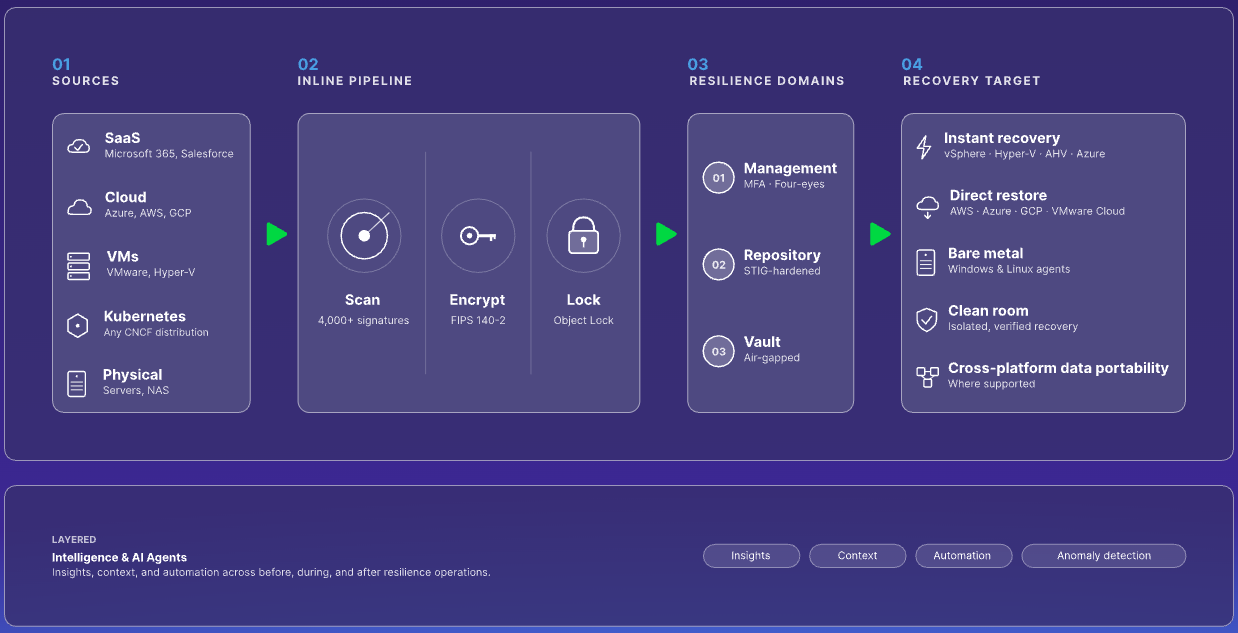
Global search and inventory capabilities allow operators to quickly determine whether specific workloads are protected and to initiate recovery actions ranging from file-level restores to full-site recovery or clean-room operations. The module also emphasizes operational consistency, reducing configuration drift and simplifying ongoing management tasks.
Built-in AI agents automate routine operations, including log analysis, ticketing workflows, and capacity planning. These capabilities aim to reduce operational overhead while improving responsiveness in large-scale environments.
Addressing the AI Trust Gap
Complementing the platform and product updates, Veeam introduced its Data and AI Trust Maturity Model, a framework designed to help organizations assess how effectively they govern and operationalize AI. The model is based on research across 300 senior business and technology leaders and highlights a widening gap between AI adoption and operational readiness.
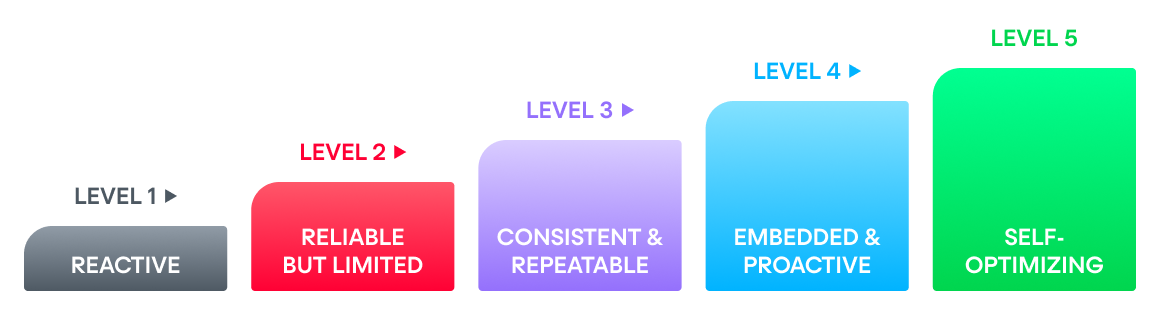
Veeam Data and AI Trust Model graphic
The findings indicate that AI is already embedded in many enterprise workflows, yet governance and auditability lag. While most organizations express confidence in scaling AI, a significant portion cannot produce audit-ready evidence to validate that confidence. Operational challenges, including skills gaps, integration complexity, and regulatory uncertainty, are emerging as primary barriers to scaling AI initiatives.
The maturity model evaluates organizations across 12 dimensions and five stages of progression, focusing on how controls perform under real-world conditions. It organizes readiness into four pillars: visibility into data and AI systems, enforcement of security and access controls, resilience through backup and recovery, and data readiness to support AI development.
The associated assessment provides scored benchmarks, peer comparisons, and prioritized recommendations, giving organizations a structured path from experimental AI use to production-scale, accountable deployments.
Availability
Veeam Data Platform v13.1 and the DataAI Resilience Module are expected to reach general availability in early Q3 2026 through Veeam’s partner ecosystem. The DataAI Command Platform and the Data and AI Trust Maturity Model are available as part of Veeam’s broader strategy to integrate data protection, security, and AI governance into a unified operational framework.


 Amazon