

The Dell PowerEdge R770AP is not a general-purpose server, and that is entirely the point. Where most 2U dual-socket platforms chase flexibility, the R770AP strips it away, trading GPU support, mixed storage options, and raw memory capacity for the highest core density, memory bandwidth, and execution determinism available in Dell’s current Intel lineup. It is a server built around a specific processor architecture for a particular class of workloads, and it makes no excuses for what it omits.
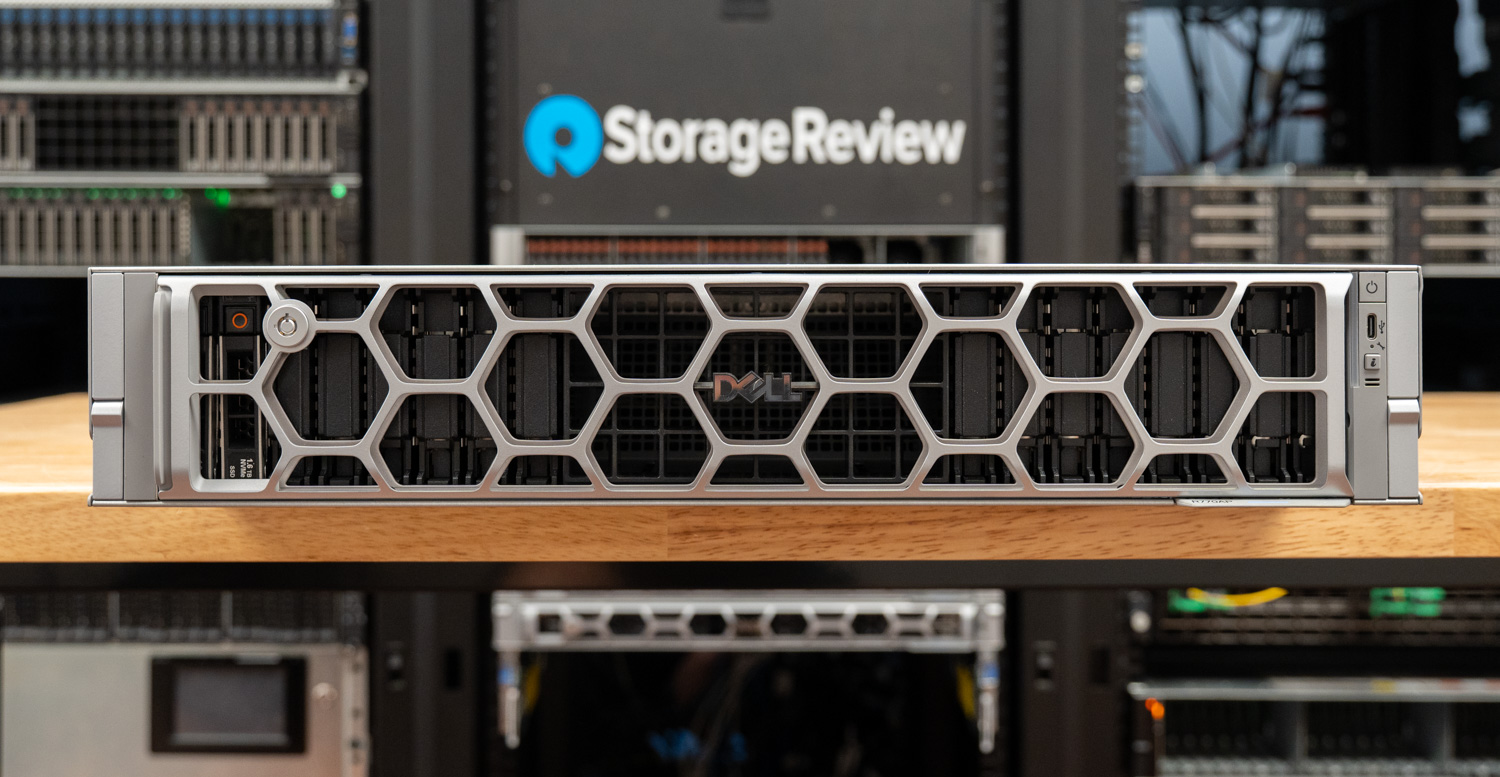
To understand why it exists, start with the platform it sits alongside. Dell’s PowerEdge R7x0 line has historically been the company’s most versatile 2U Intel server, with the AMD-powered PowerEdge R7725 filling an equivalent role on the EPYC side. The PowerEdge R770 carries that Intel tradition forward with support for both Xeon 6 P-core and E-core processors, GPU accelerators, mixed SAS/SATA/NVMe storage, up to 8 TB of memory across 32 DIMM slots, and enough PCIe Gen5 expansion to cover everything from virtualization to AI inference.
The PowerEdge R770AP is not that server.
The “AP” designation stands for Advanced Performance, but the name undersells how different this machine is. While the R770 uses Intel’s Granite Rapids-SP silicon on the LGA 4710 socket with 8 memory channels and up to 86 P-cores, the R770AP moves to the Granite Rapids-AP platform on the LGA 7529 socket, delivering up to 128 P-cores per socket (120 cores in our test configuration) and 12 DDR5 memory channels. This is the same distinction Intel draws across its entire Xeon 6 6900-series strategy: the 6900P parts on the AP platform represent Intel’s highest-performance server silicon, purpose-built for workloads where per-core performance, memory bandwidth, and execution determinism matter more than overall server configuration flexibility.
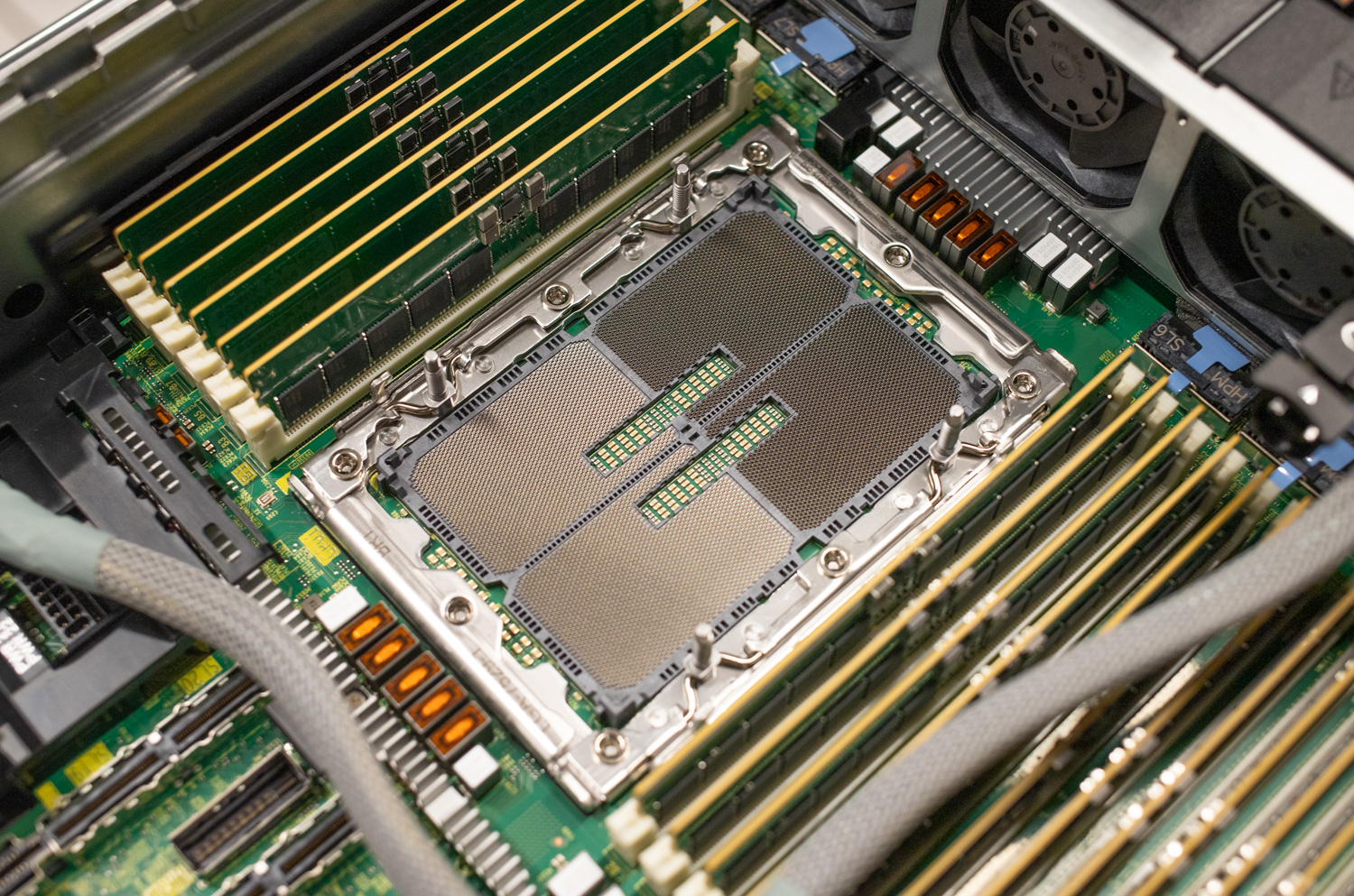
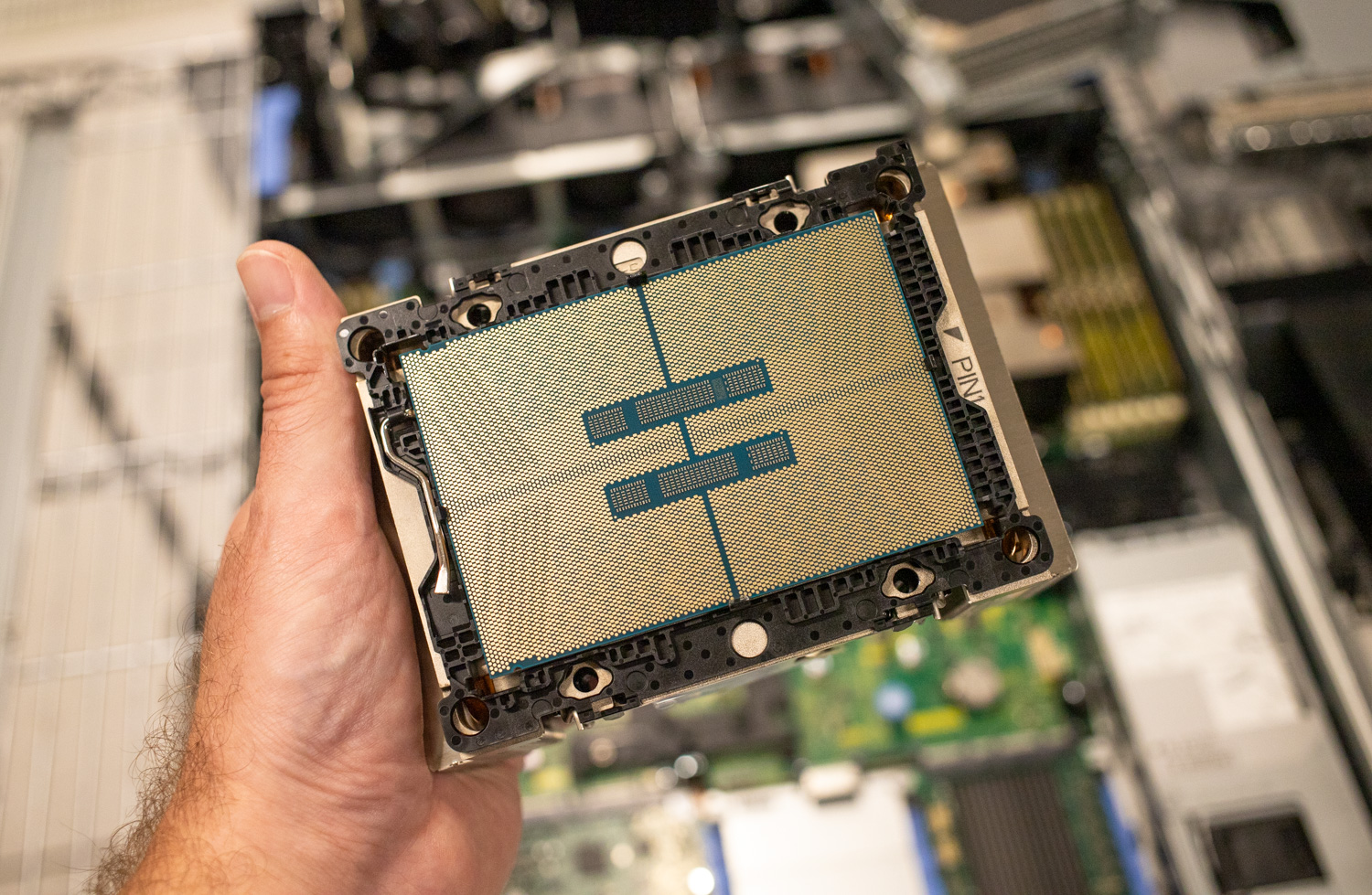
Intel’s new Granite Rapids-AP LGA 7529 Socket
Intel’s broader Xeon 6 architecture splits the data center into two lanes. E-core processors target density and power efficiency for cloud-native, scale-out workloads like microservices and content delivery. P-core processors target compute-intensive work where consistent per-thread performance is critical: HPC simulations, real-time analytics, large in-memory databases, and latency-sensitive financial compute. The 6900P series sits at the top of that P-core stack, pairing the highest available core counts with 12-channel memory bandwidth, up to 96 PCIe Gen5 lanes per socket, up to 6 UPI 2.0 links, and L3 cache pools that reach 504MB on top SKUs like the Intel Xeon 6978P. The architectural goal is not just raw throughput but predictable throughput, minimizing scheduling jitter and memory-access variability that erode performance in timing-critical environments.
The R770AP is Dell’s chassis expression of that philosophy. It strips away everything the Granite Rapids-AP platform doesn’t need: GPU support is gone entirely, SAS and SATA storage options are removed in favor of NVMe-only configurations (up to 16x 2.5-inch Gen5 NVMe or up to 32x E3.S Gen5 NVMe, configuration dependent), memory capacity tops out at 3 TB across 24 DIMM slots (12 per socket, 1DPC for maximum per-channel speed), and PCIe expansion is trimmed to five Gen5 x16 slots plus dual OCP NIC 3.0. What remains is a 2U dual-socket platform optimized for compute density, memory bandwidth, and the deterministic behavior demanded by workloads such as high-frequency trading, real-time risk analysis, and massively parallel simulation.

Kevin holding the R770AP Heatsink with the Intel 6900 Series chip
Our review unit pairs two Intel Xeon 6978P processors, each with 120 P-cores running at a 2.1 GHz base and 3.2 GHz all-core turbo, with 3TB of DDR5-6400 memory across all 24 DIMM slots. Compared to the R770, which is equipped with dual Xeon 6787P processors (86 cores each, 8 memory channels, 2 TB DDR5), the R770AP offers 39.5% more cores and 50% more memory channels. The question is whether those architectural advantages translate into proportional real-world gains, and whether the platform trade-offs are worth it for the workloads Dell and Intel are targeting.
Dell PowerEdge R770AP Specifications
The table below highlights the physical and supported configuration specifications for the Dell PowerEdge R770AP Platform.
| Specification | Dell PowerEdge R770AP |
|---|---|
| Processor | |
| Processor | Two Intel® Xeon® 6 6900-series processors with P-Cores, up to 128 Cores each |
| Memory | |
| DIMM Slots | 24 DDR5 DIMM slots |
| Maximum Memory | 3 TB |
| Memory Speed | Up to 6400 MT/s |
| Memory Type | Registered ECC DDR5 RDIMMs only |
| Storage | |
| Storage Controllers (RAID) | PERC H975i DC-MHS front (internal) |
| Internal Boot | BOSS-N1 DC-MHS: HWRAID 1, 2x M.2 NVMe SSDs or USB |
| Front Drive Bays | Up to 16x 2.5-inch G5 x4 NVMe SSD (max 245.76 TB) Up to 16x 2.5-inch G5 x2 NVMe SSD (max 245.76 TB) Up to 32x EDSFF E3.S Gen5 NVMe SSD (max 491.52 TB) |
| Rear Drive Bays | N/A |
| Power | |
| Power Supplies | 1500 W Titanium, 100-120 LLAC or 200-240 HLAC, 240 VDC, hot swap redundant 1800 W Titanium, 200-240 HLAC, 240 VDC, hot swap redundant 2400 W Titanium, 100-120 LLAC or 200-240 HLAC, 240 VDC, hot swap redundant 3200 W Titanium, 200-220 HLAC or 220.1-240 HLAC, 240 VDC, hot swap redundant 3200 W Titanium, 277 Vac & HVDC, hot swap redundant* |
| Cooling & Fans | |
| Cooling Options | Air cooling |
| Fans | Up to 6 hot swappable fans |
| Form Factor & Dimensions | |
| Form Factor | 2U rack server |
| Height | 86.8 mm (3.42 inches) |
| Width | 482 mm (19.0 inches) |
| Depth (with bezel) | 802.40 mm (31.59 inches) |
| Depth (without bezel) | 801.51 mm (31.56 inches) |
| Bezel | Optional metal bezel |
| Networking & Expansion | |
| OCP Network Options | Up to two OCP NIC 3.0 cards Slot 4: 1×8 or 1×16 Gen5 OCP 3.0 Slot 10: 1×16 Gen5 OCP 3.0 |
| Embedded NIC | 1 Gb dedicated BMC Ethernet port |
| PCIe Slots | Up to 5 Gen5 PCIe slots (x16 connectors) Slot 2: 1×16 Gen5, full height, half length Slot 3: 1×16 Gen5, full height/low profile, half length Slot 5: 1×16 Gen5, full height, half length Slot 7: 1×16 Gen5, full height, half length Slot 9: 1×16 Gen5, full height/low profile, half length |
| GPU Options | N/A |
| Ports | |
| Front Ports | 1x USB 2.0 Type-C |
| Rear Ports | 1x Dedicated BMC Ethernet port 2x USB 3.1 Type-A 1x VGA |
| Internal Ports | 1x USB 3.1 Type-A |
| Management | |
| Embedded Management | iDRAC10, iDRAC Direct, iDRAC RESTful API with Redfish, RACADM CLI, iDRAC Service Module |
| Security | |
| Security Features | Cryptographically signed firmware, Data at Rest Encryption (SEDs with local or external key mgmt), Secure Boot, Secured Component Verification (hardware integrity check), Secure Erase, Silicon Root of Trust, System Lockdown (requires iDRAC10 Enterprise or Datacenter), TPM 2.0 FIPS/CC-TCG certified, Chassis Intrusion Detection |
| Operating Systems & Hypervisors | |
| Supported OS / Hypervisors | Canonical Ubuntu Server LTS, Red Hat Enterprise Linux, SUSE Linux Enterprise Server, VMware vSAN / VMware ESXi*, Microsoft Windows, Microsoft Windows Server, Microsoft Windows Server Datacenter |
Design and Build
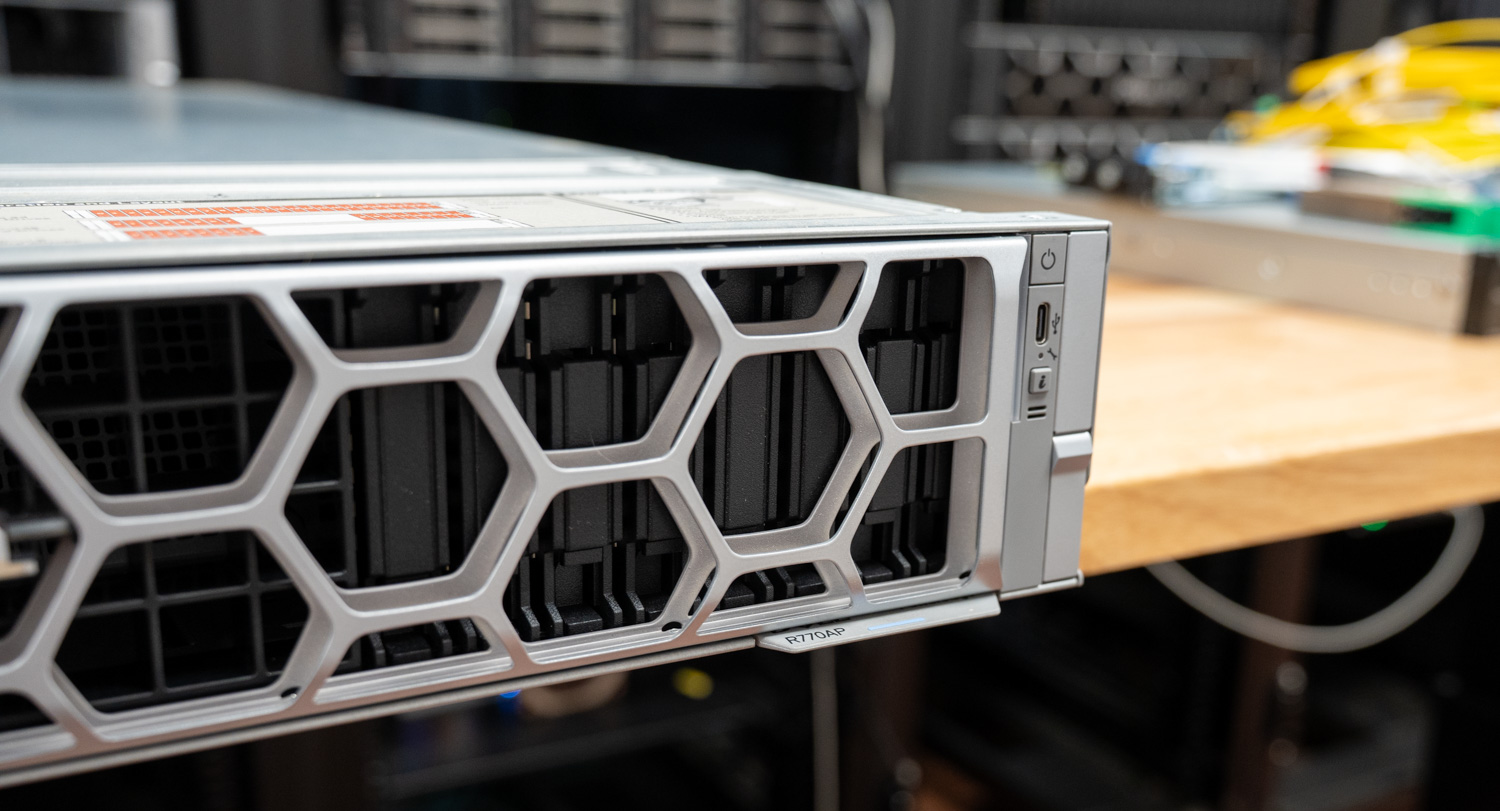
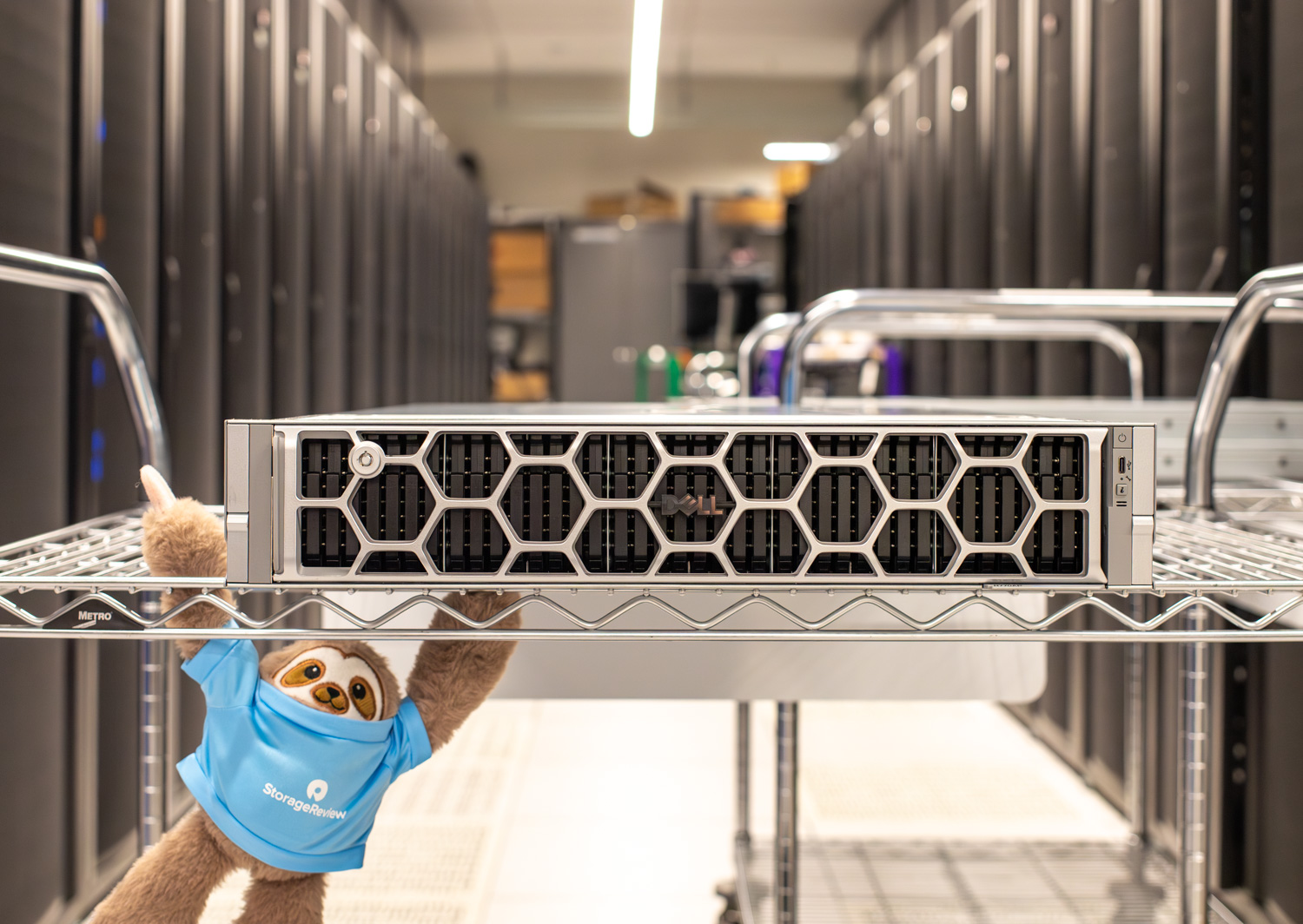
The Dell PowerEdge 770AP is a 2U rack server in Dell’s 17th Generation PowerEdge lineup, sharing the same aesthetic design language as the R770 we reviewed. It measures 3.42 inches tall, 19.0 inches wide, and 31.59 inches deep. The front bezel is optional. The front ear houses iDRAC Direct access, a USB 2.0 Type-C port, a power button, and a system ID button.
Storage
The 770AP supports three storage configurations. The unit shipped with up to 16x 2.5-inch Gen 5 x4 NVMe SSDs, with a maximum capacity of 245.76 TB. Also available are up to 16x 2.5-inch Gen 5 x2 NVMe SSDs, capping at 245.76 TB, and up to 32x EDSFF E3.S Gen 5 NVMe SSDs, which scale up to 491.52 TB. In the 16-bay configurations, Dell divides the drives into two banks of eight, left and right of the server, with the middle being an intake for airflow.
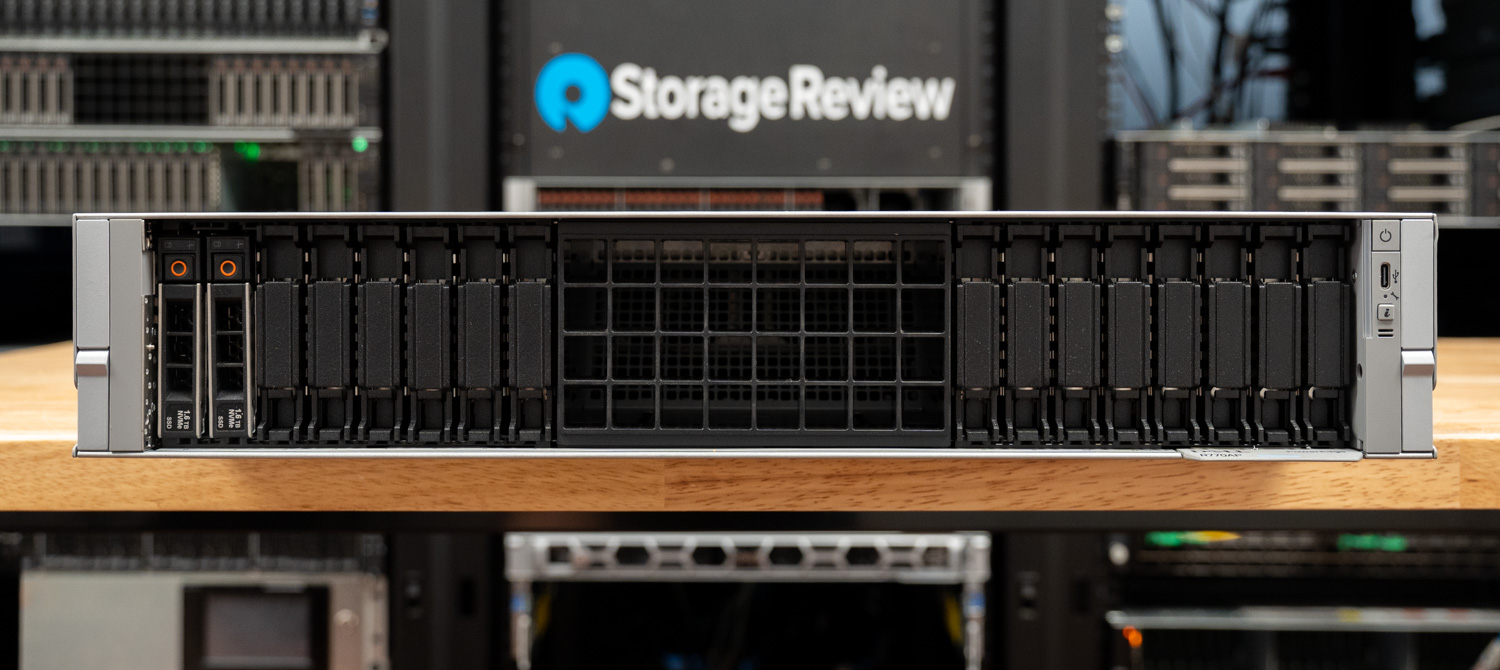
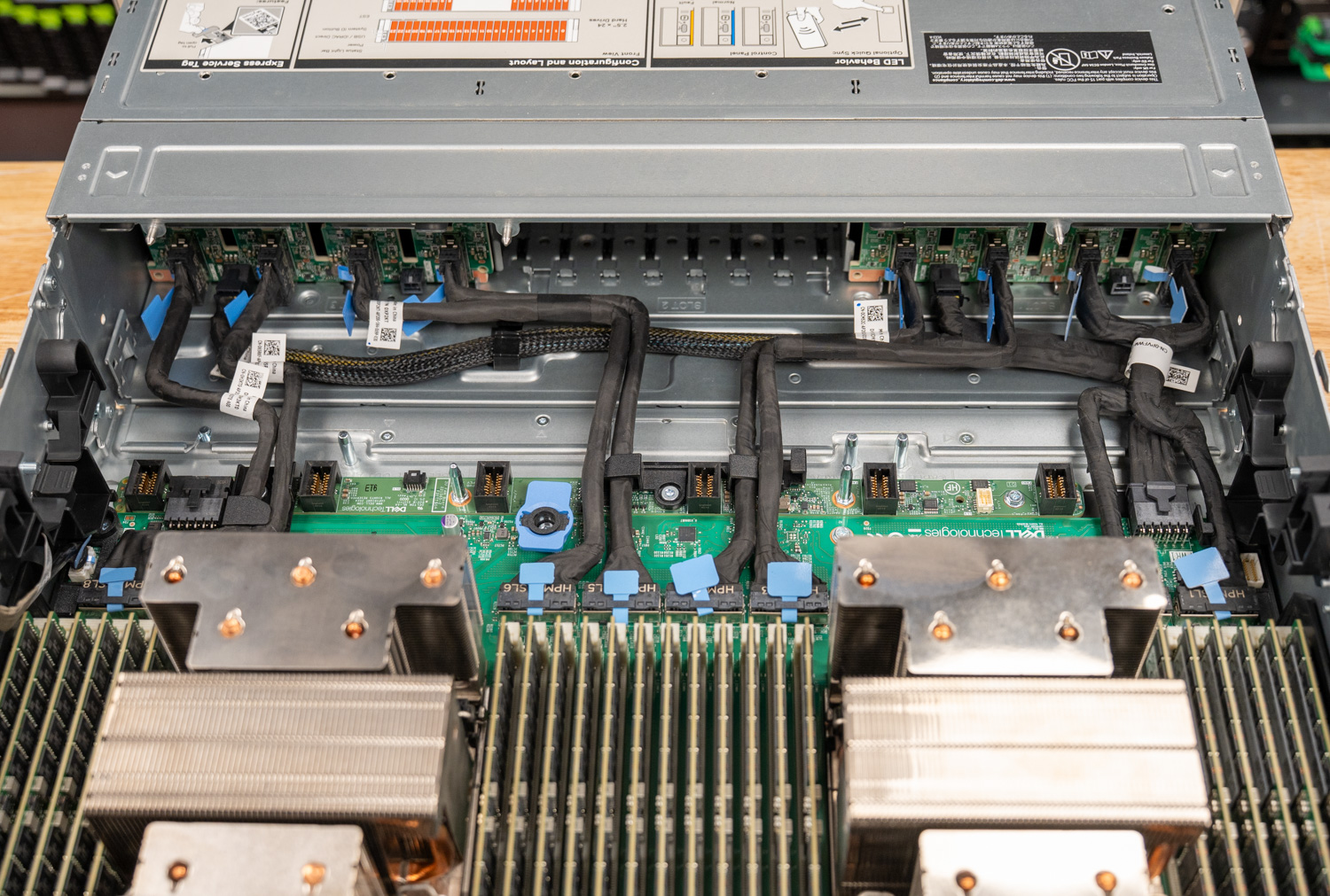
Looking further back into the chassis, the 770AP features a clean, direct NVMe cabling layout. The cables run straight from the storage backplane to the front edge of the motherboard, keeping the signal path short and the interior organized.
Rear I/O and Networking
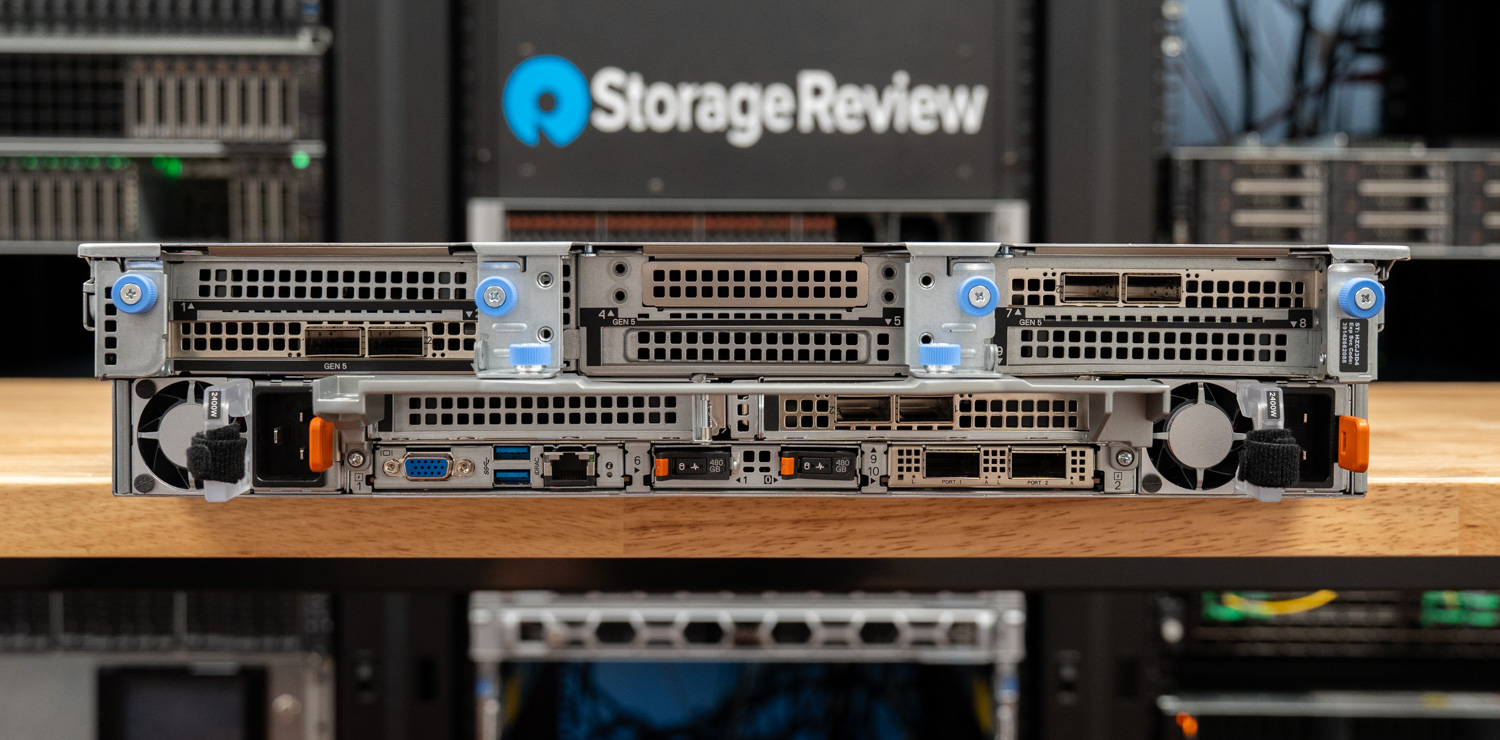
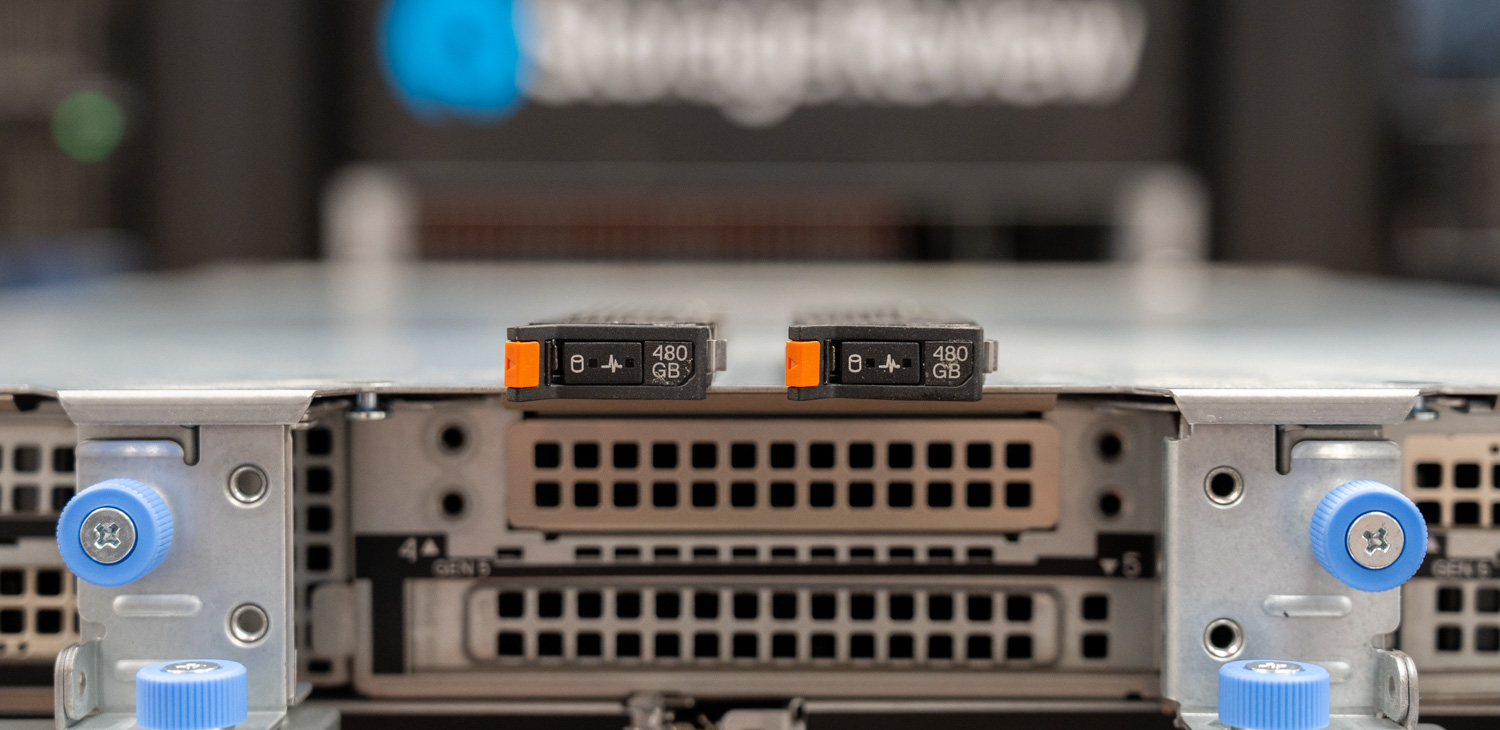
Two redundant 2400W PSUs anchor the rear of the 770AP on either end. The BOSS-N1 module handles boot duties and houses two 480GB drives for the OS.
For expansion, the server offers up to five Gen 5 PCIe slots across slots 2, 3, 5, 7, and 9, all using x16 connectors in full-height configurations. OCP 3.0 networking is handled by up to two cards: slot 4 supports x8 or x16 Gen 5, and slot 10 provides a dedicated x16 Gen 5 connection. Our unit shipped with a 200GbE OCP card alongside multiple 100GbE cards, leaving no shortage of network bandwidth.
Standard rear I/O includes a dedicated BMC Ethernet port, two USB 3.1 Type-A ports, and a VGA port.
A closer look at the BOSS-N1 module reveals the two 480GB boot drives side by side, both hot-swappable and quick to access and replace when needed.
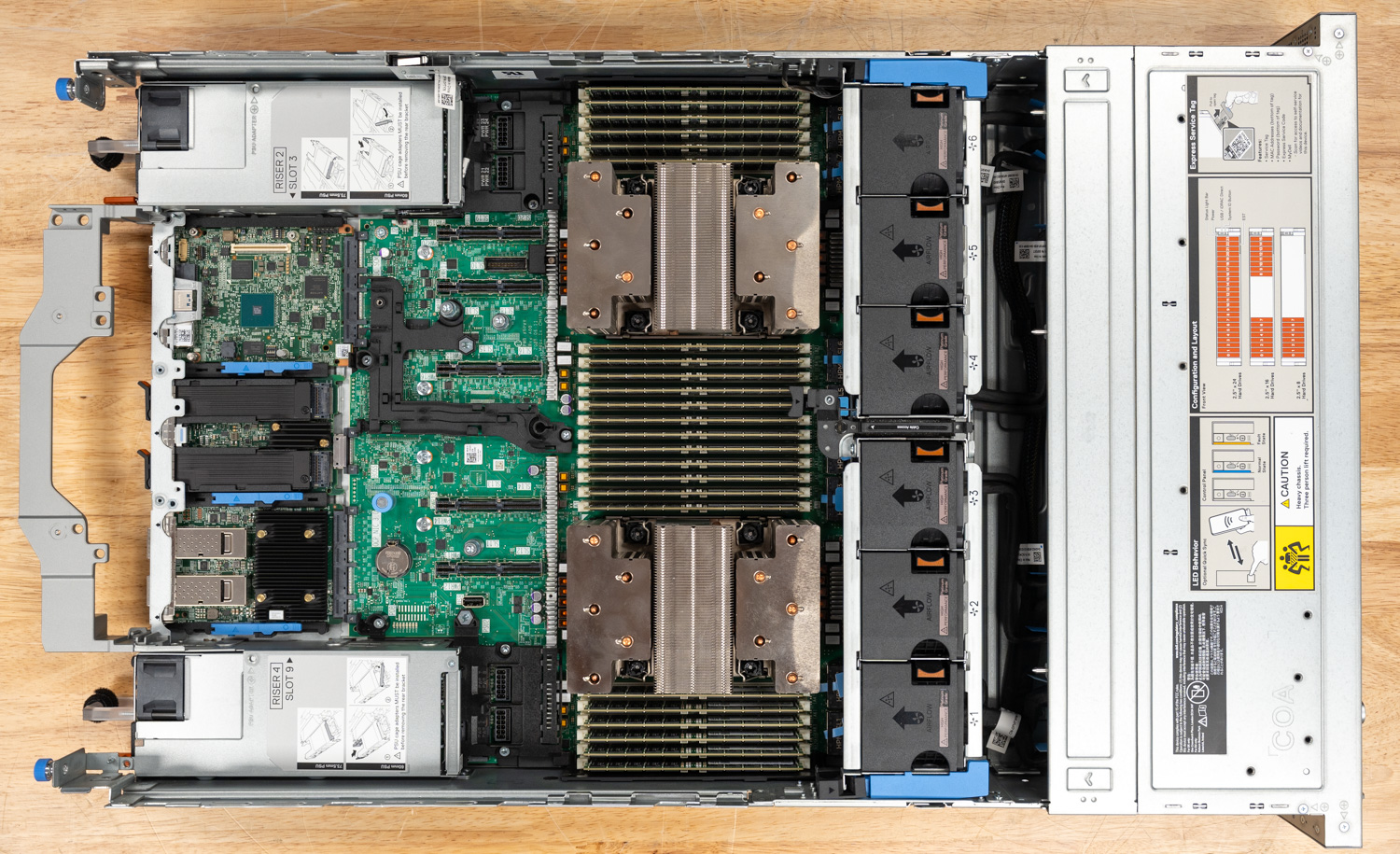
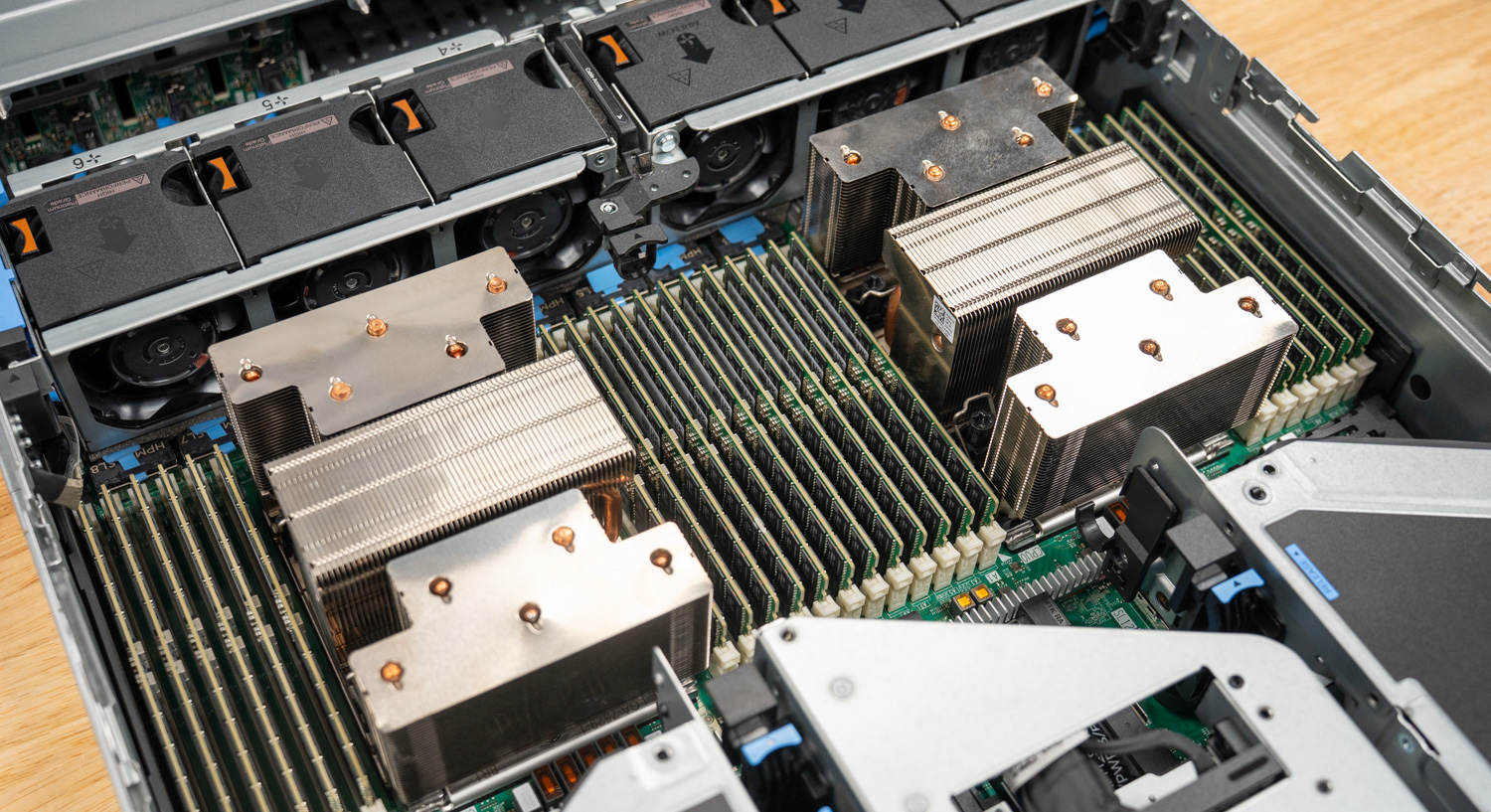
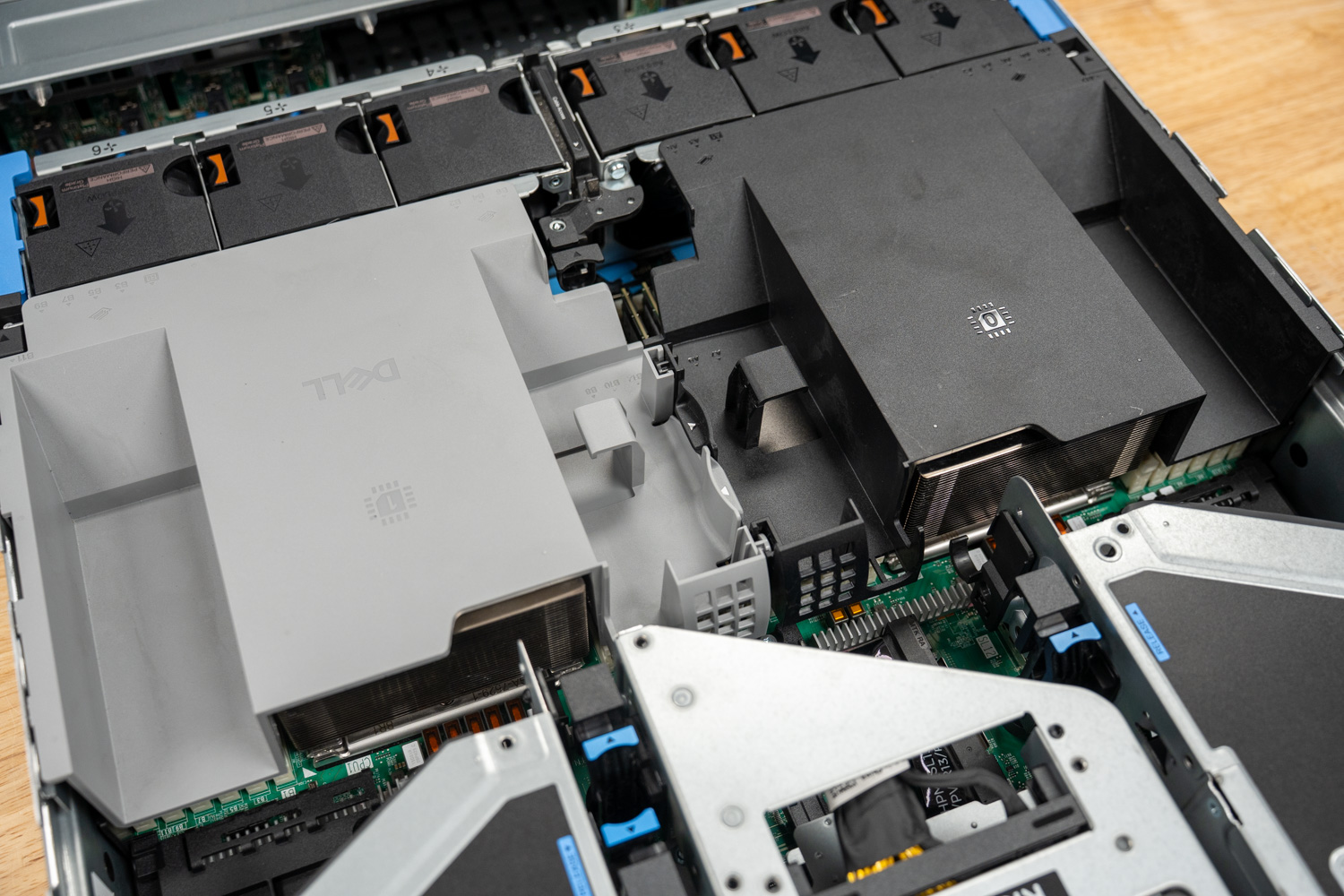
With the top cover and airflow shrouds removed, the R770AP’s interior layout is clean and well organized. Six hot-swappable fans push air across the large heatsinks, cooling the Xeon 6900 series processors, with the dual-CPU and memory configuration laid out symmetrically across the board. Also visible are the blue tabs throughout the chassis, which serve as disassembly guides for cable removal and component access.
Processor
With the CPU removed, the sheer size of the Intel Xeon 6900 series chip is immediately apparent. The R770AP uses the LGA 7529 socket, and our review unit shipped with two Intel Xeon 6978P processors. Each chip carries a 500W TDP and 120 cores, bringing the total core count to 240 across both sockets.
Cooling and Memory
To manage 1000W of CPU thermal output through air cooling alone, Dell engineered a deliberate heatsink design. The front and rear heatsinks use horizontal fins with heat pipes to move heat efficiently. At the same time, the center section features a vertical fin stack that increases airflow dwell time and surface area, giving the fans more opportunity to pull heat away before it exits the chassis. Nestled among the coolers are 24 DIMM slots in total, with each CPU flanked by 12 slots split six per side.
Power
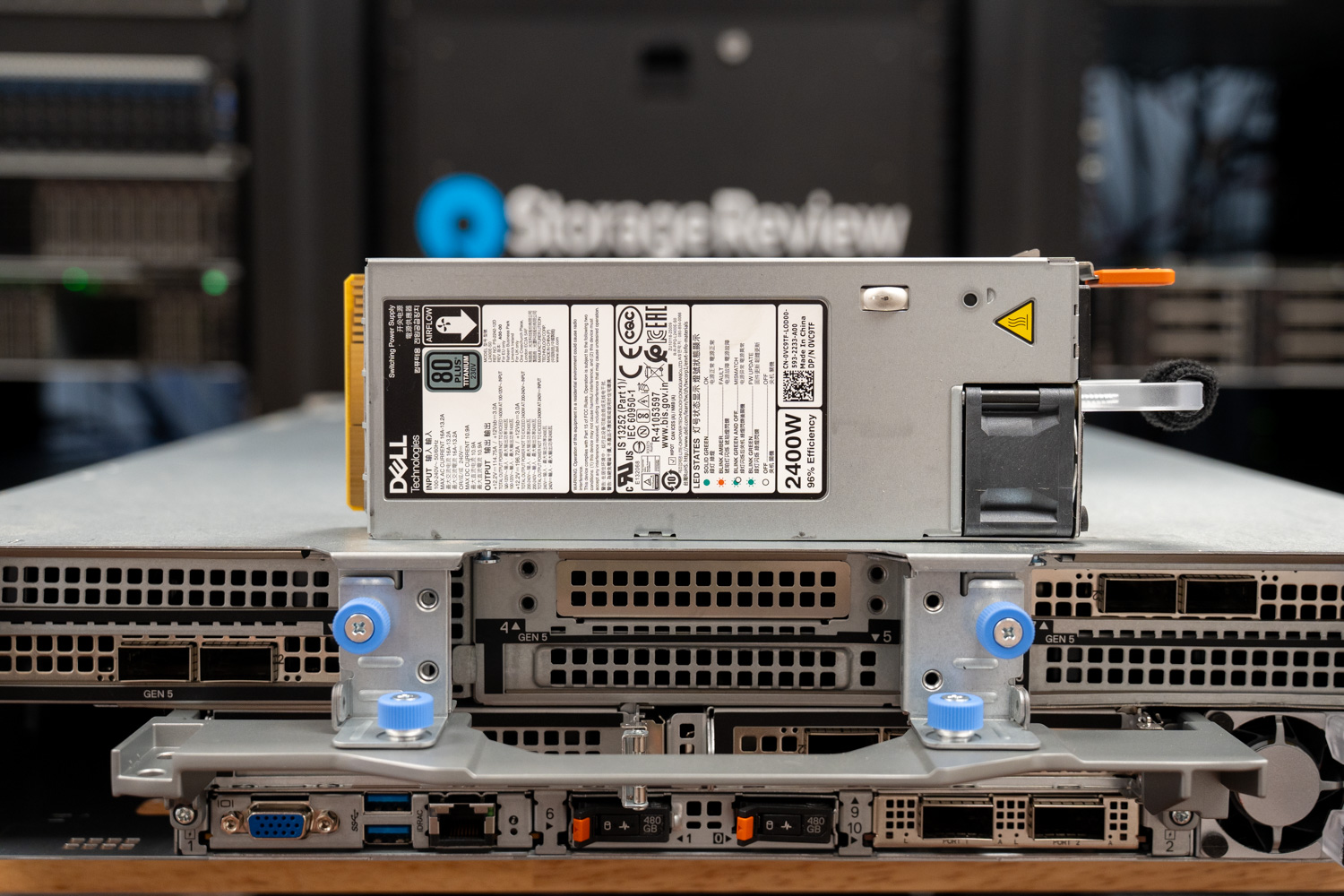
The R770AP supports four PSU options, all 80 Plus Titanium-rated and hot-swap redundant: 1500W, 1800W, 2400W, and 3200W. With up to 1000W consumed by the CPUs alone, the 1500W baseline leaves little headroom once drives and expansion cards are factored in. Our unit shipped with the 2400W units, rated at 96% efficiency, which is the practical minimum for a fully loaded storage configuration.
iDRAC 10 Management
Remote management for the R770AP is handled by iDRAC10, the same platform Dell ships as standard across its entire 17th-generation PowerEdge lineup, including the PowerEdge R770 and PowerEdge R7725 we previously reviewed. The interface is consistent across the portfolio, so administrators already familiar with iDRAC on other PowerEdge platforms will feel right at home.
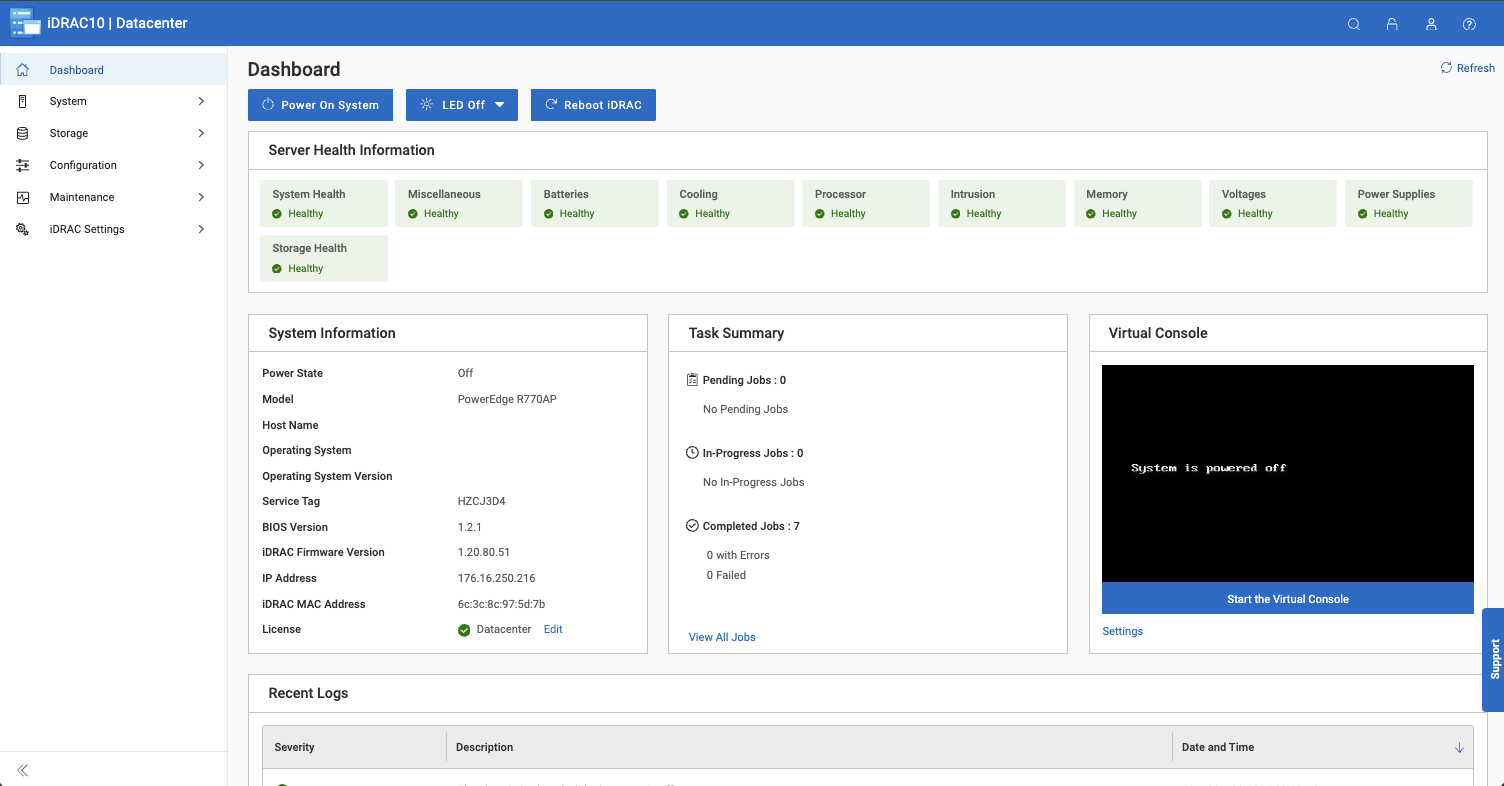
The iDRAC10 dashboard provides a full, at-a-glance health summary of every major subsystem: System Health, Processor, Memory, Cooling, Storage, Voltages, Power Supplies, Batteries, and Intrusion Detection. The review unit shows that all subsystems were reporting as healthy at the time of testing. System information and firmware version details are displayed directly on the dashboard alongside license status, which, on the review unit, is confirmed as Enterprise. The Task Summary panel tracks pending, in-progress, and completed jobs, with the review unit showing completed jobs from an initial provisioning cycle, including a small number with errors and one failed, typical of a fresh deployment.
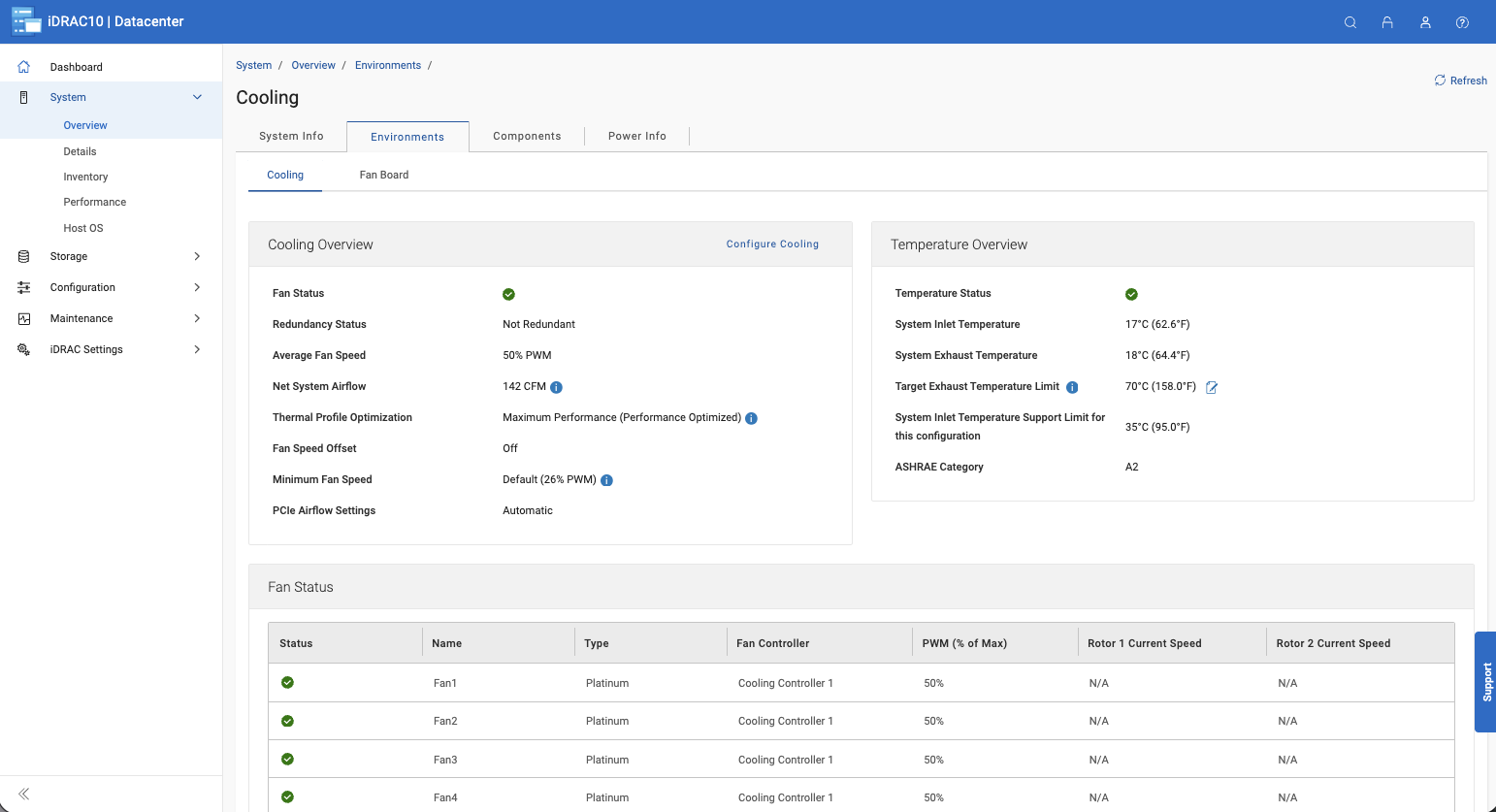
Drilling into the System Environments section reveals cooling details, including individual fan status, PWM speeds, thermal profile settings, and inlet temperature readings, all in real time. This is especially useful for validating airflow in dense rack configurations or troubleshooting thermal issues without needing physical access to the server.
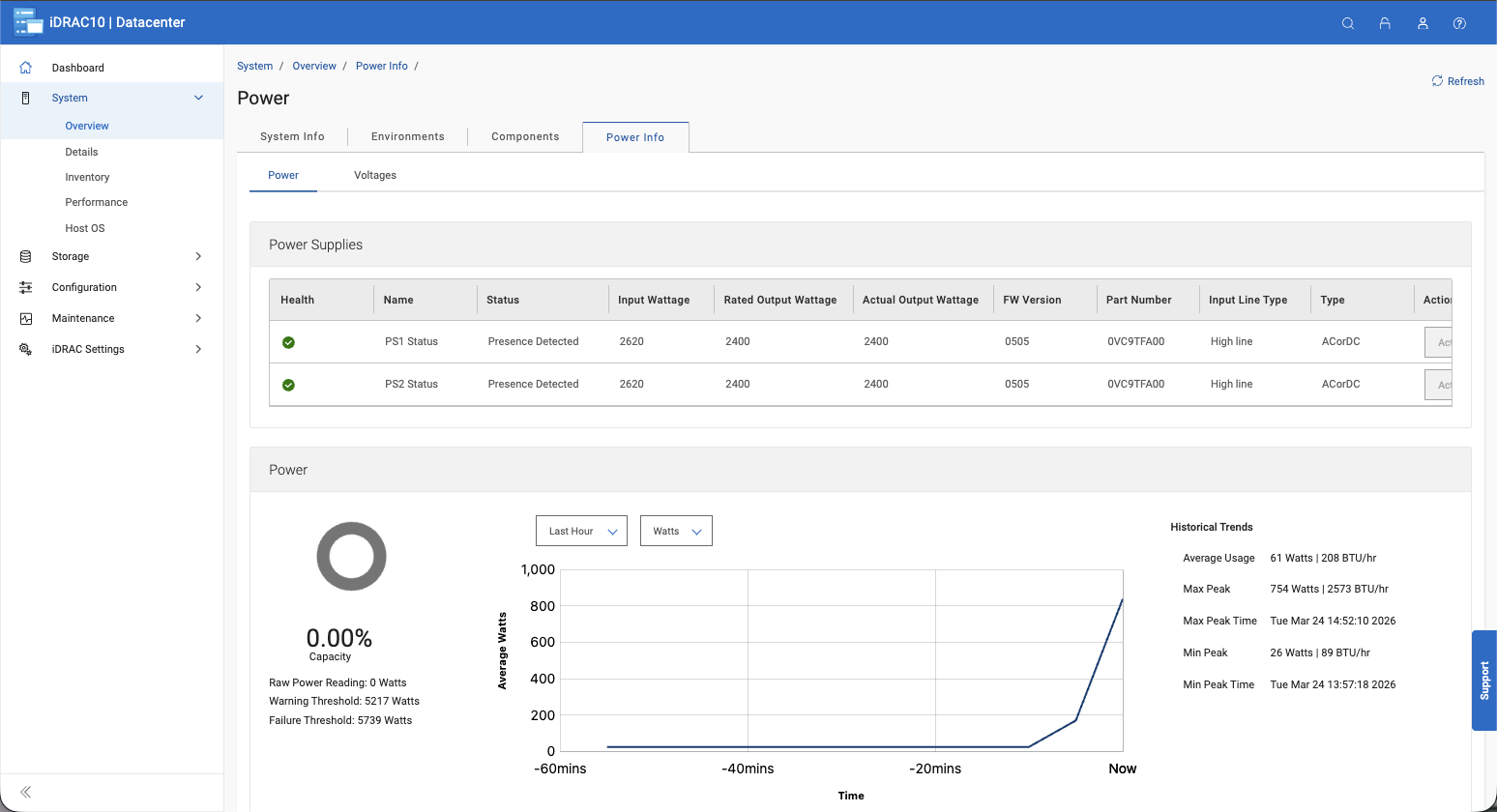
Power visibility follows the same pattern. The Power Info section breaks down PSU health, current draw, and capacity utilization alongside a rolling historical trend graph. Administrators can quickly see average and peak wattage over time, which is valuable for capacity planning and identifying workload-driven power spikes without needing a separate power monitoring tool.
Together, these views make iDRAC10 a capable out-of-band management solution that covers the full operational lifecycle of the R770AP, from initial deployment through day-to-day monitoring, all accessible remotely via browser or the RESTful Redfish API.
Dell PowerEdge R770AP Performance
To evaluate the R770AP, we compared it directly against the R770. The R770AP is equipped with dual Intel Xeon 6978P processors, each with 120 cores, for a total of 240 cores and 3 TB of DDR5 memory. The R770, by contrast, runs dual Intel Xeon 6787P processors, for a total of 172 cores and 2 TB of DDR5 memory.
To stress the CPUs across both systems, we used a focused set of compute benchmarks. y-cruncher was used to evaluate raw arithmetic throughput and multithreaded floating point performance. Blender provided a real-world rendering workload that scales with available cores and memory bandwidth. Phoronix Test Suite rounded out the benchmark set with a broader collection of CPU-bound workloads, giving a more complete picture of sustained compute performance across both platforms.
Test System Specifications
- Platform: Dell PowerEdge R770AP
- CPU: Dual Intel Xeon 6978P, 120 cores
- Memory: 3 TB DDR5
- Storage: Boss RAID1
y-cruncher
y-cruncher is a popular benchmarking and stress-testing application that launched back in 2009. This test is multithreaded and scalable, computing Pi and other constants up to the trillions of digits. Faster is better in this test. This software has been fantastic for testing high-core-count platforms and demonstrating compute advantages between single- and dual-socket platforms.
In the y-cruncher benchmark, the R770AP consistently outperformed the R770 across all test sizes. At the 1-billion-digit run, the R770AP completed in 2.692 seconds, compared to 2.753 seconds on the R770. At 10 billion digits, the R770AP finished in 30.399 seconds compared to 34.873 seconds on the R770. At 50 billion digits, the R770AP turned in 192.128 seconds against 221.255 seconds on the R770. The gap widened at the largest workload, with the 100-billion-digit run completing in 430.208 seconds on the R770AP compared to 491.737 seconds on the R770, a difference of roughly 61 seconds and an approximately 12.5% performance advantage for the R770AP.
| Y-cruncher (lower duration is better) | Dell PowerEdge R770 (2x Intel Xeon 6787P | 2TB RAM) | Dell PowerEdge R770AP (2x Intel Xeon 6978P | 3TB RAM) |
|---|---|---|
| 1 Billion | 2.753 seconds | 2.692 seconds |
| 2.5 Billion | 7.365 seconds | 6.747 seconds |
| 5 Billion | 16.223 seconds | 14.235 seconds |
| 10 Billion | 34.873 seconds | 30.399 seconds |
| 25 Billion | 99.324 seconds | 86.298 seconds |
| 50 Billion | 221.255 seconds | 192.128 seconds |
| 100 Billion | 491.737 seconds | 430.208 seconds |
Blender
An open-source 3D modeling application. This benchmark was run using the Blender Benchmark utility. The score is samples per minute, with higher being better.
In the Blender 4.3 benchmark, the R770AP outperformed the R770 across all three scenes. On the Monster scene, the R770AP scored 2,200.116 samples per minute compared to 1,706.002 on the R770. The Junkshop scene saw the R770AP turn in 1,565.643 samples per minute, compared to 1,169.370 on the R770. In the Classroom scene, the R770AP scored 1,076.122 samples per minute, compared to 791.475 on the R770, representing roughly a 36% performance advantage on that workload.
| Blender 4.3 CPU Benchmark (higher samples per minute is better) | Dell PowerEdge R770 (2x Intel Xeon 6787P | 2TB RAM) | Dell PowerEdge R770AP (2x Intel Xeon 6978P | 3TB RAM) |
|---|---|---|
| Monster | 1,706.002 samples/min | 2,200.116 samples/min |
| Junkshop | 1,169.370 samples/min | 1,565.643 samples/min |
| Classroom | 791.475 samples/min | 1,076.122 samples/min |
Phoronix Benchmarks
Phoronix Test Suite is an open-source, automated benchmarking platform that supports over 450 test profiles and 100+ test suites via OpenBenchmarking.org. It handles everything from installing dependencies to running tests and collecting results, making it ideal for performance comparisons, hardware validation, and continuous integration. We will focus on comparing the R770AP and R770 against Stream, 7-Zip, Linux kernel build, Apache, and OpenSSL tests.
Stream
In the Stream memory bandwidth test, the R770AP delivered a substantial leap over the R770, scoring 869,965.3 MB/s compared to 472,135.6 MB/s. This nearly doubles the memory bandwidth of the baseline system, reflecting the R770AP’s larger and faster memory configuration.
7-Zip
In the 7-Zip compression benchmark, the R770AP scored 806,375 MIPS, compared to 628,206 MIPS on the R770, a solid uplift driven by the higher core count of the 6978P processors.
Kernel Compile
In the Linux kernel compile test, where a lower time is better, the R770AP completed the allmod build in 176.391 seconds compared to 188.793 seconds on the R770, shaving roughly 12 seconds off the compile time.
Apache
The Apache test was the one area where the R770 edged out the R770AP, scoring 60,258.5 requests per second versus 48,729.63 on the R770AP. This is worth noting, as web-serving workloads do not always scale linearly with core count and can be influenced by memory latency and I/O characteristics.
OpenSSL
In the OpenSSL verification test, the R770AP scored 2,515,270,390,853 verify/s compared to 2,216,883,554,350 verify/s on the R770, a meaningful gain in cryptographic throughput that highlights the compute efficiency of the 6978P at scale.
| Phoronix Benchmarks | Dell PowerEdge R770 (2x Intel Xeon 6787P 86C) | Dell PowerEdge R770AP (2x Intel Xeon 6978P | 3TB RAM) |
|---|---|---|
| Stream | 472,135.6 MB/s | 869,965.3 MB/s |
| 7-ZIP | 628,206 MIP/s | 806,375 MIP/s |
| Kernel Compile (allmod) (lower is better) | 188.793 Seconds | 176.391 Seconds |
| Apache (requests per second) | 60,258.5 R/s | 48,729.63 R/s |
| OpenSSL | 2,216,883,554,350 Verify/s | 2,515,270,390,853 Verify/s |
Dell PowerEdge R770AP: High-Frequency Trading and Deterministic Performance
While our standard benchmark suite focuses on compute throughput, memory bandwidth, and general workload scaling, the R770AP’s design priorities extend into territory we don’t typically test: microsecond-level execution determinism. To illustrate what this platform can do for its most demanding target audience, Dell published a technical brief in partnership with Metrum AI that evaluates the R770AP specifically for high-frequency trading workloads. We did not conduct this testing, nor did we independently audit the results. Still, we’re including a summary here because it provides the most direct demonstration of why this server is a distinct product from the R770.
The Metrum AI methodology centers on a custom tool called jitter-c, which measures per-core wake-up latency jitter, essentially how consistently a thread scheduled to execute at a precise moment actually begins running. This metric isolates CPU scheduling variability from network, memory, and application-level factors, making it a clean point of comparison across processor generations. Using an R770AP with dual Xeon 6980P processors (256 total cores) against a prior-generation R760 with dual Xeon Platinum 8592+ processors (128 total cores), the study found that the Granite Rapids-AP architecture reduced p99 wake-up jitter to approximately 1 microsecond, roughly half that of the older platform, while simultaneously doubling core density. Those jitter profiles were then injected into a backtesting simulation engine to model the financial impact, with the results summarized below.
| Metrum AI HFT Backtest Results | Dell PowerEdge R760 (2x Xeon 8592+, 128 cores) | Dell PowerEdge R770AP (2x Xeon 6980P, 256 cores) |
|---|---|---|
| p99 Wake-Up Jitter | ~2 µs | ~1 µs |
| Mean Reversion: Total Trades | 5,175 | 6,229 (+20.4%) |
| Mean Reversion: Trades/sec | 819 | 991 (+21.1%) |
| Market Making: Total Trades | 21,765 | 32,491 (+49.3%) |
| Market Making: Trades/sec | 2,067 | 3,072 (+48.6%) |
As Dell’s Seamus Jones framed it in his commentary on the study, the value proposition is not about being fast but about being predictably fast, because in trading, a system that is quick but inconsistent is a source of risk. In contrast, a deterministic system is a strategic asset.
Conclusion
The Dell PowerEdge R770AP occupies a purposeful, narrow position within the 17th-generation PowerEdge lineup. It is not a replacement for the R770, and Dell is not positioning it as one. The R770 remains the versatile, broadly configurable 2U Intel platform it has always been, with GPU support, mixed SAS/SATA/NVMe storage, E-core and P-core processor options, and up to 8TB of memory across 32 DIMM slots. For organizations running general virtualization, mixed enterprise applications, or workloads that benefit from that flexibility in configuration, the R770 is still the right call.
The R770AP exists for the workloads that the R770 was never optimized to serve. By moving to the Granite Rapids-AP platform, with its 12-channel memory architecture, up to 128 P-cores per socket, and 504 MB of L3 cache, Dell has built a 2U system that prioritizes compute density, memory bandwidth, and execution determinism over versatility. Our benchmarks reflect that focus: STREAM bandwidth nearly doubled, Blender rendering improved 29-36%, and y-cruncher scaling widened consistently as working sets grew beyond cache. The Apache regression is worth noting, as it demonstrates that the R770AP’s NUMA topology requires workload awareness to extract full performance, and not every application will benefit from the platform shift without tuning.
The Metrum AI testing Dell published alongside this platform puts a finer point on the determinism story. Cutting p99 scheduling jitter in half while doubling core density is a meaningful architectural improvement for firms running high-frequency trading, real-time risk engines, large-scale in-memory analytics, and massively parallel simulations. For those workloads, the R770AP is a well-executed, purpose-built platform. For everything else, the R770 and R7725 remain the better-suited options in the mainstream PowerEdge portfolio.


 Amazon