

Kingston’s Dual Portable SSD is a compact external drive built for everyday storage and file transfers, with the added flexibility of dual connectors, USB-C on one end and USB-A on the other. It’s designed to function like a cross-platform thumb drive, only with SSD-level performance and much higher capacities. Available in 512GB, 1TB, and 2TB models, it’s made for users who frequently move between desktops, laptops, and mobile devices and need something simple that doesn’t require extra cables or software to get up and running.
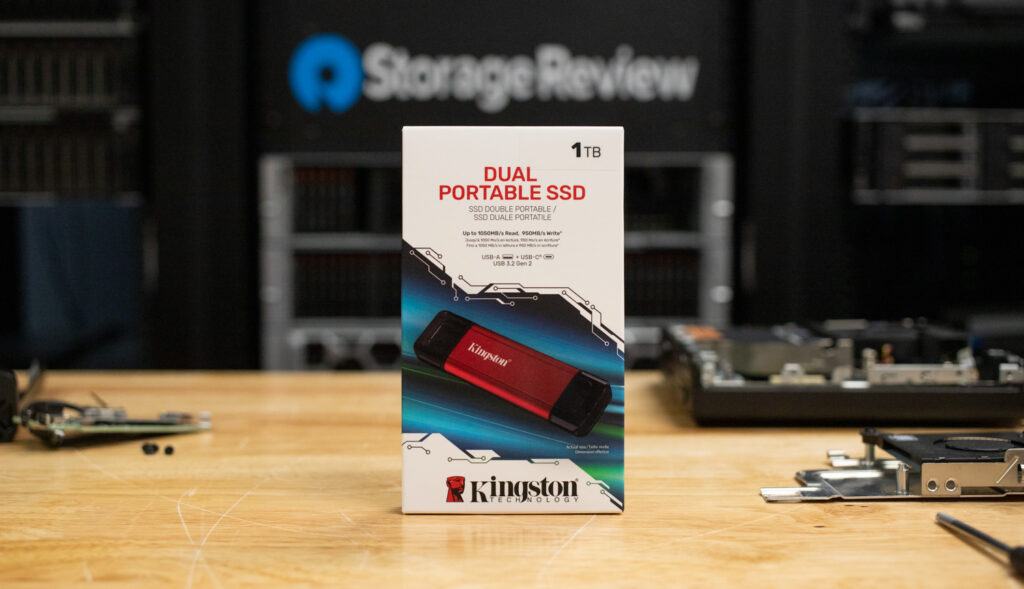
Performance-wise, the Dual Portable uses a USB 3.2 Gen 2×1 interface, which supports transfer speeds up to 1,050MB/s for reads and 950MB/s for writes. Of course, to get those speeds, you’ll need to connect to a 10Gbps port. If your device only supports USB 3.0 or Gen 1, you’ll see slower rates, which generally max out around 500MB/s. The drive’s primary opponent is just thermals in its small package, so heavier workloads may see a performance drop-off over time as heat builds up.
The Dual Portable should handle everyday tasks effectively, but it is not designed for particularly heavy workloads. When performing tasks such as recording 4K ProRes videos from an iPhone, editing 8K footage, or transferring a large batch of RAW photos from a shoot, you may encounter limitations. Additionally, this drive is not the best option for running newer games directly, as consistent read speeds and low latency are crucial for optimal performance. For anything that demands consistent high-speed performance over long sessions, you’d be better off with a faster NVMe-based drive or a dedicated desktop SSD.
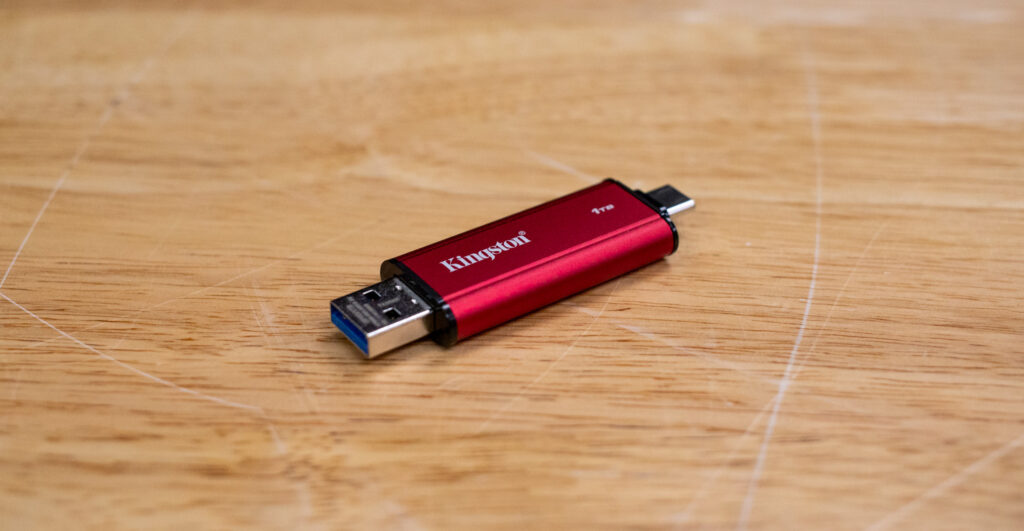
Compatibility includes official support for Windows, macOS, Linux, Android, Chrome OS, and iOS/iPadOS. There’s no bundled software, which keeps things simple but also means no built-in security features. It’s plug-and-play across most platforms, though users on mobile devices may need an OTG adapter.
Backed by a five-year warranty, the Kingston Dual Portable SSD is available in capacities of 512GB, 1TB, and 2TB.
Kingston Dual Portable SSD Specifications
| Specification | Details |
| Interface | USB Type-A and USB Type-C |
| Standard / Speed | USB 3.2 Gen 2 – Up to 1,050MB/s Read, 950MB/s Write |
| Controller | Silicon Motion SM2322 |
| NAND | 3D NAND |
| Capacities | 512GB, 1TB, 2TB |
| Dimensions | 71.85mm x 21.1mm x 8.6mm |
| Weight | 13g |
| Material | Metal + Plastic |
| Operating Temperature | 0°C to 60°C |
| Storage Temperature | -20°C to 85°C |
| Warranty | 5-Year Limited Warranty with Free Technical Support |
| Compatibility | Windows 11, macOS (v.13.7.6+), Linux (v.4.4x+), Chrome OS, Android, iOS/iPadOS (v.13+) |
Kingston Dual Portable SSD Design and Build
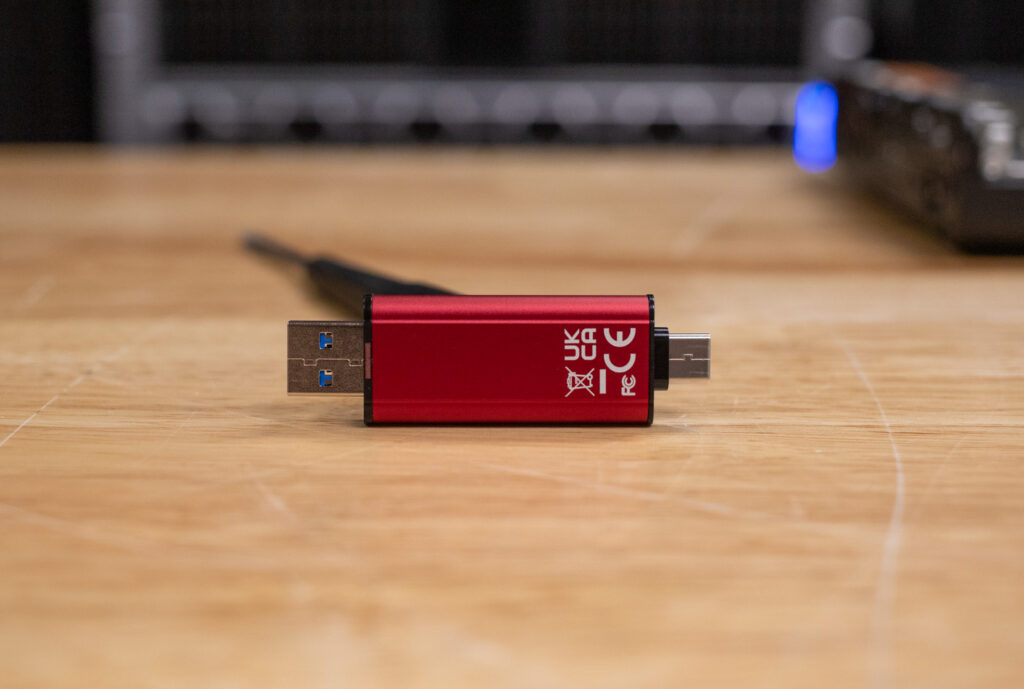
Physically, the Dual Portable SSD resembles an oversized thumb drive. It measures about 72mm long and weighs just 13 grams, so it’s easy to carry around and doesn’t really add any bulk to a mobile setup.
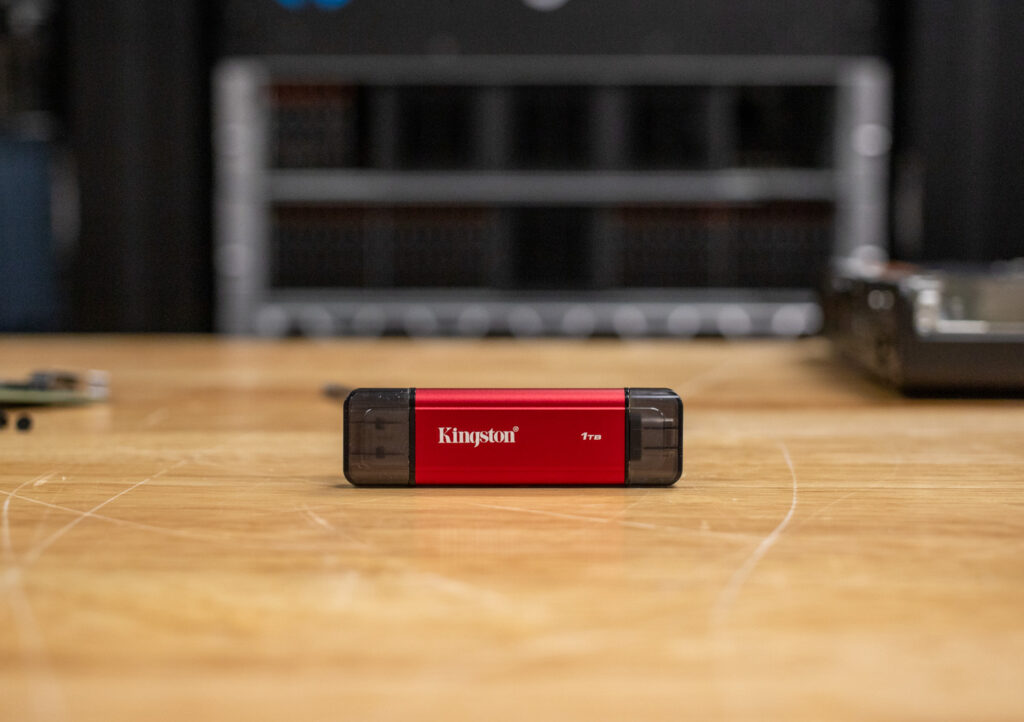
One end of the drive features a USB-C connector, while the other side has a standard USB-A plug. It ships with two separate caps to protect each port, but since they aren’t attached or tethered, they’re easy to misplace. A hinged cover or sliding mechanism would have made more sense here, especially for a device meant to be thrown into a bag or carried around daily. Once the caps are gone (and that’s very likely to happen eventually), you’re left with both connectors exposed to dust, pocket lint, or accidental damage. That said, it’s a minor gripe and pretty typical for drives like this. It doesn’t really detract from the device’s overall handiness.
The shell is made of a combination of metal and plastic, which feels sturdy enough for regular use. The case gets warm during use, so it does act as a bit of a heatsink. However, it’s not marketed as rugged, and it doesn’t offer any environmental protection, such as water or dust resistance. There’s no shock protection or reinforced casing either, so while it should survive typical daily bumps, it’s best not to treat it like a ruggedized field drive. There’s also no LED indicator to show activity, which keeps the look clean but removes a valuable bit of feedback when transferring large files.
Kingston Dual Portable SSD Performance
Blackmagic Disk Speed Test
First up is the Blackmagic Disk Speed Test, which measures a drive’s sequential read and write performance. This makes it ideal for assessing how well the drive handles large file transfers and continuous data streams.
Here, the Kingston Dual Portable hit 1,001.5MB/s read and 934.7MB/s write.
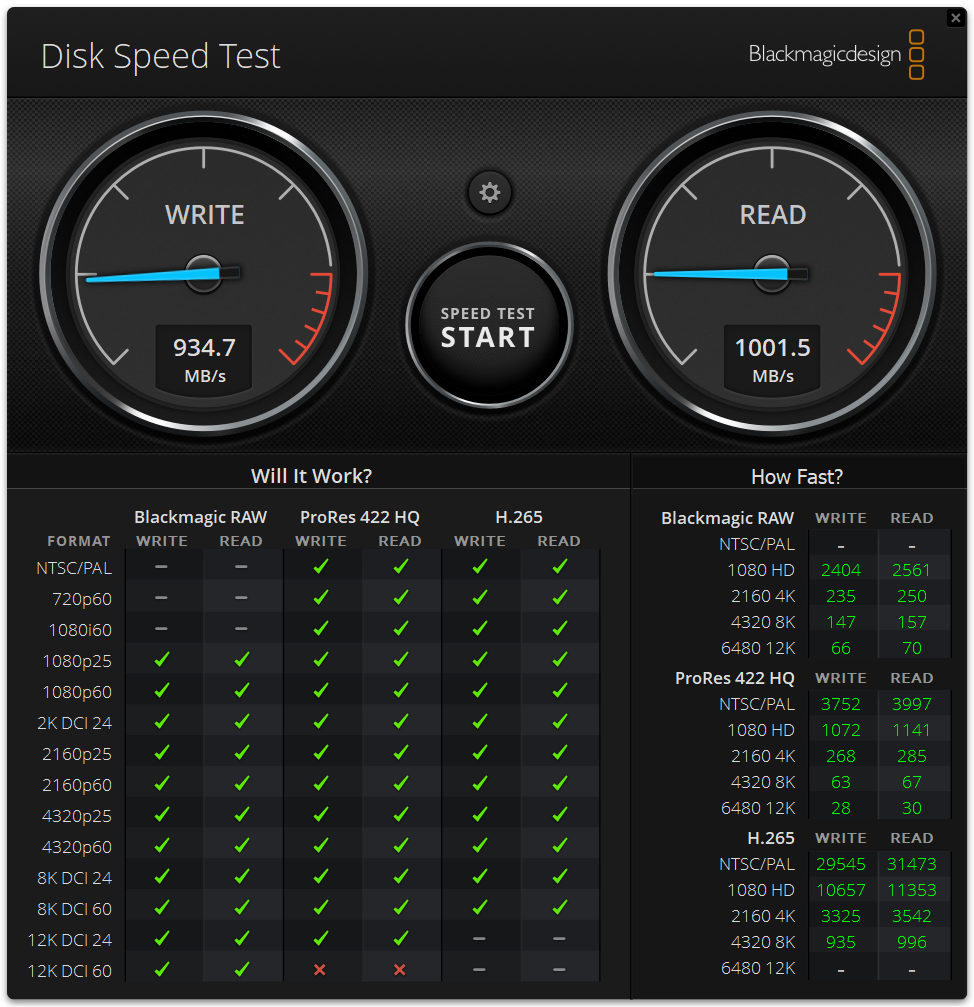
These results come close to the drive’s rated peak of 1,050MB/s for reads and 950MB/s for writes, placing it near the upper range for devices using USB 3.2 Gen 2×1. It’s not pushing any new performance boundaries, but the speeds are solid and more than capable of moving large files or handling portable apps without slowdown.
Nonetheless, Blackmagic primarily shows sequential performance, so we’ll also use IOMeter to gauge how well the drive handles more varied, real-world workloads.
IOMeter 1 Thread
The single-threaded IOMeter test examines sequential and random read/write performance under a lighter load. The speeds are often close to those in the BlackMagic test on the Sequential 2MB read and write portions, but we should see some differences in the 4-threaded portion.
Here, the Kingston Dual Portable hit 909.9MB/s sequential write and 979.36MB/s sequential read. In random 2MB performance, it posted 823.21MB/s write and 833.16MB/s read.
Looking at a random 4K performance, it reached 6,798 IOPS and 13,841 IOPS for reads and writes, respectively.
IOMeter 4 Thread
The IOMeter 4-thread test offers a more comprehensive assessment of how the Kingston Dual Portable handles multitasking and demanding workloads. Compared to its single-threaded performance, it posted noticeable improvements in sequential tasks, with 1,038.55MB/s read and 963.63MB/s write. For random operations, we recorded 867.89MB/s for writes and 1,038.64MB/s for reads.
Lastly, in random 4K performance, the new Kingston drive hit 51,838 IOPS write and 21,416 IOPS read.
Here’s a full breakdown of the IOMeter results for both single-threaded and 4-threaded tests. We compared it to the similar SanDisk Extreme PRO Dual Drive:
| Drive | Seq 2MB Write | Seq 2MB Read | Random 2MB Write | Random 2MB Read | Random 4K Write | Random 4K Read |
|---|---|---|---|---|---|---|
| Kingston Dual Portable (1 thread) |
909.9MB/s | 979.36MB/s | 823.21MB/s | 833.16MB/s | 6,798 IOPS | 13,841 IOPS |
| Kingston Dual Portable (4 thread) |
963.63 MB/s | 1,038.55MB/s | 867.89MB/s | 1,038.64MB/s | 51,838 IOPS | 21,416 IOPS |
| SanDisk Extreme PRO Dual Drive (1 thread) |
848.79MB/s | 915.58MB/s | 829.69MB/s | 858.77MB/s | 8,361 IOPS | 3,481 IOPS |
| SanDisk Extreme PRO Dual Drive (4 thread) |
957.07MB/s | 885.80MB/s | 792.99MB/s | 982.69MB/s | 8,361 IOPS | 13,144 IOPS |
Intensive Load
Given this SSD’s positioning for workloads commonly targeting external SSDs, we also ran a sustained sequential write workload on the thumb drive. With a 2MB sustained write workload, we measured a drop in write performance to about 80MB/s. Using CrystalDiskInfo, we observed a rise in drive temperature to 75 °C, indicating that some of the performance drop was due to heat. Retrofiting two M.2 heatsinks to pull heat away from the two sides of the thumbdrive, its temperature dropped to 65C and our real-time write performance bumped up to 120-130MB/s.
PCMark 10 Performance
The PCMark 10 Quick System Drive Benchmark simulates real-world usage scenarios, focusing on how a drive performs during common tasks like launching apps, opening files, and handling background activity. It’s a good way to gauge how an SSD would feel in everyday use, especially if you’re considering running software or working directly from the drive rather than just storing files.
| Benchmark | Result |
| PCMark 10 Quick System Drive Score | 1,086 |
| Bandwidth | 144.09MB/s |
| Average Access Time | 128µs |
Here, the Kingston Dual Portable SSD scored 1,086 points, with a measured bandwidth of 144.09MB/s and an average access time of 128µs. While these numbers aren’t great for a system or boot drive, they’re solid for an external USB-based SSD, especially one focused more on portability and convenience than raw speed. It’s not the best choice for running demanding software or working directly from large project files on the drive. Still, performance here is more than acceptable for browsing files, working on documents, or transferring data back and forth without noticeable lag.
Conclusion
Overall, the Kingston Dual Portable SSD is a solid choice if you’re looking for something to handle everyday storage tasks. Its performance aligns well with its ratings, delivering close to 1GB/s in both sequential reads and writes during testing. Random performance is also solid for a USB 3.2 Gen 2 drive, making it quick enough for everyday transfers and general workloads. Moreover, with native USB-C and USB-A connectors built directly into the drive, it’s easy to plug in just about anywhere, whether you’re using a laptop, desktop, phone, or tablet.
Pricing for the Kingston Dual Portable SSD places it in the midrange. At launch, the 512GB model costs $96.99, the 1TB version $143.99, and the 2TB option $238.99. That’s a bit higher per gigabyte than some cable-based portable SSDs using the same USB 3.2 Gen 2 interface and also more than the comparable 1TB SanDisk Dual Drive, which typically sells for around $90. However, Kingston’s model consistently posted faster sequential and random read and write performance in testing, particularly in multithreaded reads and 4K write performance.
The small size does work against the drive under demanding workloads, though. For sustained use cases, buyers may want to consider larger, full-size external SSDs with better thermals. That said, this is a simple, speedy SSD that works well across desktops, laptops, tablets, and phones for most daily activities.
Leaderboard: This drive appears in the Also Tested section of our Best Portable SSDs leaderboard.


 Amazon