

LaCie has been a fixture in our lab for well over a decade. From the 8big Rack Thunderbolt 2 we covered in 2014 through the many generations of 5big, 6big, 8big, and Rugged devices that have followed, the formula has been consistent: premium Neil Poulton-designed enclosures, Seagate drives inside, Mac-centric polish, a solid warranty, and a clear focus on creative professionals. The new LaCie 8big Pro5 carries that pedigree forward in build quality, design, and purpose, and arrives at a notable inflection point for high-capacity direct-attached storage.
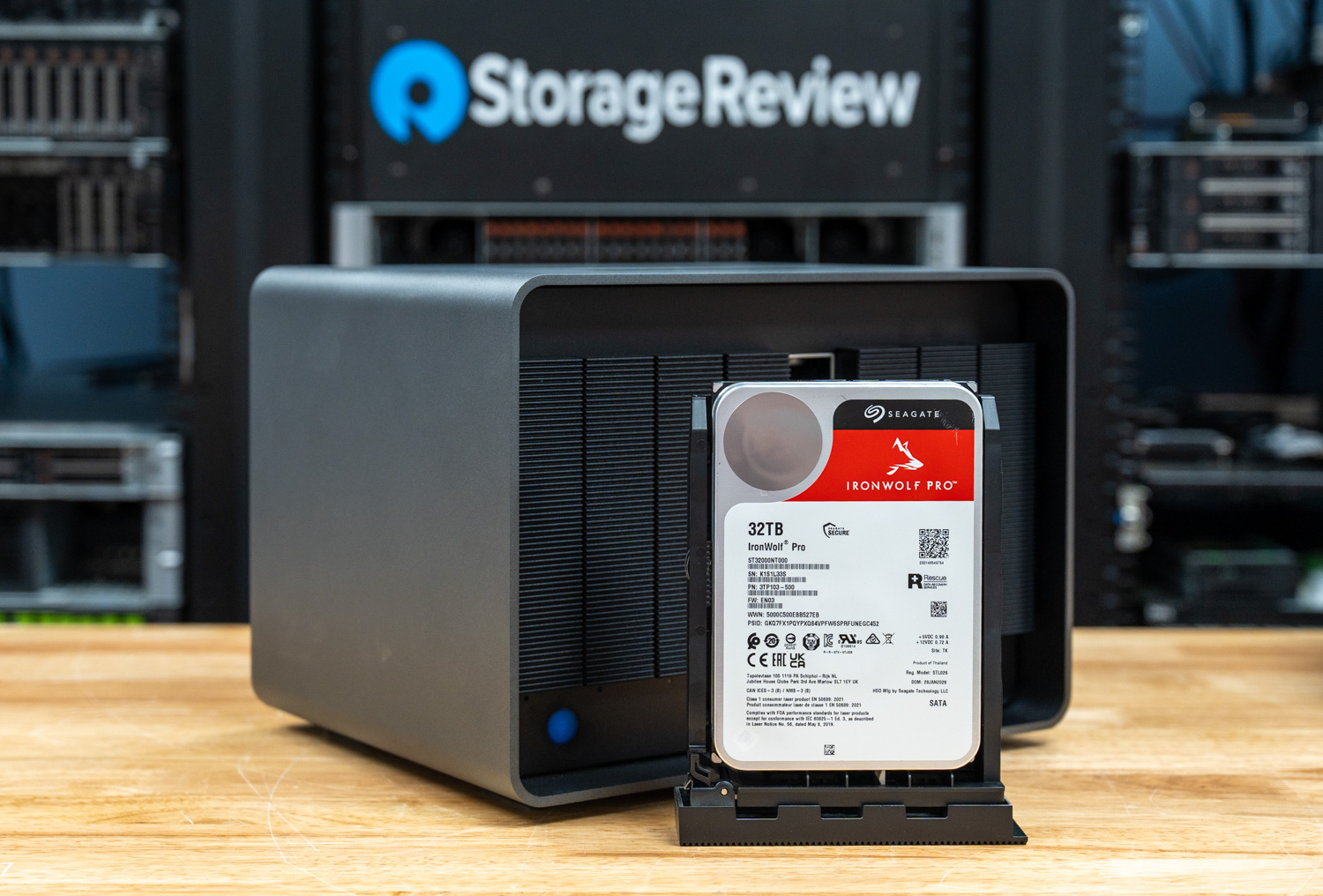
With eight 32TB HAMR-based Seagate IronWolf Pro drives on board, the 8big Pro5 tops out at 256TB of raw capacity. As far as turnkey desktop DAS products go, nothing else on the market ships at that capacity today. Competing 8-bay Thunderbolt enclosures from OWC, Sabrent, and others cap out at around 192 TB with the previous-generation PMR drives. While it is technically possible to roll your own by pairing a bare enclosure with eight 32TB IronWolf Pros, that DIY route leaves you stitching together the warranties across vendors. Seagate backs the complete LaCie kit end-to-end, including the drives, which is an advantage at this capacity point and for the value of the workloads involved.
Heat-assisted magnetic recording has been more than two decades in the making, and it has finally moved from hyperscale sampling to a product that a creative professional can put on a desk. For teams working with multi-stream 4K and 8K RAW footage, large photogrammetry or virtual production asset libraries, or AI-assisted content pipelines that consume storage faster than any prior generation, the jump from 24TB-era PMR drives to 32TB HAMR in the same eight bays is a meaningful change. We walked through the technical foundations of HAMR with Seagate’s Colin Presly on Podcast #124: The Path to 50TB HDDs with Frickin Lasers. The roadmap Colin laid out then is now shipping as product, with Mozaic 3+ drives at 30TB and up, Mozaic 4+ pushing to 44TB, and a longer arc toward 100TB drives as platter density continues to climb.
Around that storage core, LaCie delivers the rest of the package you would expect. The 8big Pro5 connects via Thunderbolt 5, which Seagate quotes at up to 80Gbps bidirectional for data, with additional headroom when combined with display traffic. In practice, the ceiling for a hard-drive array is set by the drives themselves. The IronWolf Pro 32TB is rated for up to 285 MB/s sustained, so eight drives in parallel have a theoretical maximum of about 2.2 GB/s before caching effects are taken into account.
The host port delivers up to 140W of power to a connected laptop, with two downstream Thunderbolt 5 ports rated at 30W each and a USB 20Gbps port rated at 15W for daisy-chained peripherals and displays. The LaCie 8big Pro5 ships preconfigured as a single RAID 5 array for 224TB of usable capacity, with RAID 0, 1, 6, 10, 50, and 60 available through LaCie RAID Manager. Build quality, thermals, and design are vintage LaCie, which we will cover in detail throughout the rest of this review. Pricing starts at $5,979 for the 32TB base configuration, with SKUs available up to 64TB, 128TB, 192TB, and 256TB.
LaCie 8big Pro5 – Build and Design
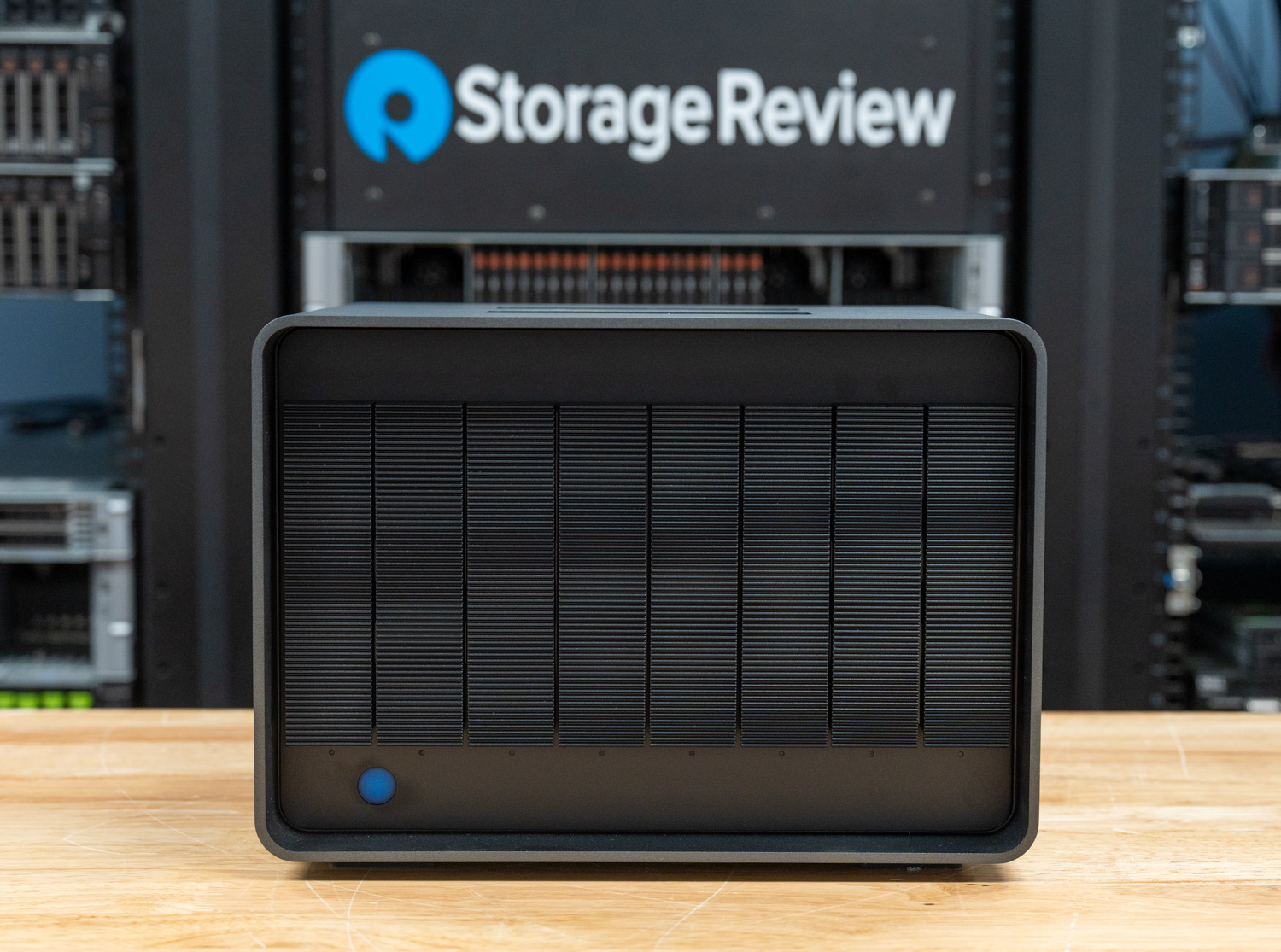
At the front of the LaCie 8big Pro5, the unit features a clean, minimal industrial design that aligns with its professional focus. It measures 11.69 inches in length, 9.13 inches in width, and 8.46 inches in height, giving it a compact yet substantial footprint for an eight-bay system.
Our review unit shipped fully populated with eight of Seagate’s new IronWolf Pro 32TB drives, for a total raw capacity of 256TB. With all drives installed, the system weighs just over 29 pounds, underscoring both its density and solid construction.
The enclosure itself is crafted from a single-piece aluminum chassis finished in metallic gray, giving it a premium, durable feel. Up front, each drive bay is tool-less, allowing quick, easy access to swap or service drives. Each tray is paired with an individual status LED, providing clear, at-a-glance visibility into drive activity and health without requiring interaction with the software.
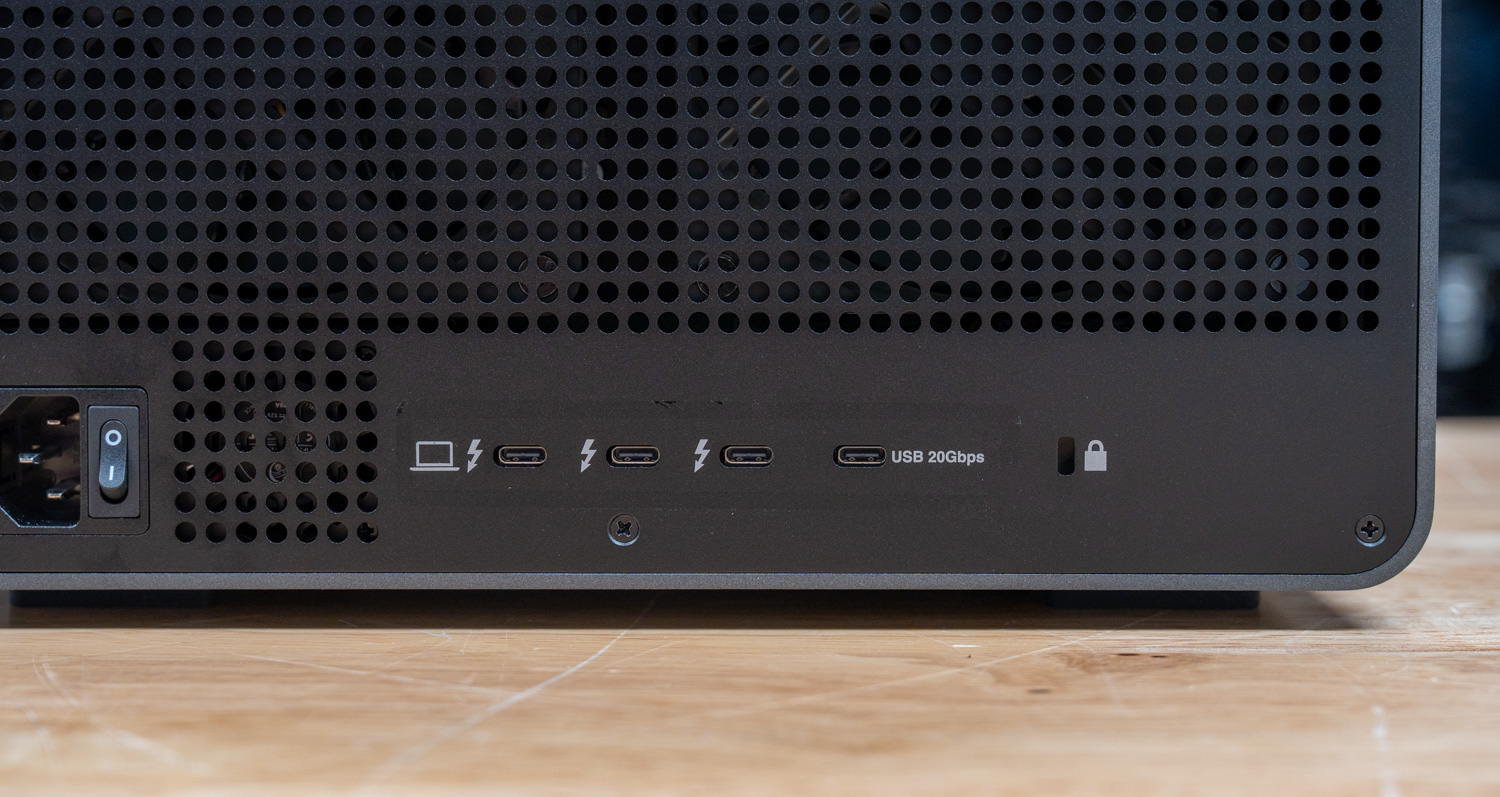
At the rear, the LaCie 8big Pro5 maintains the same clean, functional design, with heavy perforations across the back panel to support airflow in a fully populated chassis. Power is handled via a standard C19 input and a physical power switch, confirming that the power supply is fully integrated into the unit rather than relying on an external brick.
Connectivity centers on four USB-C ports, each clearly labeled for its role. The leftmost port serves as the primary host connection, operating over Thunderbolt 5 with up to 80Gbps bandwidth and delivering up to 140W of power, making it well-suited for powering and connecting a laptop with a single cable.
Next to it are two additional Thunderbolt 5 downstream ports. These ports enable expansion beyond the enclosure, supporting external storage devices or displays while also delivering up to 30W of power to connected peripherals. This makes the unit function as both a high-capacity storage array and a compact docking hub.
The final USB-C port supports a 20 Gbps connection, intended primarily for additional storage expansion. It also provides up to 15W of power, which is sufficient for bus-powered drives and similar accessories.
To round things out, there is a Kensington lock slot for physically securing the device, a practical addition for shared workspaces or studio environments where the unit may not always be in a controlled rack or locked room.
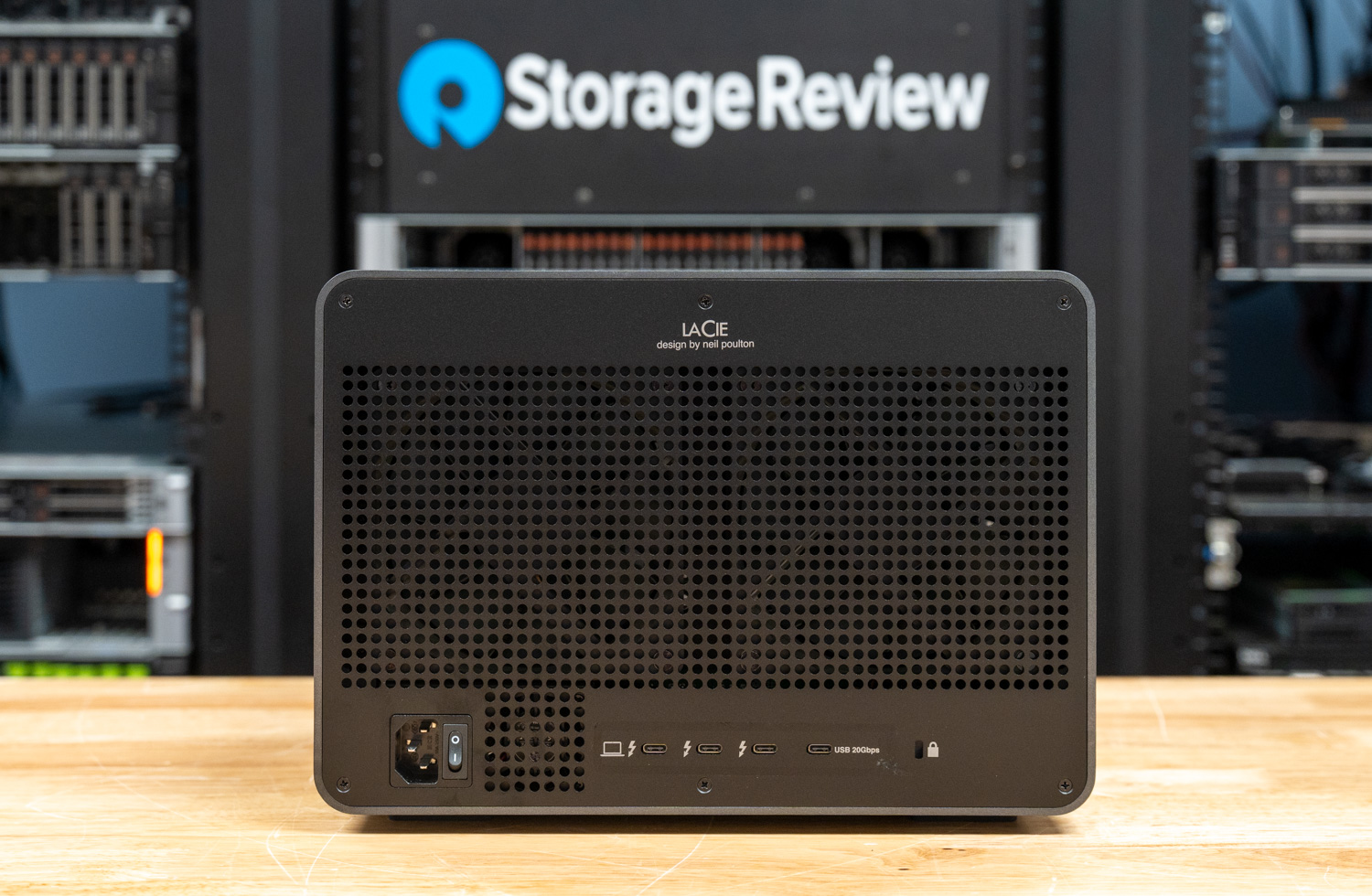
From a wider rear view, the airflow design becomes much more apparent. The majority of the back panel is perforated, allowing the system to move a significant amount of air across all eight drives. Cooling is handled by a three-fan setup, with two larger fans serving the primary drive bay area and a smaller fan dedicated to the lower section housing the controller and power components. This separation helps ensure consistent airflow across both the storage and internal electronics. This is especially important in a fully populated 256TB configuration where thermal buildup can become a limiting factor over sustained workloads.
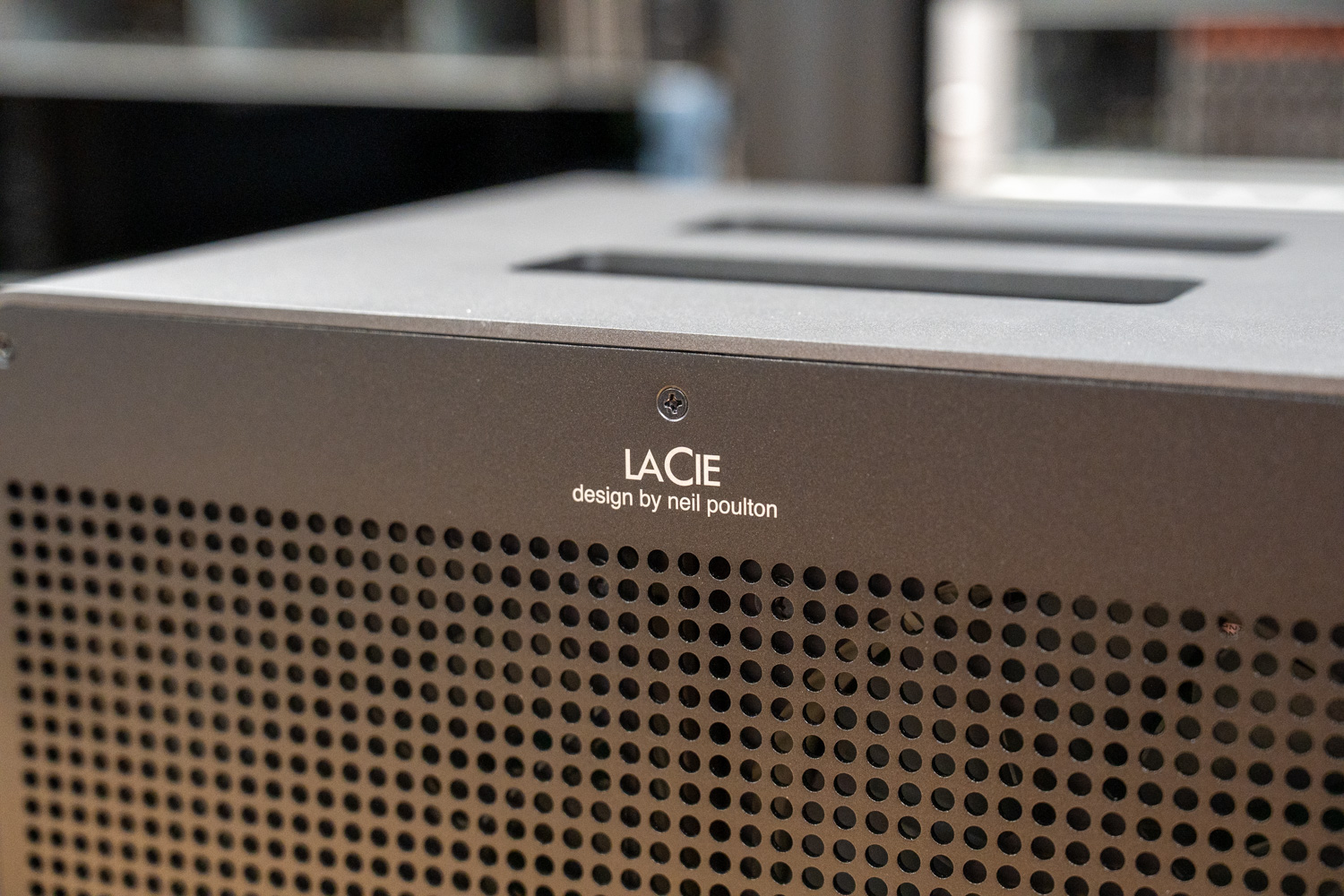
You can also see the subtle branding here, with “LaCie – design by Neil Poulton” centered along the upper portion of the rear panel, reinforcing the industrial design heritage that has been a hallmark of LaCie systems for years.
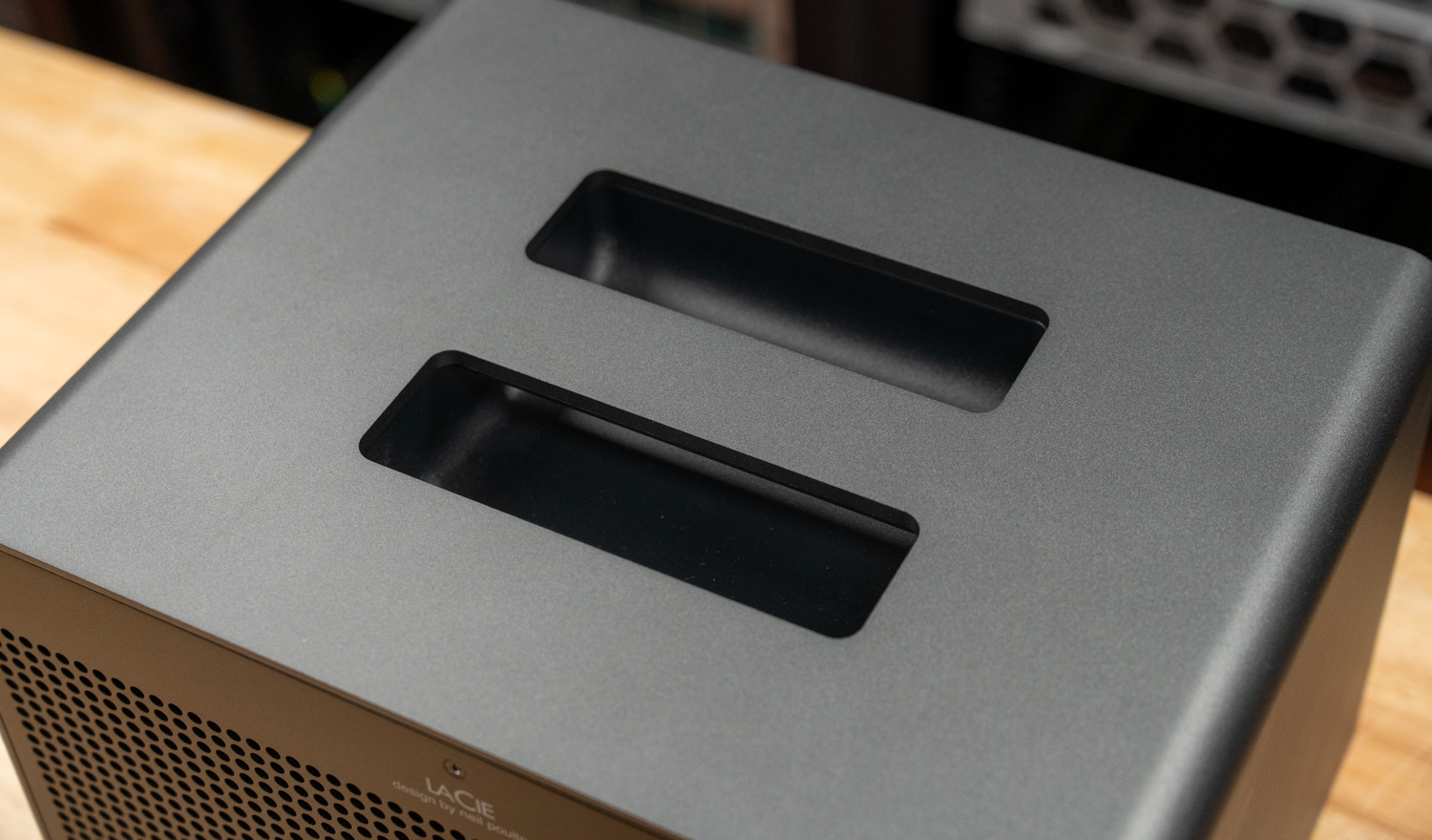
Up top, LaCie adds a simple yet practical touch with the integrated handle cutouts. Machined directly into the aluminum, these recessed grips provide a secure way to lift and move the unit without compromising the clean design language.
Given that the system weighs just over 29 pounds when fully populated, a built-in grip like this makes a noticeable difference during deployment or repositioning. It is a small detail, but one that reflects an understanding that this is not a lightweight desktop accessory and will occasionally need to be handled with a bit more care.
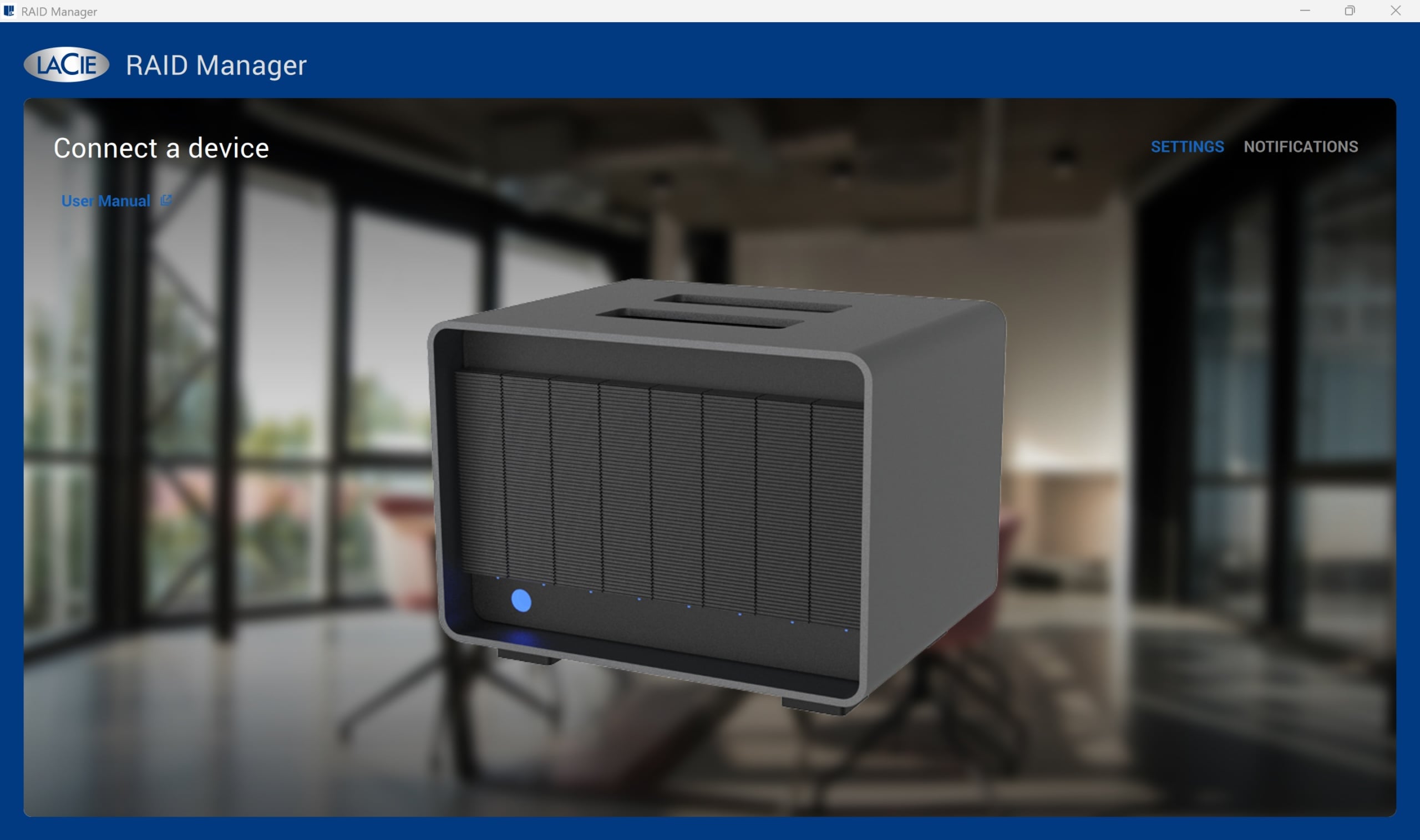
LaCie 8big Pro5 – LaCie RAID Manager software
To manage the 8big Pro5’s storage configuration, LaCie requires its RAID Manager software. This utility is available for Windows and macOS and is necessary to configure the array in RAID modes or switch the unit to JBOD, depending on your deployment needs.
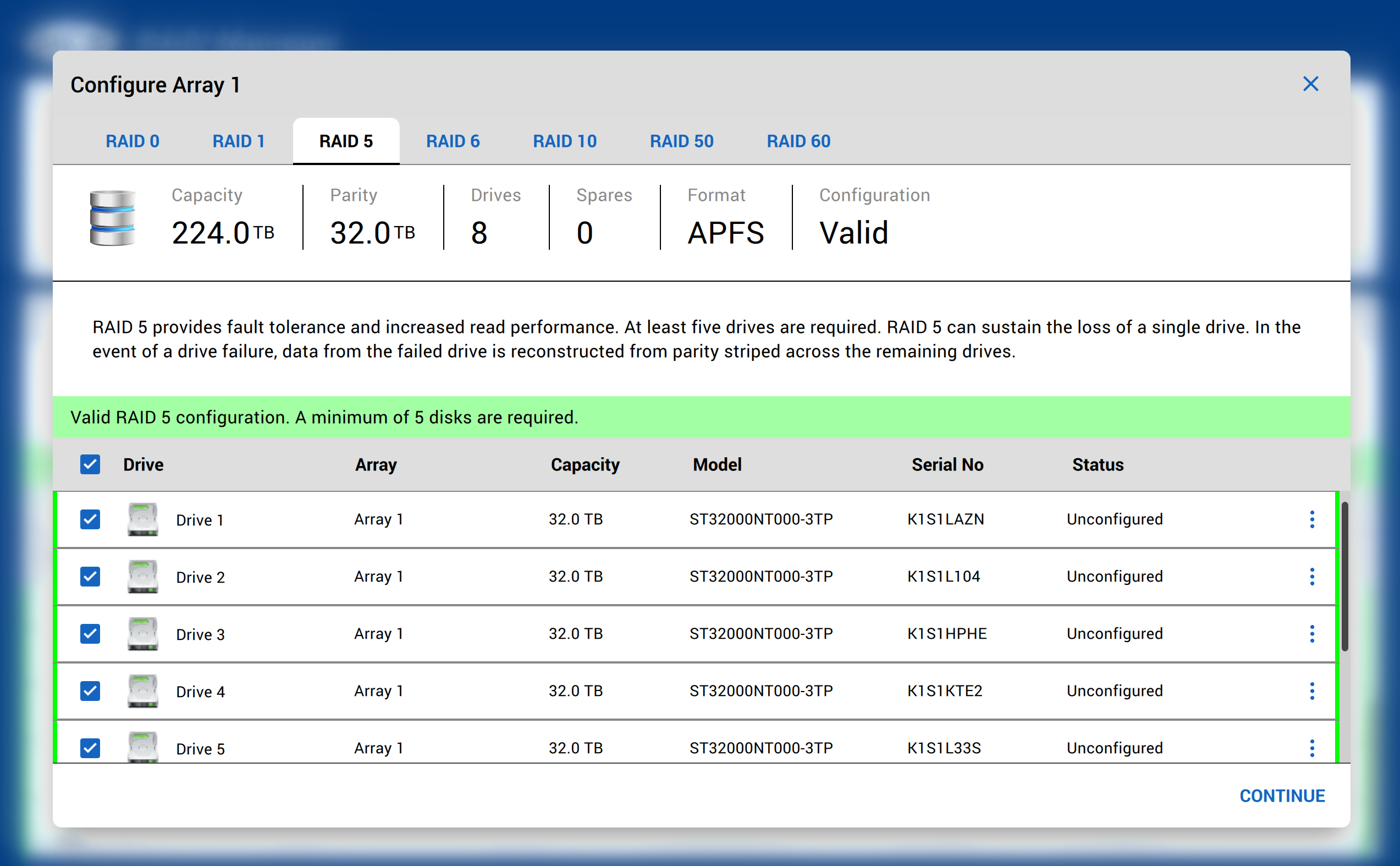
Through RAID Manager, users can choose from a full range of RAID levels, including RAID 0, RAID 1, RAID 5, RAID 6, RAID 10, RAID 50, and RAID 60. This flexibility allows the unit to be tailored for everything from maximum performance to high levels of redundancy and fault tolerance. As shown here, a RAID 5 configuration using all eight 32TB drives yields 224TB of usable capacity and provides single-drive fault tolerance through parity.
In addition to RAID configuration, the software also allows you to format the array in either APFS for macOS environments or NTFS for Windows deployments, making it easy to integrate into mixed or platform-specific workflows. The interface itself is straightforward, providing visibility into drive status, serial numbers, and overall array health, while also confirming valid configurations before deployment.
LaCie 8big Pro5 – Performance
For Windows testing, we leveraged a Dell Pro Max 14 with the following configuration:
- Intel Core Ultra 9 285H
- NVIDIA RTX PRO 2000 8GB GDDR7
- 64GB LPDDR5X-8400
- 1TB SSD
For macOS testing, we used an M4 MacBook Air.
To evaluate the performance of the 8big Pro5, we began testing in a Windows environment with ExFat, configuring the array in RAID 5. This setup reflects a common balance of capacity, performance, and redundancy for general-purpose use. In this configuration, we ran a series of benchmarks, including IOMeter for synthetic workload analysis, Blackmagic Disk Speed Test for media-focused throughput, and PCMark 10 Disk Benchmark to capture more real-world application behavior.
After completing Windows testing, we switched to a macOS environment using RAID 5 and ExFAT. This allowed us to measure the performance of the same configuration across Windows and Mac environments. In this configuration, we reran Blackmagic Disk Speed Test to compare results in a macOS-native workflow and added ATTO Disk Benchmark to analyze performance across varying transfer sizes.
Blackmagic Disk Speed Test
The Blackmagic Disk Speed Test benchmarks a drive’s read and write speeds to estimate its performance, especially for video editing tasks. It helps users ensure their storage is fast enough for high-resolution content, such as 4K or 8K video.
The Blackmagic results show clear, real-world performance gains across RAID configurations. In RAID 5 in Windows, the 8big Pro5 delivers 1,418.4 MB/s read and 2,061.5 MB/s write speeds, offering a strong balance of performance and data protection. When moved to macOS, read performance remains nearly identical at 1,414.9 MB/s, while write speeds are 1,751.3 MB/s, reflecting some platform differences rather than a limitation of the array itself.
Looking at the Blackmagic workload breakdown, RAID 5 still proves more than capable for high-resolution media workflows. At these speeds, the array comfortably supports formats up through 8K, including 8K DCI and even 12K playback in several codecs, with consistent results across ProRes 422 HQ and H.265. This reinforces that RAID 5 is not just a safe option, but a practical one for professional video editing where both performance and redundancy matter.
In practice, RAID 5 delivers more than enough performance for demanding video workflows while maintaining data protection.
| Blackmagic (higher is better) | LaCie 8big Pro5 – Windows Raid 5 ExFat | LaCie 8big Pro5 – macOS Raid 5 ExFat |
|---|---|---|
| Read | 1,418.4 MB/s | 1,414.9 MB/s |
| Write | 2,061.5 MB/s | 1,751.3 MB/s |
PCmark 10 Storage
PCMark 10 Storage Benchmarks evaluate real-world storage performance using application-based traces. They test the system and data drives, measuring bandwidth, access times, and consistency under load. These benchmarks offer practical insights beyond synthetic tests, enabling users to compare modern storage solutions effectively.
The PCMark 10 result of 717 gives a useful look at how the 8big Pro5 behaves under real-world workloads rather than pure synthetic throughput. This benchmark incorporates traces from everyday applications, which tend to be more sensitive to latency and mixed I/O patterns than large sequential transfers.
| PCmark 10 Storage (higher is better) | LaCie 8big Pro5 – Windows Raid 5 ExFat |
|---|---|
| Overall Score | 717 |
IOMeter
We also ran the LaCie 8big Pro5 array through IOMeter. This lets us dig deeper into workloads, including random and sequential performance. We tested the 8big with a single queue to simulate lighter use and with four queue to see how the DAS handles heavier, more demanding scenarios.
At 1 queue, sequential performance is 1,752.2 MB/s read and 1,851.5 MB/s write, showing strong throughput even under a lighter load. Random 2MB performance lands at 233.8 MB/s read, and 654.1 MB/s write, while small-block 4K operations reach 297 IOPS read and 5,482 IOPS write.
| IOMeter (1 queue) | LaCie 8big Pro5 – Windows Raid 5 Raw |
|---|---|
| Seq 2MB Read | 1,752.2 MB/s |
| Seq 2MB Write | 1,851.5 MB/s |
| Random 2MB Read | 233.8 MB/s |
| Random 2MB Write | 654.1 MB/s |
| Random 4K Read | 297 IOPS |
| Random 4K Write | 5,482 IOPS |
Scaling to 4 queue, sequential reads increase to 1,949.1 MB/s, while writes remain steady at 1,873.6 MB/s, indicating the array is already near its write ceiling. Random 2MB performance improves more noticeably, with reads rising to 391.1 MB/s and writes to 980.5 MB/s. For 4K workloads, reads scale to 1,103 IOPS, while writes settle at 4,458 IOPS.
| IOMeter (4 queue) | LaCie 8big Pro5 – Windows Raid 5 Raw |
|---|---|
| Seq 2MB Read | 1,949.1 MB/s |
| Seq 2MB Write | 1,873.6 MB/s |
| Random 2MB Read | 391.1 MB/s |
| Random 2MB Write | 980.5 MB/s |
| Random 4K Read | 1,103 IOPS |
| Random 4K Write | 4,458 IOPS |
ATTO Disk Benchmark Summary (LaCie 8big Pro5 – macOS RAID 5, ExFat)
The ATTO results provide a clear picture of how the 8big Pro5 behaves in macOS when pushed to maximum throughput across a wide range of transfer sizes in a RAID 5 configuration.
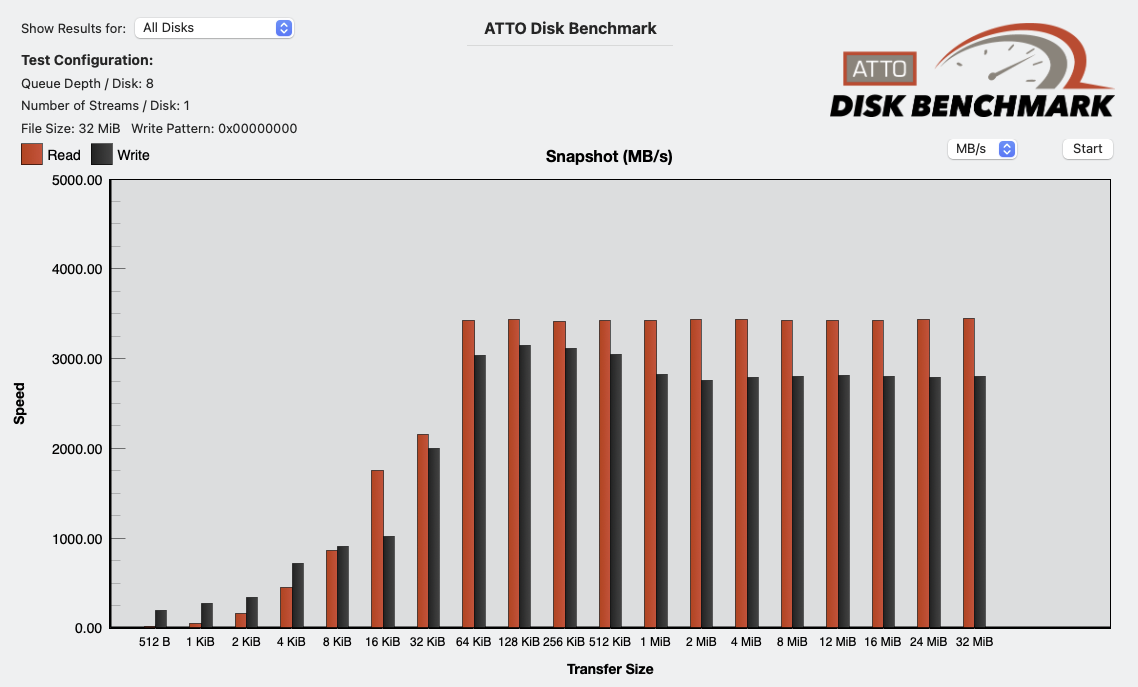
At lower transfer sizes, performance ramps up gradually, as expected for an HDD-based array. Small-block operations (under 16KB) remain relatively modest, but once you move to larger transfer sizes, the system scales more effectively.
From around 64KB onward, throughput stabilizes and becomes a far more representative measure of real-world performance. Peak read speeds reach approximately 3.4 GB/s, while write performance settles slightly lower in the 2.7-3.1 GB/s range across larger block sizes.
Overall, the results show strong sequential performance, with the array delivering high read throughput and slightly lower, but still consistent, write speeds under sustained workloads.
Conclusion
The LaCie 8big Pro5 marks a meaningful leap forward for the line. At 256TB raw over Thunderbolt 5, with eight HAMR-based IronWolf Pro drives housed in a well-designed Neil Poulton enclosure, it is the first turnkey desktop DAS to deliver both a massive capacity jump and next-generation interface bandwidth to creative pros in a single box. The 8big formula is all here: premium build, thoughtful thermals, quiet operation, mature RAID management through LaCie RAID Manager, and a clear focus on the video, photo, and 3D asset workflows that have consistently outpaced the storage they rely on.
Performance lands where a well-tuned eight-bay array should. In RAID 5, the array comfortably handles multi-stream 4K and 8K editing with room to spare. Small-block random performance is modest, as expected for any HDD-based array, but that is not the workload profile this product is built for. For bulk sequential transfers, active project storage, and long-form media ingest, the array delivers the throughput that modern creative workflows need. The Thunderbolt 5 host port with 140W of power delivery, plus the two downstream TB5 ports and the 20Gbps USB-C, also make the unit a legitimate one-cable docking solution for a laptop-based edit bay, not just a storage target.
Pricing starts at $5,979 for the 32TB base configuration and scales up through 64TB, 128TB, 192TB, and 256TB tiers. That is a meaningful investment, but a 5-year warranty that covers both the enclosure and the drives end-to-end, Rescue Data Recovery Services, and the operational simplicity of a single-box deployment distinguish it from a DIY build using bare IronWolf Pros and a third-party enclosure. For creative professionals, production teams, and studios working at 4K, 8K, and beyond, and for anyone whose project data has outgrown what previous-generation PMR arrays could deliver in the same footprint, the 8big Pro5 is the most capable turnkey desktop DAS available today and earns the shortlist spot for high-end workflows that need both the capacity and the interface to match.



 Amazon