

We recently received Supermicro’s dual-socket Turin-based A+ Server AS-2126HS-TN for review. It’s a 2U platform designed to support extremely high-core-count workloads and to provide flexible PCIe expansion. Built around and supporting dual AMD EPYC 9005 (Turin) and 9004 (Genoa) series processors, the system targets a broad range of enterprise and data center use cases, including virtualization, software-defined storage, AI inference and machine learning, cloud computing, enterprise server consolidation, and high-performance computing (HPC).
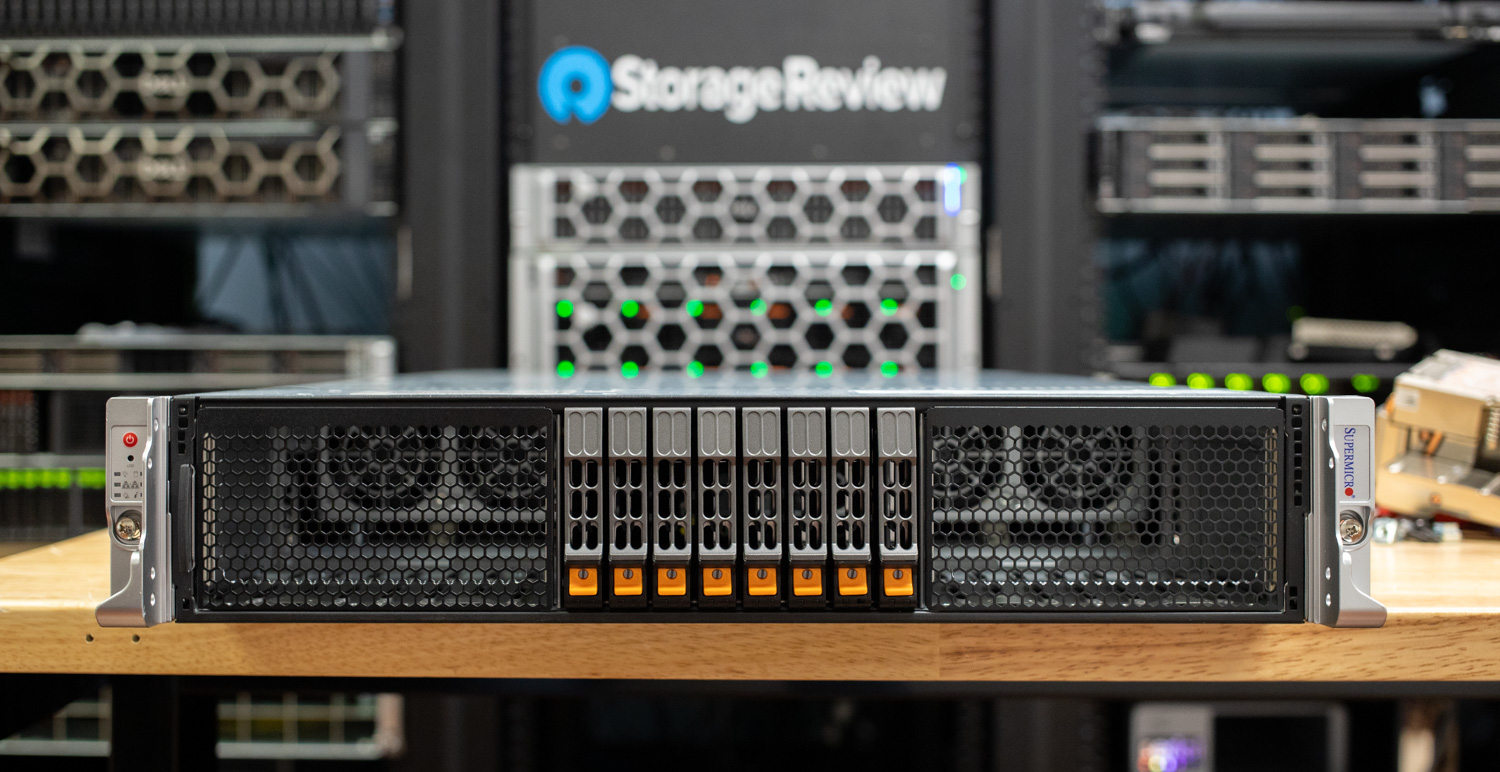
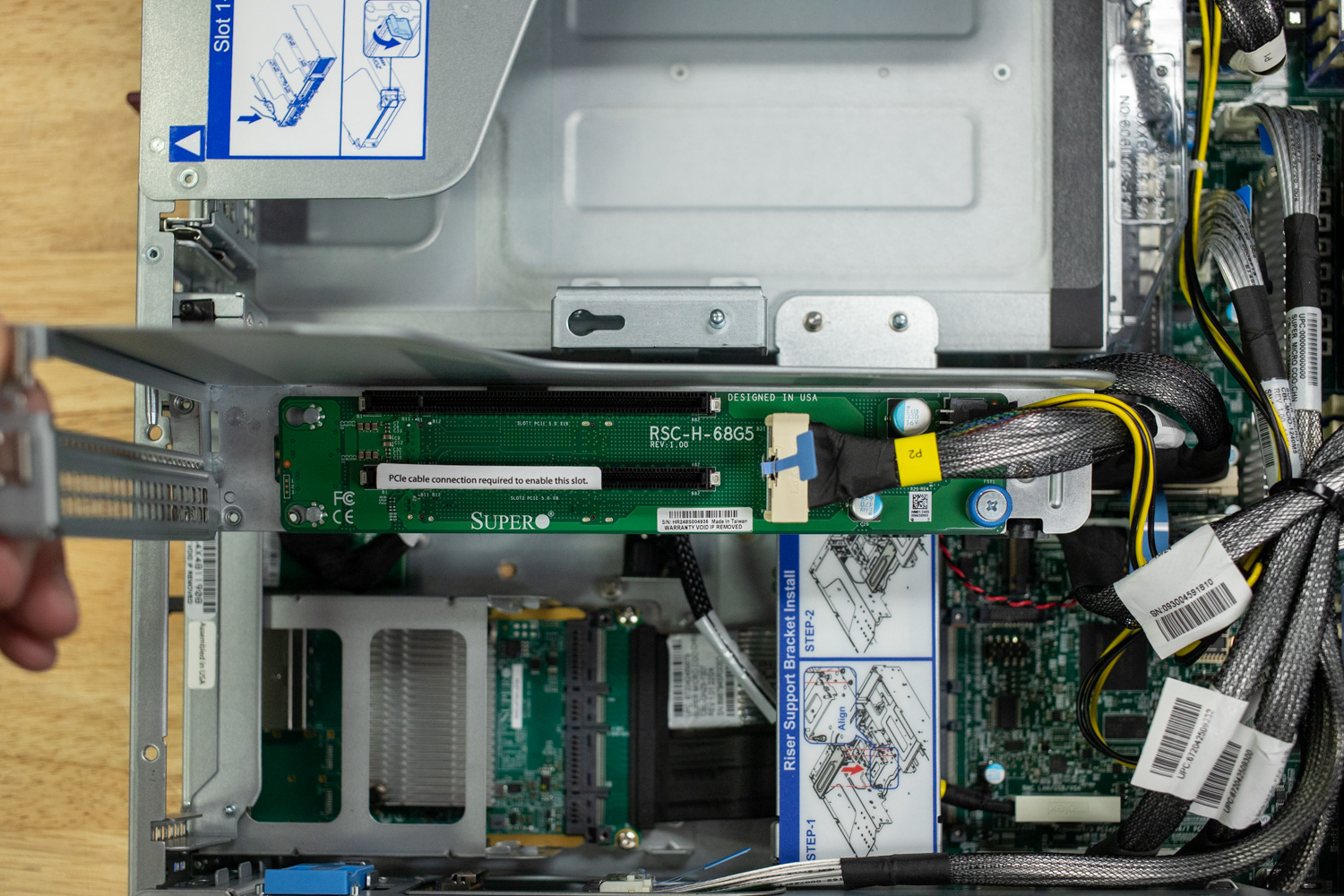
The AS-2126HS-TN supports multiple PCIe slot configurations, allowing deployments to prioritize either accelerator density or I/O flexibility. Depending on configuration, the platform can be populated with up to four PCIe 5.0 x16 slots, up to eight PCIe 5.0 x8 slots, or mixed layouts to accommodate GPUs, high-speed networking, and storage controllers. This modular approach enables the system to adapt to compute-dense, I/O-heavy, or accelerator-focused workloads without requiring changes to the underlying chassis.
To evaluate the platform, we ran the AS-2126HS-TN through our enterprise testing stack, focusing on CPU-intensive workloads that reflect real-world deployment scenarios. Our testing emphasizes sustained multithreaded performance, memory behavior, and platform-level efficiency, providing insight into how Supermicro’s Turin-based design performs under demanding enterprise and HPC conditions.
Supermicro AS-2126HS-TN Specifications
The table below outlines the hardware specifications of the Supermicro AS-2126HS-TN, providing an overview of its platform design, compute capabilities, expansion options, and power and cooling characteristics.
| Specification | Supermicro A+ Server AS -2126HS-TN |
|---|---|
| System Overview | |
| Product SKU | A+ Server AS -2126HS-TN |
| Motherboard | Super H14DSH |
| Form Factor | 2U Rackmount |
| Chassis Model | CSE-HS201-R000NFP |
| Processors | |
| CPU Support | Dual processor(s); AMD EPYC™ 9005/9004 Series Processors |
| Max Core Count | Up to 384C / 768T |
| Max CPU TDP | Supports up to 500W TDP CPUs* |
| CPU Cooling Note | Air-cooled CPUs with a TDP over 400W are only supported under specific conditions. |
| GPU & Acceleration | |
| Max GPU Count | Up to 3 double-width GPUs |
| Supported GPUs (PCIe) | NVIDIA: H100 NVL, RTX 6000 Ada Generation, L4 AMD: Instinct™ MI210 |
| GPU-GPU Interconnect | PCIe |
| Memory | |
| DIMM Slots | 24 DIMM slots |
| Max Memory (1DPC, EPYC 9005) | Up to 6TB ECC DDR5 RDIMM @ 6400MT/s |
| Max Memory (1DPC, EPYC 9004) | Up to 6TB ECC DDR5 RDIMM @ 4800MT/s |
| Memory Voltage | 1.1V |
| Onboard Devices & Networking | |
| Chipset | System on Chip |
| Network Connectivity | Via AIOM (AOC options available) |
| BMC / IPMI | IPMI 2.0 with virtual media over LAN and KVM-over-LAN support |
| Input / Output | |
| LAN (BMC) | 1 RJ45 1GbE dedicated BMC LAN port |
| USB | 2 × USB 3.0 (rear) |
| Video | 1 × VGA |
| TPM | 1 TPM onboard / port 80 |
| BIOS | |
| BIOS Type | AMI 64MB SPI Flash EEPROM |
| BIOS Features | Plug and Play (PnP); UEFI 2.8; USB keyboard support; ACPI 6.5; SMBIOS 3.7 or later |
| Management | |
| Software / Tools | SuperCloud Composer®; Supermicro Server Manager (SSM); Super Diagnostics Offline (SDO); KVM with dedicated LAN; IPMI 2.0; Supermicro Thin-Agent Service (TAS); SuperServer Automation Assistant (SAA); IPMIView |
| Power Configurations | ACPI/APM power management; power-on mode control for AC power loss recovery; power button override mechanism |
| Security | |
| Hardware Security | TPM 2.0; Silicon Root of Trust (RoT) – NIST 800-193 compliant |
| Security Features | Cryptographically signed firmware; Secure Boot; Secure firmware updates; Automatic firmware recovery; Supply chain security (remote attestation); Runtime BMC protections; System lockdown |
| PC Health Monitoring | |
| Fan Monitoring | Tachometer monitoring; speed control status; PWM fan connectors |
| Temperature Monitoring | CPU & chassis environment monitoring; thermal control for fan connectors |
| Voltage / Sensors | System temp; Memory temp; CPU temp; 3.3V standby; +5V standby; +5V; +3.3V; +12V; CPU thermal trip support |
| Front Panel | |
| LED Indicators | HDD activity; LAN1 activity; Power status; System information |
| Buttons | Power On/Off; UID |
| Expansion & Interconnect | |
| PCIe Slot Configuration | Option A*: 4 × PCIe 5.0 x16 FHFL double-width slots; 1 × PCIe 5.0 x16 AIOM (OCP 3.0 compatible) Option B*: 8 × PCIe 5.0 x8 (in x16) FHFL slots; 1 × PCIe 5.0 x16 AIOM (OCP 3.0 compatible) *Requires additional parts; see optional parts list. Refer to system callout images for details. |
| CXL Support | Up to 4 CXL 2.0 x16 devices |
| Storage | |
| Drive Bays (Default) | Total 8 bays; 8 front hot-swap 2.5″ NVMe*/SATA* drive bays |
| Drive Bays (Option A) | Total 24 bays; 24 front hot-swap 2.5″ NVMe*/SATA* drive bays |
| M.2 | 2 × M.2 PCIe 3.0 x4 NVMe (M-key 2280/22110) |
| Storage Note | NVMe/SATA support may require additional storage controller and/or cables |
| Cooling | |
| Fans | Up to 6 counter-rotating 60×60×56mm fans |
| Air Shroud | 2 air shrouds |
| Power | |
| Power Supply Options | 2× 1200W / 1300W / 1600W / 2000W / 2600W (varies by configuration) |
| Included / Listed PSU | 2× 2000W redundant (1+1) Titanium level (96%) |
| PSU Dimensions (W×H×L) | 73.5 × 40 × 265 mm |
| Input (varies by PSU) | 1000W: 100–127Vac / 50–60Hz 1800W: 200–220Vac / 50–60Hz 2700W: 200–240Vac 1980W: 220–230Vac / 50–60Hz 2000W: 220–240Vac / 50–60Hz (UL only) 2000W: 230–240Vac / 50–60Hz 2000W: 230–240Vdc / 50–60Hz (CQC only) |
| +12V Rail (varies by input) | Max 83A (100–127Vac) / Max 150A (200–220Vac) / Max 225A (200–240Vac) Max 165A (220–230Vac) / Max 166A (230–240Vac) |
| 12V SB | Max 3.5A / Min 0A |
| Output Type | Backplanes (gold finger) |
| Dimensions & Weight | |
| Height | 3.5″ (88.9 mm) |
| Width | 17.2″ (437 mm) |
| Depth | 31.74″ (806.2 mm) |
| Package (H×W×D) | 9.96″ × 26.46″ × 43.31″ |
| Weight | Gross: 75 lbs (34 kg); Net: 45 lbs (20.5 kg) |
| Available Color | Silver |
Supermicro AS-2126HS-TN Build and design
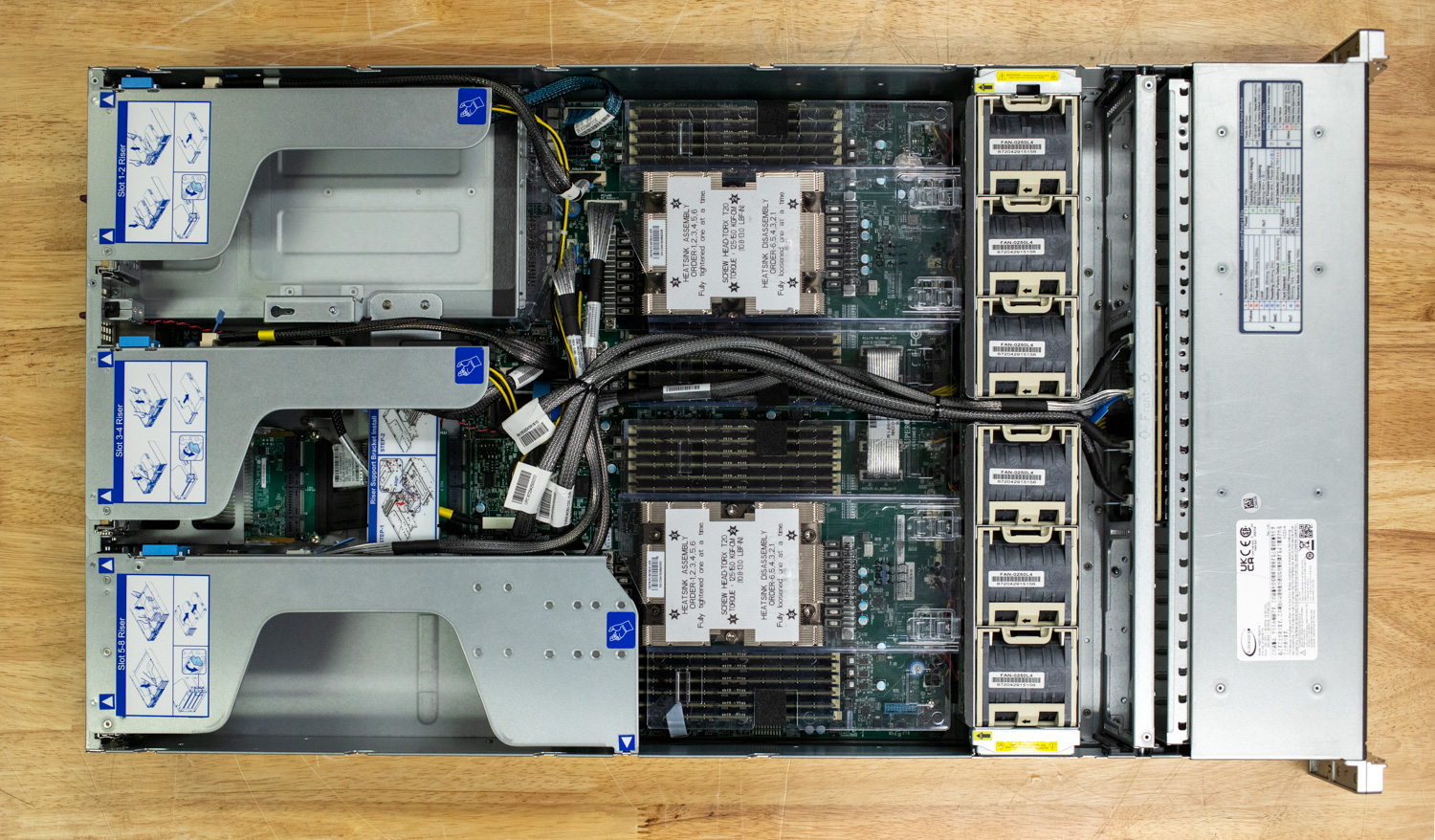
The Supermicro A+ Server AS-2126HS-TN is a dense 2U dual-socket platform engineered for extreme core counts, high-TDP processors, and accelerator-heavy configurations. Its internal layout follows a disciplined front-to-back airflow path that balances thermal efficiency, power scalability, and serviceability across compute, memory, storage, and expansion subsystems.
Front Section: Storage and Air Intake
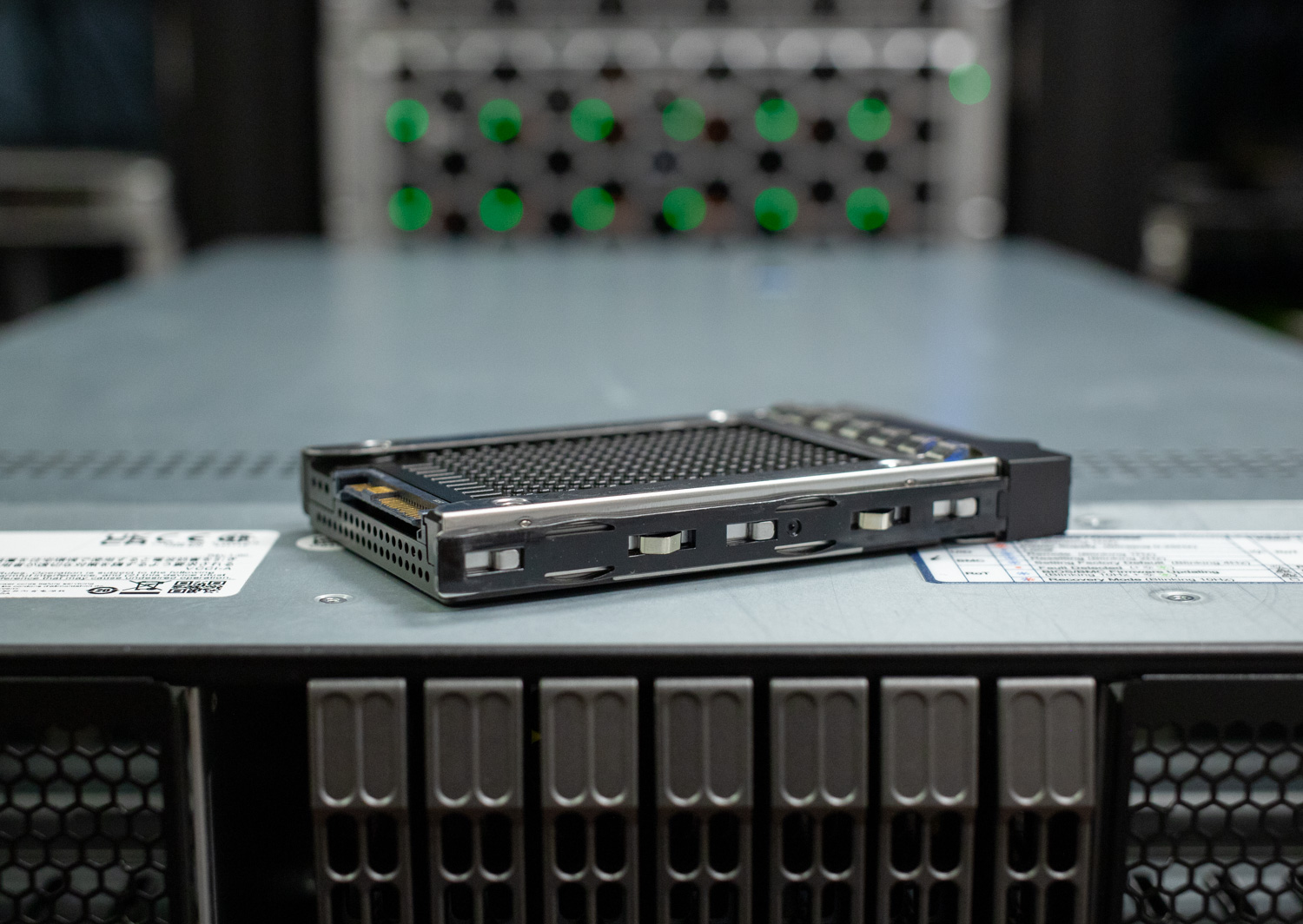
The front of the chassis is designed for high-density storage and unrestricted airflow. Depending on configuration, the system supports up to 8 or 24 NVMe drive bays, providing direct PCIe connectivity for high-performance storage workloads. These bays are positioned ahead of the main airflow path, ensuring cool intake air is evenly distributed before reaching the compute and expansion zones.
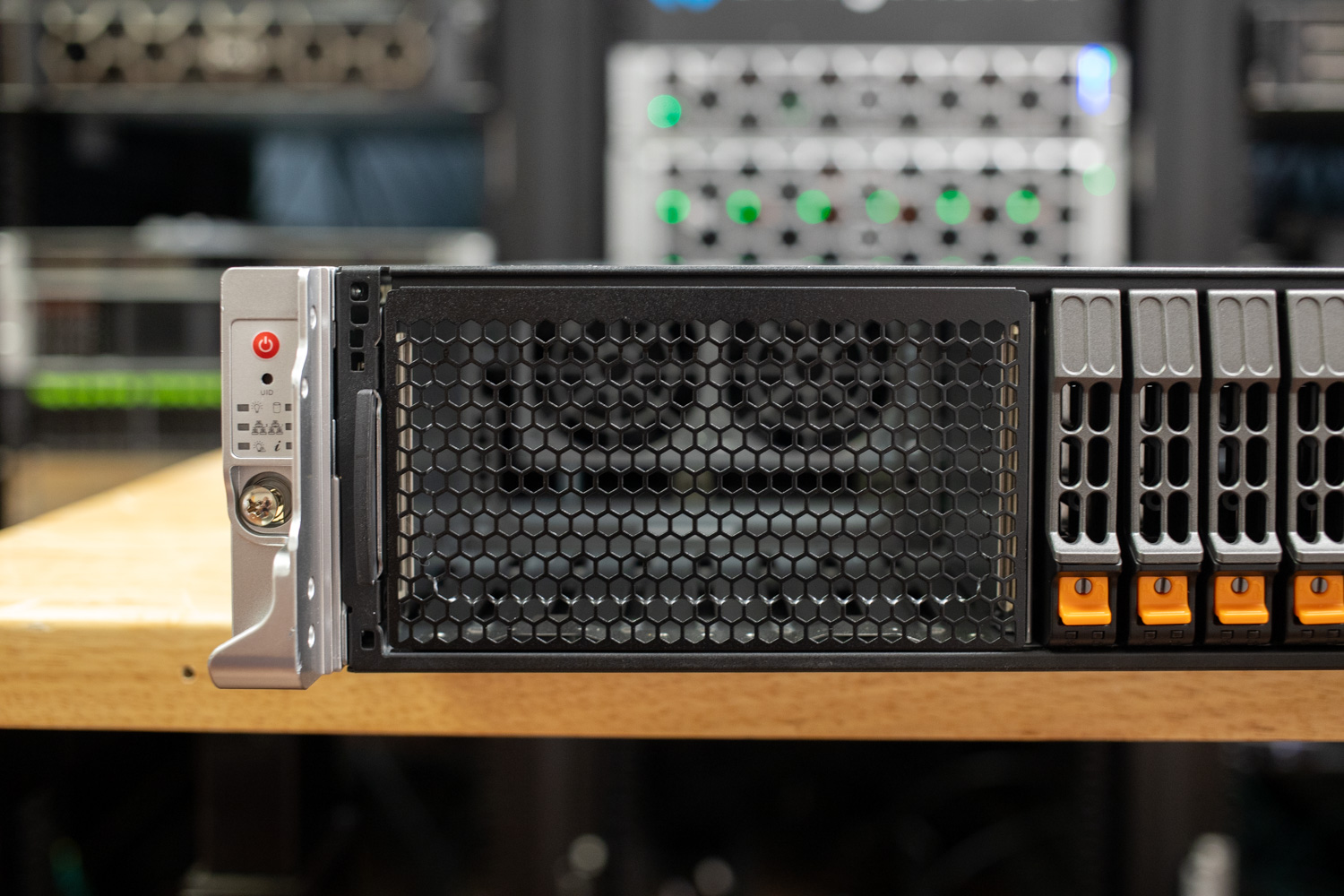
This layout allows storage to operate independently of CPU and accelerator thermals, maintaining consistent performance under sustained I/O load while minimizing airflow disruption within the chassis.
Mid-Chassis: Cooling Architecture
Immediately behind the front storage area is a bank of six hot-swap, high-performance internal fans. These fans create a straight-through cooling channel, generating sufficient static pressure to support dual AMD EPYC processors with TDPs up to 500W and multiple double-width PCIe GPUs.
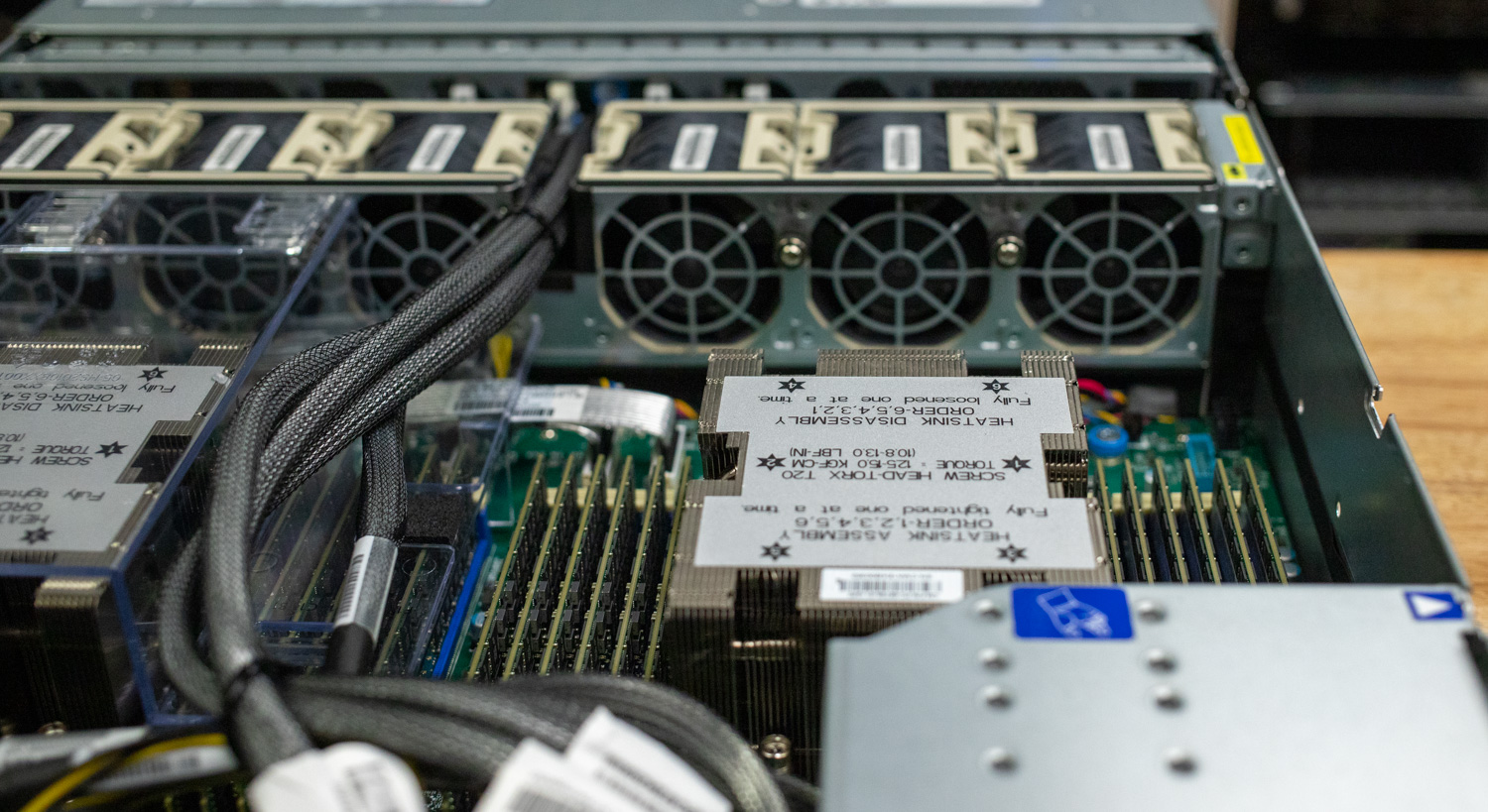
Fan speed is dynamically controlled through PWM connectors and monitored via onboard tachometers, with thermal policies managed at the system level. This design allows the platform to adapt cooling behavior in real time based on CPU, memory, and chassis temperatures, ensuring stable operation across a wide range of workload profiles.
Compute Core: CPUs and Memory
At the heart of the system is the Super H14DSH motherboard, which supports dual AMD EPYC 9005 or 9004-series processors. With support for up to 384 cores and 768 threads, the AS-2126HS-TN is positioned for highly parallel workloads such as virtualization, HPC, and AI inference.
The platform supports processors with TDPs up to 500W, with air-cooled operation above 400W available under specific thermal configurations. Each processor is paired with a full set of memory channels feeding 24 DDR5 DIMM slots, supporting up to 6TB of ECC DDR5 RDIMM in 1DPC configurations. Memory speeds scale with processor generation, reaching up to 6400 MT/s with EPYC 9005 or 4800 MT/s with EPYC 9004 CPUs.
This symmetrical memory layout minimizes latency and ensures balanced airflow across all DIMMs, even in fully populated configurations.
Boot Storage and Onboard Connectivity
For operating system and management storage, the system includes two onboard M.2 PCIe 3.0 NVMe slots, isolated from the main NVMe backplane. This separation allows administrators to dedicate front bays to application or data storage while keeping boot media thermally and logically independent.
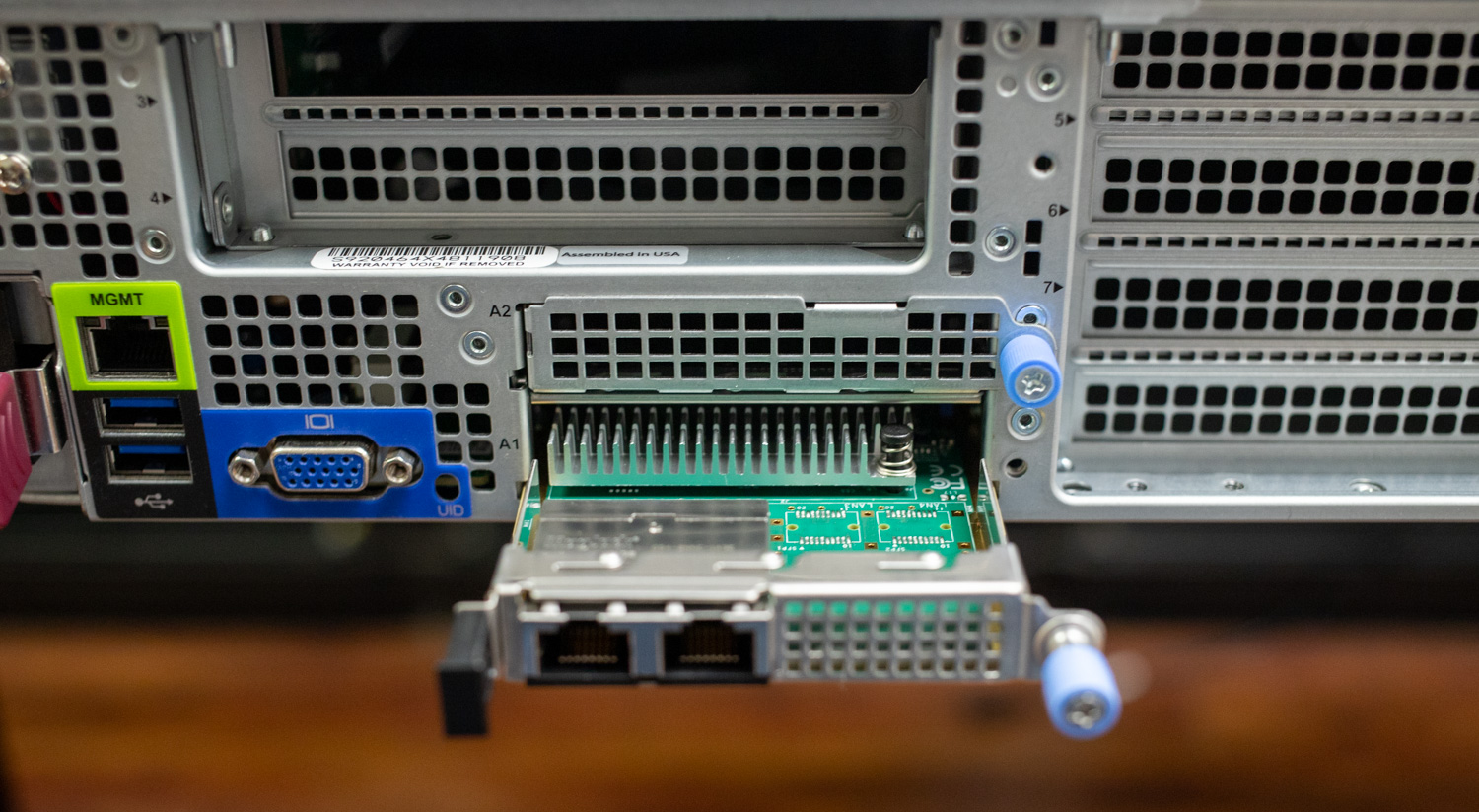
Networking is handled through an AIOM (OCP 3.0) PCIe 5.0 x16 slot, enabling flexible network configurations without consuming standard PCIe expansion slots. This approach preserves valuable PCIe real estate for accelerators or additional storage controllers.
Expansion and GPU Support
The rear half of the chassis is dedicated to PCIe expansion and accelerator support. The AS-2126HS-TN supports up to three double-width PCIe GPUs, making it suitable for compute-dense deployments. Supported accelerators include NVIDIA PCIe GPUs such as the H100 NVL, RTX 6000 Ada Generation, and L4, as well as AMD Instinct MI210 accelerators.
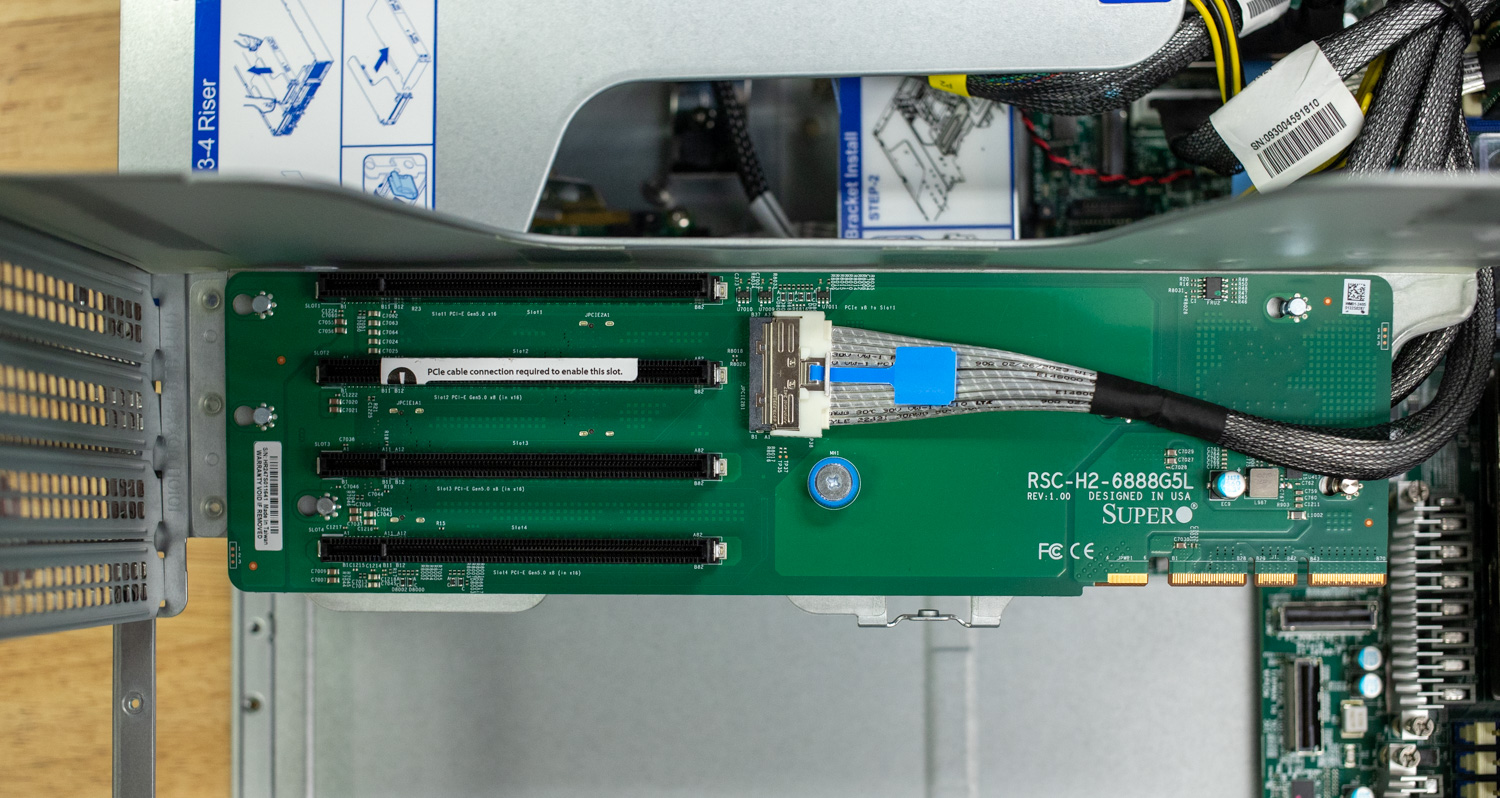
All expansion slots are PCIe Gen 5, arranged to maintain airflow clearance and mechanical stability for full-height, full-length cards. GPU-to-GPU communication is handled over PCIe, keeping the platform flexible and vendor-agnostic while supporting a wide range of accelerator configurations.
Rear I/O and Management
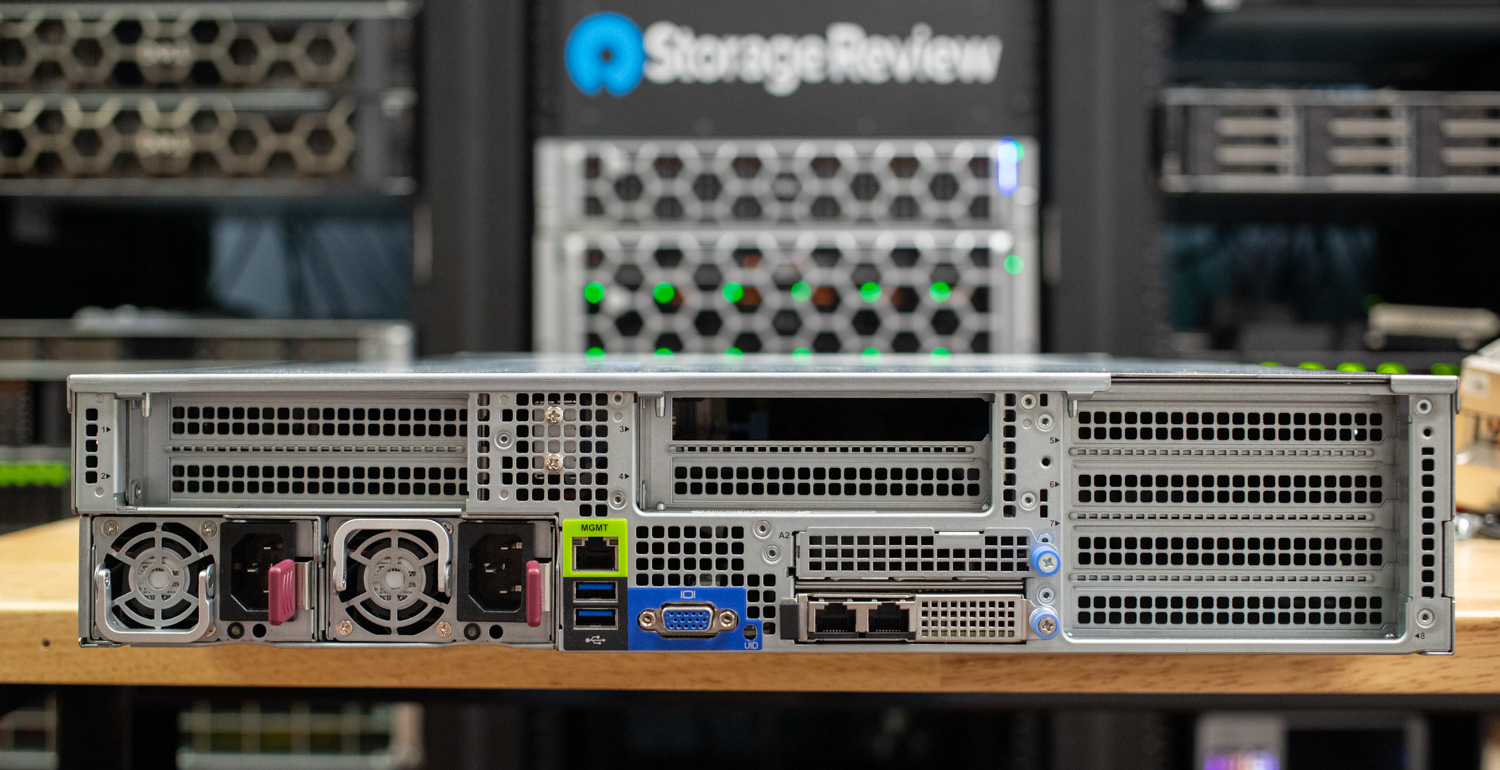
The rear I/O panel consolidates local and out-of-band management access. It includes a dedicated 1 GbE IPMI LAN port, two USB 3.0 ports, and a VGA output for direct console access. Management is handled via IPMI 2.0, with KVM-over-LAN and virtual media support integrated into Supermicro’s broader management stack, including SuperCloud Composer, Supermicro Server Manager, and IPMIView.
Power Delivery and Electrical Flexibility
Power delivery is handled by redundant, titanium-efficiency power supplies available in 1200W, 1300W, 1600W, 2000W, and 2600W configurations. This wide PSU range allows the platform to scale from CPU-dense deployments to fully populated GPU systems without over- or under-provisioning power capacity.
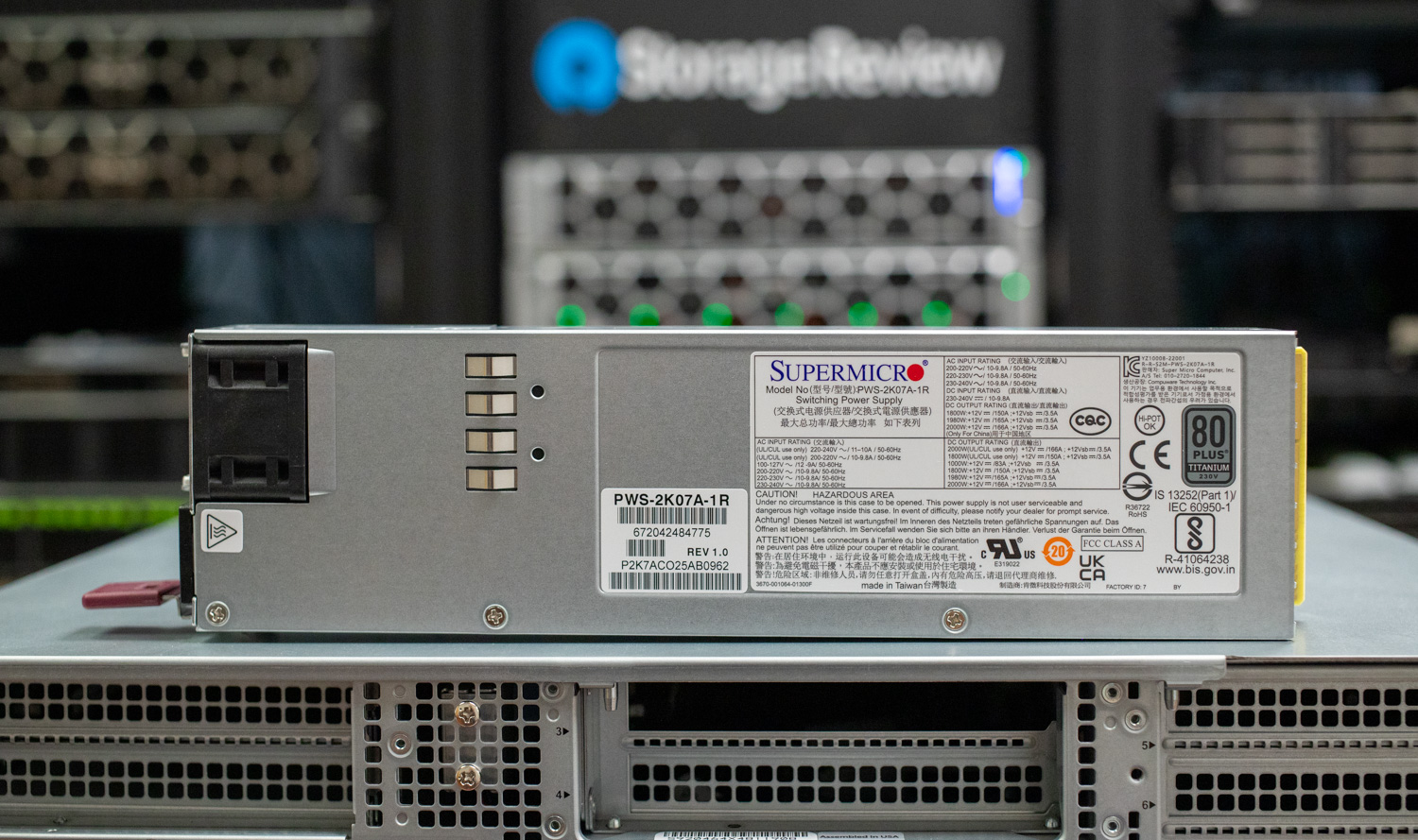
The system supports both 120V AC, 240V AC, and 48–60V DC input options, making it suitable for traditional enterprise racks, high-density data centers, and telecom environments. Integrated ACPI/APM power management enables controlled recovery from power loss, configurable power-on behavior, and power button override functionality. Combined with redundant PSU design, the platform delivers both electrical efficiency and operational resilience under sustained load.
Security, Monitoring, and Reliability
The AS-2126HS-TN integrates a comprehensive security and monitoring framework, including TPM 2.0, Silicon Root of Trust, secure boot, cryptographically signed firmware, and automatic firmware recovery. Runtime BMC protections and system lockdown features help ensure platform integrity throughout the system lifecycle.
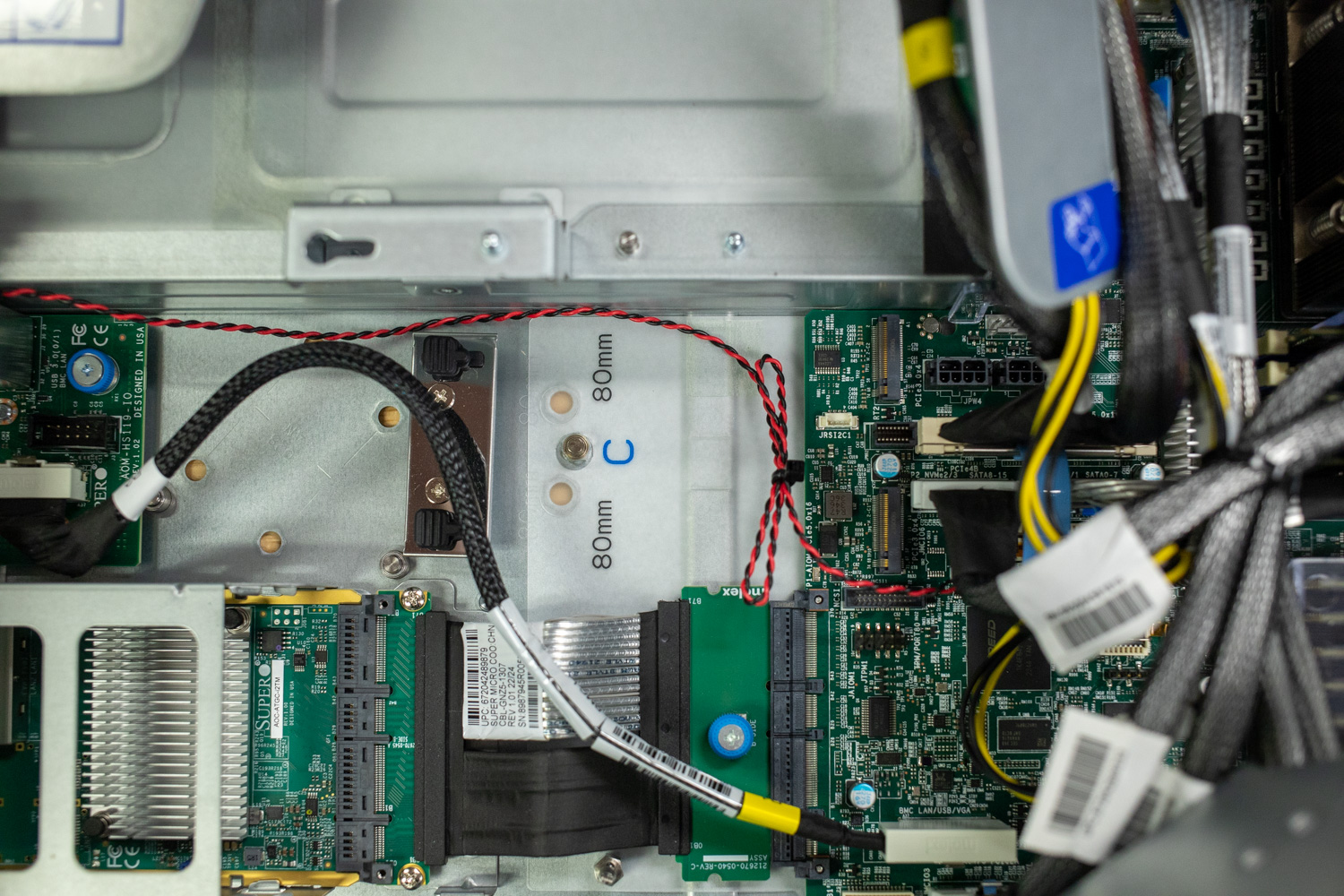
2x M.2 mounting points for boot disk
Health monitoring spans CPU, memory, voltage rails, fan speed, and chassis temperatures, with real-time telemetry feeding into Supermicro’s management tools. This enables proactive monitoring and rapid response to thermal or power anomalies in production environments.
Supermicro Management (BMC)
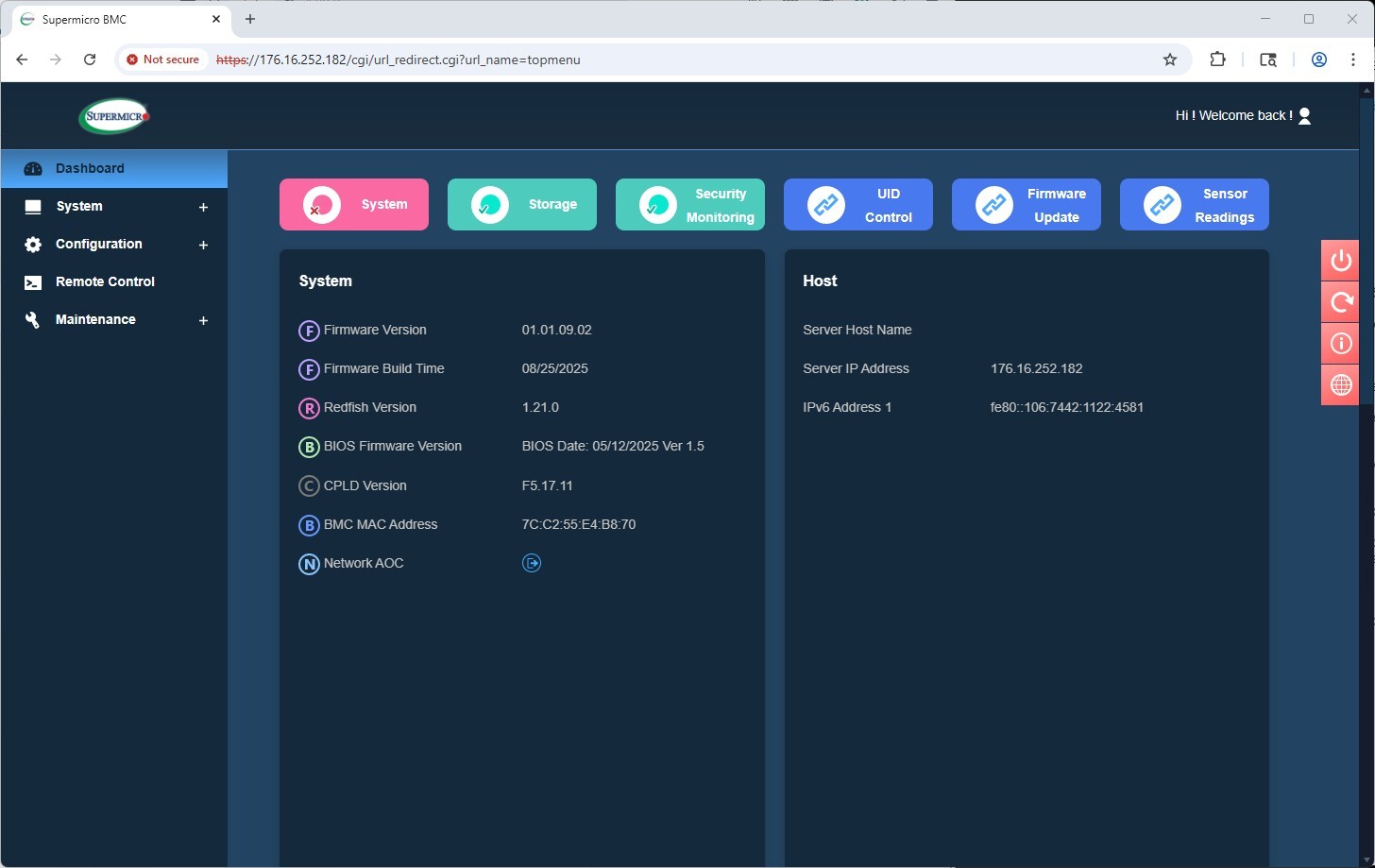
The AS-2126HS-TN ships with Supermicro’s integrated BMC, a platform we have covered before across multiple A+ systems, and it remains a critical part of day-to-day management. The dashboard presents a consolidated view of system health and configuration, providing immediate visibility into firmware status, hardware inventory, and sensor telemetry. From the landing page, administrators can quickly verify BMC, BIOS, CPLD, and Redfish versions, confirm network configuration, and validate host identity before proceeding with deeper troubleshooting or maintenance tasks.
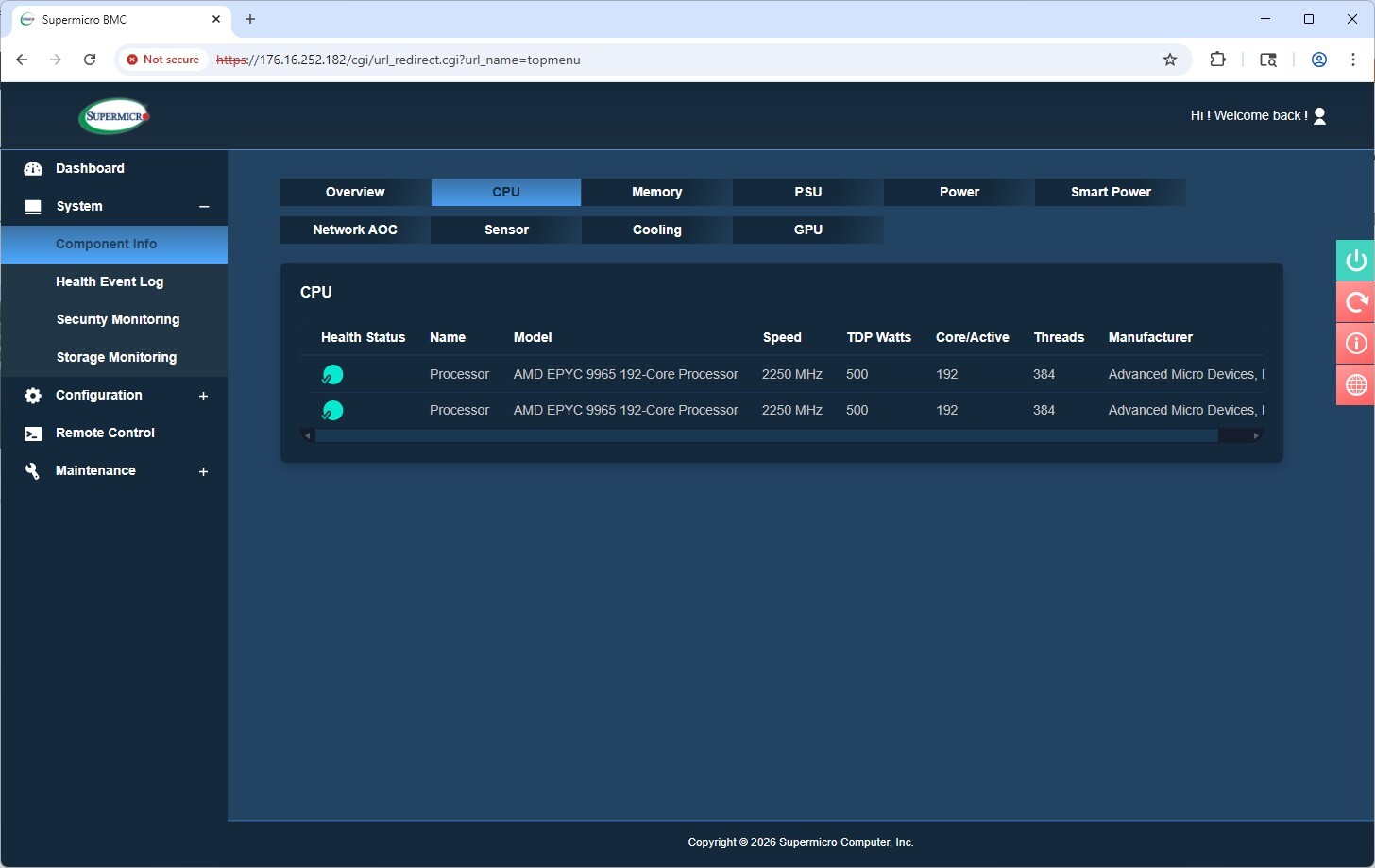
In Component Info, the BMC accurately reports our installed AMD EPYC processors, showing both 192-core processors in the system. Each socket is populated with an AMD EPYC 9965, with 192 active cores and 384 threads per CPU, and a configured 500 W TDP. This view provides a quick way to confirm processor population and other component characteristics directly from the BMC, ensuring they are operating at full potential.
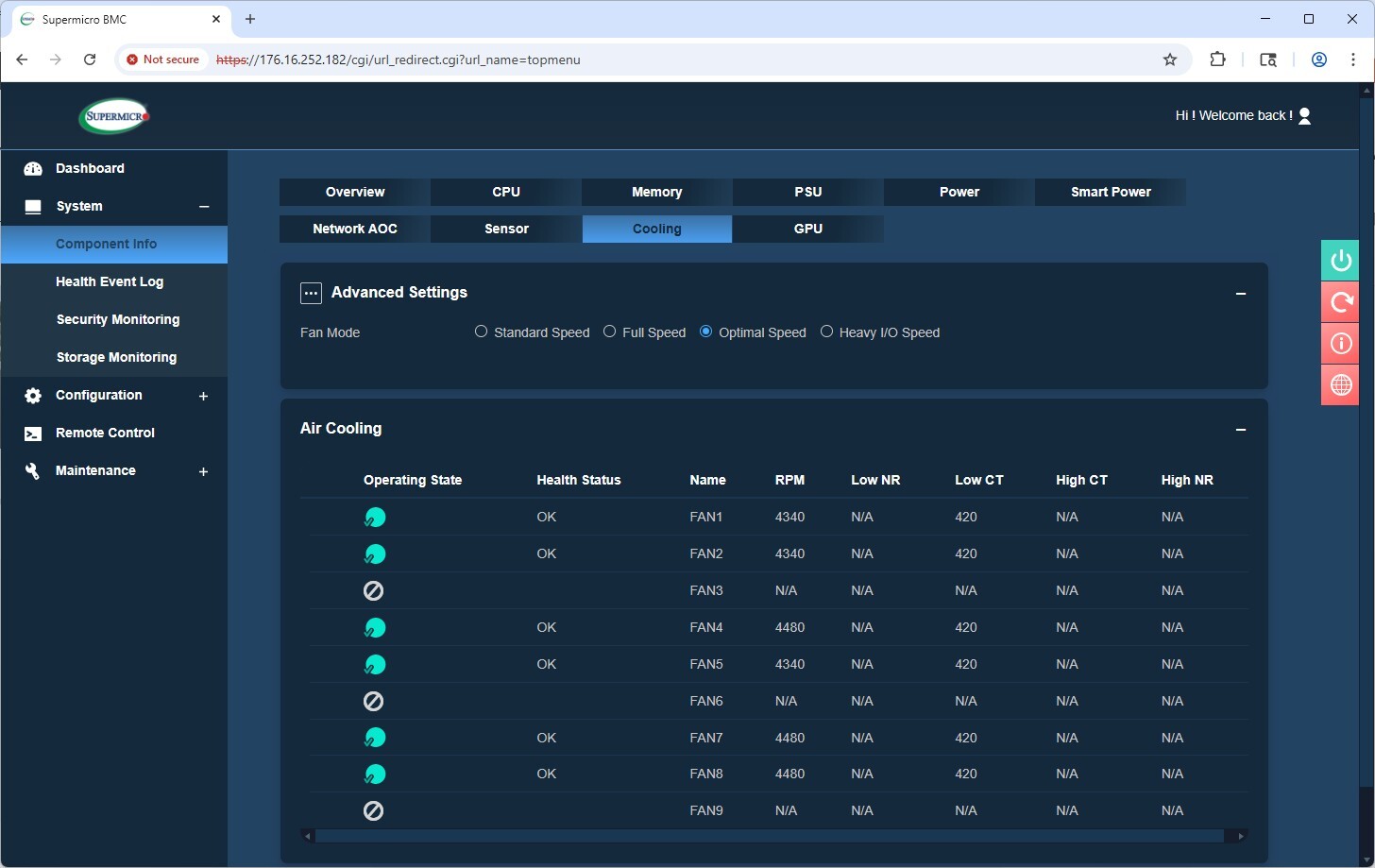
Within Component Info, Cooling tab, the BMC provides control over four selectable fan modes: Standard Speed, Full Speed, Optimal Speed, and Heavy I/O Speed. These presets allow quick adjustment of airflow behavior depending on workload and thermal demands without requiring BIOS changes. Below the mode selection, the interface lists individual fan status and real-time RPM readings, offering a straightforward view of system cooling health.
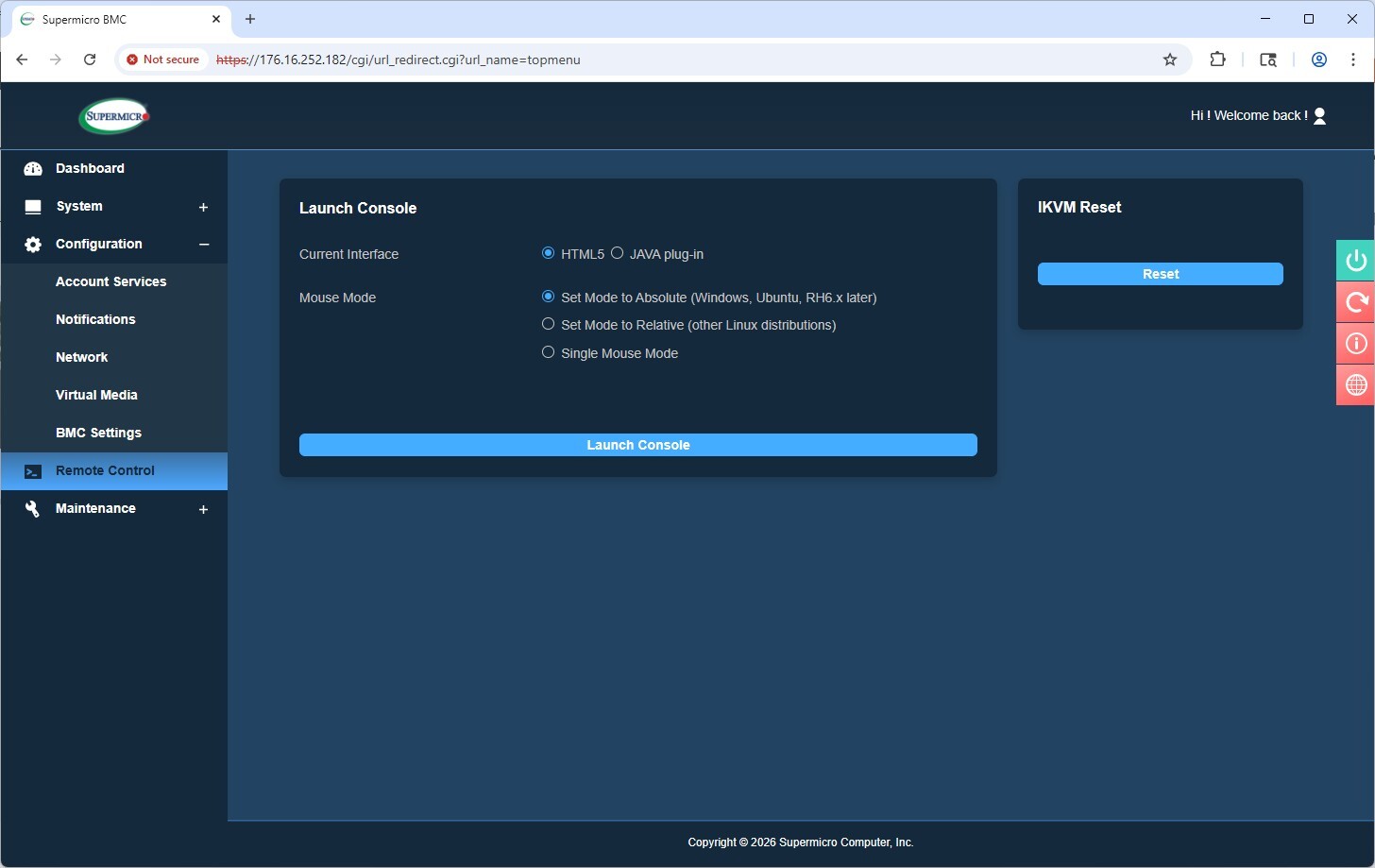
 For remote access, the AS-2126HS-TN’s BMC includes an integrated KVM console accessible via an HTML5 interface or a legacy Java plug-in. The console settings allow selection of basic mouse mode to accommodate different operating systems, and an IKVM reset option is available if the session becomes unresponsive. This provides full out-of-band console access for installation, troubleshooting, and recovery tasks without requiring local peripherals.
Supermicro AS-2126HS-TN Performance Testing
For testing, the Supermicro AS-2126HS-TN was not configured with a storage-dense or GPU-heavy power and cabling layout. As a result, our evaluation focused exclusively on CPU-only performance, using Blender, y-cruncher, and Phoronix benchmarks to characterize raw compute throughput on the dual-socket AMD EPYC platform.
The AS-2126HS-TN was equipped with two AMD EPYC 9965 192-core processors, providing a total of 384 cores and 768 threads. To provide context, results are compared against a Dell PowerEdge R7725 configured with the same dual AMD EPYC 9965 processors and 1.5TB of system memory. Both systems were tested using the same benchmark suites and settings to ensure consistency across platforms.
Supermicro A+ Server AS -2126HS-TN Configuration
- CPU: 2x AMD EPYC 9965 (192-core)
- RAM: 1.5TB 24 x 64GB DDR5 6000MT
- SSD: Micron 7.68TB NVMe Datacenter SSD
Blender 4.5
Blender is an open-source 3D modeling application. This benchmark was run using the Blender Benchmark utility. The score is measured in samples per minute, with higher values indicating better performance.
In the Blender CPU SMT benchmark, the Supermicro A+ Server AS-2126HS-TN equipped with dual AMD EPYC 9965 processors delivers strong results that highlight the scaling benefits of a 192-core architecture in heavily threaded rendering workloads. Using the Blender Benchmark utility, the system recorded 3,070.84 samples per minute in Monster, 2,063.61 in Junkshop, and 1,527.39 in Classroom.
For comparison, the Dell PowerEdge R7725 configured with the same dual EPYC 9965 processors posts slightly higher throughput in this SMT-enabled scenario, reaching 3,193.11 samples per minute in Monster, 2,174.63 in Junkshop, and 1,608.79 in Classroom. The relatively narrow gap between the two platforms suggests broadly similar behavior under SMT-heavy rendering loads, with differences likely driven by platform-level tuning rather than raw compute capability.
| Blender CPU SMT (Samples per minute; higher is better) | Supermicro A+ Server AS -2126HS-TN (AMD EPYC 9965 192C) | Dell PowerEdge R7725 (Dual AMD EPYC 9965 192C) |
|---|---|---|
| Monster | 3,070.84 | 3,193.11 |
| Junkshop | 2,063.61 | 2,174.63 |
| Classroom | 1,527.39 | 1,608.79 |
With SMT disabled, the Supermicro system shows a notable increase in raw throughput across all three scenes. Performance rises to 4,018.10 samples per minute in Monster, 2,707.10 in Junkshop, and 1,990.51 in Classroom, demonstrating how Blender’s CPU renderer can benefit from reduced thread contention on very high core-count systems.
In this configuration, the Dell PowerEdge R7725 continues to post higher absolute throughput, delivering 4,304.21, 2,870.34, and 2,079.79 samples per minute in Monster, Junkshop, and Classroom, respectively. While the Dell system maintains an edge in peak results, the Supermicro AS-2126HS-TN shows substantial gains with SMT disabled, underscoring how the threading strategy can significantly influence performance on platforms operating at this scale.
| Blender CPU no SMT (Samples per minute; higher is better) | Supermicro A+ Server AS -2126HS-TN (AMD EPYC 9965192C) | Dell PowerEdge R7725 (Dual AMD EPYC 9965 192C) |
|---|---|---|
| Monster | 4,018.10 | 4,304.21 |
| Junkshop | 2,707.10 | 2,870.34 |
| Classroom | 1,990.51 | 2,079.79 |
y-cruncher
y-cruncher is a multithreaded and scalable program that can compute Pi and other mathematical constants to trillions of digits. Since its launch in 2009, it has become a popular benchmarking and stress-testing application for overclockers and hardware enthusiasts.
In the y-cruncher benchmark, the Supermicro AS-2126HS-TN demonstrates consistent and predictable scaling as problem sizes increase. The system completes the 1-billion-digit run in 8.092 seconds, extending to 15.245 seconds at 2.5 billion and 24.961 seconds at 5 billion digits.
As workloads grow larger, compute times scale linearly, reaching 44.350 seconds at 10 billion digits, 114.107 seconds at 25 billion, and 246.688 seconds at 50 billion digits. At the most demanding 100-billion-digit run, the system completes the calculation in 572.800 seconds, underscoring its ability to sustain high thread counts over long execution windows.
The Dell PowerEdge R7725 completes the same workloads slightly faster across all test sizes, finishing the 100-billion-digit run in 481.207 seconds.
| Y-Cruncher (Total Computation Time) | Supermicro A+ Server AS -2126HS-TN (AMD EPYC 9965 192C) | Dell PowerEdge R7725 (Dual AMD EPYC 9965 192C) |
|---|---|---|
| 1 Billion | 8.092 s | 7.879 seconds |
| 2.5 Billion | 15.245 s | 13.811 seconds |
| 5 Billion | 24.961 s | 22.107 seconds |
| 10 Billion | 44.350 | 40.111 seconds |
| 25 Billion | 114.107 | 98.445 seconds |
| 50 Billion | 246.688 | 211.567 seconds |
| 100 Billion | 572.800 | 481.207 seconds |
Phoronix Benchmarks
Phoronix Test Suite is an open-source, automated benchmarking platform that supports over 450 test profiles and 100+ test suites via OpenBenchmarking.org. It handles everything from installing dependencies to running tests and collecting results, making it ideal for performance comparisons, hardware validation, and continuous integration.
Stream Memory Bandwidth
In the Stream memory bandwidth test, the Supermicro AS-2126HS-TN delivers 807,766 MB/s of sustained throughput. The Dell PowerEdge R7725 reaches 883,312 MB/s, indicating slightly higher peak memory bandwidth, though both systems operate well within the range expected for dual-socket EPYC 9005 platforms.
7-Zip Compression
For 7-Zip Compression, the Supermicro system achieves 1,262,832 MIPS, demonstrating strong integer performance and effective multi-thread scaling. The Dell system posts 1,326,967 MIPS, showing a modest advantage in this workload while remaining in the same overall performance tier.
Kernel Compile
In the kernel compile (allmod) workload, the Supermicro AS-2126HS-TN completes the task in 117.97 seconds, finishing ahead of the Dell PowerEdge R7725, which completes the same workload in 139.36 seconds. This result highlights the Supermicro platform’s efficiency in parallel build scenarios common in development and CI environments.
Apache Web Server
The Apache benchmark shows the Supermicro system handling 90,623.69 requests per second, while the Dell system reaches 96,782.75 requests per second. Both systems demonstrate strong web-serving throughput, with the Dell configuration posting slightly higher peak request handling.
OpenSSL Verification
In OpenSSL verification, the Supermicro AS-2126HS-TN reaches 3.55 TB/s, reflecting substantial cryptographic throughput suitable for encryption-heavy workloads. The Dell PowerEdge R7725 extends further to 4.41 TB/s, indicating higher peak cryptographic performance, though both platforms deliver performance well beyond typical enterprise requirements.
| Phoronix Benchmarks | Supermicro A+ Server AS -2126HS-TN (AMD EPYC 9965 192C) | Dell PowerEdge R7725 (Dual AMD EPYC 9965 192C) |
|---|---|---|
| Stream | 807,766.0 MB/s | 883,312.0 MB/s |
| 7-ZIP | 1,262,832 MIPS | 1,326,967 MIP/s |
| Kernel Compile (allmod) | 117.97 Seconds | 139.356 Seconds |
| Apache (requests per second) | 90,623.69 R/s | 96,782.75 R/s |
| Open SSL | 3,545,769,484,910 Verify/s | 4,409,642,672,307 Verify/s |
Conclusion
The Supermicro A+ Server AS-2126HS-TN offers a well-balanced dual-socket Turin platform that emphasizes compute density, power scalability, and flexible PCIe expansion in a 2U form factor. Its support for dual AMD EPYC 9005-series processors, high-TDP configurations, and flexible I/O layouts positions it well for enterprise, cloud, and HPC environments where sustained parallel performance and configurability are key.
Across our enterprise test suite, the AS-2126HS-TN delivered consistent, predictable performance on CPU-intensive workloads. While it trailed slightly behind in several absolute-throughput metrics, the Supermicro platform remained competitive, demonstrating strong scaling and efficiency across rendering, compute, and mixed workloads. Taken together, the results reinforce the AS-2126HS-TN as a capable and flexible foundation for high-core-count deployments, particularly where platform versatility and power headroom are as important as peak benchmark numbers.


 Amazon