

Our last look at a Ubiquiti switch was nearly a year ago, when we reviewed the Ubiquiti Pro Max 48 PoE. With some time having passed since that review, we are turning our attention back to the Pro Max lineup with a much more compact option, the Ubiquiti Pro Max 16 PoE, along with the Pro Max 16 Rack Mount Kit.
The Pro Max 16 is available in both PoE and non-PoE variants, but for this review, we received and tested the PoE model. It is a 16-port Layer 3 switch built around 2.5 GbE connectivity, Etherlighting, PoE++ output, and a total PoE budget of 180 W. At the time of review, the Pro Max 16 PoE is priced at $399. This makes it an accessible entry point into the Pro Max family, while still delivering higher-speed access and advanced switching capabilities.

Designed for flexibility, the Pro Max 16 PoE features a small-profile chassis and an external power supply, keeping the unit compact and lightweight. This makes it well-suited for desktop deployments, wall mounting, and installations in tight or confined spaces. For environments that require rack integration, the optional Pro Max 16 Rack Mount Kit allows the switch to be mounted cleanly in a standard 19-inch rack while maintaining visual consistency with larger Pro Max switches.
Overall, the Pro Max 16 PoE is positioned as a versatile access switch that delivers 2.5 GbE, PoE++, and Layer 3 functionality to smaller offices, labs, edge closets, and desk-side deployments without the space or power requirements of higher-port-density models.
Ubiquiti Pro Max 16 PoE Specifications
The table below highlights the technical and physical specifications of the Ubiquiti Pro Max 16 PoE.
| Specification | Details |
|---|---|
| Overview | |
| Dimensions | 325.1 x 160 x 43.7 mm (12.8 x 6.3 x 1.7″) |
| Port Layout | 1 GbE RJ45: 12 (All PoE+) 2.5 GbE RJ45: 4 (All PoE++) 10G SFP+: 2 |
| Max. PoE Output | Up to PoE++ |
| Total PoE Availability | 180W |
| Layer 3 Support | Yes |
| Form Factor | Rack mount (1U), desktop, wall |
| Etherlighting | Yes |
| Performance | |
| Switching Capacity | 84 Gbps |
| Non-Blocking Throughput | 42 Gbps |
| Forwarding Rate | 62 Mpps |
| Supported VLANs | 1,000 |
| MAC Address Table Size | 16,000 |
| L3 Table Size | |
| ARP Entries | 6,000 |
| IPv4 Routes | 512 |
| Packet Buffer Size | 1.5 MB |
| Access Lists | IPv4: 128 MAC: 128 |
| Layer 3 Features | |
| DHCP Server | Yes |
| DHCP Relay | Yes |
| Inter-VLAN Routing | Yes |
| Static Routing | Yes |
| Layer 2 Features | |
| LACP Aggregation | Yes |
| STP / RSTP | Yes |
| QoS (DSCP) | Yes |
| Pro AV Profiles | Play, Dante, Q SYS, NDI, SDVoE, Shure, AES67, Crestron |
| Advanced IGMP | Querier, Fast Leave, Router Port |
| IGMP Snooping | Yes |
| 802.1X | Yes |
| DHCP Snooping / Guarding | Yes |
| Port Isolation / Mirroring | Yes |
| Jumbo Frames | Yes |
| LLDP-MED / Voice VLAN | Yes |
| Loop Protection | Yes |
| Hardware | |
| PoE Ports | PoE+: 12 PoE++: 4 |
| Max PoE Wattage per Port | PoE: 15.4W PoE+: 32W PoE++: 64W |
| Max Power Consumption | 25W (excl. PoE) 210W (incl. PoE) |
| Power Method | AC adapter |
| Power Supply | AC/DC external, 210W Supported voltage: 50–54V DC |
| Management | Ethernet, AR |
| Heat Dissipation | 68 BTU/hr (excluding PoE) |
| Weight | 2.1 kg (4.6 lb) |
| Enclosure / Mount Material | SGCC steel |
| Supported Rack Depth | 400–1200 mm (15.7–47.2″) |
| LCM Display | 1.3″ touchscreen |
| Operating Temperature | -5 to 40° C (23 to 104° F) |
| Operating Humidity | 10 to 90% noncondensing |
| Etherlighting | Ethernet: Yes SFP+: Yes |
Ubiquiti Pro Max 16 PoE Design & Build
The Ubiquiti Pro Max 16 PoE immediately stands out for its compact, purpose-built design compared to traditional rack-focused switches. Measuring just 12.8 x 6.3 x 1.7 inches, this is a true small-footprint 1U device that feels equally at home on a desktop, mounted on a wall, or installed in a rack using the optional Pro Max 16 Rack Mount Kit. The enclosure is constructed from a silver-matte SGCC steel, giving it a solid, rigid feel despite its reduced size and relatively light 4.6 lb weight.
Front Panel and Ports
The front of the switch is clean and minimalist, anchored by Ubiquiti’s 1.3-inch LCM touchscreen. This provides at-a-glance visibility into device status, network information, and alerts without opening UniFi Network. To the right of the display is the full Ethernet port layout, comprising 12 1 GbE PoE+ ports and 4 2.5 GbE PoE++ ports. Each port supports Etherlighting, which uses color-coded illumination to indicate link speed, activity, and PoE status. This is especially useful in dense or low-light environments, where quick visual confirmation can save time during deployment or troubleshooting.

Rounding out the front connectivity are two 10G SFP+ uplink ports, with Etherlighting. These ports allow the Pro Max 16 PoE to uplink to aggregation or core switches while maintaining a compact access-layer footprint.
Chassis Profile and Mounting
From the side profile, the chassis’s shallow depth becomes more apparent. This switch is significantly shorter than traditional enterprise access switches, making it easier to place on shelving, desks, or in shallow wall cabinets. The rack-mount kit converts the Pro Max 16 PoE into a standard 1U rack device. It provides a dedicated space for the external power supply, keeping the installation tidy rather than leaving the adapter dangling behind the rack.

Rear Panel and Power Design
The rear of the unit highlights one of the most significant design differences compared to larger Pro Max switches: the external power supply. The Pro Max 16 PoE uses a 210 W AC-to-DC external adapter, supplying 50 to 54 V DC to the switch. This design choice helps keep the main chassis smaller and cooler while still supporting a total PoE budget of 180 W. The switch’s maximum power consumption is 25 W, with up to 210 W when PoE draw is included.

While some enterprise environments prefer internal power supplies, the external adapter makes sense here, given the intended use cases, especially for desktop, edge closet, and space-constrained deployments.
Thermal and Acoustic Characteristics
With a maximum heat dissipation of 68 BTU per hour, excluding PoE, the Pro Max 16 PoE is designed to operate quietly and efficiently. There are no aggressive airflow requirements, and the operating temperature range of -5 to 40 degrees Celsius supports both office and light-industrial environments. This makes it suitable for home labs, businesses, studios, and AV racks where noise and heat output are a concern.

UniFi Network Management overview
The Ubiquiti Pro Max 16 PoE is managed via the UniFi Network application, and the experience closely mirrors what we have seen on larger Pro Max switches despite its smaller form factor. Once adopted, the switch immediately appears in the device list with clear visibility into its role, uplink, and operational state, making it easy to integrate into an existing UniFi environment.
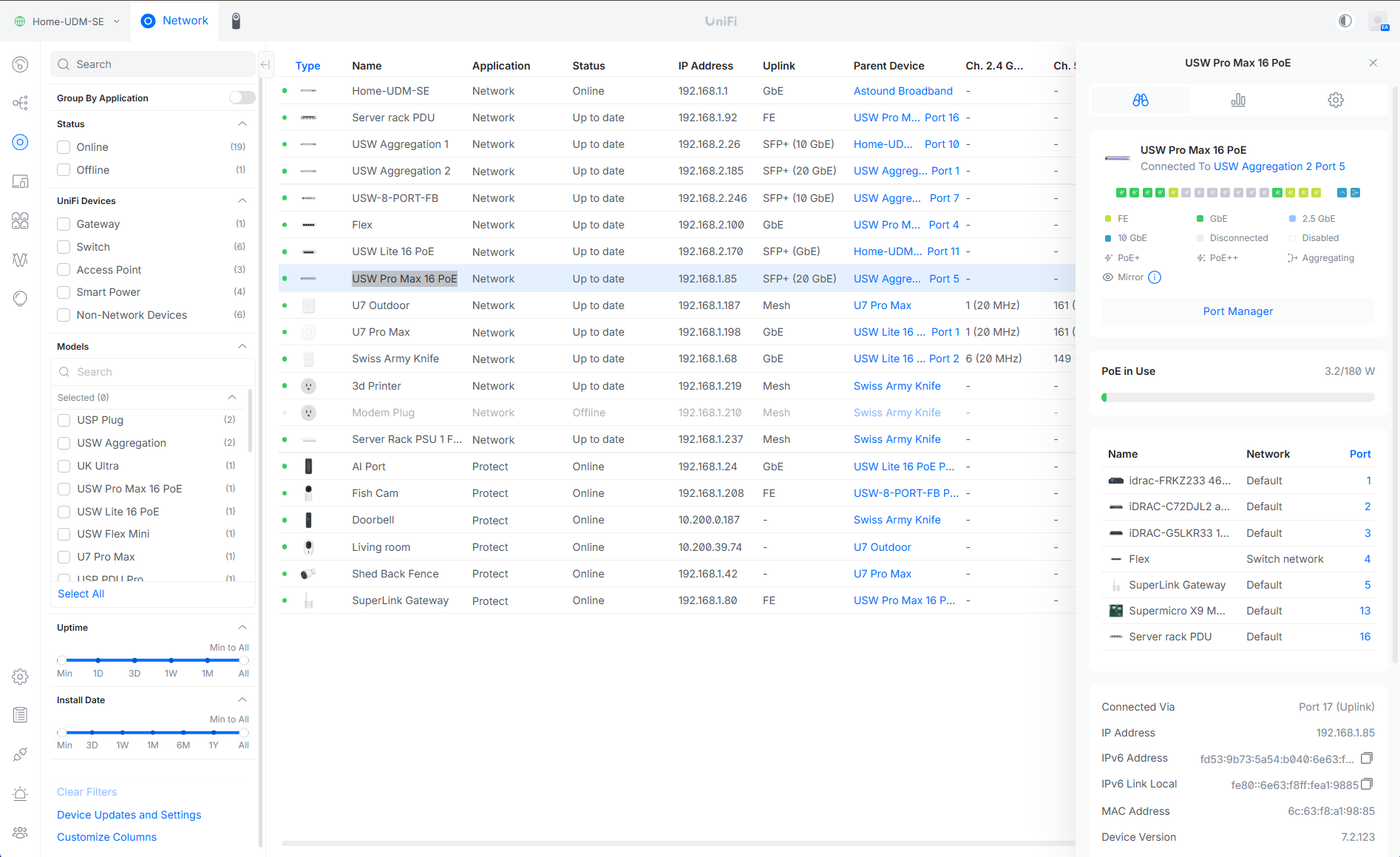
From the main device overview screen, UniFi presents a concise snapshot of the switch. Key details such as IP address, firmware version, uplink speed, and PoE usage are available without digging through menus. In our environment, the Pro Max 16 PoE is uplinked via 10 GbE SFP+ to an aggregation switch, as shown in the interface. The live PoE usage meter is handy, showing total draw against the 180 W budget and providing quick confirmation that there is still headroom for additional powered devices.
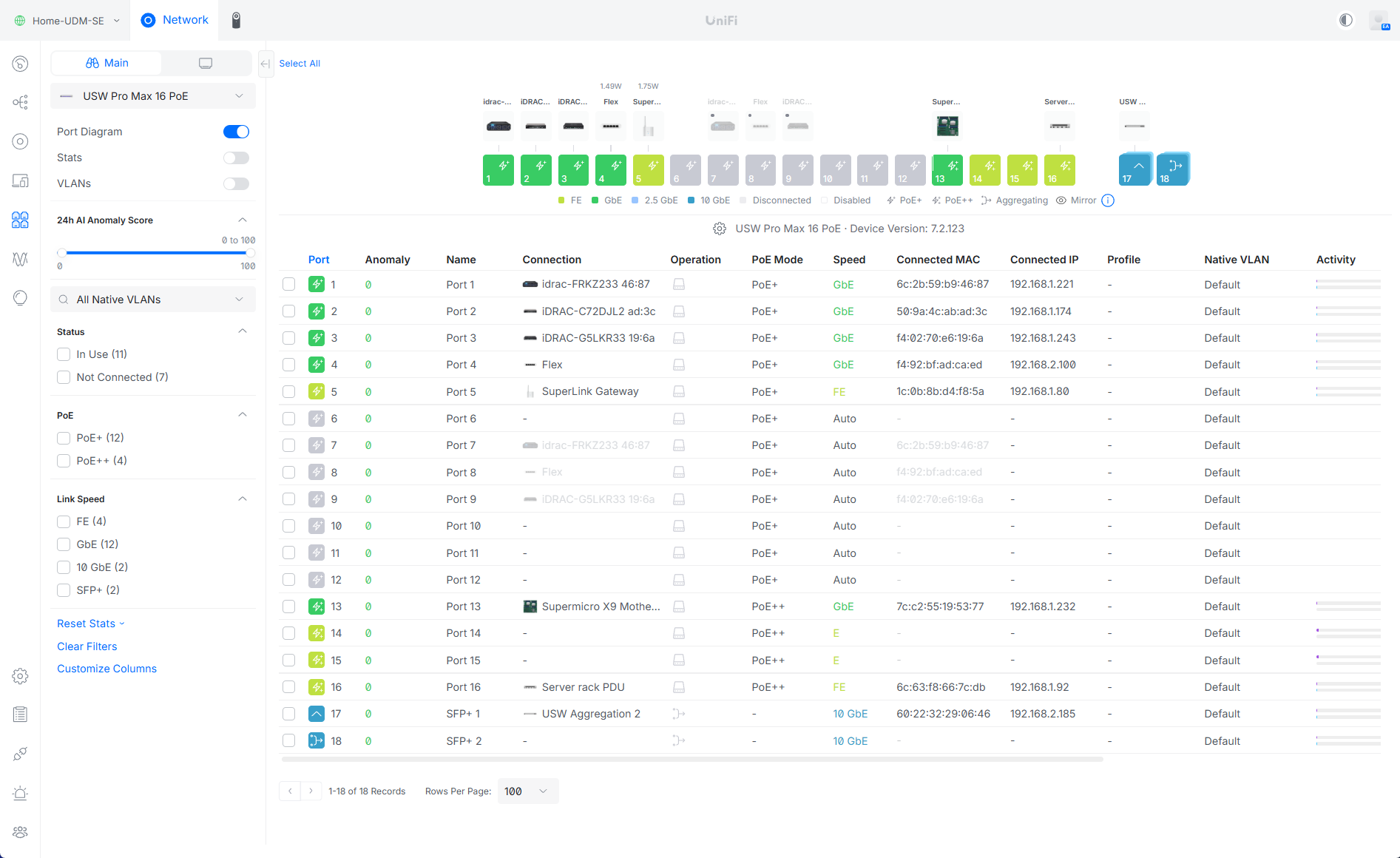
The Port Manager view makes the Pro Max 16 PoE particularly easy to work with. All sixteen Ethernet ports and both SFP+ uplinks are visually laid out, with real-time indicators for link speed, connection state, and PoE mode. The distinction between PoE+ and PoE++ ports is immediately visible, helping avoid confusion when connecting higher-power devices. In mixed environments, it is easy to identify which ports are running at Fast Ethernet, 1 GbE, or 2.5 GbE, and which are currently unused or disabled.
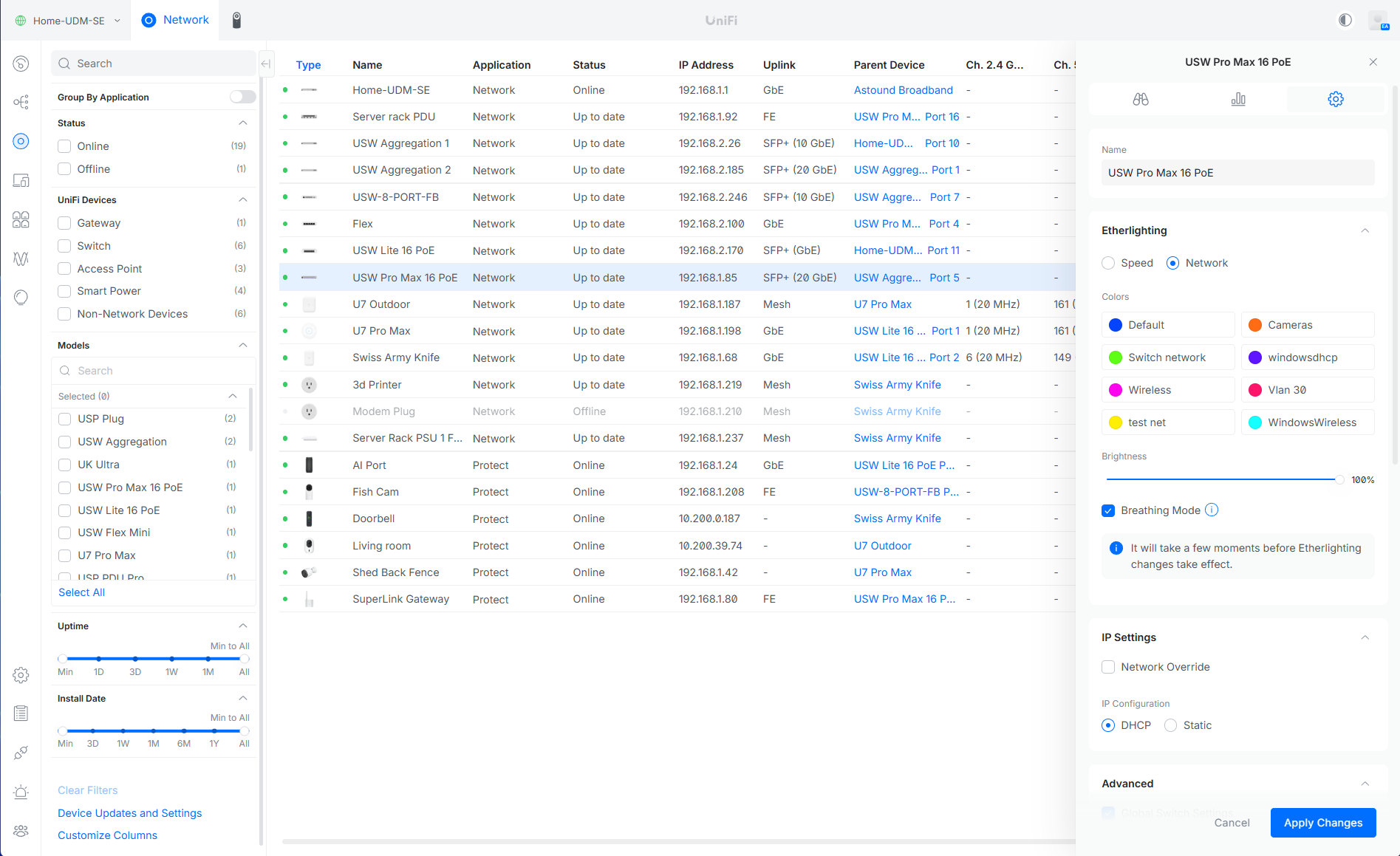
Etherlighting is also configured in the UniFi Network application and is clearly shown in the device settings. Ports can be set to display speed-based colors or network-based colors tied to specific VLANs or roles. Brightness and breathing mode controls are available, allowing the lighting to be adjusted for rack, office, or lab environments. While Etherlighting is not essential to operation, it provides practical visual context when standing in front of the switch, especially in setups with multiple networks or device types.
Overall, UniFi Network management complements the Pro Max 16 PoE hardware design well. The software does not feel scaled back or simplified compared to larger models, and day-to-day tasks such as monitoring ports, checking PoE usage, and adjusting settings remain straightforward. This makes the Pro Max 16 PoE feel like a full-featured UniFi switch, but in a smaller, more flexible package.
Conclusion
The Ubiquiti Pro Max 16 PoE hits a convenient sweet spot in the current UniFi switching lineup. It delivers Layer 3 functionality, 2.5 GbE access, and a mix of PoE+ and PoE++ ports in a package that is both affordable and easy to deploy across a wide range of environments. This is the kind of switch that makes sense for modern access layers where higher-speed endpoints and power-hungry devices are becoming the norm, but where a full-size access switch would be unnecessary or overkill.
The Pro Max 16 PoE’s biggest strengths are its physical design and mounting flexibility. The compact chassis, external power supply, and lightweight build make it equally at home on a desk, mounted to a wall, or tucked into a shallow cabinet. For rack installations, the optional Pro Max 16 Rack Mount (UACC-Pro-Max-16-RM) kit adds clean 19-inch compatibility for just $49.00, allowing this small switch to blend seamlessly with larger rack-mounted gear.
In terms of features, the Pro Max 16 PoE doesn’t feel compromised. Support for 2.5 GbE, PoE++, advanced Layer 2 and Layer 3 features, Pro AV profiles, and Etherlighting give it capabilities that extend well beyond basic edge switching. UniFi Network management ties it all together with strong visibility into ports, power usage, and traffic, and the experience is consistent with that of larger, more expensive Pro Max models.
At $399 at the time of review, the Pro Max 16 PoE stands out as an affordable Layer 3 switch that delivers high-speed access, meaningful PoE power, and extensive deployment flexibility in a compact form factor.
Product Pages (affiliate links)


 Amazon