

Ubiquiti continues to expand its high-performance switching portfolio with the Pro XG lineup. It’s designed around 10GbE copper connectivity for environments that require higher access-layer bandwidth without moving directly to fiber or SFP+. The Pro XG series targets use cases such as next-generation WiFi access points, high-speed workstations, and direct-attached storage scenarios where multi-gig or full-rate 10GbE links are becoming the norm.
We recently received several switches from the XG lineup and evaluated two PoE-enabled models: the Switch Pro XG 10 PoE and the Switch Pro XG 8 PoE. Both switches emphasize 10GbE RJ45 connectivity, Layer 3 switching, and Ubiquiti’s Etherlighting port identification. Still, they are designed for distinct deployment scenarios, ranging from high-density rack-mount environments to compact desktop or wall-mounted installations.
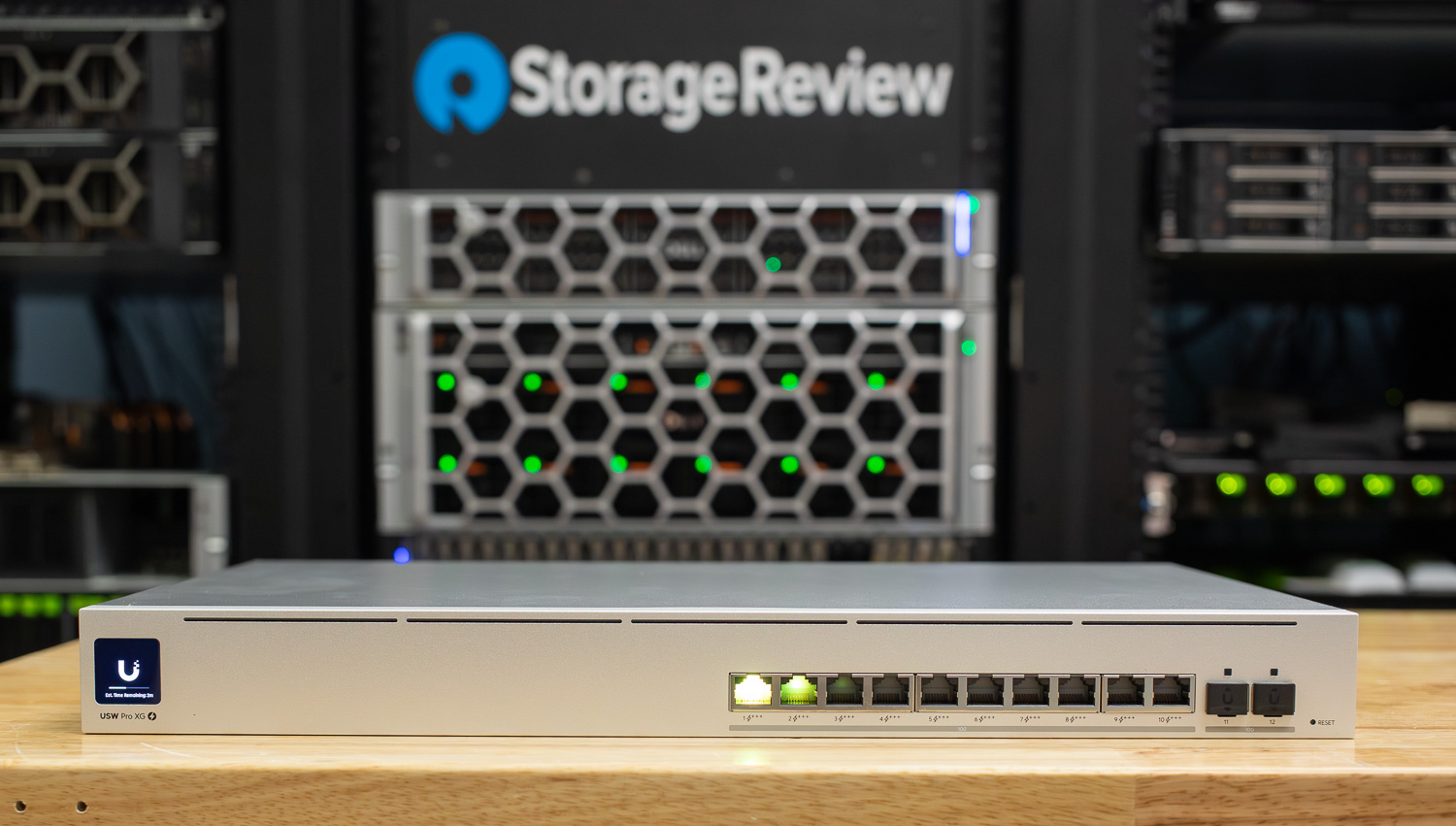
The Pro XG 10 PoE is a 1U rack-mount switch offering 10 total 10GbE RJ45 ports, 2 x 10G SFP+ uplinks, and a substantial 400W PoE+++ budget, making it well-suited for dense access-layer deployments or power-hungry devices. At $699, it targets professional environments that need centralized power delivery alongside high throughput.
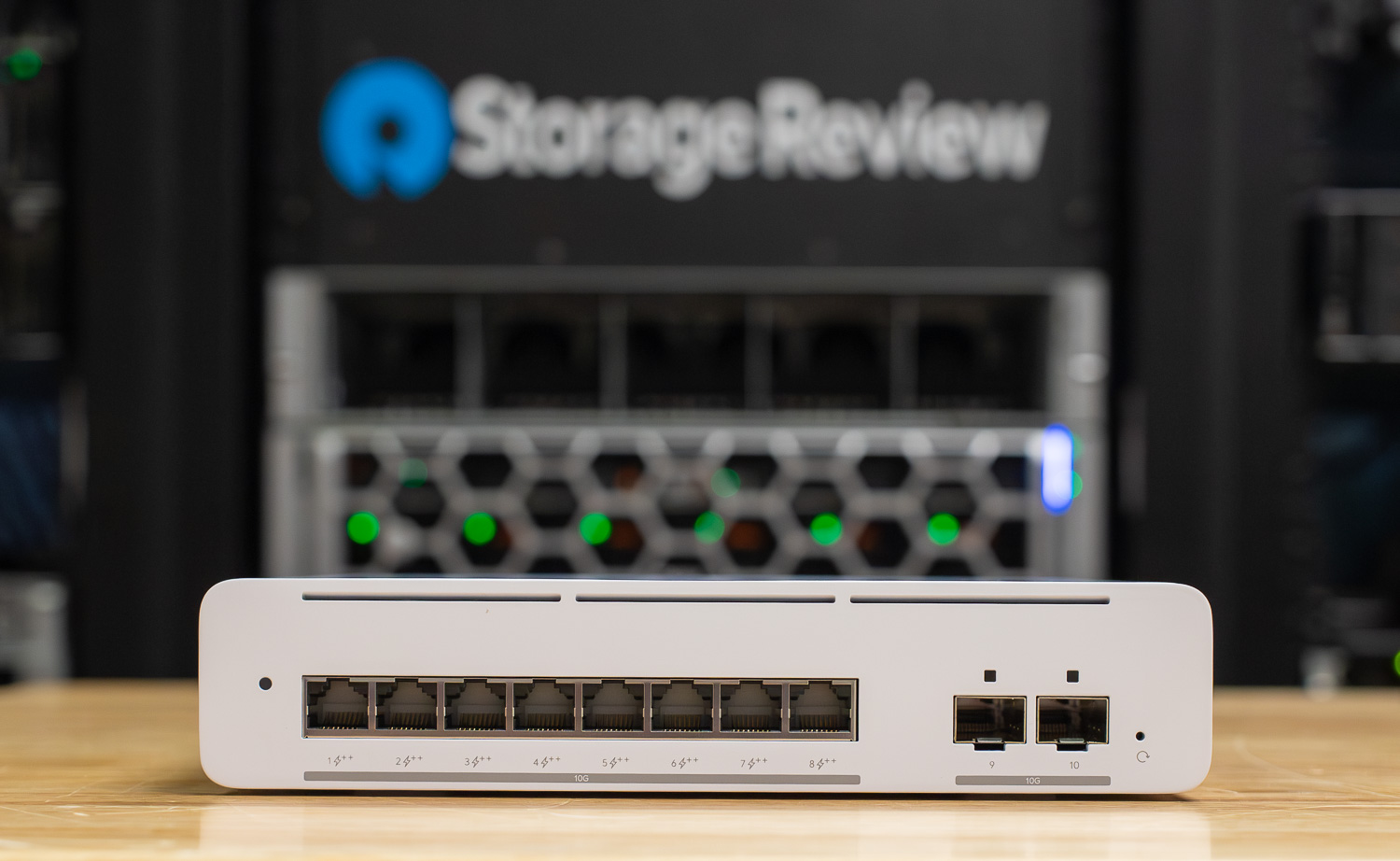
By contrast, the Pro XG 8 PoE adopts a compact desktop or wall-mountable form factor, pairing 8 total 10GbE RJ45 ports and 2 x 10G SFP+ uplinks with a 155W PoE++ budget. Priced at $499, it is aimed at smaller installations, edge deployments, or high-speed desktop and lab scenarios, such as NAS-to-PC connectivity, workstation clusters, or localized PoE access point aggregation.
With both switches now in the lab, we examine how these two Pro XG models compare in terms of design, performance, power delivery, and real-world use cases, and where each one makes the most sense in a modern 10GbE-focused network.
Ubiquiti Switch Pro XG 8 PoE & Switch Pro XG 10 PoE Specifications
The table below outlines the specifications of the Ubiquiti Switch Pro XG 10 PoE and Switch Pro XG 8 PoE, presented side by side for easy comparison across form factor, performance, and power capabilities.
| Metric | Pro XG 10 PoE | Pro XG 8 PoE |
|---|---|---|
| Overview | ||
| Dimensions | 442.4 x 285 x 44 mm (17.4 x 11.2 x 1.7″) |
210.4 x 173.8 x 43.7 mm (8.28 x 6.84 x 1.7″) |
| Port Layout – 10 GbE RJ45 | 10 (All PoE+++) (10G/5G/2.5G/1G/100M) |
8 (All PoE++) (10G/5G/2.5G/1G/100M) |
| Port Layout – 10G SFP+ | 2 (10G/1G) |
2 (10G/1G) |
| Max. PoE Output | Up to PoE+++ | Up to PoE++ |
| Total PoE Availability | 400W | 155W |
| Redundancy | DC Power Backup | — |
| Layer 3 | ✓ | ✓ |
| Form Factor | Rack mount (1U) | Compact desktop, wall mount |
| Etherlighting | ✓ | ✓ |
| Performance | ||
| Switching Capacity | 240 Gbps | 200 Gbps |
| Total Non-Blocking Throughput | 120 Gbps | 100 Gbps |
| Forwarding Rate | 179 Mpps | 149 Mpps |
| Supported VLANs | 1,000 | 1,000 |
| MAC Address Table Size | 32,000 | 32,000 |
| L3 Table Size – ARP Entries | 12,000 | 12,000 |
| L3 Table Size – IPv4 Routes | 12,000 | 12,000 |
| Packet Buffer Size | 2 MB | 2 MB |
| Access Lists – IPv4 | 128 | 128 |
| Access Lists – MAC | 128 | 128 |
| Hardware & Power | ||
| PoE Ports | PoE+++ 10 |
PoE++ 8 |
| Max. Power Consumption | 65W (Excluding PoE output) 520W (Including PoE output) |
61W (Excluding PoE output) 210W (Including PoE output) |
| Power Supply | AC/DC, internal, 550W | AC/DC, external, 210W |
| Weight | Without mounting brackets: 4.6 kg (10.14 lb) With mounting brackets: 4.7 kg (10.36 lb) |
1.6 kg (3.5 lb) |
Ubiquiti Switch Pro XG 10 PoE Build and Design
Starting with the Ubiquiti Switch Pro XG 10 PoE, a 1U rack-mount switch built around a compact, dense chassis measuring 17.4 × 11.2 × 1.7″. It weighs 10.36 lbs with the brackets installed, giving it a substantial, premium feel when racking and handling. The enclosure is constructed from matte-silver SGCC steel, and the included mounting hardware is also SGCC steel for added rigidity. The switch is rated for 15.7 to 47.2″ rack depths, allowing it to fit cleanly in shallow network racks as well as full-depth cabinets.
From a performance standpoint, the Pro XG 10 PoE is designed for high-throughput aggregation, with 240 Gbps of switching capacity, 120 Gbps of non-blocking throughput, and a 179 Mpps forwarding rate. It supports up to 1,000 VLANs, a 32,000-entry MAC address table, 12,000 ARP entries, and 12,000 IPv4 routes in its Layer 3 tables. Packet buffering is listed at 2 MB, while access control resources include 128 IPv4 ACLs and 128 MAC ACLs, making it suitable for segmented edge or aggregation deployments.
Front panel design and connectivity
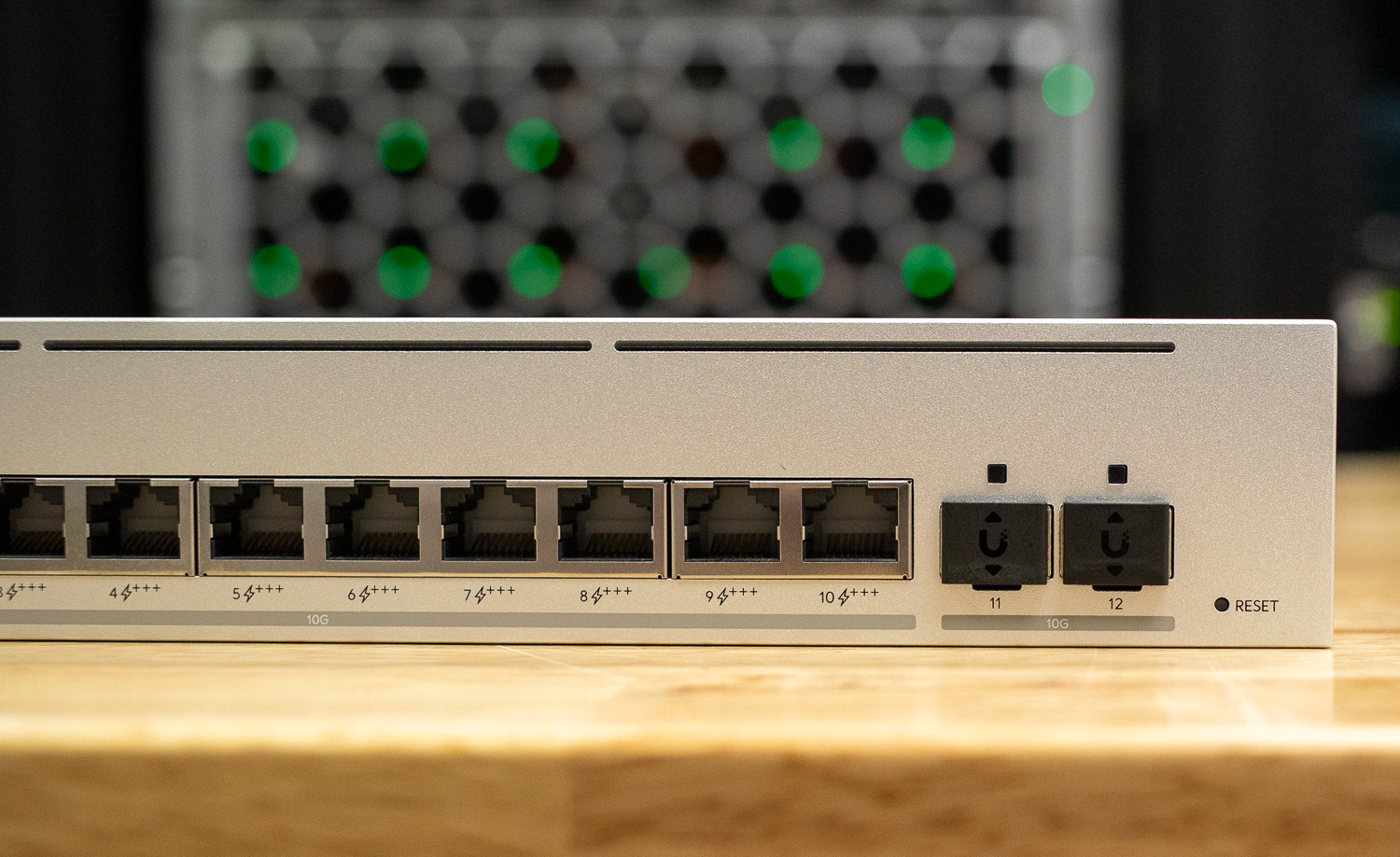
The front panel features 10× 10GbE RJ45 ports, all supporting PoE+++, along with 2× 10G SFP+ uplink ports that support 10G and 1G operation. Ubiquiti’s Etherlighting is present on both the RJ45 and SFP+ interfaces, providing clear visual identification and real-time port status. This is especially useful in dense racks where tracing 10GbE copper connections can be time-consuming. A 1.3-inch touchscreen LCM display is also integrated into the front panel, offering quick local access to device information and status without requiring remote management.
PoE is a key focus of this model, with 400W of total PoE power available across all ports. Each port supports up to PoE+++, with per-port limits defined by the PSE class: 15.4W for PoE, 30W for PoE+, 60W for PoE++, and 90W for PoE+++. Power consumption is rated at 65W maximum, excluding PoE output, and up to 520W maximum when PoE delivery is fully utilized.
Side profile and mounting
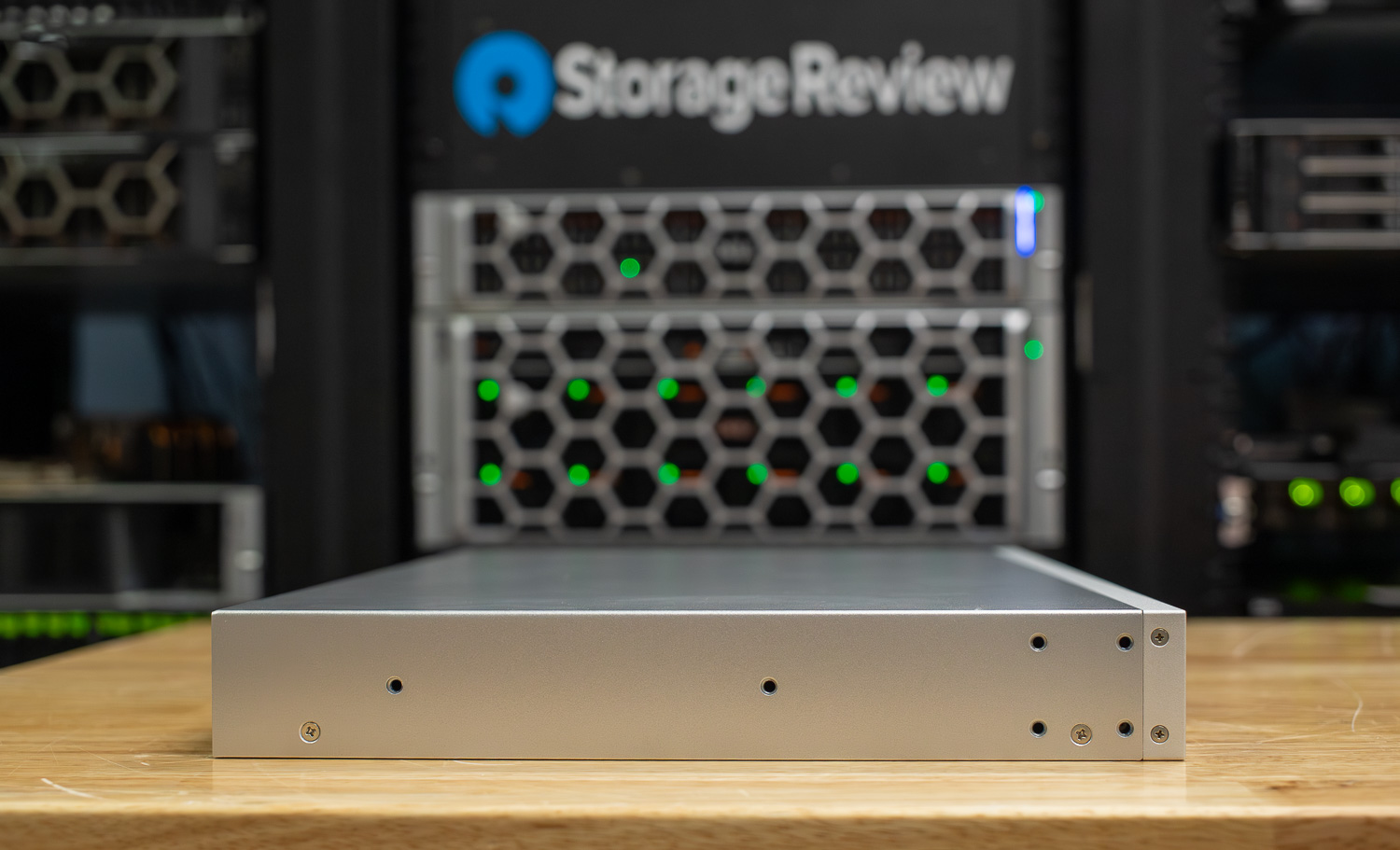
The side profile is clean and functional, featuring standard rack-mount ears for 1U installation. With both the chassis and mounting hardware made of SGCC steel, the switch feels solid once installed and remains stable even under heavy copper cabling.
Rear panel cooling and power
At the rear, the switch uses four cooling fans to maintain airflow during sustained high-throughput switching and heavy PoE loads. Power is supplied via a universal AC input rated at 100-240V AC, 50/60 Hz, which feeds an internal 550W AC/DC power supply. For redundancy, the switch includes a USP RPS DC input, enabling DC power backup from an external battery or a redundant power system. A locking power connector is also present to help prevent accidental disconnections in crowded racks.
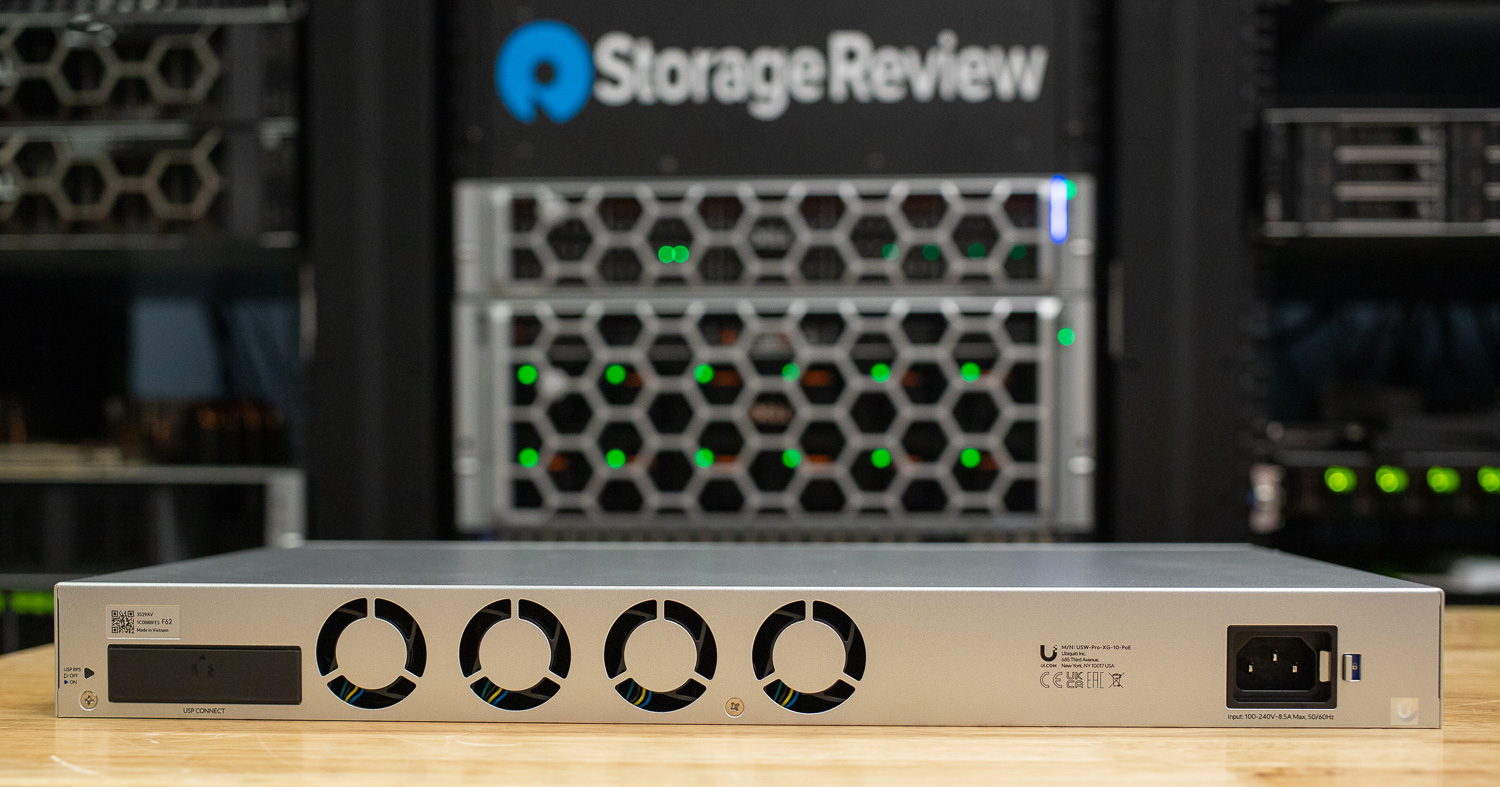
Overall, the Switch Pro XG 10 PoE offers a solid, premium design with dense 10GbE connectivity, high switching capacity, robust PoE delivery, and a chassis clearly intended for professional rack environments. The inclusion of Etherlighting and a front-facing 1.3″ touchscreen adds practical visibility features that complement its enterprise-focused build.
Ubiquiti Switch Pro XG 8 PoE Build and Design
The 8-port model takes a very different physical approach than its rack-mount sibling, focusing on compact deployment while retaining robust 10GbE capability. The chassis measures 8.28 × 6.84 × 1.7″ and weighs 3.5 lb, making it well-suited for desktop, shelf, or wall-mounted installations. The enclosure is built from white SGCC steel, giving it a clean, durable finish that remains solid despite its smaller footprint. Flexible mounting hardware is included, allowing it to be positioned in tight spaces such as wiring closets, media cabinets, or desks.
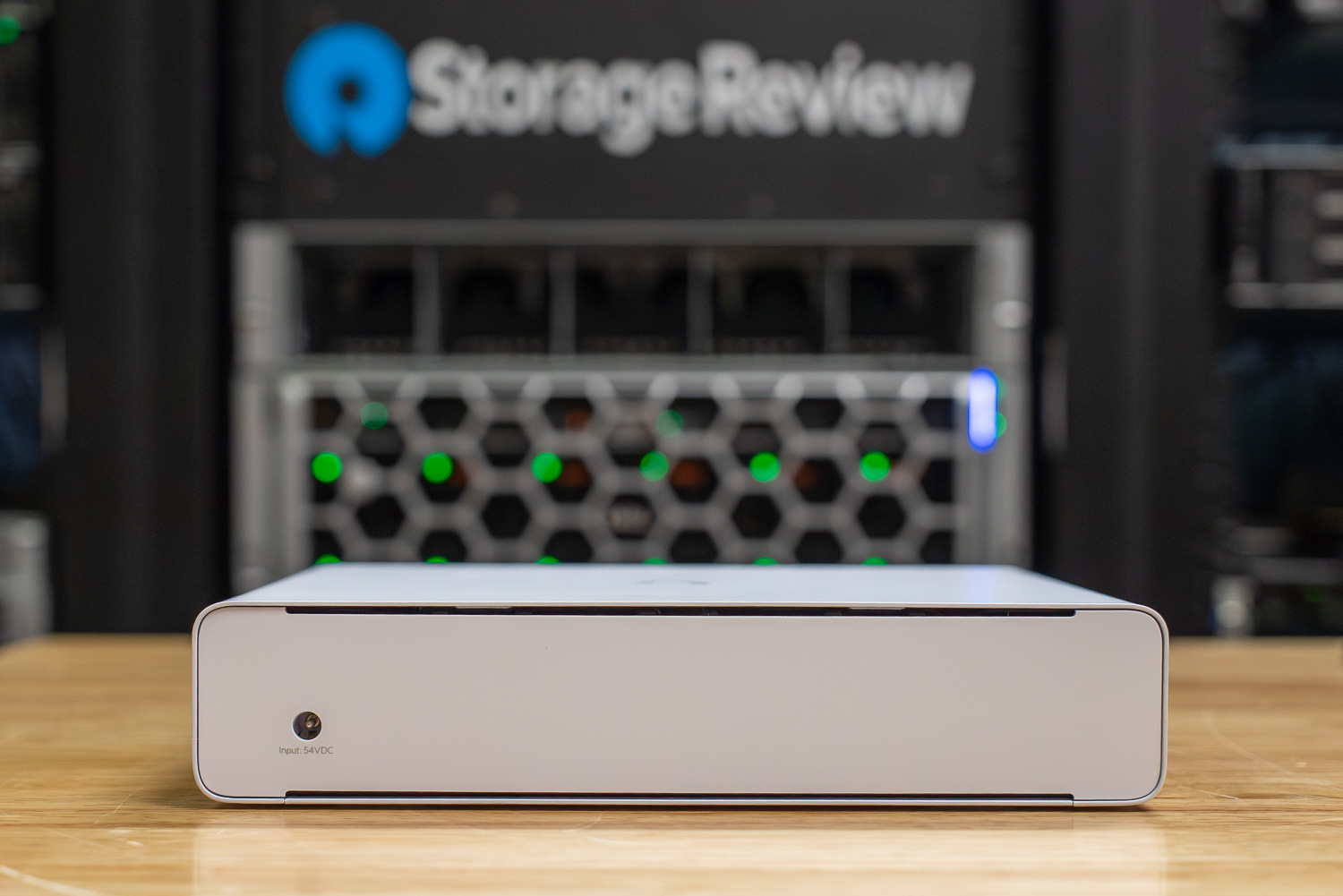
Despite its size, the switch delivers strong performance, with 200 Gbps switching capacity, 100 Gbps total non-blocking throughput, and a 149 Mpps forwarding rate. It supports up to 1,000 VLANs, a 32,000-entry MAC address table, 12,000 ARP entries, and 12,000 IPv4 routes for Layer 3 operations. Packet buffering is rated at 2 MB, and access control resources include 128 IPv4 ACLs and 128 MAC ACLs, keeping feature parity with larger models in day-to-day network segmentation and policy use.
Front panel design and connectivity
The front panel features 8× 10GbE RJ45 ports, all supporting PoE++ and data rates spanning (10G/5G/2.5G/1G/100M), along with 2× 10G SFP+ ports that operate at 10G or 1G. Etherlighting is present on Ethernet ports, providing clear visual port identification and status. Unlike the 10-port rack model, this version does not include a touchscreen display. Instead, it relies on status LEDs for system and port activity, which aligns well with its compact, deployment-focused design.
PoE capability remains a key strength, with 155W of total PoE power. Each port supports up to PoE++ at 60W. Compared to the larger model, this results in 30W less maximum output per port, but remains more than sufficient for high-end access points, cameras, and compact PoE-powered edge devices. Power consumption is rated at 61W maximum, excluding PoE output, and up to 210W maximum when PoE is fully utilized.
Power design and cooling
Power is delivered via an external 210W AC/DC power adapter with a 50-57V DC input. This external supply helps keep the chassis compact and reduces internal heat density, which is beneficial for desktop or wall-mounted environments. Internally, the switch uses a small fan for active cooling, ensuring stable operation under sustained load without requiring the airflow patterns expected in a full rack.
Ubiquiti Switch Pro XG Lab Testing and Management
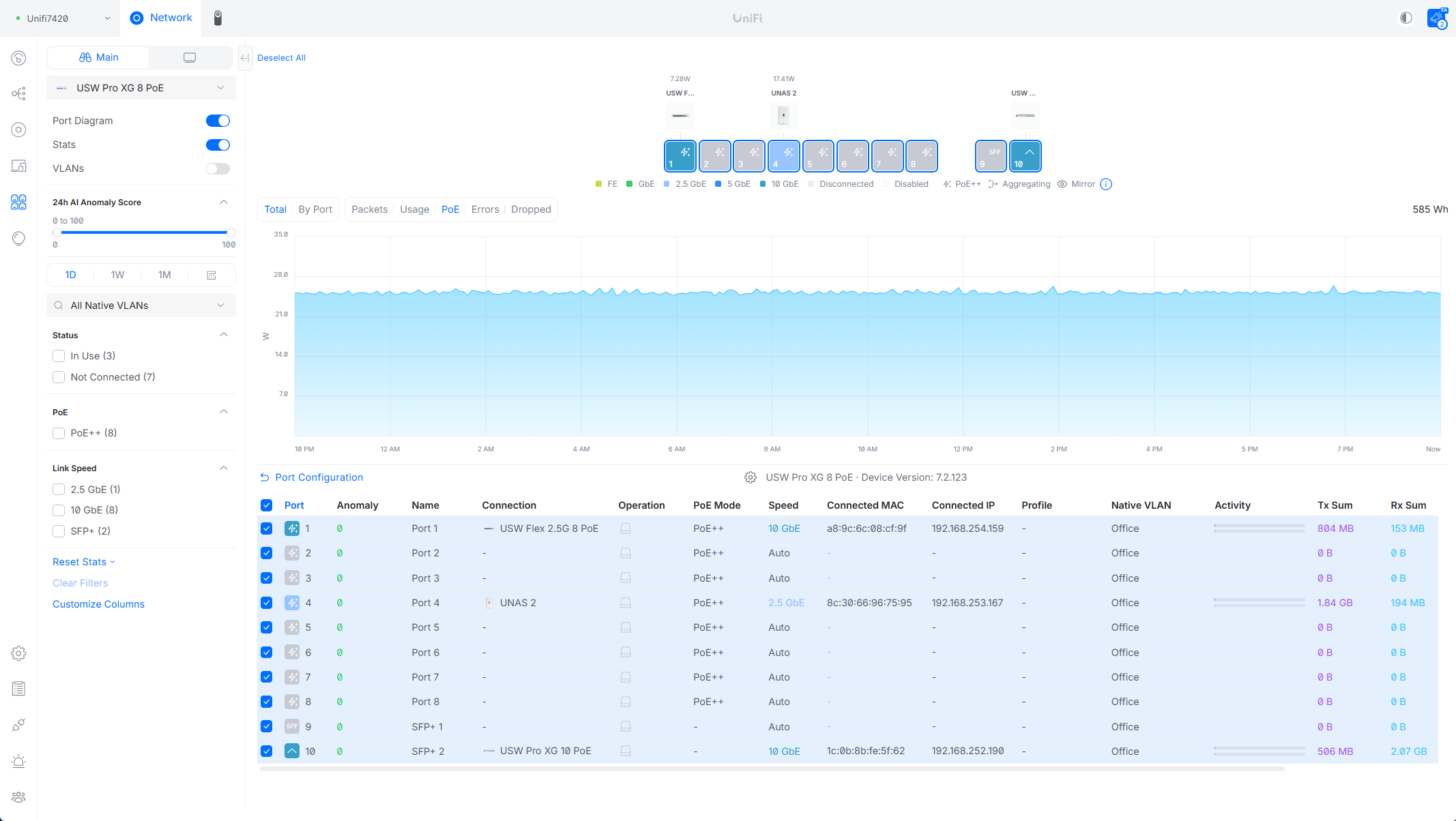
To evaluate real-world PoE performance, we used both XG switches to power representative high-speed access and multi-gig edge devices. The Switch Pro XG 10 PoE was populated with six Netgear WBE750 WiFi 7 access points, which support PoE++ and can draw up to 39W max per device. In our lab environment, however, each access point averaged closer to 15W under normal idle operating load, allowing us to observe sustained multi-port PoE delivery and available power headroom rather than peak-only behavior.
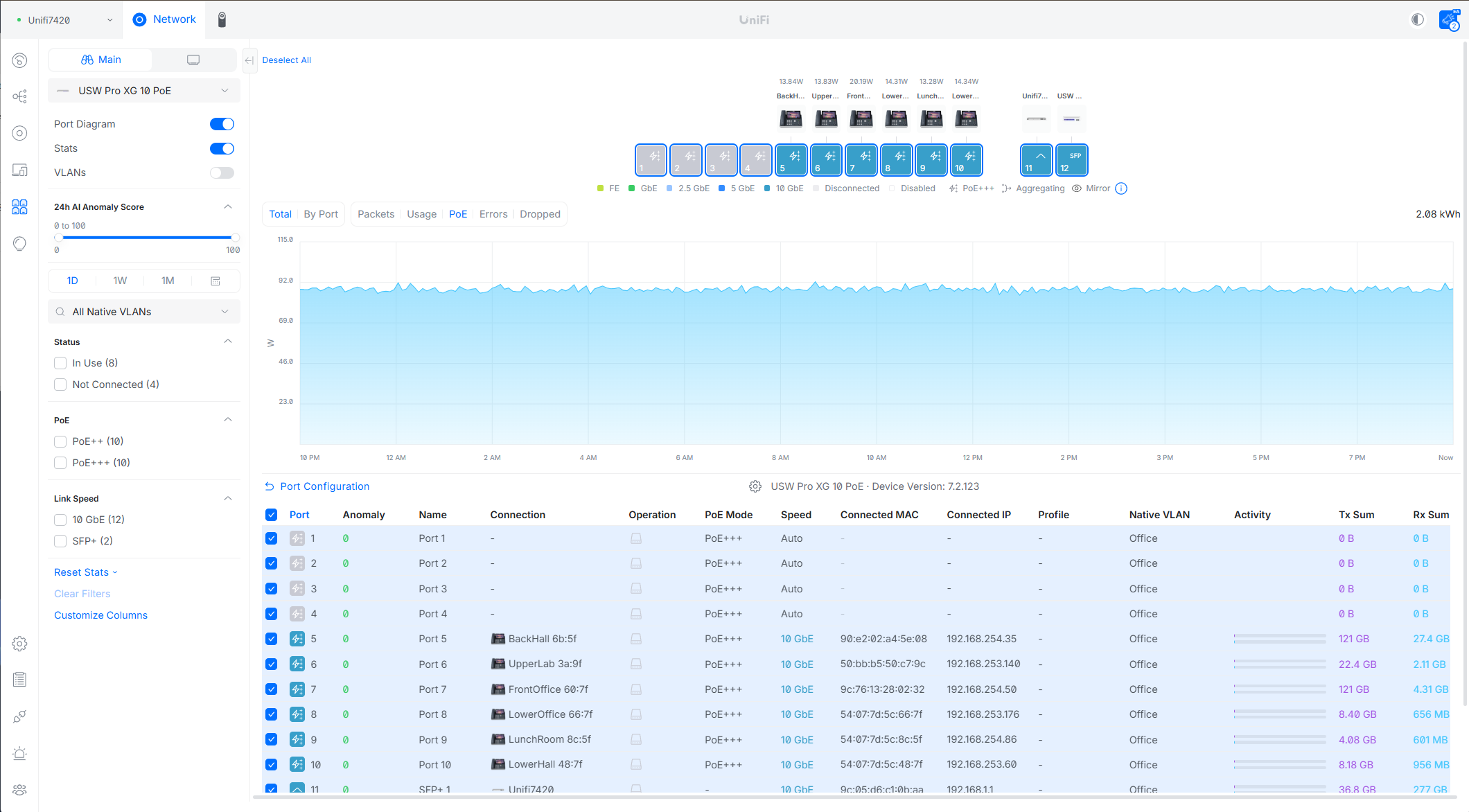
The Switch Pro XG 8 PoE was used in a lighter edge-deployment scenario, powering a mix of low-power devices, including a UniFi Flex 2.5GbE 8 PoE switch with a 10GbE uplink and the recently reviewed UNAS 2, which was operated entirely via PoE++. This setup reflects a common desktop or wall-mounted use case in which the switch provides both aggregation and power for compact infrastructure without requiring multiple external adapters.
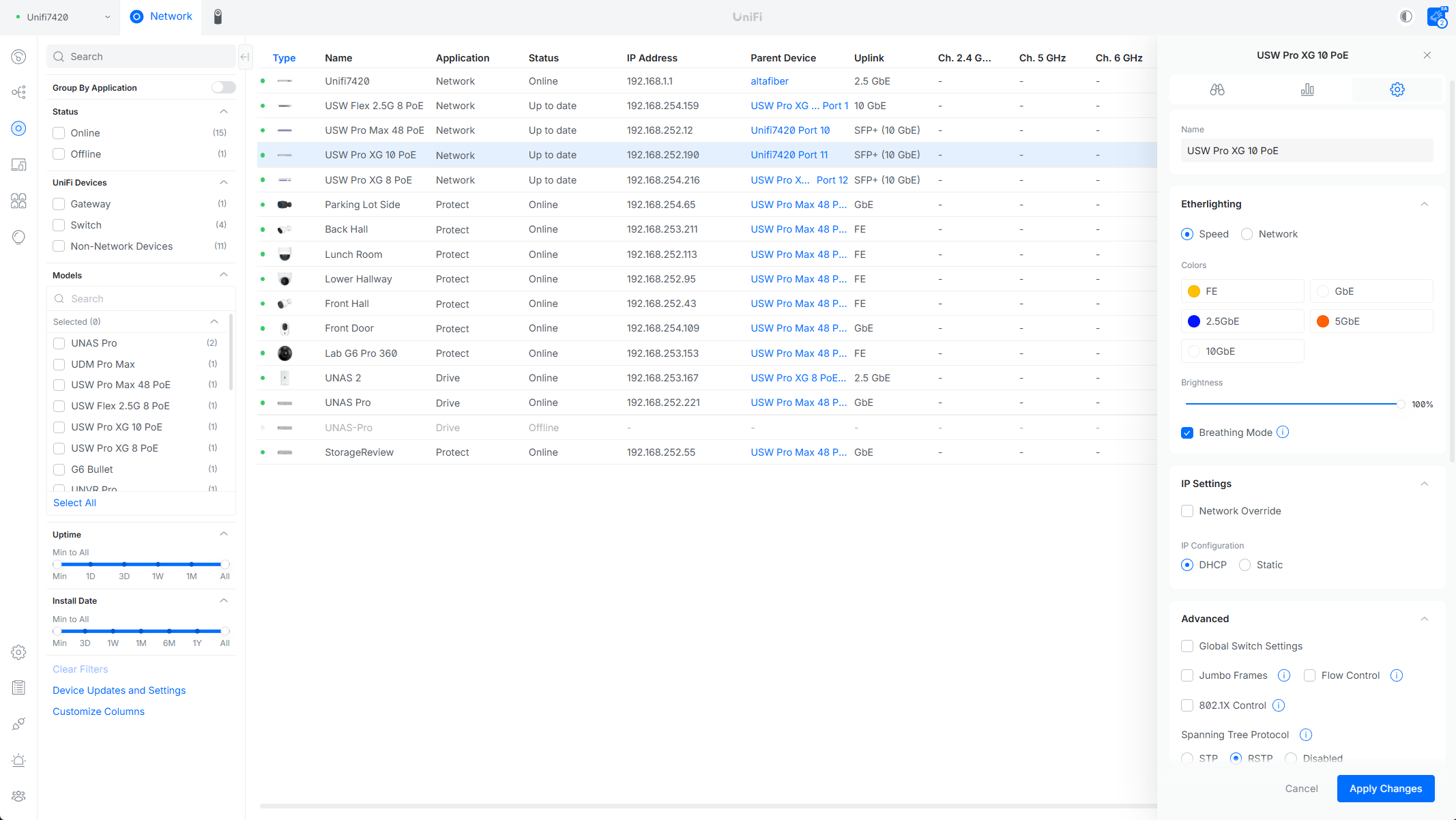
Management of the XG lineup is consistent with that of other UniFi switches we have evaluated. All configuration is managed through the UniFi Network application; navigating to the Devices view provides a centralized list of connected hardware. Selecting an individual XG switch opens its dedicated device panel, allowing direct access to Etherlighting configuration, network settings (including DHCP or static IP assignment), and advanced options such as jumbo frames, flow control, and spanning tree behavior.
From the same interface, administrators can also perform common operational tasks, including restarting the switch, locating it via LED identification, removing it from the site, or applying manual firmware updates. Overall, the experience remains familiar and streamlined, making it easy to integrate the XG switches into existing UniFi-managed environments without introducing additional management complexity.
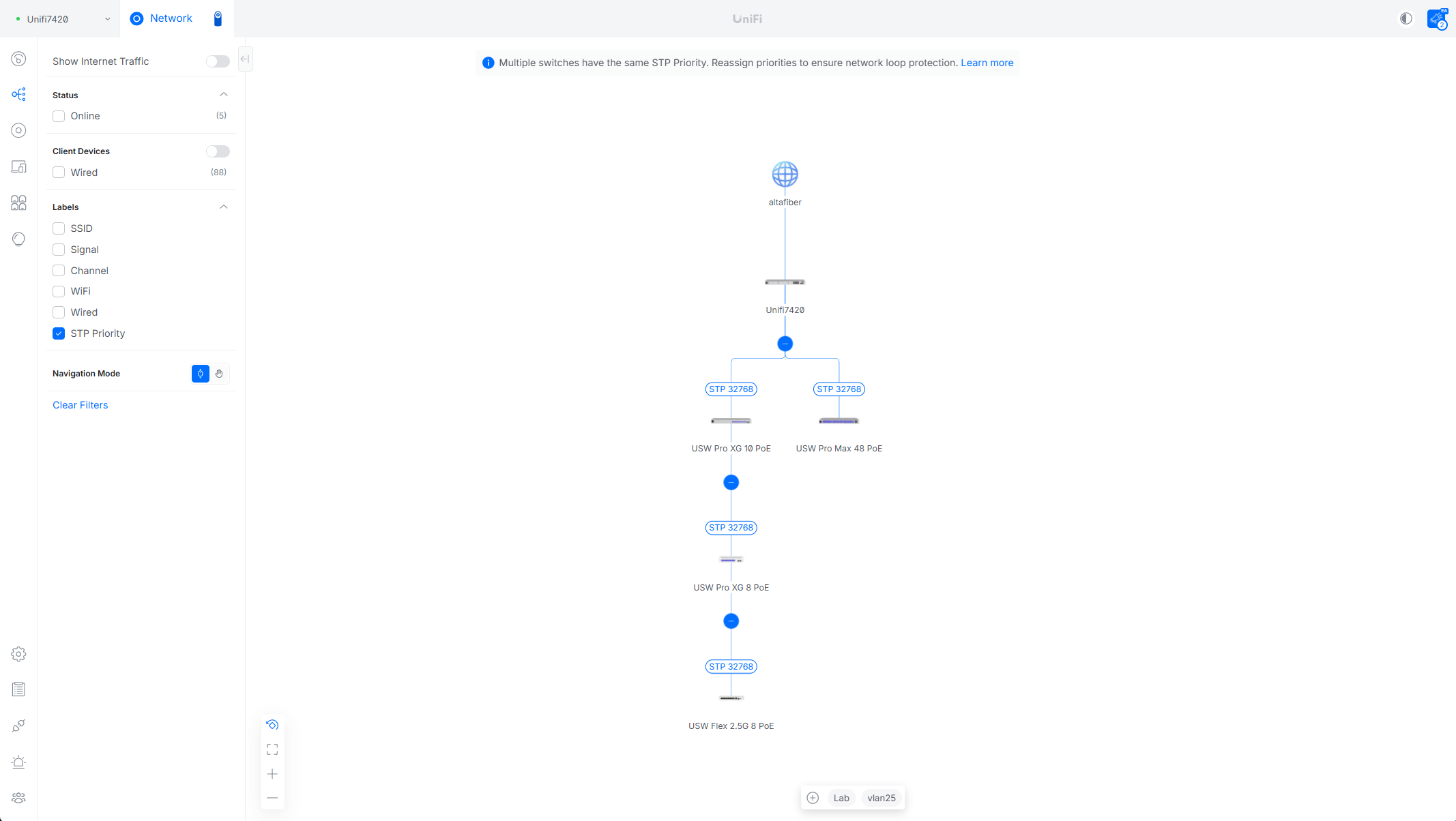
The UniFi Network topology view provides a clear, real-time visualization of the lab environment, showing how the XG switches are interconnected and uplinked back to the UDM Pro Max. From this view, it is easy to trace uplink paths, verify link speeds, and understand the switching fabric hierarchy at a glance.
The topology view also exposes the current Spanning Tree Protocol (STP) configuration, including switch priorities and active paths. These settings can be manually adjusted directly within the UniFi interface to better control root bridge selection and prevent potential network loops as the environment scales or changes.
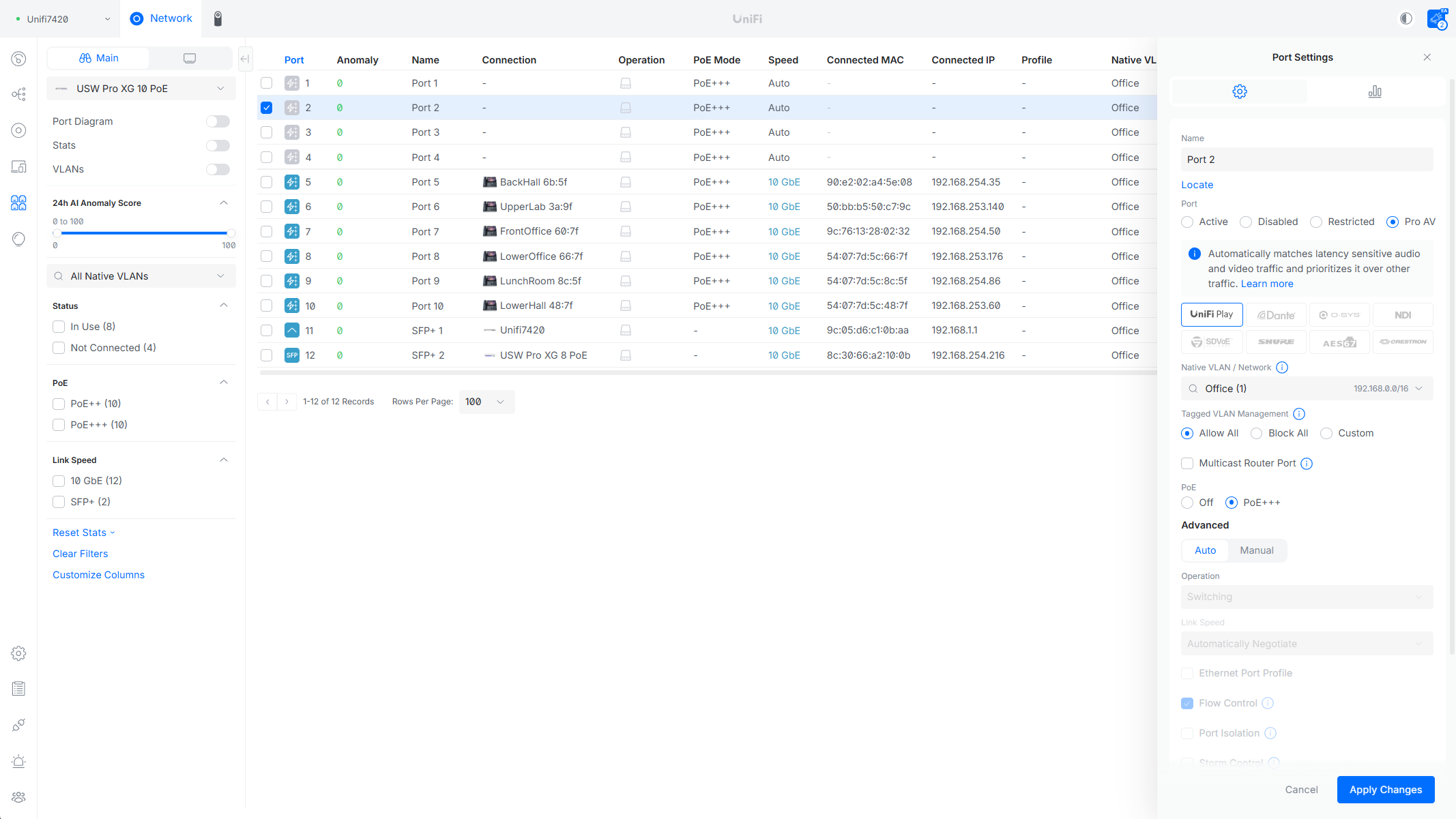
From the Ports view within the UniFi Network application, administrators can drill down into individual port configurations on the XG switches. Selecting a single port exposes detailed status information along with configurable options for PoE behavior, link speed, VLAN assignment, and traffic handling.
UniFi also includes built-in support for Pro AV applications at the port level, allowing latency-sensitive audio and video traffic to be automatically prioritized without requiring manual QoS tuning. Combined with per-port PoE control and advanced options such as flow control and port isolation, this granular visibility enables you to tailor each port to its intended workload while maintaining consistent performance across the switch.
Conclusion
From our perspective, the XG lineup represents a milestone for affordable multi-gig and 10GbE PoE and non-PoE installations that demand high throughput and clean, modern layouts. They range from compact 8-port desktop deployments to rack-mountable configurations with 10-, 24-, or 48-port capabilities. Ubiquiti has positioned the Pro XG family as a practical on-ramp to 10GbE copper, offering a compelling alternative to more complex and expensive fiber-first designs while still delivering the bandwidth modern networks increasingly require.
The Switch Pro XG 10 PoE is clearly aimed at dense access-layer and aggregation roles, where its high PoE budget, PoE+++ support, and rack-mount form factor make it well-suited for next-generation WiFi access points, power-hungry edge devices, and centralized 10GbE deployments. It offers enough power and throughput to scale without forcing a move into enterprise-class switching tiers.
The Switch Pro XG 8 PoE takes a different but equally effective approach, focusing on compact, flexible deployment. Its desktop and wall-mountable design, combined with full 10GbE RJ45 connectivity and PoE++ support, makes it an excellent fit for labs, studios, creative workspaces, and edge environments where space and simplicity are just as important as performance. It also works particularly well for localized high-speed workloads such as NAS-to-workstation connectivity or small PoE aggregation points.
Management remains a strong point across the lineup. UniFi’s familiar interface, detailed topology views, granular per-port configuration, and Etherlighting visibility make deployment and ongoing operations straightforward, even as environments grow more complex. The addition of built-in Pro AV support further enhances the value of these switches, making them especially attractive for studios and AV-focused spaces that rely on powered speakers, controllers, and other latency-sensitive devices, all without requiring manual QoS tuning.
Overall, the Pro XG lineup delivers a well-balanced combination of performance, power delivery, and usability at price points that make 10GbE copper far more accessible. For organizations, labs, and creative professionals seeking to modernize their access layer with high-speed copper networking, Ubiquiti’s Pro XG switches stand out as a thoughtfully designed, highly practical solution.


 Amazon