

Ubiquiti continues to expand into the enterprise wireless market with the introduction of the UniFi E7 and E7-Campus, two flagship WiFi 7 access points designed for high-density, high-performance deployments. Built around a 10-stream tri-band radio architecture, 10GbE connectivity, and the latest 802.11be standard, the E7 family marks a significant step forward from previous UniFi generations, bringing features traditionally reserved for premium enterprise vendors into the UniFi ecosystem.
While both access points share the same core hardware platform and WiFi 7 feature set, they target very different deployment scenarios. The standard UniFi E7 is optimized for demanding indoor environments, such as offices, schools, convention spaces, and other areas where large numbers of clients compete for airtime. The UniFi E7-Campus builds on that foundation with a redesigned directional antenna system and RF characteristics tailored for large indoor venues, courtyards, stadiums, outdoor gathering spaces, and campus-wide deployments where extended coverage and client density are equally important.
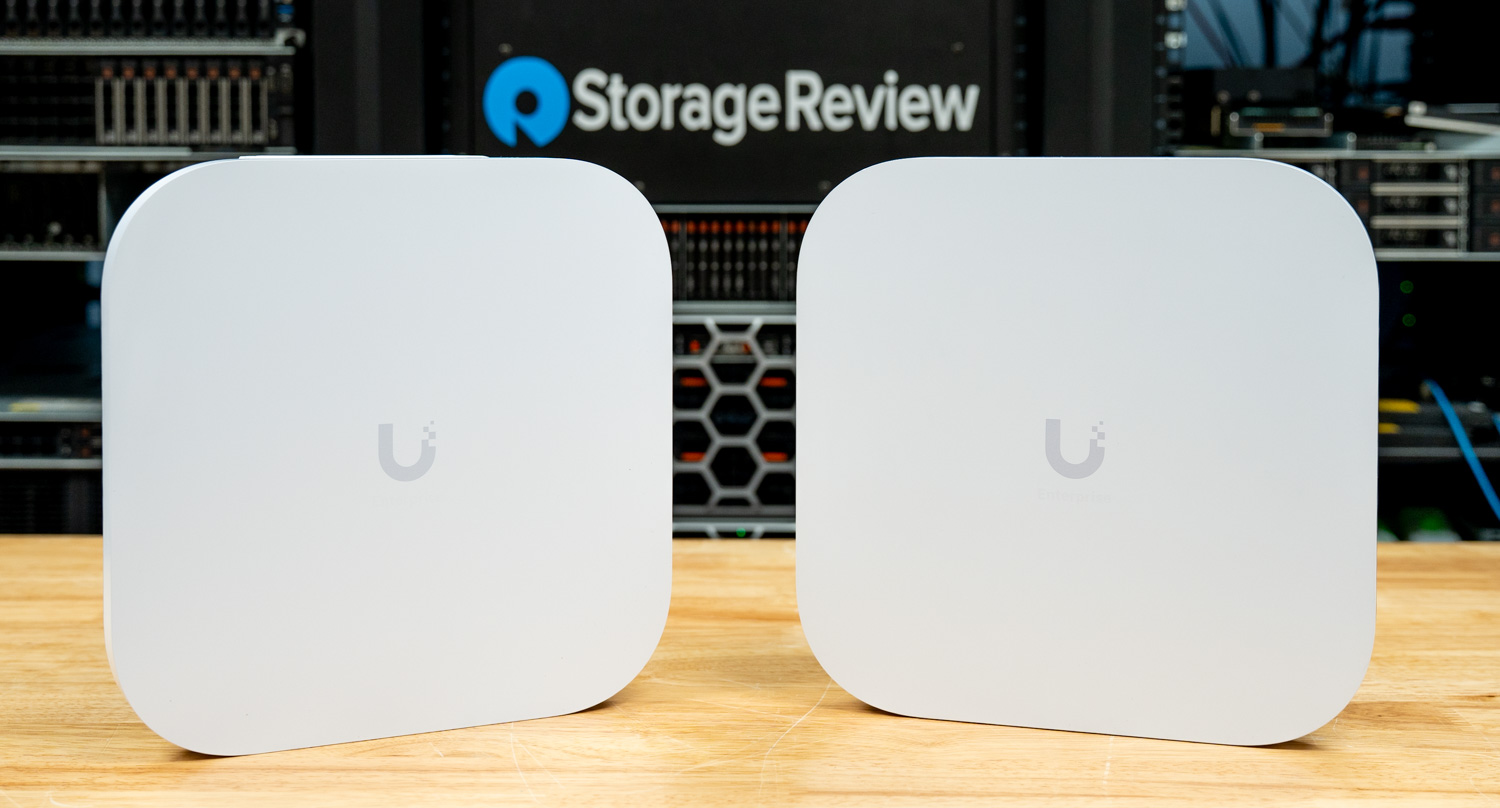
The E7 lineup also signals UniFi’s continued expansion beyond the SMB market into larger enterprise deployments. As organizations adopt multi-gig switching, faster internet connections, and bandwidth-intensive applications, wireless infrastructure is increasingly the limiting factor. By pairing WiFi 7 radios with 10GbE uplinks and enterprise-class management via UniFi Network, the E7 family provides the headroom needed for modern campus networks while maintaining the simplified deployment and centralized management that have become hallmarks of the UniFi platform.
With pricing starting at $499 for the UniFi E7 and $799 for the UniFi E7-Campus (affiliate links), these access points sit at the premium end of Ubiquiti’s portfolio. Rather than simply chasing higher headline speeds, they are designed to deliver the capacity, coverage, and scalability organizations need for their next-generation wireless infrastructure. In this review, we’ll examine where each model fits, explore the hardware differences between the two, and dive into key features.
Specifications
| Specifications | E7 | E7-Campus |
|---|---|---|
| Overview | ||
| Price | $499.00 | $799.00 |
| WiFi Standard | WiFi 7 | WiFi 7 |
| Spatial Streams | 10 | 10 |
| Coverage Area | 185 m² (2,000 ft²) | 465 m² (5,000 ft²) |
| Max. Client Count | 1000+ | 1000+ |
| Uplink | 10 GbE 1 GbE |
10 GbE 1 GbE |
| Power Method | PoE++ | PoE++ |
| Physical | ||
| Dimensions | 250 x 250 x 43.5 mm (9.8 x 9.8 x 1.7″) |
Device: 250 x 250 x 45.5 mm (9.8 x 9.8 x 1.8″) Articulating mount: ⌀104 x 149.4 (⌀4.1 x 5.9″) |
| Weight | 1.8 kg (4 lb) | Device: 2.2 kg (4.9 lb) With articulating mount: 3.1 kg (6.8 lb) |
| Mounting | Ceiling, Wall, VESA (Pro Mount Included) |
Wall, Pole (Mounts Included) VESA (Optional) |
| Weatherproofing | — | IPX6 IP67 with Waterproof Door Kit (Included) |
| Performance | ||
| MIMO | 6 GHz: 4 x 4 5 GHz: 4 x 4 2.4 GHz: 2 x 2 |
6 GHz: 4 x 4 5 GHz: 4 x 4 2.4 GHz: 2 x 2 |
| Max. Data Rate | 6 GHz: 11.5 Gbps 5 GHz: 8.6 Gbps 2.4 GHz: 688 Mbps |
6 GHz: 11.5 Gbps 5 GHz: 8.6 Gbps 2.4 GHz: 688 Mbps |
| Antenna Gain | 6 GHz: 6 dBi 5 GHz: 6 dBi 2.4 GHz: 5 dBi |
6 GHz: 12 dBi 5 GHz: 12 dBi 2.4 GHz: 9 dBi |
| Max. TX Power | 6 GHz: 24 dBm / 30 dBm 5 GHz: 30 dBm 2.4 GHz: 23 dBm |
6 GHz: 30 dBm (36 dBm EIRP) 5 GHz: 30 dBm 2.4 GHz: 23 dBm |
| Features | ||
| Wireless Meshing / Roaming / RRM | ✓ | ✓ |
| Zero-Wait DFS | ✓ | ✓ |
| PRISM™ RF Filtering | — | ✓ |
| Hardware | ||
| Max. Power Consumption | 43W | 44W |
| Supported Voltage Range | 42.5–57V DC | 42.5–57V DC |
| Networking Interface | (1) 10 GbE RJ45 port (1) 1 GbE RJ45 port |
(1) 10 GbE RJ45 port (1) GbE RJ45 port |
| Environmental | ||
| Operating Temperature | -30 to 50° C (-22 to 122° F) | -30 to 60° C (-22 to 140° F) |
| Operating Humidity | 5 to 95% noncondensing | 5 to 95% noncondensing |
| Software | ||
| UniFi Network Version | Version 9.2.87 and later | Version 9.0.114 and later |
Performance Positioning: WiFi 7 at Scale
From a throughput perspective, both the E7 and E7-Campus fully leverage the expanded bandwidth of WiFi 7. With up to 11.5 Gbps on 6 GHz using 320 MHz channels, these APs target environments with dozens or hundreds of clients active simultaneously, rather than chasing single-client peak speeds.
The key differentiator, however, is RF design. The standard E7 uses omnidirectional antennas with moderate gain, making it ideal for traditional indoor deployments such as offices, classrooms, or dense residential settings. In contrast, the E7-Campus uses high-gain directional antennas, delivering significantly higher dBi values and focused coverage patterns. As a result, it performs far more effectively in large open areas, outdoor campuses, or long-range indoor corridors.
Additionally, the E7 Campus includes PRISM RF filtering and active hardware filtering, which give it an advantage in congested RF environments. Both models support Zero-Wait DFS, which maintains channel availability when a radar event forces a channel switch, but the Campus pairs that capability with filtering hardware tailored to the interference profiles of dense outdoor and mixed-use deployments.
Build and Design
The E7 follows the familiar UniFi ceiling-mount design language, with a low-profile squircle enclosure measuring 250 x 250 x 43.5 mm. Ubiquiti clearly intended it for clean indoor installations, blending into office ceilings or wall mounts without drawing attention. Build quality is consistent with UniFi’s higher-end gear, using a mix of UV-stabilized polycarbonate and aluminum.
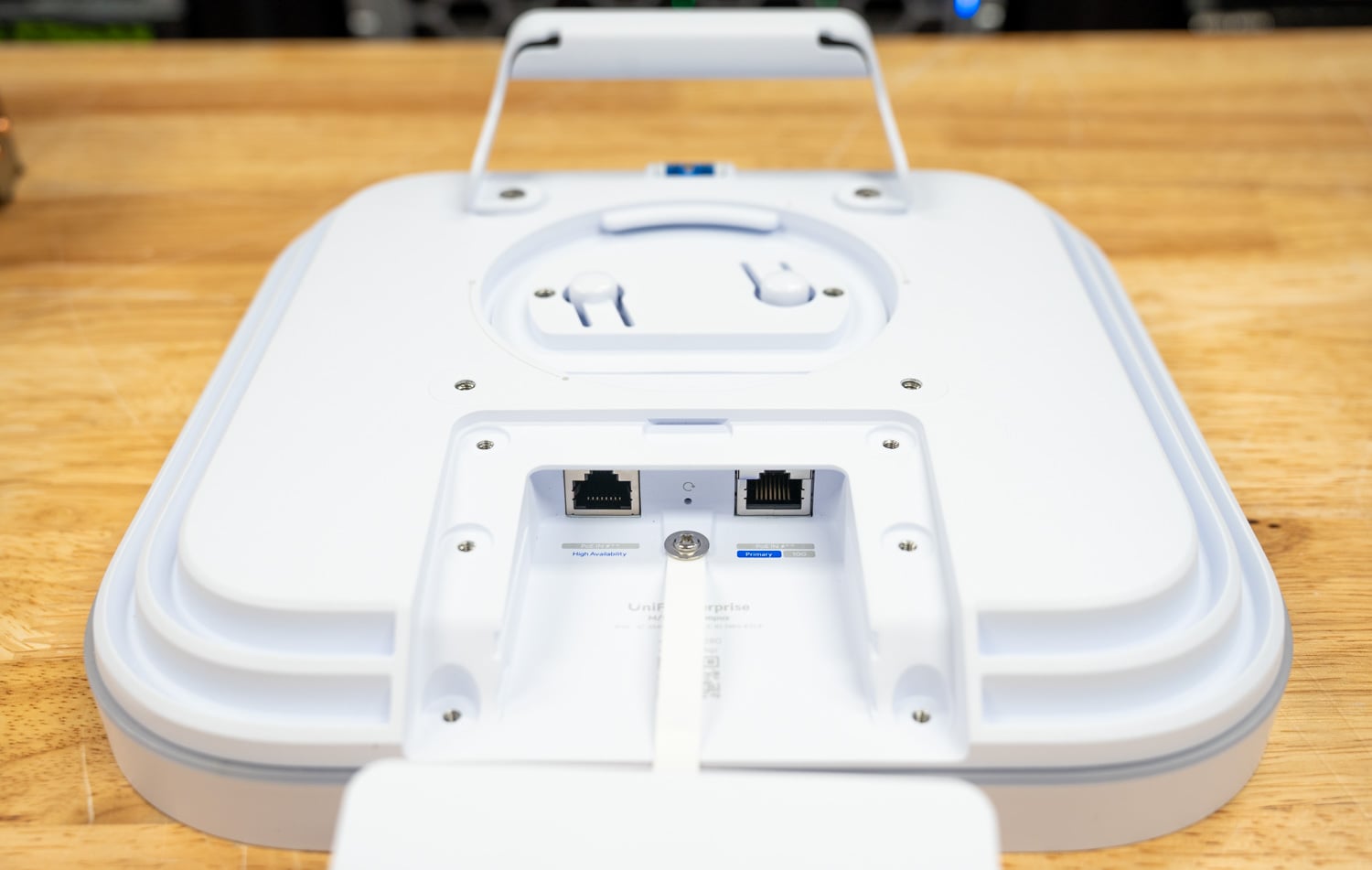
The E7-Campus, on the other hand, takes a more purpose-built approach. While similar in footprint, it adds thickness and more rugged construction, along with an articulating mount for precise directional alignment. Furthermore, with IPX6 weather resistance and IP67 support via the included waterproof door kit, it handles harsh outdoor conditions without compromise.
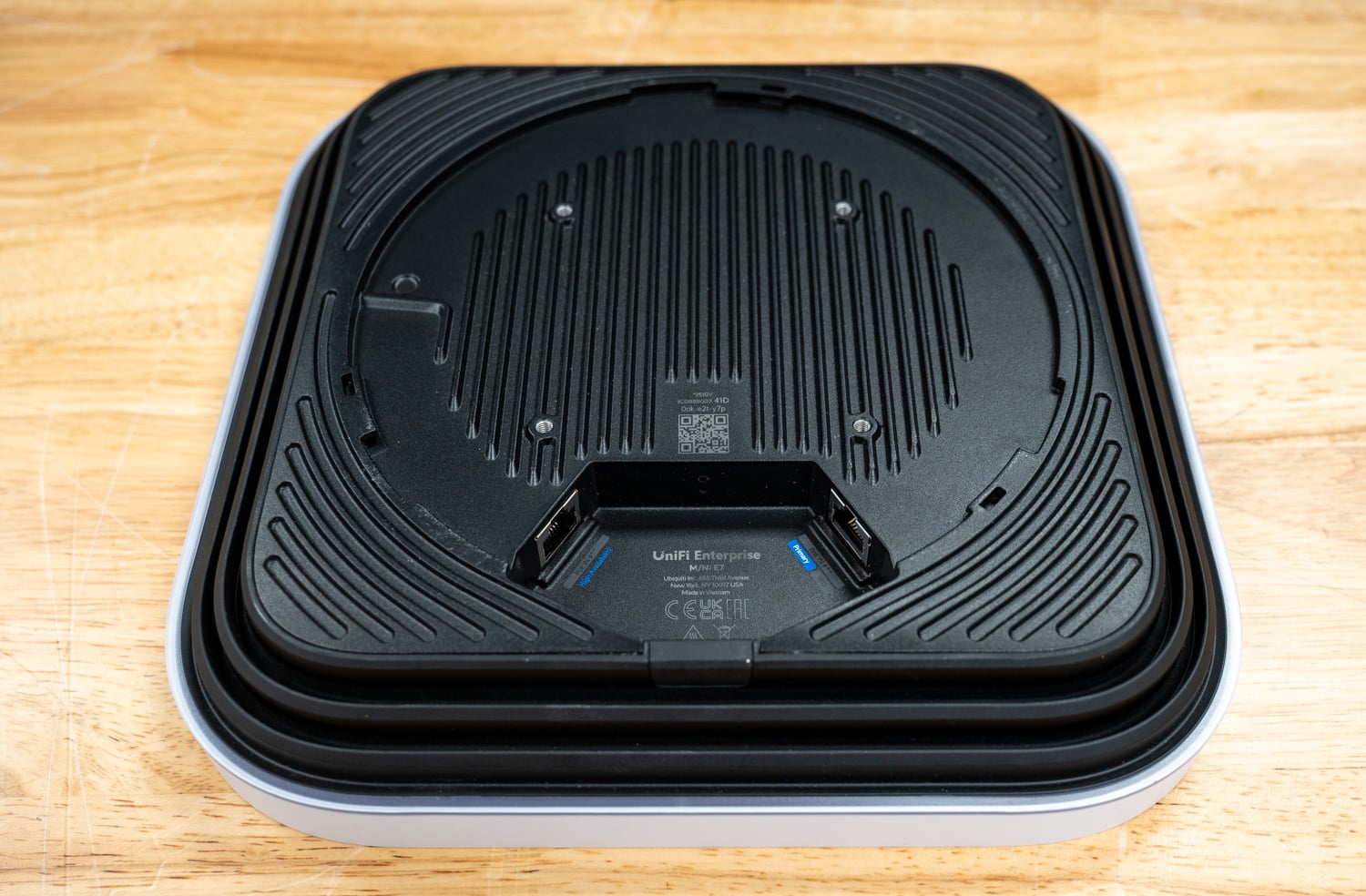
Weight also reflects the difference in intent. The E7 remains relatively lightweight at 1.8 kg, while the E7-Campus weighs 2.2 kg (3.1 kg with the mount), reinforcing its focus on industrial deployment.
Deployment Flexibility
The E7 and E7-Campus target distinct deployment scenarios yet share enough DNA to coexist naturally within a unified UniFi infrastructure. The standard E7 supports ceiling, wall, and VESA mounting, with a pro mount included out of the box, making it straightforward to deploy in standard commercial interiors. Moreover, its omnidirectional radiation pattern suits symmetric coverage zones where clients approach from all directions.
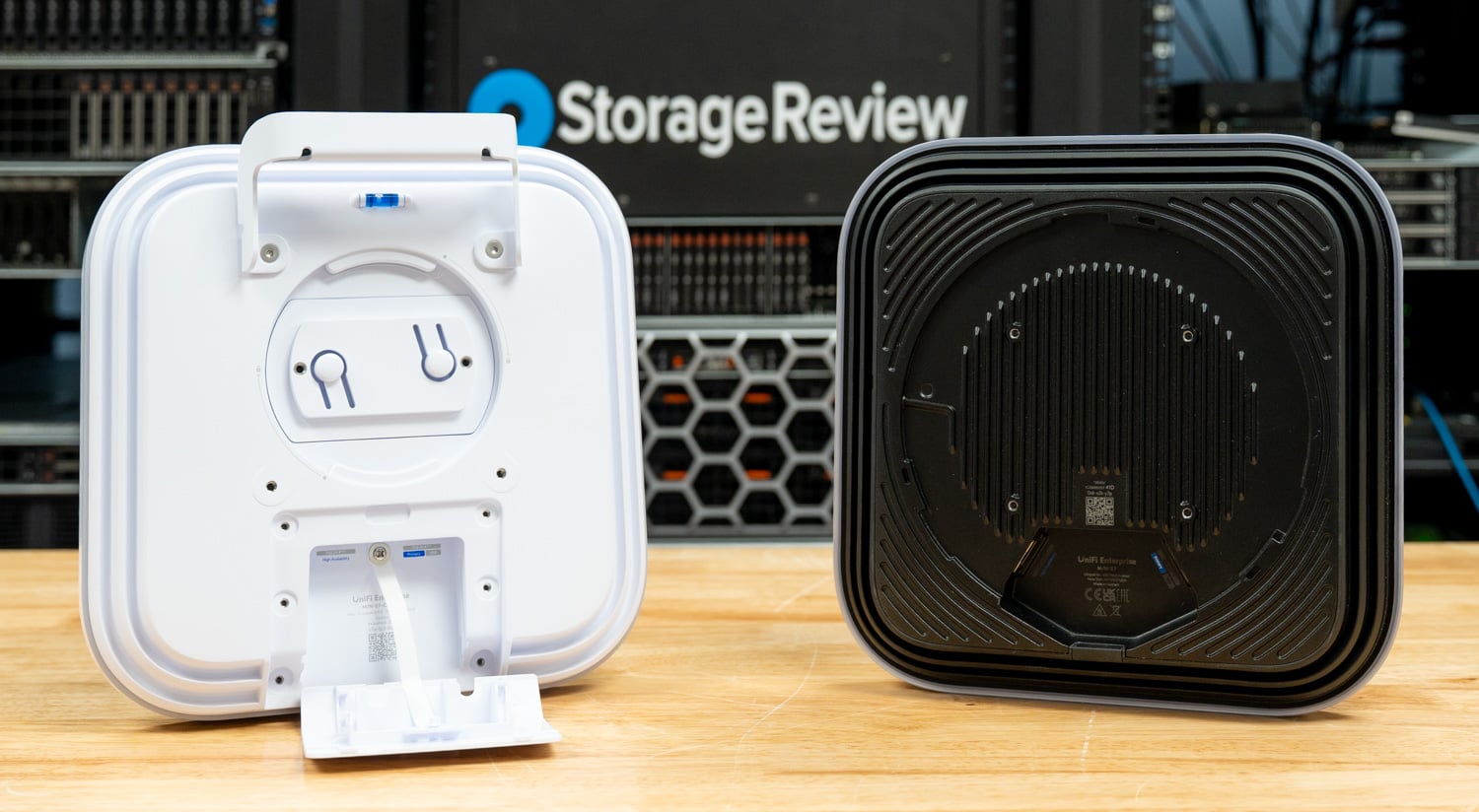
The E7-Campus flips that logic entirely. Wall and pole mounting are the primary options, with VESA available as an option, and the included articulating mount enables precise beam aiming. This directional approach is critical for deployments across large outdoor quads, parking structures, stadiums, or long indoor corridors. The pole mount accommodates pole diameters from 1 to 2.5 inches, covering most standard street and facility poles without additional hardware.
Both models require PoE++ power delivery, so infrastructure planning must account for 802.3bt-capable switches or injectors. Ubiquiti offers a 10G PoE++ Adapter (60W) as an accessory for the E7. Power draw is nearly identical between the two units at 43W and 44W, respectively, meaning existing PoE++ budgets translate cleanly when mixing models across a deployment.
From a high-availability standpoint, both APs include a redundant 1 GbE port alongside the primary 10 GbE uplink, a welcome addition at this tier that provides network architects with a failover path without additional hardware.
Software and Management
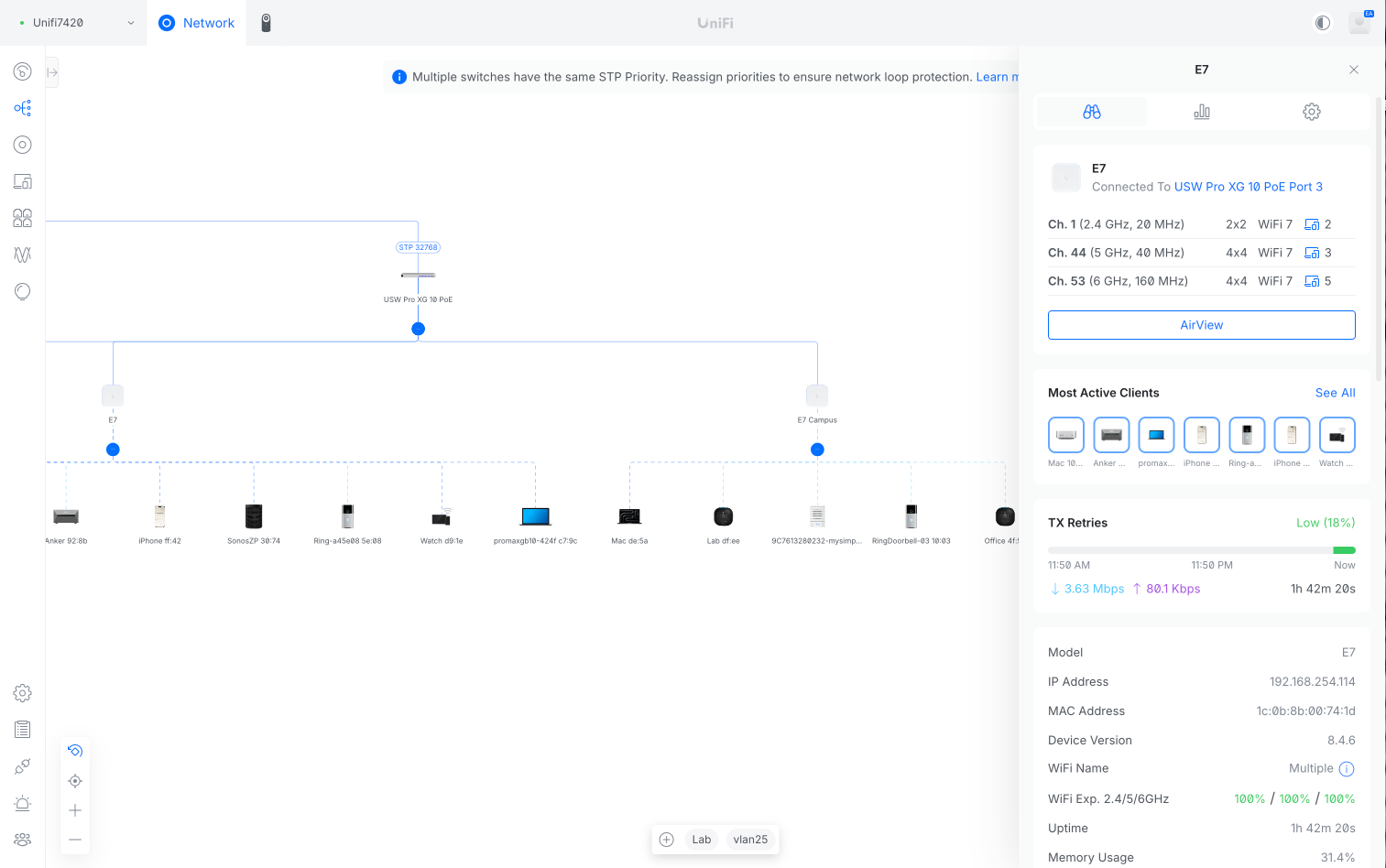
Both access points are managed through the UniFi Network application, which provides centralized wireless management across the entire deployment. Administrators can configure SSIDs, VLANs, security policies, radio settings, guest access, roaming behavior, and RF optimization from a single interface, while monitoring client health, coverage, airtime utilization, and overall network performance. Whether managing a handful of access points or a campus-wide deployment, UniFi Network offers a unified platform for deployment, monitoring, firmware updates, and ongoing wireless optimization.
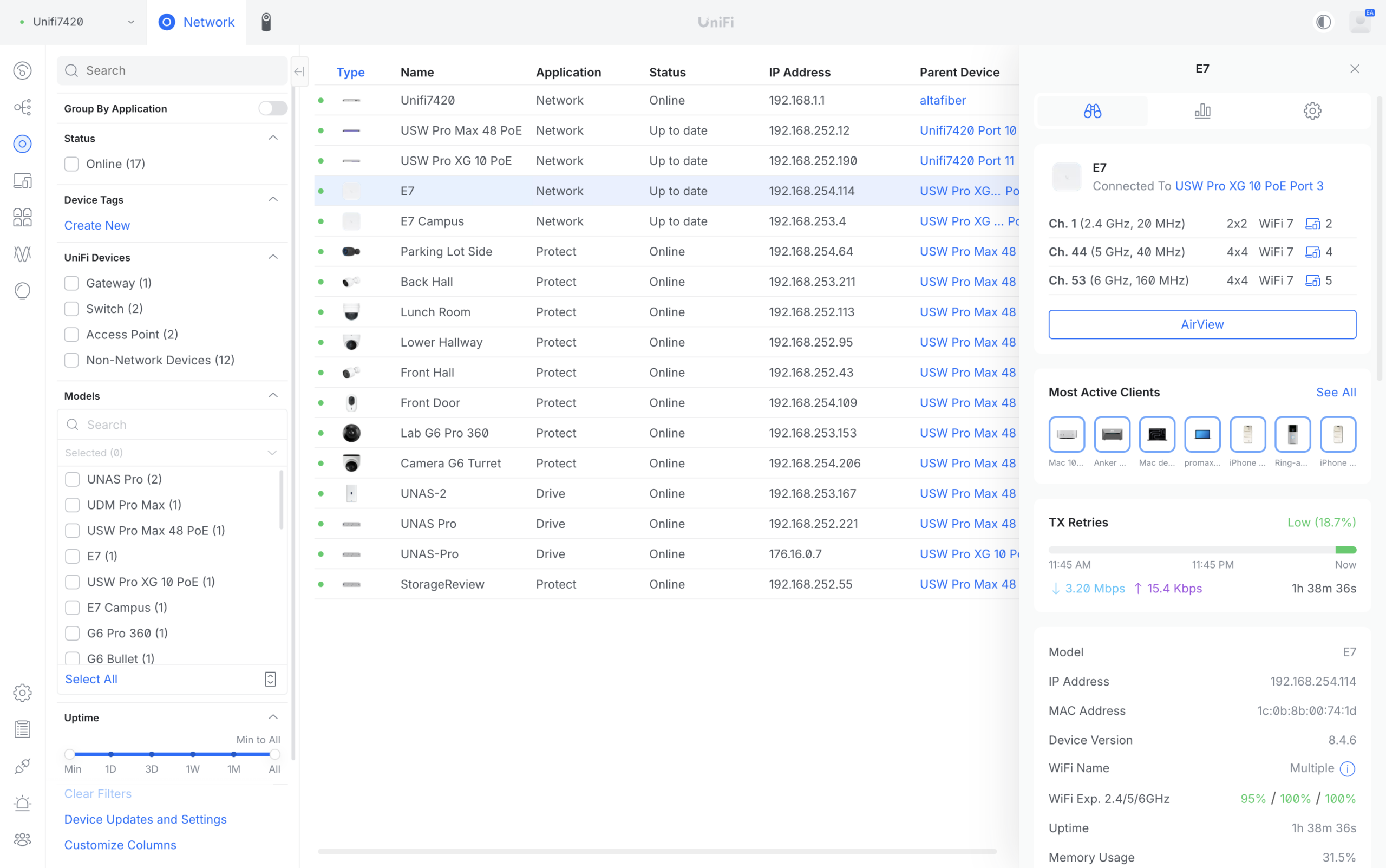
Feature parity across the software stack is strong. Both APs support wireless meshing, band steering, 802.11r fast roaming, 802.11k RRM, and real-time spectral analysis. The full captive portal suite is available on both, including voucher-based, payment-based, and external portal authentication, making either unit viable for hospitality or public-access deployments. RADIUS over TLS (RadSec) and dynamic VLAN assignment round out the enterprise authentication story.
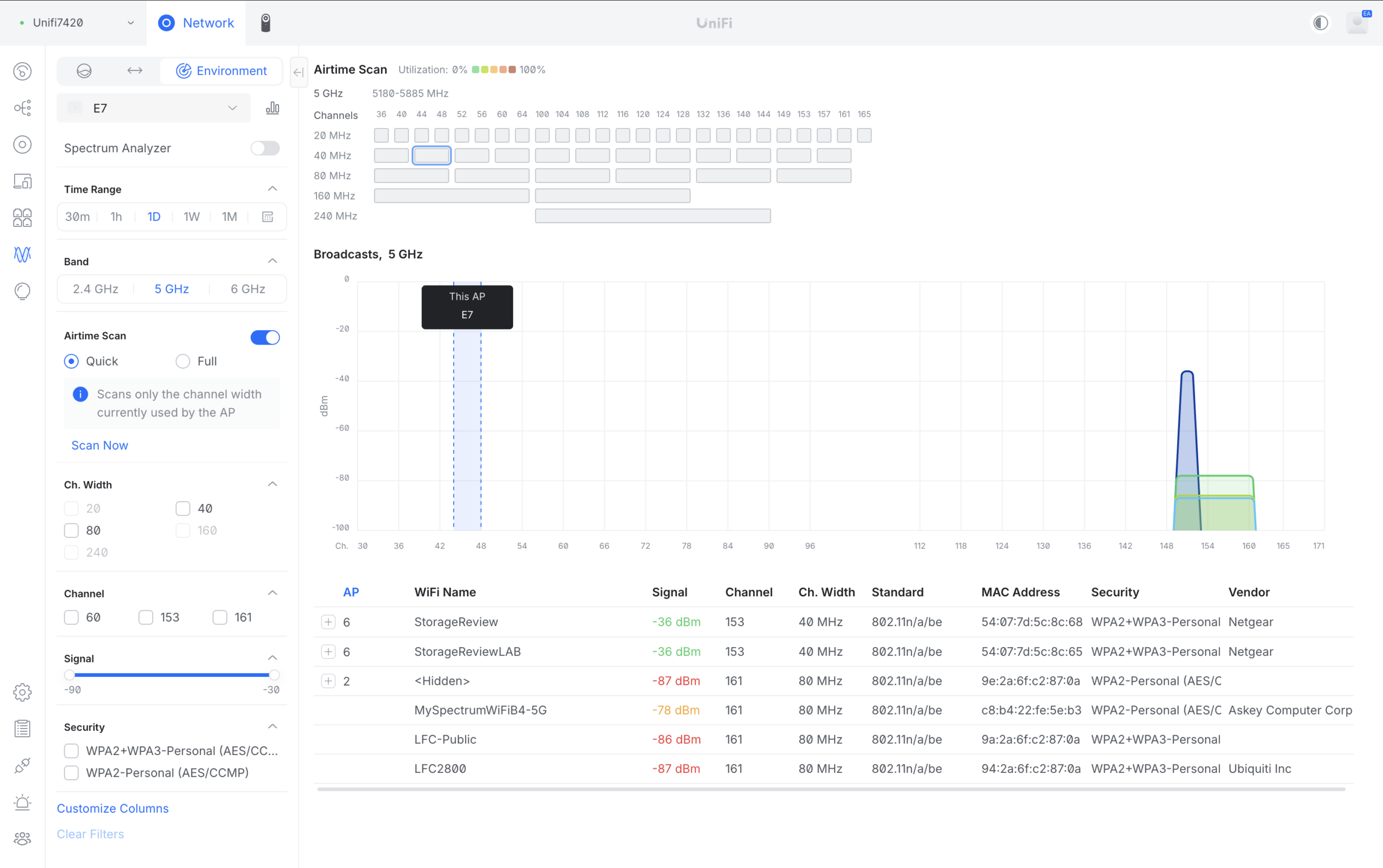
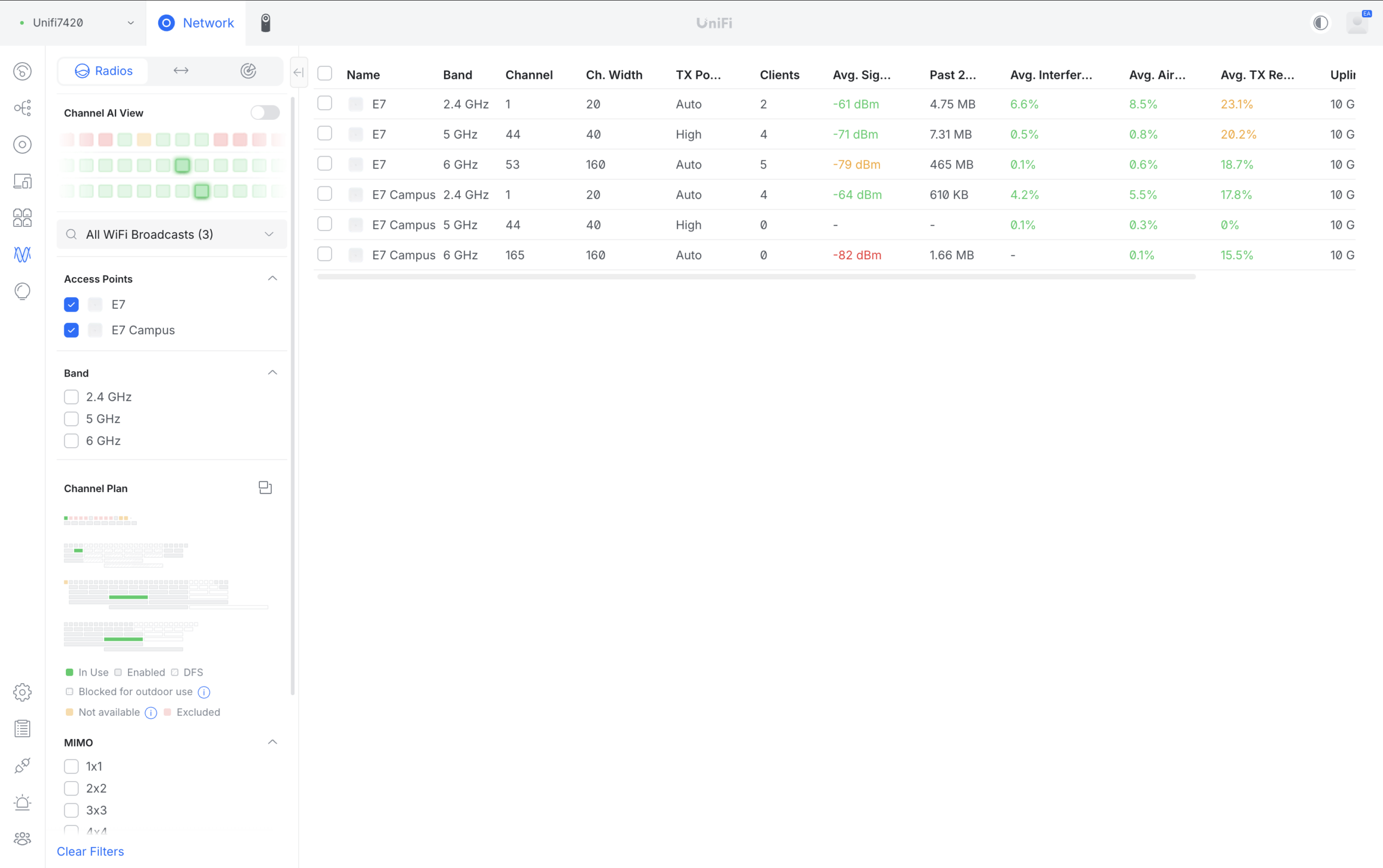
That shared foundation includes Zero-Wait DFS on both models, eliminating the channel-switching delays standard DFS introduces when radar is detected. Beyond it, the E7 Campus adds PRISM RF filtering, and in outdoor or mixed-use environments where 5 GHz DFS channels and adjacent-band interference are common, the combination translates directly into a more consistent client experience.
6 GHz and AFC Considerations
Both models support operation in the 6 GHz band, though available channels and transmit power are governed by regional regulations. In the FCC/IC regulatory domain (United States and Canada), UniFi supports Automated Frequency Coordination (AFC), allowing eligible deployments to operate in Standard Power mode where permitted. AFC dynamically coordinates channel usage with incumbent licensed services, enabling higher transmit power than Low Power Indoor operation while protecting existing spectrum users. Outside FCC/IC regions, 6 GHz availability and power limits vary by local regulations.
Hardware design further separates the two access points. The UniFi E7 uses omnidirectional 6 dBi antennas and operates at up to 24 dBm on 6 GHz, increasing to 30 dBm (36 dBm EIRP) when AFC-enabled Standard Power operation is available. The E7-Campus pairs a 30 dBm (36 dBm EIRP) 6 GHz radio with high-gain 12 dBi directional antennas, concentrating RF energy into a focused coverage pattern rather than broadcasting uniformly in all directions. This directional design delivers significantly greater effective coverage and signal strength across its intended service area, making it well suited for large indoor venues, courtyards, stadiums, and outdoor campus deployments.
Conclusion
The UniFi E7 and E7-Campus represent a mature, well-differentiated approach to enterprise WiFi 7. Rather than offering two versions of the same product with minor spec bumps, Ubiquiti draws a clear architectural line between them. The E7 is a high-density indoor workhorse built for environments that require high client capacity under controlled RF conditions. The E7-Campus, by contrast, is a purpose-engineered outdoor, long-range platform that adds directional RF, active filtering, and environmental hardening to tackle the more demanding deployments for which the standard E7 was never designed.
At $499, the E7 competes strongly in its price range, particularly given its 10 GbE uplink and 1000+ client capacity. The E7 Campus at $799 carries a meaningful price premium, but the inclusion of PRISM RF filtering, IP67-capable weatherproofing, and high-gain 12 dBi directional antennas makes the case clear. For organizations already invested in the UniFi ecosystem, both units slot in naturally and extend existing infrastructure without compromise. For those evaluating enterprise WiFi 7 platforms from scratch, the E7 family sets a high bar for both capability and manageability.


 Amazon