

HPE has announced the first four ProLiant Gen13 servers, and all of them run on 6th Gen AMD EPYC, the SP7-socket Venice parts AMD listed last month. The lineup is the two-socket, eight-GPU HPE ProLiant DL585a Gen13, the 1U single-socket HPE ProLiant DL525 Gen13 with up to 256 cores and 16-channel memory, and two Open Compute dense-compute systems, the HPE ProLiant XD245 Gen13 and HPE ProLiant XD285 Gen13. All four carry PCIe Gen6 and a new iLO 8 management processor that adds automatic drive encryption, two-person approval for destructive actions, and wider post-quantum cryptography.
The first four are HPE’s performance tier, and John Carter, HPE’s vice president of mainstream compute, said on a pre-briefing call that this launch is aimed at agentic AI, EDA, CAE, and simulation, and that it “is not your Swiss Army knife” set of products. Asked about a mainstream two-socket 2U Gen13 server, Carter said: “not today, but stay tuned.” HPE’s release confirms that Gen13 will expand to mainstream enterprise, virtualization, software-defined infrastructure, database, and AI systems after these four, plus the edge, where HPE refreshed its rugged ProLiant line im Mai.
The 500-series numbering carries the same message, because HPE has historically reserved it for the performance tier, previously the four-socket DL560 and DL580, and Gen13 extends it to the single-socket DL525 and the GPU-dense DL585a to set them apart from the mainstream 300 series. Carter also said HPE’s early customer conversations suggest the single-socket DL525 carries enough cores and memory bandwidth that a rack of two-processor 2U boxes would run out of power or other resources first, which is why HPE sees the 1U single-socket as the sweet spot for the traditional buyer.
HPE ProLiant DL585a Gen13
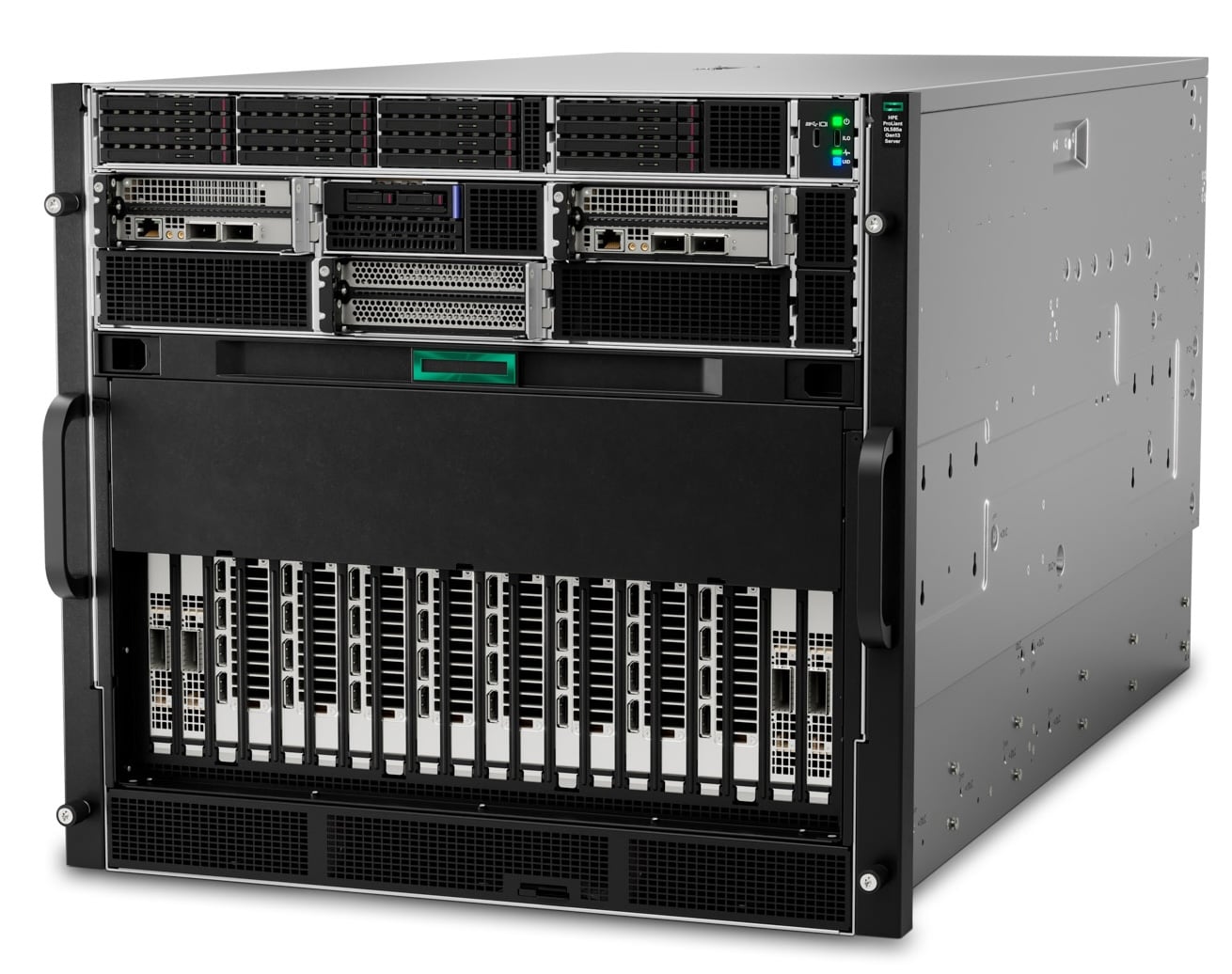
The DL585a Gen13 is the flagship: two 6th Gen EPYC processors, up to eight double-wide PCIe GPUs or 16 single-wide liquid-cooled cards, 32 DIMM slots, up to 16 E3.S drives, and PCIe Gen6. The launch QuickSpecs list two orderable GPUs, the NVIDIA RTX PRO 6000 Blackwell Server Edition 96GB and RTX PRO 6000D 84GB, in sets of one, two, four, or eight; HPE’s briefing slide adds Rubin PCIe, H200 NVL, and AMD GPUs to come, attached through an HPE or NVIDIA switchboard. HPE positions it for inference, virtualization, RAG fine-tuning, analytics, and agentic AI.
The DL585a is a 10U box, and Carter said the height is deliberate because enterprise buyers are still air-cooling existing data centers and, in his words, run out of power at the rack before they run out of space, so HPE chose a large air-cooled chassis over density it could not power anyway. That matches what Tim Shedd told us on our data center thermals podcast in August: air cooling still accounts for roughly 90 percent of global server shipments, and most enterprise inference hardware has to land in 10- to 15-year-old air-cooled data centers, because that is where the data is.
Power is split into two domains: two 3200W supplies for the system board and up to twelve 3200W supplies for the GPUs, all N+N. HPE will offer accelerators from NVIDIA, Intel, and AMD, and Carter said the DL585a is where HPE’s Private Cloud AI systems head in Gen13.
A loaded DL585a weighs up to 117 kg (258 lb), and HPE suggests using a lift and multiple sets of hands. Memory tops out at 8TB with 256GB RDIMMs, and HPE recommends system memory of at least twice the total GPU memory. There is no embedded networking; an OCP 3.0 or PCIe adapter is required. The drive slots are PCIe Gen6, but every E3.S SSD on the launch list is a Gen5 part, which aligns with the market: Gen6 enterprise SSDs such as Micron’s 9650 have been announced but are not yet widely available.

| Normen | HPE ProLiant DL585a Gen13 |
|---|---|
| Compute and Memory | |
| Prozessoren | 2x 6th Gen AMD EPYC (SP7), up to 256 cores, up to 600W each |
| Memory | 32 DIMM slots (16 per processor), 1DPC; up to 8TB DDR5-8000 with 256GB RDIMMs or 4TB MRDIMM-12800 |
| Beschleuniger | |
| GPU-Dichte | Up to 8 PCIe double-wide or up to 16 PCIe single-wide (liquid-cooled) |
| GPU-Unterstützung | Launch QuickSpecs: NVIDIA RTX PRO 6000 Blackwell Server Edition 96GB, RTX PRO 6000D 84GB; HPE briefing slide also lists Rubin PCIe, H200 NVL, and AMD GPUs 0, 1, 2, 4, or 8 GPUs; no mixing of models; NVIDIA 2-8-5 reference architecture supported |
| GPU Attach | HPE switchboard or NVIDIA switchboard |
| Stoff | North/South: NVIDIA BlueField-3, BlueField-4 East/West: ConnectX-8, ConnectX-9 via NVIDIA switchboard; ConnectX-7 and other options via HPE switchboard |
| Integrated Fabric | 8x QSFP (with NVIDIA switchboard) |
| Speicherung und Erweiterung | |
| Lagerung | Up to 16 E3.S EDSFF NVMe (12-drive cage default on the CTO SKU) |
| PCIe-Steckplätze | Up to 6 front PCIe Gen6 x16 Up to 2 rear PCIe Gen6 x16 1 rear OCP 3.0 (up to x4) |
| Netzwerken | PCIe stand-up adapters and one OCP 3.0 adapter; no embedded networking |
| Fahrgestell | |
| Formfaktor | 10U; 43.95 x 44.8 x 81.92 cm (17.3 x 17.64 x 32.25 in); 88 to 117 kg (194 to 258 lb) depending on configuration |
| Kühlung: | Air-cooled; 15 hot-plug dual-rotor 80mm fan assemblies (5 internal, 10 rear); 10 to 30 °C standard inlet, ASHRAE A3/A4 |
| Tuning | Dual domain, N+N: 2x 3200W M-CRPS Titanium for the system plus 8 or 12x 3200W for the GPUs (10 or 14 supplies total) |
| USB | 4 USB 3.0 (1 front Type-C, 2 rear Type-A, 1 internal) plus iLO front service port |
| Verwaltung | |
| Verwaltung | HPE iLO 8 via DC-SCM (standard), HPE Compute Ops Management; iLO Advanced and OneView optional |
| Sicherheit | Embedded TPM, Silicon Root of Trust |
| CTO SKU | P97048-B21 (TAA: P97048-B21#GTA) |
HPE ProLiant DL585a Gen13 Configurations
HPE’s QuickSpecs list four factory configurations, all with eight GPU slots and the HPE switchboard, differing in rear PCIe slot count, drive count, and controller kits.
| Normen | 6-slot PCIe Gen6 x16, 8 EDSFF, Direct Attach, 8x GPU | 8-slot PCIe Gen6 x16, 8 EDSFF, 8x GPU | 7-slot PCIe Gen6 x16, 8 EDSFF, 1x Controller, 8x GPU | 6-slot PCIe Gen6 x16, 16 EDSFF, 2x Controller, 8x GPU |
|---|---|---|---|---|
| HPE Switchboard | ||||
| Configuration SKU | P96669-B21 | P96672-B21 | P96675-B21 | P96678-B21 |
| Switchboard Enablement Kit | P96973-B21 | P96973-B21 | P96973-B21 | P96973-B21 |
| Slots and Drives | ||||
| GPU-Steckplätze | 8 | 8 | 8 | 8 |
| FHFL x16 Gen6 PCIe Slots (Front) | 4 | 4 | 4 | 4 |
| FH 3/4-Length x16 Gen6 PCIe Slots (Front) | 2 | 2 | 2 | 2 |
| FHHL x16 Gen6 PCIe Slots (Rear) | 0 | 2 | 1 | 0 |
| EDSFF-Laufwerke | 8 | 8 | 8 | 16 |
| OCP Gen4 x4 Slots | 1 | 1 | 1 | 1 |
| Sets | ||||
| 16 EDSFF Upgrade Kit | P97050-B21 | |||
| FHFL GPU Switchboard Cage Kit | P97055-B21 | P97055-B21 | P97055-B21 | P97055-B21 |
| Rear FHHL PCIe Enablement Kit | P97052-B21 | P97052-B21 | ||
| Front FHHL PCIe Enablement Kit | P97053-B21 | P97053-B21 | ||
| FHHL PCIe Front Upgrade Riser Kit | P97054-B21 | |||
HPE ProLiant DL525 Gen13
The DL525 Gen13 is a 1U single-socket system with one 6th Gen EPYC processor at up to 256 cores and 600W, 16 memory channels at one DIMM per channel, and up to 4TB of DDR5-8000 or 2TB of MRDIMM-12800. Storage runs to 20 E3.S drives, and the front can take two double-wide or four single-wide full-length GPUs, with three more half-height cards at the rear.
HPE pitches the DL525 for fraud detection, market data, risk and pricing models, EDA, simulation, and inference, the same memory-bandwidth argument behind the STAC-A2 record HPE set with MRDIMMs on the XD230 in June, and it is the first of the four to ship. The product brief claims up to 2x the compute performance without naming the comparison system, and notes that direct liquid cooling is optional for denser configurations. Two M-CRPS supplies of up to 3200W each feed the box, a power budget sized for the front GPU slots.

| Normen | HPE ProLiant DL525 Gen13 |
|---|---|
| Compute and Memory | |
| Prozessor | 1x 6th Gen AMD EPYC (SP7), up to 256 cores, up to 600W |
| Memory | 16 channels, 1DPC; up to 4TB DDR5 at 8000 MT/s or 2TB MRDIMM at 12800 MT/s |
| Storage and Accelerators | |
| Lagerung | Up to 20 EDSFF E3.S 1T NVMe; up to 1 M.2 2280 NVMe |
| Stiefel | Up to 1 NS204 boot device (front or rear) |
| GPU | Up to 2 double-wide or 4 single-wide FHFL at the front; up to 3 single-wide HHHL at the rear |
| I / O | |
| I/O (Front) | Up to 4 PCIe Gen6 slots; up to 1 OCP 3.0 slot |
| I/O (Rear) | Up to 3 PCIe Gen6 slots; up to 1 OCP 3.0 slot |
| Speichercontroller | PCIe and OCP options |
| Chassis and Management | |
| Formfaktor | 1U |
| Tuning | Up to 2 M-CRPS power supplies (60mm or 73mm), up to 3200W |
| Kühlung: | Air or direct liquid cooling |
| Verwaltung | HPE iLO 8 via DC-SCM, Compute Ops Management, OneView |
HPE ProLiant XD245 and XD285 Gen13
The XD245 and XD285 Gen13 are the successors to HPE’s Apollo 2000 and XD2000 dense-compute line, siblings of the GPU-dense XD685, and the first to move to Open Rack V3, with shared power and a choice of liquid or air cooling. Both use the same two-socket node with 32 DIMM slots, two PCIe Gen6 x16 slots, an OCP 3.0 slot, two EDSFF bays, and two hot-plug M.2 drives, with Ethernet, InfiniBand, or Slingshot networking at 400Gb or 800Gb. HPE aims them at CAE, weather and climate modeling, scientific research, and financial modeling.
The XD245 packs four server nodes into a 2U chassis, up to eight 6th Gen EPYC processors in all, and is direct liquid-cooled only, with a 40 °C inlet requirement. The XD285 carries two nodes in the same 2U chassis and stays on air, which Carter said is for customers who want the density but cannot bring liquid to the rack yet.

| Normen | HPE ProLiant XD245 and XD285 Gen13 |
|---|---|
| Fahrgestell | |
| XD245 Gen13 | 2U chassis with four direct liquid-cooled nodes (up to 600W CPUs); 40 °C inlet requirement |
| XD285 Gen13 | 2U chassis with two air-cooled nodes |
| Rack | 21-inch OCP rack, ORV3, 44OU, 1200mm depth |
| Servicing | Independent node servicing |
| Pro Knoten | |
| Prozessoren | 2x 6th Gen AMD EPYC (SP7), up to 256 cores, up to 600W each |
| Memory | 32 DDR5 RDIMM or MRDIMM slots; 32GB, 64GB, 96GB, and 128GB modules |
| RAM-Geschwindigkeit | Up to 8000 MT/s RDIMM; up to 12800 MT/s MRDIMM |
| Expansion | 2 PCIe Gen6 x16 slots and 1 OCP 3.0 |
| Laufwerkseinschübe | 2 EDSFF |
| Interner Speicher | 2 M.2, externally accessible, hot-plug |
| Hardware-RAID | Supported (RAID 0 and 1 prioritized) |
| Netzwerken | Ethernet, InfiniBand, or Slingshot at 400Gb or 800Gb |
| Verwaltung | HPE iLO 8 |
iLO 8 Security and Compute Ops Management
iLO 8 is the other significant update to the Gen13 story, and HPE claims four industry firsts for it. Automatic self-encrypting drive (Auto-SED) support activates any SED on first boot with no configuration, external key manager, or manual step. Multi-person authorization (MPA) requires two authorized users to approve high-impact actions such as key provisioning and secure erase. Post-quantum cryptography readiness now extends beyond firmware to server communication paths, and component verification built on Silicon Root of Trust checks the authenticity of parts as they are added or replaced.
Chris Bradley of HPE’s Compute Technical Enablement team filled in the details on the call. Auto-SED keys live in the iLO security enclave or can be exported to an enterprise key manager. MPA is enforced per server, so a policy can require a second approver for something as routine as a power-off. The post-quantum work that started in Gen12 firmware in March 2025 now covers management-plane traffic between the server and its backplane, drives, and PCIe devices, to meet CNSA 2.0 and NIST requirements.
“Organizations need to turn their investments in agentic AI and inference into business value without adding operational complexity or risk,” said Krista Satterthwaite, senior vice president and general manager, Compute at HPE. “For these workloads, HPE ProLiant Gen13 brings together optimized performance, built-in, automatic security, intelligent operations, and proven reliability.”
On the operations side, Compute Ops Management gains low-touch onboarding, compliance monitoring, and near real-time power capacity insights. The addition Bradley singled out is an agentic workflow that compares HPE’s published advisories against a customer’s fleet and flags affected servers with a remediation path, so administrators stop pulling advisories by hand. HPE cites a Forrester study it commissioned that found customers spent 50 percent less time managing servers and saw a 209 percent return over three years.
HPE also says each ProLiant generation goes through more than 1,000 tests and 10,000 hours of validation, including stress and corner-case testing past published operating limits, and cites an IDC study it sponsored that credits HPE Tech Care with up to 97 percent less unplanned downtime.
Verfügbarkeit
HPE’s release puts the DL525 Gen13 “later in 2026,” the DL585a Gen13 in early 2027, and the two XD systems in 2027. On the call, Carter was more specific: the DL525 ships in November, the DL585a in early to mid spring, and the XD245 and XD285 around early summer. All four are available through HPE Financial Services’ 90/9 Advantage program, with no payments for 90 days followed by nine months at 1 percent per month.
Gen12 is not finished either, Carter said, with more systems still coming, including the two-socket NVIDIA Vera system HPE angekündigt im Juni, the ProLiant Compute DL394 Gen12, which ships later this year. For the mainstream two-socket Gen13 box most enterprise buyers are waiting for, Carter offered no date beyond “stay tuned.”



 Amazon