---
description: SanDisk’s WD_BLACK SN8100 is blazing fast. We tested it against top Gen5 SSDs—and it might just be our new favorite consumer drive.
title: "SanDisk WD_BLACK SN8100 Review: Elite Performance in a Gen5 SSD"
image: https://www.storagereview.com/wp-content/uploads/2025/05/StorageReview-SanDisk-WD_Black-SN8100-5.jpg
---
[![Storage Review]()](https://storagereview.com/)
---
[Facebook](https://www.facebook.com/@storagereview) [X (Twitter)](https://twitter.twitter.com/storagereview) [Instagram](https://www.instagram.com/storagereview/) [LinkedIn](https://www.linkedin.com/company/storagereview-com) [YouTube](https://www.youtube.com/user/storagereview?sub_confirmation=1) [Email](mailto:info@storagereview.com) [Spotify](https://open.spotify.com/show/1y6VnznABhHeOSMOmbDTz0) [Reddit](https://www.reddit.com/r/StorageReview/) [Discord](https://discord.gg/TwMHb4azdC) [RSS Feed](https://www.storagereview.com/rss.xml) [TikTok](https://www.tiktok.com/@storagereview)
[Facebook](https://www.facebook.com/@storagereview) [X (Twitter)](https://twitter.com/storagereview) [Instagram](https://www.instagram.com/storagereview/) [LinkedIn](https://www.linkedin.com/company/storagereview-com) [YouTube](https://www.youtube.com/user/storagereview?sub_confirmation=1) [Email](mailto:info@storagereview.com) [Spotify](https://open.spotify.com/show/1y6VnznABhHeOSMOmbDTz0) [Reddit](https://www.reddit.com/r/StorageReview/) [Discord](https://discord.gg/TwMHb4azdC) [RSS Feed](https://www.storagereview.com/rss.xml) [TikTok](https://www.tiktok.com/@storagereview)
[](https://www.storagereview.com)
≡ Menu
- [Home](https://www.storagereview.com/)
- [Storage Reviews](https://www.storagereview.com/review)
- [Consumer Reviews](https://www.storagereview.com/consumer)
- [Enterprise Reviews](https://www.storagereview.com/enterprise)
- [Ubiquiti Reviews](https://www.storagereview.com/best/ubiquiti-reviews)
- [SR Merch](https://store.storagereview.com)
- [Leaderboards](https://www.storagereview.com/best)
- [Best Storage Arrays](https://www.storagereview.com/best/storage-arrays)
- [Best Enterprise SSDs](https://www.storagereview.com/best/enterprise-ssds)
- [Best Servers](https://www.storagereview.com/best/servers)
- [Best Desktops for Local AI](https://www.storagereview.com/best/desktops-local-ai)
- [Best Laptops for Local AI](https://www.storagereview.com/best/laptops-local-ai)
- [Best Local LLM Tools](https://www.storagereview.com/best/local-llm-tools)
- [Agentic AI Hardware](https://www.storagereview.com/best/agentic-ai-hardware)
- [Best SSDs & Hard Drives](https://www.storagereview.com/best_drives)
- [Best Portable SSDs](https://www.storagereview.com/best/portable-ssds)
- [Best Business Laptops](https://www.storagereview.com/best/business-laptops)
- [Best Mobile Workstations](https://www.storagereview.com/best/mobile-workstations)
- [Best Desktop Workstations](https://www.storagereview.com/best/desktop-workstations)
- [Best Mini PCs](https://www.storagereview.com/best/mini-pcs)
- [Best Laptop Battery Life](https://www.storagereview.com/best/laptop-battery-life)
- [Storage Reference Guide](https://www.storagereview.com/storage-reference-guide)
- [About SR](https://www.storagereview.com/about-storagereview)
- [StorageReview.com Sweepstakes Rules and Regulations](https://www.storagereview.com/storagereview-com-sweepstakes-rules-and-regulations)
Search
[Home](https://www.storagereview.com/) » [Review](https://www.storagereview.com/review) » SanDisk WD\_BLACK SN8100 Review: Elite Performance in a Gen5 SSD
# SanDisk WD\_BLACK SN8100 Review: Elite Performance in a Gen5 SSD
by Lyle Smith on May 13, 2025
[Client SSD](https://www.storagereview.com/consumer/client-ssd) ◇ [Consumer](https://www.storagereview.com/consumer)
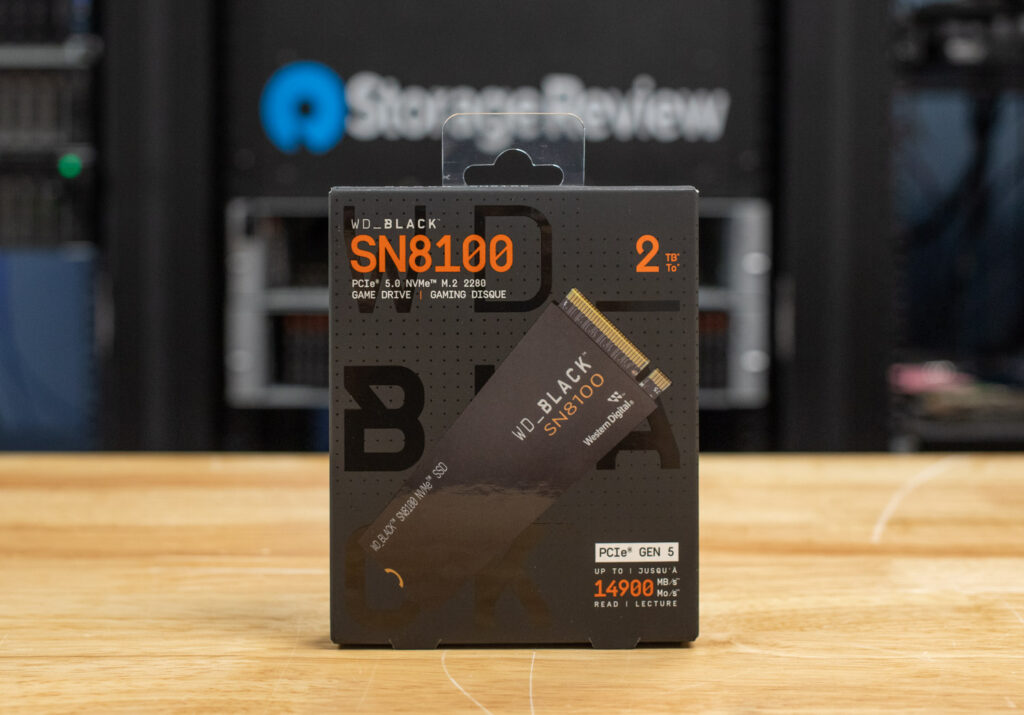
The Sandisk WD\_BLACK SN8100 is the company’s newest flagship Gen5 SSD, built to push performance in modern desktops and workstations. It targets power users who need fast, reliable storage for demanding tasks like 8K editing, large game installs, and complex project workloads. With capacities up to 4TB available now and an 8TB model expected later this year, the SN8100 is their highest-performing consumer drive yet.
*Editor’s Note:*
*Before we get too far, we recognize that the title of this review and the product’s branding may be confusing. WD has recently spun out the flash business, which is called Sandisk now (again?). The SN8100 was started as a WD product, then transitioned to Sandisk as the split took place. The WD\_Black branding has historically been WD’s premium offering, targeted to gamers and enthusiasts. Until Sandisk launches new products under its own flag, expect brand confusion as the dust settles. Ideally, Sandisk will abandon WD references and return to a more well-understood family and product names like “Extreme” and “Extreme Pro.” – Brian Beeler*
### **Sandisk WD\_BLACK SN8100 Features and Performance Profile**
BiCS8 TLC 3D CBA NAND powers the new drive and features onboard DRAM to help with metadata caching and sustained performance over long sessions. Sandisk also includes its nCache 4.0 SLC caching layer to boost short-term write speeds. The Sandisk-tuned Silicon Motion SM2508 controller under the hood is the clear differentiator. Built on a 6nm process, this quad-core ARM Cortex R8 chip supports eight NAND channels at up to 3,600 MT/s each, giving it serious throughput potential.
The controller features smart clock-gating, which helps cut power use by dynamically shutting off unused parts of the chip in real time. It also supports advanced ECC through Silicon Motion’s NANDXtend technology, helping to preserve data integrity and endurance even under heavy workloads. On the interface side, the SN8100 runs on PCIe Gen5 x4 with NVMe 2.0 support, while remaining backward compatible.
![Sandisk WD\_BLACK SN8100 bare drive controller]()
As for the specifics of its performance profile, Sandisk claims the SN8100 can hit sequential read speeds of up to 14.9GB/s across all capacities. For writes, the 2TB and 4TB models are rated at up to 14GB/s, while the 1TB version tops at 11GB/s.
On the random side, the 2TB and 4TB drives are listed at up to 2.3 million IOPS for reads and 2.4 million IOPS for writes. The 1TB version brings that read figure down to 1.6 million IOPS but still holds the same write performance.
These specs place the SN8100 firmly in the top tier of PCIe Gen5 SSDs, making it one of the fastest consumer drives announced. That said, we’ll put it through some heavy benchmarking, including sustained performance and consistency under load, to test it in our benchmarks to see how well it delivers beyond the spec sheet.
![Sandisk WD\_BLACK SN8100 drive label]()
All models comply with TCG Opal 2.02, a widely adopted storage security specification that enables hardware-based encryption and policy management. TCG Opal allows integration into software ecosystems that manage secure boot, drive locking, and data erasure routines.
The 2TB and 4TB drives are rated 6.5W during active reads and 7.0W for writes. The 1TB version uses slightly less, with 6.2W for both operations. Idle power consumption is rated at 5mW. Sanfisk indicates this efficiency is a significant improvement over previous Gen4 drives, especially under load, which should translate to less strain on system cooling.
## **Sandisk WD\_BLACK SN8100 Reliability**
The SN8100 also comes in a version with a pre-installed heatsink, which uses anodized aluminum and dual thermal interface pads to help manage heat passively. Its low-profile design makes it easy to fit into tighter builds and doesn’t need extra power cables or active cooling. WD also included customizable RGB lighting, allowing users to match the drive’s appearance with the rest of their build.
![Sandisk WD\_BLACK SN8100 back]()
The ratings for endurance are in line with those of other high-end TLC-based drives. The 4TB model is rated for up to 2,400TBW, the 2TB at 1,200TBW, and the 1TB at 600TBW. All capacities come with a five-year limited warranty and an MTTF of 1.75 million hours.
## **Drive Management**
SSD management occurs through the [SanDisk Dashboard](https://support-en.sandisk.com/app/products/downloads/softwaredownloads), a streamlined utility with a clean layout that gives users access to key diagnostic and monitoring features. It lets you check drive health, track performance, monitor temperature, and confirm interface status at a glance. The tool also supports firmware updates and, for drives like the SN8100, includes options for customizing RGB lighting if your model supports it.
The main overview screen is organized into clear panels. At the top, you’ll see the drive’s name, capacity (in this case, the WD\_BLACK SN8100 2TB), and the current firmware version. It shows overall drive health as a percentage, live temperature readings, and a detailed capacity breakdown (available, used, and unallocated). You’ll also find real-time reporting on the interface speed. At the bottom, a performance graph updates with read/write speeds and queue data every few seconds, although it’s idle in this screenshot.
![SanDisk SSD Management Tool]()
One particularly useful section is the Interface Speed panel. Here, the software displays both the capability of the SSD (in this case, “Gen5, 4 lanes”) and its actual connection (also “Gen5, 4 lanes”). This is especially helpful because not all M.2 slots on a motherboard run at full x4 speeds, even if they support Gen5. Having both values shown side by side gives you a quick way to confirm whether your drive is running at its full potential or is bottlenecked by the slot.
## **Sandisk WD\_BLACK SN8100 Specifications**
The SanDisk WD\_BLACK SN8100 NVMe SSD is available now at SanDisk.com and select global retailers in 1TB ($179.99), 2TB ($279.99), and 4TB ($549.99) capacities. Heatsink versions will arrive this fall, starting at $199.99 for 1TB. An 8TB model, with and without heatsink, is expected later this year.
| **Product Specifications** | **4TB
WDS400T1XHM-00CMT0** | **2TB
WDS200T1XHM-00CMT0** | **1TB
WDS100T1XHM-00CMT0** |
| --- | --- | --- | --- |
| **Form Factor** | M.2 2280 | | |
| **Interface** | PCIe Gen5 x4 NVMe 2.0 | | |
| **NAND** | TLC 3D CBA NAND | | |
| **DRAM** | Yes | | |
| **Sequential Read (up to)** | 14,900 MB/s | 14,900 MB/s | 14,900 MB/s |
| **Sequential Write (up to)** | 14,000 MB/s | 14,000 MB/s | 11,000 MB/s |
| **Random Read (up to)** | 2.3M IOPS | 2.3M IOPS | 1.6M IOPS |
| **Random Write (up to)** | 2.4M IOPS | 2.4M IOPS | 2.4M IOPS |
| **Average Active Power Read** | 6.5W | 6.5W | 6.2W |
| **Average Active Power Write** | 7.0W | 7.0W | 6.2W |
| **Sleep (PS4)** | 5 mW | | |
| **Endurance (TBW)** | 2,400 | 1,200 | 600 |
| **MTTF (up to)** | 1.75 million hours | | |
| **Limited Warranty** | 5 years | | |
| **Compatibility** | Backward compatible with PCIe Gen4/Gen3 x4, x2, x1; Windows 10+ | | |
| **RoHS Compliance** | Yes | | |
| **Security** | TCG Opal 2.02 | | |
| **Operating Temperature** | 32°F to 185°F (0°C to 85°C) | | |
| **Non-Operating Temperature** | -40°F to 185°F (-40°C to 85°C) | | |
| **Dimensions** | Length: 80mm, Width: 25mm, Height: 11.25mm | | |
| **Weight** | 31.2g | | |
## **SN8100 Performance**
### Comparables
Before diving into the benchmarks, here’s a list of comparable drives tested alongside the SN8100 and their respective PCIe generation:
- [Crucial P310](https://www.storagereview.com/review/crucial-p310-2tb-review-budget-friendly-nvme-ssd-with-heatsink) (PCIe Gen4)
- [Crucial T705](https://www.storagereview.com/review/crucial-t705-review) (PCIe Gen5)
- [Crucial P510](https://www.storagereview.com/review/crucial-p510-review-gen5-performance-at-a-gen4-price) (PCIe Gen5)
- [Samsung 9100 Pro 4TB](https://www.storagereview.com/review/samsung-9100-pro-ssd-review-gen5-speed-for-power-users) (PCIe Gen5)
- [Samsung 990 Pro](https://www.storagereview.com/review/samsung-990-pro-4tb-ssd-review) (PCIe Gen4)
- [WD SN850X](https://www.storagereview.com/review/wd-black-sn850x-ssd-review) (PCIe Gen4)
For this review, we’ll focus on the **2TB** model of the WD\_BLACK SN8100.
We’ll put these drives through various tests to evaluate real-world and synthetic performance. This includes LLM load times to measure how quickly they handle large AI models, DirectStorage tests to see how fast they load game assets and process in-game data, and Blackmagic Design to assess read and write speeds for high-resolution video editing. We’ll also run PCMark 10 to gauge overall system responsiveness, 3DMark Storage to test gaming performance, and FIO tests to measure peak sequential and random read/write speeds under heavy workloads.
Here’s the high-performance test rig we used for benchmarking:
- CPU: [AMD Ryzen 7 9800X3D](https://www.storagereview.com/review/amd-ryzen-7-9800x3d-review)
- Motherboard: Asus ROG Crosshair X870E Hero
- RAM: G.SKILL Trident Z5 Royal Series DDR5-6000 (2x16GB)
- GPU: [NVIDIA GeForce RTX 4090](https://www.storagereview.com/review/nvidia-rtx-4090-vs-rtx-6000-ada-can-a-gaming-gpu-compete-with-a-workstation-powerhouse)
- OS: Windows 11 Pro, Ubuntu 24.10 Desktop
### **Peak Synthetic Performance**
The FIO test is a flexible and powerful benchmarking tool used to measure the performance of storage devices, including SSDs and HDDs. It evaluates metrics such as bandwidth, IOPS (Input/Output Operations Per Second), and latency under different workloads, like sequential and random read/write operations. This test helps to assess the peak performance of storage systems, making it useful for comparing different devices or configurations. We measured the peak burst performance for this test, limiting the workload to a 10GB footprint on both SSDs.
In the FIO burst test, the SN8100 delivers exceptional peak performance across all workloads. It tops the chart in sequential throughput, hitting 15GB/s for reads and 14.1GB/s for writes, edging out even the Crucial T705 and Samsung 9100 Pro. Latency is equally impressive, averaging just 0.56ms for reads and 0.59ms for writes.
For 4K random operations, the SN8100 sustains 2.312M IOPS for reads and 2.144M IOPS for writes, with average latencies of 0.22 ms and 0.24 ms, respectively. These figures place it among the fastest drives tested, trailing only the 9100 Pro in read IOPS while offering a competitive write and latency profile.
| **FIO Test (higher MB/s/IOPS is better)** | **Sandisk SN8100
** | **Crucial P310 2TB** | **Crucial P510 1TB** | **Crucial T705 2TB** | **Samsung 990 Pro 2TB** | **Samsung 9100 Pro 4TB** | **WD SN850X 2TB** |
| --- | --- | --- | --- | --- | --- | --- | --- |
| **Sequential 128K Read (2T/64Q)** | 15,000 MB/s (0.56ms avg latency) | 7,197 MB/s (1.16ms avg latency) | 8,835 MiB/s (0.90 ms avg latency) | 14,400 MB/s (0.58ms avg latency) | 7,483 MB/s (1.12ms avg latency) | 14,600 MB/s (0.57ms avg latency) | 6,632 MB/s (0.76ms avg latency) |
| **Sequential 128K Write (2T/64Q)** | 14,100 MB/s (0.59ms avg latency) | 6,376 MB/s (1.31ms avg latency) | 9,961 MiB/s (0.80 ms avg latency) | 12,300 MB/s (0.68ms avg latency) | 7,197 MB/s (1.16ms avg latency) | 13,300 MB/s (0.63ms avg latency) | 7,235 MB/s (0.92ms avg latency) |
| **Random 4K Read (16T/32Q)** | 2.312M IOPS (0.22ms avg latency) | 1.163M IOPS (0.80ms avg latency) | 1.163M IOPS (0.44ms avg latency) | 1.585M IOPS (0.32ms avg latency) | 1.400M IOPS (0.36ms avg latency) | 2.734M IOPS (0.18ms avg latency) | 1.2M IOPS (0.43ms avg latency) |
| **Random 4K Write (16T/32Q)** | 2.144M IOPS (0.24ms avg latency) | 1.196M IOPS (0.43ms avg latency) | 1.196M IOPS (0.51ms avg latency) | 2.703M IOPS (0.19ms avg latency) | 1.403M IOPS (0.36ms avg latency) | 2.734M IOPS (0.19ms avg latency) | 825K IOPS (0.62ms avg latency) |
### **Average LLM Load Time**
The Average LLM Load Time test evaluated the load times of three different LLMs: DeepSeek R1 7B, Meta Llama 3.2 11B, and DeepSeek R1 32B. Each model was tested 10 times, and the average load time was calculated. This test measures how quickly the drive can load large language models (LLMs) into memory. LLM load times are critical for AI-related tasks, especially for real-time inference and large dataset processing. Faster loading means the model can quickly process data, improving AI responsiveness and reducing waiting time.
In the Average LLM Load Time test, the SN8100 ranks near the top across all model loads. It completes the DeepSeek R1 7B load in just 2.5702 seconds, outperforming every other drive in the comparison, including the previous fastest, Samsung 9100 Pro (2.6173s). For the more demanding Meta Llama 3.2 11B Vision model, it records 3.5856 seconds, placing it just behind the 9100 Pro (3.6017s) and slightly faster than the T705 (3.6312s) and 990 Pro (3.6312s).
Its advantage is most noticeable with the DeepSeek R1 32B model, which posted a load time of 4.2870 seconds. The second-place 9100 Pro posted a time of 4.3735 seconds, finishing well ahead of the other consumer drives in the lineup, including the P510 (5.0594s) and T705 (5.1080s).
| **Average LLM Load Time (lower is better)** | **Sandisk SN8100** | **Crucial P310 2TB** | **Crucial P510 1TB** | **Crucial T705 2TB** | **Samsung 990 Pro 2TB** | **Samsung 9100 Pro 4TB** | **WD SN850X 2TB** |
| --- | --- | --- | --- | --- | --- | --- | --- |
| **DeepSeek R1 7B** | 2.5702s | 3.1889s | 2.8817s | 2.8758s | 2.8758s | 2.6173s | 3.0082s |
| **Meta Llama 3.2 11B Vision** | 3.5856s | 3.7083s | 3.6631s | 3.6312s | 3.6312s | 3.6017s | 3.6543s |
| **DeepSeek R1 32B** | 4.2870s | 5.4844s | 5.0594s | 5.1080s | 5.1080s | 4.3735s | 5.4844s |
### **3DMark Direct Storage**
The 3DMark DirectStorage Feature Test evaluates how Microsoft’s DirectStorage optimizes game asset loading on PCIe SSDs. By reducing CPU overhead and improving data transfer speeds, DirectStorage enhances loading times, especially when paired with GDeflate compression and Windows 11’s BypassIO. This test isolates storage performance to highlight the potential bandwidth improvements when DirectStorage is enabled.
Looking at the results for this test, the SN8100 leads in nearly every DirectStorage metric. Starting with Storage to VRAM (GDeflate Compression), it showed a bandwidth of 26.11 GB/s, outperforming all other tested drives, including the high-end Crucial T705 (25.75 GB/s) and Samsung 9100 Pro (23.77 GB/s).
For uncompressed Storage to VRAM, the SN8100 delivers 12.94 GB/s with DirectStorage enabled (the best tested SSDs) and 7.63 GB/s with DirectStorage off. Its Storage to RAM speeds are equally good at 12.94 GB/s (DS on) and 9.78 GB/s (DS off), the highest among all entries.
The SN8100 also posts a strong GDeflate decompression bandwidth of 64.51 GB/s. Though this is lower than the rest of the tested consumer SSDs, it’s still a solid result.
| **3DMark Direct Storage, (GB/s, higher is better)** | **Sandisk SN8100** | **Crucial P310 2TB** | **Crucial P510 1TB** | **Crucial T705 2TB** | **Samsung 990 Pro 2TB** | **Samsung 9100 Pro 4TB** | **WD SN850X 2TB** |
| --- | --- | --- | --- | --- | --- | --- | --- |
| **Storage to VRAM (GDeflate Compression)** | 26.11 | 14.81 | 19.63 | 25.75 | 14.18 | 23.77 | 15.28 |
| **Storage to VRAM (DirectStorage on, Uncompressed)** | 12.94 | 10.75 | 8.33 | 10.71 | 11.28 | 11.26 | 11.11 |
| **Storage to VRAM (DirectStorage off, Uncompressed)** | 7.63 | 8.5 | 6.92 | 8.79 | 8.84 | 8.92 | 8.93 |
| **Storage to RAM (DirectStorage on, Uncompressed)** | 12.94 | 6.46 | 9.06 | 12.03 | 6.57 | 11.62 | 6.78 |
| **Storage to RAM (DirectStorage off, Uncompressed)** | 9.78 | 5.87 | 7.49 | 8.83 | 6.20 | 9.48 | 6.27 |
| **GDeflate Decompression Bandwidth** | 64.51 | 65.43 | 66.22 | 66.36 | 65.71 | 66.61 | 64.96 |
### **Blackmagic Disk Speed Test**
The Blackmagic Disk Speed Test benchmarks a drive’s read and write speeds, estimating its performance, especially for video editing tasks. It helps users ensure their storage is fast enough for high-resolution content, like 4K or 8K video.
Here, the WD SN8100 posts the fastest overall results with 10,005.2MB/s read and 10,581MB/s write. It edges out other Gen5 competitors like the Crucial T705 (8,464.2MB/s read, 10,256.4MB/s write), Samsung 9100 Pro (9,542.3MB/s read, 9,907.9MB/s write), and Crucial P510 (7,853.9MB/s read, 7,939.6MB/s write).
![WF sn8100 2tb blackmagic]()
Among the Gen4 drives, the Samsung 990 Pro, WD SN850X, and Crucial P310 trail behind, with read speeds in the 5,200–5,800MB/s range and write speeds hovering just under 6,000 MB/s. These results are an excellent example of the generational performance leap offered by PCIe Gen5 technology.
| **Blackmagicdesign (MB/s, higher is better)** | **Sandisk SN8100** | **Crucial P310 2TB** | **Crucial P510 1TB** | **Crucial T705 2TB** | **Samsung 990 Pro 2TB** | **Samsung 9100 Pro 4TB** | **WD SN850X 2TB** |
| --- | --- | --- | --- | --- | --- | --- | --- |
| **Read MB/s** | 10,005.2 | 5,282.4 | 7,853.9 | 8,464.2 | 5,769.5 | 9,542.3 | 5,862.6 |
| **Write MB/s** | 10,581 | 5,458.9 | 7,939.6 | 10,256.4 | 5,842.9 | 9,907.9 | 5,894.8 |
### **PCMark10 Storage**
PCMark 10 Storage Benchmarks evaluate real-world storage performance using application-based traces. They test system and data drives, measuring bandwidth, access times, and consistency under load. These benchmarks provide practical insights beyond synthetic tests, helping users compare modern storage solutions effectively.
Results show that the SN8100 scored 8,644**,** among the leaders in this test. It lands just behind the Crucial T705 (8,783), but ahead of the Samsung 9100 Pro (7,552) and Samsung 990 Pro (7,173). It also significantly outperforms the other Gen4 drives: Crucial P510 (6,450), P310 (6,436), and WD SN850X (4,988).
| **PCMark 10 Data Drive (higher is better)** | **Sandisk SN8100** | **Crucial P310 2TB** | **Crucial P510 1TB** | **Crucial T705 2TB** | **Samsung 990 Pro 2TB** | **Samsung 9100 Pro 4TB** | **WD SN850X 2TB** |
| --- | --- | --- | --- | --- | --- | --- | --- |
| **Overall Score** | 8,644 | 6,436 | 6,450 | 8,783 | 7,173 | 7,552 | 4,988 |
### **3DMark Storage**
The 3DMark Storage Benchmark tests your SSD’s gaming performance by measuring tasks like loading games, saving progress, installing game files, and recording gameplay. It evaluates how well your storage handles real-world gaming activities and supports the latest storage technologies for accurate performance insights.
Here, the SN8100 scores **6,047**, placing it at the top of the leaderboard with a nice lead. It outpaces all other tested Gen5 drives, including the Crucial T705 (5,100), Samsung 9100 Pro (4,779), and Crucial P510 (4,148), as well as every Gen4 model. This makes the WD SN8100 likely an impressive performer for gaming responsiveness and other real-world tasks.
| **3DMark Storage benchmark (higher is better)** | **Sandisk SN8100** | **Crucial P310 2TB** | **Crucial P510 1TB** | **Crucial T705 2TB** | **Samsung 990 Pro 2TB** | **Samsung 9100 Pro 4TB** | **WD SN850X 2TB** |
| --- | --- | --- | --- | --- | --- | --- | --- |
| **Overall Score** | 6,047 | 3,848 | 4,148 | 5,100 | 4,128 | 4,779 | 3,962 |
### **GPU Direct Storage**
One of the tests we conducted on this testbench was the Magnum IO GPU Direct Storage (GDS) test. GDS is a feature developed by NVIDIA that allows GPUs to bypass the CPU when accessing data stored on NVMe drives or other high-speed storage devices. Instead of routing data through the CPU and system memory, GDS enables direct communication between the GPU and the storage device, significantly reducing latency and improving data throughput.
**How GPU Direct Storage Works**
Traditionally, when a GPU processes data stored on an NVMe drive, the data must first travel through the CPU and system memory before reaching the GPU. This process introduces bottlenecks, as the CPU becomes a middleman, adding latency and consuming valuable system resources. GPU Direct Storage eliminates this inefficiency by enabling the GPU to access data directly from the storage device via the PCIe bus. This direct path reduces the overhead associated with data movement, allowing faster and more efficient data transfers.
AI workloads, especially those involving deep learning, are highly data-intensive. Training large neural networks requires processing terabytes of data, and any delay in data transfer can lead to underutilized GPUs and longer training times. GPU Direct Storage addresses this challenge by ensuring that data is delivered to the GPU as quickly as possible, minimizing idle time and maximizing computational efficiency.
In addition, GDS is particularly beneficial for workloads that involve streaming large datasets, such as video processing, natural language processing, or real-time inference. By reducing the reliance on the CPU, GDS accelerates data movement and frees up CPU resources for other tasks, further enhancing overall system performance.
Among the lineup of tested SSDs, the SN8100 delivers great performance, particularly at larger block sizes. At the 16K block size and a 128 queue depth, it achieves 3.4 GiB/s read (0.564ms, 225.9K IOPS) and 2.1 GiB/s write (0.907ms, 140.6K IOPS). This places it near the top for read throughput at this block size and ahead of many Gen5 competitors, though its write performance lags slightly.
As block sizes increase, the SN8100 continues to impress. At 128K, it reaches 5.9 GiB/s reads (2.626ms, 48.7K IOPS) and 5.8 GiB/s writes (2.668ms, 47.9K IOPS), outpacing nearly all other drives in both throughput and latency, including the Samsung 9100 Pro and Crucial T705.
At the 1M block size, the SN8100 posts a strong 6.5 GiB/s read (19.264ms, 6.6K IOPS) and 5.9 GiB/s write (21.063ms, 6.1K IOPS), placing it slightly ahead of the 9100 Pro and T705 in write performance and matching their read efficiency.
Overall, the SN8100 is one of the most well-rounded Gen5 drives for GDS tasks among the tested drives, consistently ranking near the top across all tested block sizes.
Here’s a full run-down:
| **GDSIO Chart (16K,128K,1M Block Size Averages)** | **Sandisk SN8100** | **Crucial P310 2TB** | **Crucial P510 1TB** | **Crucial T705 2TB** | **Samsung 990 Pro 2TB** | **Samsung 9100 Pro 4TB** | **WD SN850X 2TB** |
| --- | --- | --- | --- | --- | --- | --- | --- |
| (16K Block Size 128 IO Depth) Average Read | 3.4 GiB/s
(0.564ms) IOPS: 225.9K | 3.1 GiB/s (0.627ms) IOPS: 203.2K | 2.3 GiB/s (0.837ms) IOPS: 152.2K | 3.3 GiB/s (0.587ms) IOPS: 217.0K | 2.7 GiB/s (0.731ms) IOPS: 174.4K | 3.4 GiB/s (0.565ms) IOPS: 226.4K | 2.3 GiB/s (0.736ms) IOPS: 173.2K |
| (16K Block Size 128 IO Depth) Average Write | 2.1 GiB/s
(0.907ms) IOPS: 140.6K | 2.2 GiB/s (0.902ms) IOPS: 141.4K | 2.3 GiB/s (0.842ms) IOPS: 151.5K | 2.3 GiB/s (0.836ms) IOPS: 152.6K | 2.2 GiB/s (0.903ms) IOPS: 141.2K | 2.3 GiB/s (0.839ms) IOPS: 161.7K | 2.0 GiB/s (0.989ms) IOPS: 129.0K |
| (128K Block Size 128 IO Depth) Average Read | 5.9GiB/s
(2.626ms) IOPS: 48.7K | 4.1 GiB/s (3.845ms) IOPS: 33.3K | 4.5 GiB/s (3.450ms) IOPS: 37.1K | 5.5 GiB/s (2.863ms) IOPS: 44.7K | 4.0 GiB/s (3.944ms) IOPS: 32.4K | 5.2 GiB/s (3.001ms) IOPS: 44.9K | 4.1 GiB/s (3.878ms) IOPS: 33.3K |
| (128K Block Size 128 IO Depth) Average Write | 5.8GiB/s
(2.668ms)
IOPS: 47.9K | 3.9 GiB/s (3.992ms) IOPS: 32.0K | 4.8 GiB/s (3.262ms) IOPS: 39.2K | 5.6 GiB/s (2.799ms) IOPS: 45.7K | 4.1 GiB/s (3.849ms) IOPS: 33.2K | 5.9 GiB/s (2.662ms) IOPS: 47.3K | 4.0 GiB/s (3.958ms) IOPS: 33.0K |
| (1M Block Size 128 IO Depth) Average Read | 6.5GiB/s
(19.264ms)
IOPS: 6.6K | 4.4 GiB/s (28.462ms) IOPS: 4.5K | 4.8 GiB/s (26.2181ms) IOPS: 4.9K | 6.0 GiB/s (20.738ms) IOPS: 6.2K | 3.9 GiB/s (32.415ms) IOPS: 3.9K | 6.3 GiB/s (19.877ms) IOPS: 6.4K | 4.4 GiB/s (30.501ms) IOPS: 4.5K |
| (1M Block Size 128 IO Depth) Average Write | 5.9GiB/s
(21.063ms) IOPS: 6.1K | 4.1 GiB/s (30.964ms) IOPS: 4.2K | 5.0 GiB/s (25.121ms) IOPS: 5.1K | 6.0 GiB/s (20.855ms) IOPS: 6.1K | 4.2 GiB/s (29.520ms) IOPS: 4.3K | 6.1 GiB/s (20.579ms) IOPS: 6.2K | 4.1 GiB/s (30.782ms) IOPS: 4.2K |
## Conclusion
The Sandisk WD\_BLACK SN8100 delivers precisely what you’d expect from a flagship Gen5 SSD. It’s extremely fast, consistent, and outperforms its competition in most of our benchmarking. Coupling all this with solid endurance ratings, hardware encryption support, and a five-year warranty, it covers almost everything most power users expect from a high-end SSD.
![Sandisk WD\_BLACK SN8100 with system board]()
Performance-wise, the SN8100 showed impressive results in nearly every test. It led the pack in sequential read and write speeds, posted some of the best 4K random IOPS numbers, and performed exceptionally well in real-world scenarios like large language model loading, DirectStorage game asset transfers, and GPU Direct Storage workloads. It consistently landed at or near the top in synthetic and application-based benchmarks.
For anyone running a Gen5-supported system, the SN8100 is an excellent addition to your rig. It brings significant performance gains over Gen4 drives and is perfect for tasks that demand speed and reliability, such as gaming, editing high-resolution media, or running AI models. As one of the fastest consumer SSDs on the market, with an excellent software tool and aggressive pricing, it’s an easy pick for a Best Of 2025 award!
![]()
**Engage with StorageReview**
[Newsletter](https://www.storagereview.com/storage_newsletter) | [YouTube](https://www.youtube.com/user/StorageReview "Opens in a new window") | Podcast [iTunes](https://podcasts.apple.com/gb/podcast/storagereview-com-storage-reviews/id1060681115 "Opens in a new window")/ [Spotify](https://open.spotify.com/show/1y6VnznABhHeOSMOmbDTz0 "Opens in a new window") | [Instagram](https://www.instagram.com/storagereview/ "Opens in a new window") | [Twitter](https://twitter.com/storagereview "Opens in a new window") | [TikTok](https://www.tiktok.com/@storagereview? "Opens in a new window") | [RSS Feed](https://www.storagereview.com/rss.xml)
![]()
### Lyle Smith
Lyle is a writer for StorageReview, covering a broad set of end user and enterprise IT topics.
Previous post: [Lexar Professional Workflow Review: A Modular Approach to Creative Storage](https://www.storagereview.com/review/lexar-professional-workflow-review-a-modular-approach-to-creative-storage)
Next post: [From VMware to Proxmox VE: A Step-by-Step Escape Plan](https://www.storagereview.com/review/esxi-to-pve)
Trusted Vendors
Products and solutions from our affiliate partners:
- [

Ubiquiti](https://store.ui.com/us/en?a_aid=StorageReview "Opens in a new window")
- [

Newegg](https://click.linksynergy.com/fs-bin/click?id=g5terNMDhz0&offerid=1207190.18&subid=0&type=4 "Opens in a new window")
- [
 Amazon](https://amzn.to/4fLJUEW "Opens in a new window")
Newsletter
Subscribe to the StorageReview newsletter to stay up to date on the latest news and reviews. We promise no spam!
1
Leave this field empty if you’re human:
## Advertisement
Content Categories
[Facebook](https://www.facebook.com/@storagereview) [X](https://twitter.com/storagereview) [Instagram](https://www.instagram.com/storagereview/) [LinkedIn](https://www.linkedin.com/company/storagereview-com) [YouTube](https://www.youtube.com/user/storagereview?sub_confirmation=1) [Email](mailto:info@storagereview.com) [Spotify](https://open.spotify.com/show/1y6VnznABhHeOSMOmbDTz0) [Reddit](https://www.reddit.com/r/StorageReview/) [Discord](https://discord.gg/TwMHb4azdC) [RSS](https://www.storagereview.com/rss.xml) [TikTok](https://www.tiktok.com/@storagereview)
Copyright © 1998-2025 Flying Pig Ventures, LLC Cincinnati, Ohio. All rights reserved.
Manage your privacy
To provide the best experiences, we and our partners use technologies like cookies to store and/or access device information. Consenting to these technologies will allow us and our partners to process personal data such as browsing behavior or unique IDs on this site and show (non-) personalized ads. Not consenting or withdrawing consent, may adversely affect certain features and functions.
Click below to consent to the above or make granular choices. Your choices will be applied to this site only. You can change your settings at any time, including withdrawing your consent, by using the toggles on the Cookie Policy, or by clicking on the manage consent button at the bottom of the screen.
Functional Functional Always active
The technical storage or access is strictly necessary for the legitimate purpose of enabling the use of a specific service explicitly requested by the subscriber or user, or for the sole purpose of carrying out the transmission of a communication over an electronic communications network.
Preferences Preferences
The technical storage or access is necessary for the legitimate purpose of storing preferences that are not requested by the subscriber or user.
Statistics Statistics
The technical storage or access that is used exclusively for statistical purposes. The technical storage or access that is used exclusively for anonymous statistical purposes. Without a subpoena, voluntary compliance on the part of your Internet Service Provider, or additional records from a third party, information stored or retrieved for this purpose alone cannot usually be used to identify you.
Marketing Marketing
The technical storage or access is required to create user profiles to send advertising, or to track the user on a website or across several websites for similar marketing purposes.
Statistics
Marketing
Features
Always active
Always active
- Manage options
- Manage services
- Manage {vendor\_count} vendors
- [Read more about these purposes](https://cookiedatabase.org/tcf/purposes/)
Accept Deny Manage options Save preferences Manage options
- {title}
- {title}
- {title}
Manage your privacy
To provide the best experiences, we use technologies like cookies to store and/or access device information. Consenting to these technologies will allow us to process data such as browsing behavior or unique IDs on this site. Not consenting or withdrawing consent, may adversely affect certain features and functions.
Functional Functional Always active
The technical storage or access is strictly necessary for the legitimate purpose of enabling the use of a specific service explicitly requested by the subscriber or user, or for the sole purpose of carrying out the transmission of a communication over an electronic communications network.
Preferences Preferences
The technical storage or access is necessary for the legitimate purpose of storing preferences that are not requested by the subscriber or user.
Statistics Statistics
The technical storage or access that is used exclusively for statistical purposes. The technical storage or access that is used exclusively for anonymous statistical purposes. Without a subpoena, voluntary compliance on the part of your Internet Service Provider, or additional records from a third party, information stored or retrieved for this purpose alone cannot usually be used to identify you.
Marketing Marketing
The technical storage or access is required to create user profiles to send advertising, or to track the user on a website or across several websites for similar marketing purposes.
Statistics
Marketing
Features
Always active
Always active
- Manage options
- Manage services
- Manage {vendor\_count} vendors
- [Read more about these purposes](https://cookiedatabase.org/tcf/purposes/)
Accept Deny Manage options Save preferences Manage options
- {title}
- {title}
- {title}
Manage consent Manage consent
```json
{"@context":"https:\/\/schema.org","@graph":[{"@type":"WebPage","@id":"https:\/\/www.storagereview.com\/review\/sandisk-wd_black-sn8100-review-elite-performance-in-a-gen5-ssd","url":"https:\/\/www.storagereview.com\/review\/sandisk-wd_black-sn8100-review-elite-performance-in-a-gen5-ssd","name":"SanDisk WD_BLACK SN8100 Review: Elite Performance in a Gen5 SSD - StorageReview.com","isPartOf":{"@id":"https:\/\/www.storagereview.com\/#website"},"primaryImageOfPage":{"@id":"https:\/\/www.storagereview.com\/review\/sandisk-wd_black-sn8100-review-elite-performance-in-a-gen5-ssd#primaryimage"},"image":{"@id":"https:\/\/www.storagereview.com\/review\/sandisk-wd_black-sn8100-review-elite-performance-in-a-gen5-ssd#primaryimage"},"thumbnailUrl":"https:\/\/www.storagereview.com\/wp-content\/uploads\/2025\/05\/StorageReview-SanDisk-WD_Black-SN8100-5.jpg","datePublished":"2025-05-13T12:00:15+00:00","dateModified":"2025-05-27T18:42:31+00:00","description":"SanDisk’s WD_BLACK SN8100 is blazing fast. We tested it against top Gen5 SSDs—and it might just be our new favorite consumer drive.","breadcrumb":{"@id":"https:\/\/www.storagereview.com\/review\/sandisk-wd_black-sn8100-review-elite-performance-in-a-gen5-ssd#breadcrumb"},"inLanguage":"en-US","potentialAction":[{"@type":"ReadAction","target":["https:\/\/www.storagereview.com\/review\/sandisk-wd_black-sn8100-review-elite-performance-in-a-gen5-ssd"]}]},{"@type":"ImageObject","inLanguage":"en-US","@id":"https:\/\/www.storagereview.com\/review\/sandisk-wd_black-sn8100-review-elite-performance-in-a-gen5-ssd#primaryimage","url":"https:\/\/www.storagereview.com\/wp-content\/uploads\/2025\/05\/StorageReview-SanDisk-WD_Black-SN8100-5.jpg","contentUrl":"https:\/\/www.storagereview.com\/wp-content\/uploads\/2025\/05\/StorageReview-SanDisk-WD_Black-SN8100-5.jpg","width":1500,"height":1047},{"@type":"BreadcrumbList","@id":"https:\/\/www.storagereview.com\/review\/sandisk-wd_black-sn8100-review-elite-performance-in-a-gen5-ssd#breadcrumb","itemListElement":[{"@type":"ListItem","position":1,"name":"Home","item":"https:\/\/www.storagereview.com\/"},{"@type":"ListItem","position":2,"name":"Review","item":"https:\/\/www.storagereview.com\/review"},{"@type":"ListItem","position":3,"name":"SanDisk WD_BLACK SN8100 Review: Elite Performance in a Gen5 SSD"}]},{"@type":"WebSite","@id":"https:\/\/www.storagereview.com\/#website","url":"https:\/\/www.storagereview.com\/","name":"StorageReview.com","description":"StorageReview.com is a leading provider of news and reviews throughout the entire IT stack - from the datacenter to the edge, and all points in between.","publisher":{"@id":"https:\/\/www.storagereview.com\/#organization"},"potentialAction":[{"@type":"SearchAction","target":{"@type":"EntryPoint","urlTemplate":"https:\/\/www.storagereview.com\/?s={search_term_string}"},"query-input":{"@type":"PropertyValueSpecification","valueRequired":true,"valueName":"search_term_string"}}],"inLanguage":"en-US"},{"@type":"Organization","@id":"https:\/\/www.storagereview.com\/#organization","name":"StorageReview.com","url":"https:\/\/www.storagereview.com\/","logo":{"@type":"ImageObject","inLanguage":"en-US","@id":"https:\/\/www.storagereview.com\/#\/schema\/logo\/image\/","url":"https:\/\/www.storagereview.com\/wp-content\/uploads\/2020\/02\/Storage-Reviews-2-2.png","contentUrl":"https:\/\/www.storagereview.com\/wp-content\/uploads\/2020\/02\/Storage-Reviews-2-2.png","width":344,"height":61,"caption":"StorageReview.com"},"image":{"@id":"https:\/\/www.storagereview.com\/#\/schema\/logo\/image\/"},"sameAs":["https:\/\/x.com\/storagereview","http:\/\/youtube.com\/user\/storagereview"]}]}
```