

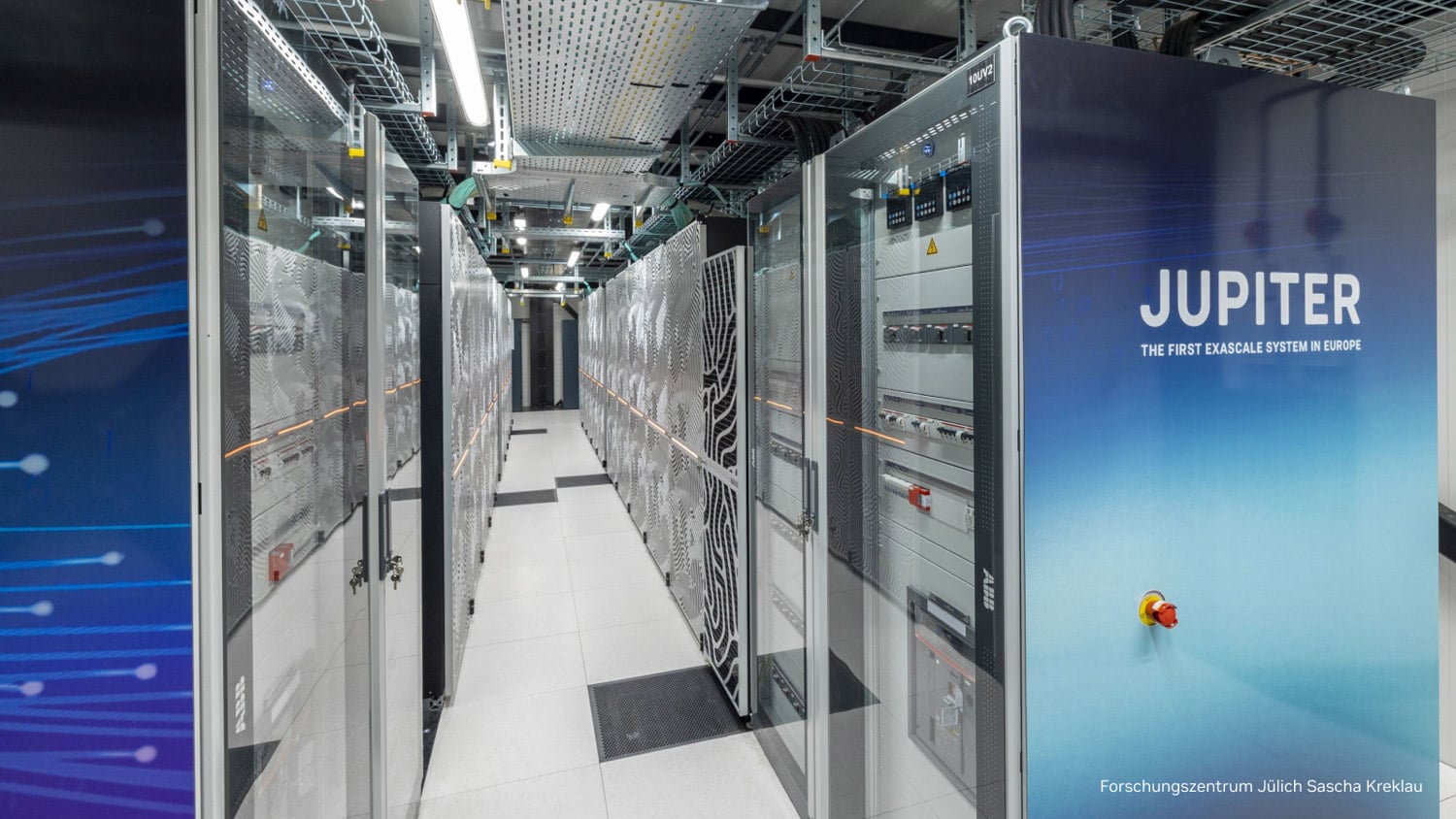
NVIDIA has run a 104-qubit simulation of a fault-tolerant quantum processor on 목성, Europe’s first exascale supercomputer at the Jülich Supercomputing Centre, using 8,192 GH200 GPUs. Announced ahead of GTC Berlin, the run models magic state cultivation, a method of producing the non-Clifford states a fault-tolerant computer consumes during logical operations, under realistic hardware noise. NVIDIA calls it the largest comprehensive simulation of a fault-tolerant quantum processor to date and says cultivation needs 90 percent fewer qubits than previous methods, a comparison the company does not spell out.
104-Qubit Fault-Tolerant Modeling Under Realistic Noise
Earlier Jülich work simulated 50 qubits under ideal, noiseless conditions, and this run keeps the noise in. The 104 physical qubits cover the data and auxiliary qubits across the whole protocol, which starts a magic state in a distance-3 color code, adds flag measurements to catch harmful faults, grows it into a distance-7 hybrid color and surface code, and finishes with further error-correction rounds and readout. The noise model goes beyond random bit and phase flips to coherent phase errors that can accumulate and interfere, and selected sites carry a third energy level so the simulation captures leakage out of the computational states.
The state is a full state vector, with no Clifford shortcuts for the non-Clifford operations that prepare the magic state. The encoded register comes to 45 bits, about 35.2 trillion complex amplitudes, which occupy 512 TiB of distributed GPU memory in double precision, or 64 GiB on each of the 8,192 GPUs, with room left for communication and analysis.
NVIDIA’s simulator reorders operations while preserving dependencies and measurement statistics, reuses storage as qubits are measured and released, and packs the three-level sites into binary storage, so five of them (243 basis states) fit in eight bits. In small cases, independent tensor-network calculations matched the state-vector results to about one part in 10 trillion.
Development on GB200 NVL72 and the cuQuantum Stack
A GB200 NVL72 system at the NVIDIA Accelerated Quantum Research Center served as the development platform. Researchers scaled tests from four GPUs to hundreds there, compared results against JUPITER, and studied how accuracy changed with more compute before committing the full 8,192-GPU allocation, which NVIDIA says cut a week-long simulation effort to days. The run uses cuQuantum’s cuStateVec library for the state-vector evolution, with cuBLASMp and cuSOLVERMp factoring selected partitions of the stored state so approximate methods can be checked against the full reference. The cultivation circuit is expressed through the fault-tolerant logical layer of CUDA-Q.
Kristel Michielsen, director of the Jülich Supercomputing Centre at the Forschungszentrum Jülich facility, said: “Europe’s investment in JUPITER gives researchers the ability to investigate questions that were previously beyond reach.” NVIDIA’s stated goal for the work is to connect the error propagation it observed to the quality and cost of logical operations, so hardware teams can weigh designs before fabricating them. No logical error rates, fidelities, or runtimes have been published for the run so far.


 아마존