

AMD has introduced the Ryzen AI Halo developer platform and previewed the next-generation Ryzen AI Max PRO 400 Series, extending its push into local AI development and commercial AI PCs. The announcement centers on higher local memory capacity, stronger on-device inference performance, and broader support for agentic AI workflows running directly on x86 client systems.

The current Ryzen AI Halo developer platform is built around the Ryzen AI Max+ 395 processor and is designed for developers to build and deploy local generative and agentic AI applications. AMD positions the platform as a way to reduce dependence on cloud infrastructure during testing, fine-tuning, and deployment, while also streamlining local AI development by supporting ROCm software and widely used AI frameworks and tools.
Pre-orders for the Ryzen AI Halo platform are scheduled to begin in June 2026, with pricing starting at $3,999. At the hardware level, the platform combines a 16-core, 32-thread Ryzen AI Max+ 395 processor with boost clocks up to 5.1GHz, 80MB of total cache, Radeon 8060S graphics with 40 compute units, and up to 128GB of unified memory. AMD also rates the integrated XDNA 2 NPU at 50 TOPS, targeting on-device inference and multi-step agent workloads that require more local capacity than mainstream AI PCs typically provide.
Ryzen AI Halo
| Model | Cores / Threads | Boost / Base Frequency | Total Cache | Graphics Model | cTDP | NPU TOPS | Graphics CUs | Unified Memory |
|---|---|---|---|---|---|---|---|---|
| AMD Ryzen AI Max+ 395 | 16C / 32T | Up to 5.1 GHz / 3.0 GHz | 80 MB | AMD Radeon 8060S Graphics | 45 – 120W | 50 | 40 Graphics CUs | Up to 128GB |
AMD also used the launch to announce the next Ryzen AI Halo platform, which will transition to the Ryzen AI Max PRO 400 Series in Q3 2026. That update increases the platform ceiling to 192GB of memory, with up to 160GB available as VRAM, and raises NPU throughput to up to 55 TOPS. The larger memory pool is one of the more significant changes, as it broadens the range of local models and multi-agent workflows that can run on a single client system without offloading to external infrastructure.
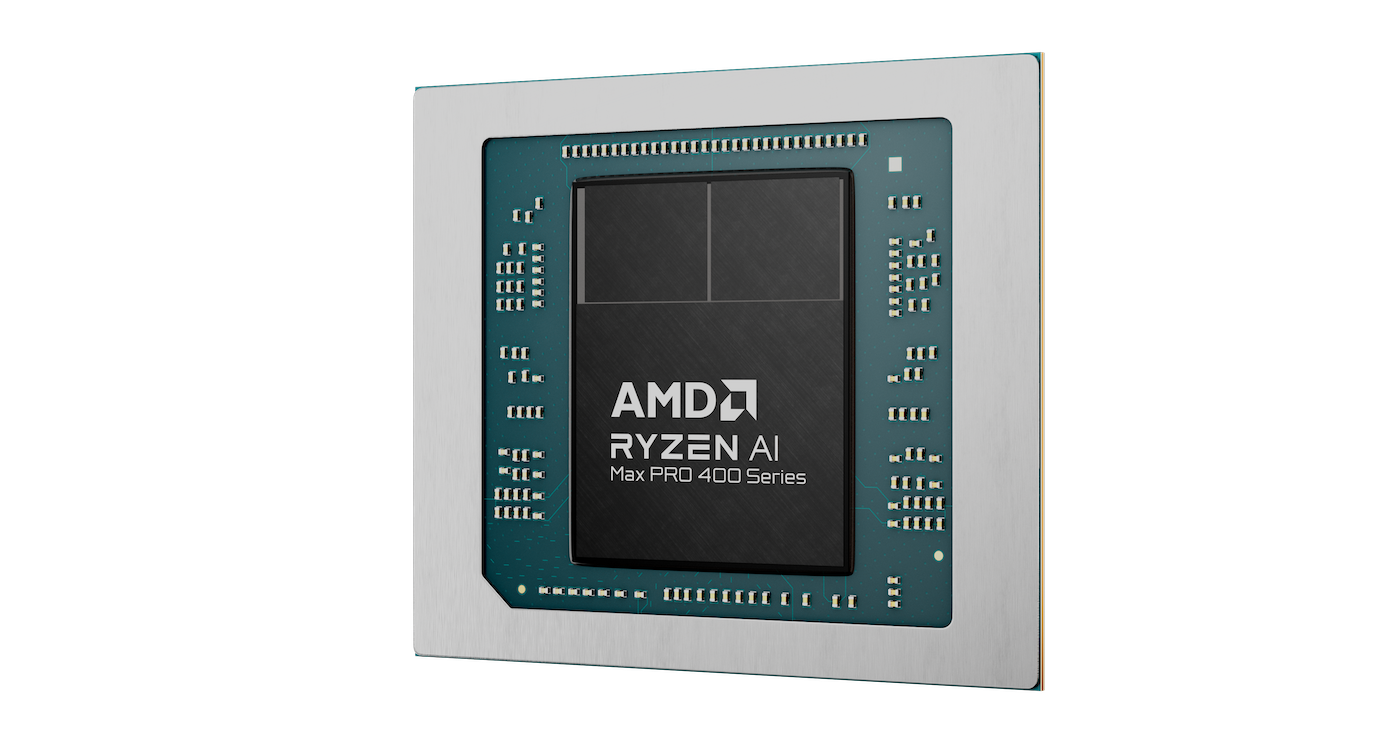
Alongside the developer platform, AMD introduced three Ryzen AI Max PRO 400 Series SKUs for commercial systems: the Ryzen AI Max+ PRO 495, Ryzen AI Max PRO 490, and Ryzen AI Max PRO 485. These processors are built on AMD’s Zen 5 architecture and combine CPU, RDNA 3.5 graphics, and XDNA 2 NPU resources into a single package. AMD said systems based on these chips will arrive from OEM partners, including ASUS, HP, and Lenovo, starting in Q3 2026, targeting commercial AI PCs, mobile workstations, and small form-factor desktops.
Ryzen AI Max+ PRO 400 Series
| Model | Cores / Threads | Boost / Base Frequency | Total Cache | Graphics Model | cTDP | NPU TOPS | Graphics CUs | Unified Memory |
|---|---|---|---|---|---|---|---|---|
| Ryzen AI Max+ PRO 495 | 16C / 32T | Up to 5.2 GHz / 3.1 GHz | 80 MB | AMD Radeon 8065S | 45 – 120W | Up to 55 TOPS | 40 Graphics CUs | Up to 192GB |
| Ryzen AI Max+ PRO 490 | 12C / 24T | Up to 5.0 GHz / 3.2 GHz | 76 MB | AMD Radeon 8050S | 45 – 120W | Up to 50 TOPS | 32 Graphics CUs | Up to 192GB |
| Ryzen AI Max+ PRO 485 | 8C / 16T | Up to 5.0 GHz / 3.6 GHz | 40 MB | AMD Radeon 8050S | 45 – 120W | Up to 50 TOPS | 32 Graphics CUs | Up to 192GB |
At the top of the stack, the Ryzen AI Max+ PRO 495 features 16 cores and 32 threads, boost speeds up to 5.2GHz, 80MB of cache, Radeon 8065S graphics with 40 compute units, and up to 55 TOPS of NPU performance. The Ryzen AI Max PRO 490 scales to 12 cores and 24 threads, 76MB of cache, Radeon 8050S graphics with 32 compute units, and up to 50 TOPS. The Ryzen AI Max PRO 485 is configured with 8 cores and 16 threads, 40MB of cache, the same Radeon 8050S graphics configuration, and up to 50 TOPS. All three PRO models support up to 192GB of unified memory and operate within a 45W-120W cTDP range.
AMD claims the new PRO lineup can run local AI models, including 300B+ parameter LLMs, on an x86 client processor. Just as important for enterprise and workstation buyers, the company is framing the platform as a consolidated engine for AI acceleration, graphics, and traditional professional workloads, including design, rendering, simulation, and engineering. That places the Ryzen AI Max PRO 400 Series somewhere between an AI PC platform and a compact workstation-class solution.


 Amazon