

KIOXIA America has introduced the XG10 Series, a new client NVMe SSD family aimed at performance-class OEM notebooks, desktops, and workstations. As the successor to the XG8 Series, the XG10 moves to a PCIe 5.0 x4 interface and NVMe 2.0d, giving KIOXIA a Gen5 client drive designed for heavier local workloads such as AI-assisted applications, content creation, and high-end gaming.
The headline change is the jump to PCIe Gen5 bandwidth. In a four-lane client configuration, PCIe 5.0 roughly doubles the available host interface bandwidth over PCIe 4.0, which helps explain the step up in both sequential and random performance. KIOXIA rates the XG10 at up to 14,000 MB/s read and 12,000 MB/s write, with random performance up to 2,000K IOPS read and 1,600K IOPS write. Compared with the prior XG8 generation, the company says the new drive delivers up to 2x faster sequential reads, more than 2x faster sequential writes, roughly 122% higher random reads, and about 158% higher random writes.
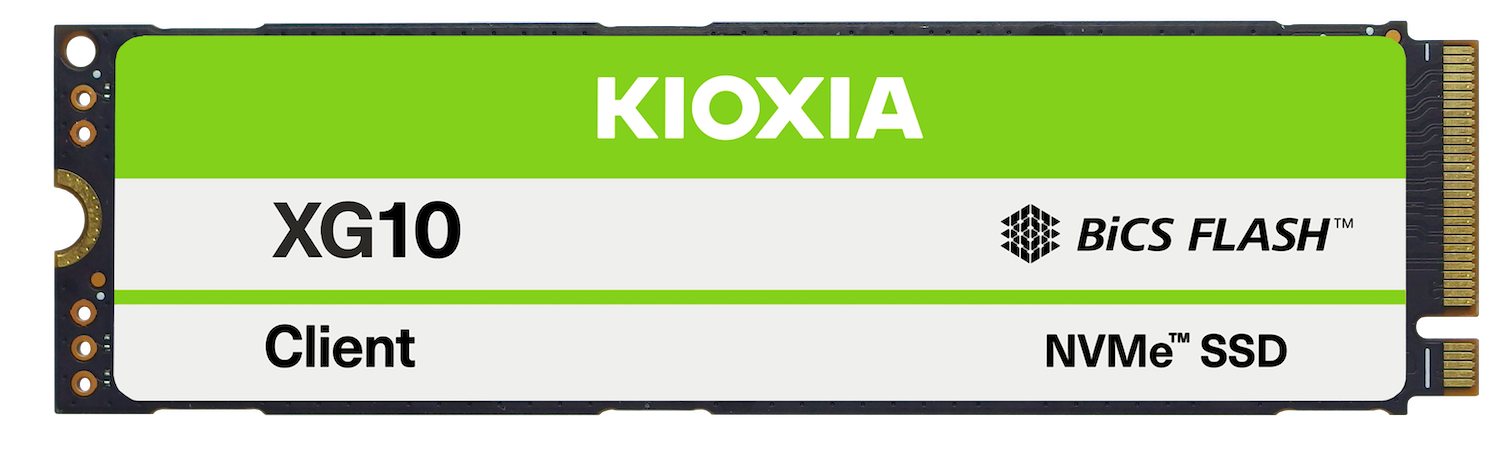
That performance profile puts the XG10 squarely in the upper tier of client storage, especially for systems expected to process large data sets locally. For workstation-class laptops and AI PCs, higher sequential throughput can help with moving large project files, model assets, and media libraries. At the same time, stronger random performance is more relevant to application responsiveness, asset loading, and scratch-disk behavior. In gaming systems, the gains are more likely to show up in load times, patch installs, and background asset streaming than directly in frame rates.
Comparison to KIOXIA’s Recently Launched Client SSDs
| EG7 | BG8 | XG10 | |
|---|---|---|---|
| Swimlane/Target | Value | Mainstream | Performance |
| Form Factors M.2 Type | 2230, 2242, 2280 | 2230, 2242, 2280 | 2280 |
| Flash Memory Type | BiCS FLASH gen. 8 QLC | BiCS FLASH gen. 8 TLC | BiCS FLASH gen. 8 TLC (512GB and 1024GB use BiCS FLASH gen. 6 TLC) |
| NAND Package | 1pkg NAND Flash Placement | 1pkg NAND Flash Placement | 2pkg NAND Flash Placement |
| Interface | PCIe®Gen4 x4, NVMe 2.0d | PCIe Gen5 x4, NVMe 2.0d | PCIe Gen5 x4, NVMe 2.0d |
| SoC | 4ch SoC design without DRAM (HMB) | 4ch SoC design without DRAM (HMB) | 8ch SoC design with DRAM |
| Capacities | 512 GB, 1024 GB, 2048 GB | 512 GB, 1024 GB, 2048 GB | 512 GB, 1024 GB, 2048 GB, 4096 GB |
| Max Seq. Read | 7,000 MB/s | 10,300 MB/s | 14,000 MB/s |
| Max Seq. Write | 6,200 MB/s | 10,000 MB/s | 12,000 MB/s |
| Max Random Read | 1,000 KIOPS | 1,435 KIOPS | 2,000 KIOPS |
| Max Random Write | 1,000 KIOPS | 1,300 KIOPS | 1,600 KIOPS |
| Active Power | 4.5 W | 5 W | 10 W |
| Endurance (1024GB) | 600 TBW | 1,200 TBW | 1,200 TBW |
The XG10 Series will ship in the standard M.2 2280 form factor with capacities of 512GB, 1TB, 2TB, and 4TB. KIOXIA is also including support for self-encrypting drive functionality based on TCG Opal 2.02, a feature that remains relevant for OEMs building commercial client systems that require hardware-based data-at-rest protection and policy-based fleet management. That makes the XG10 a better fit not just for enthusiast-class hardware, but also for business notebooks and mobile workstations where security and manageability matter.
KIOXIA is positioning the XG10 for high-performance PCs, including AI PCs, workstations, and gaming platforms. That aligns with where Gen5 client SSDs are most practical today. While PCIe 5.0 brings clear bandwidth advantages, sustained performance in client systems still depends heavily on platform thermals, power delivery, and OEM tuning, particularly in thinner notebook designs. In larger mobile workstations and desktops, those constraints are typically easier to manage.
In its announcement, KIOXIA said PCIe 5.0 is a meaningful step forward for client storage and framed the XG10 as a response to increasingly demanding workloads across creator, gaming, and professional systems. The company is currently sampling the new SSDs to select PC OEM customers, with end-system shipments expected to begin in the second quarter of 2026.


 Amazon