

Couchbase has announced the general availability of its AI Data Plane, positioning it as a unified data infrastructure layer for enterprise AI agents. The release is aimed at organizations trying to move agentic AI projects beyond pilots by combining persistent memory, real-time context retrieval, and consistent data access across cloud, edge, and lakehouse environments within a single architecture.
At a high level, Couchbase addresses a common enterprise issue: production AI agents that depend on multiple disconnected services for vector search, caching, document storage, and integration logic. Couchbase’s approach is to consolidate those functions into a governed operational layer that spans Capella and self-managed deployments, giving platform teams a single control plane for the data services that support AI agents.
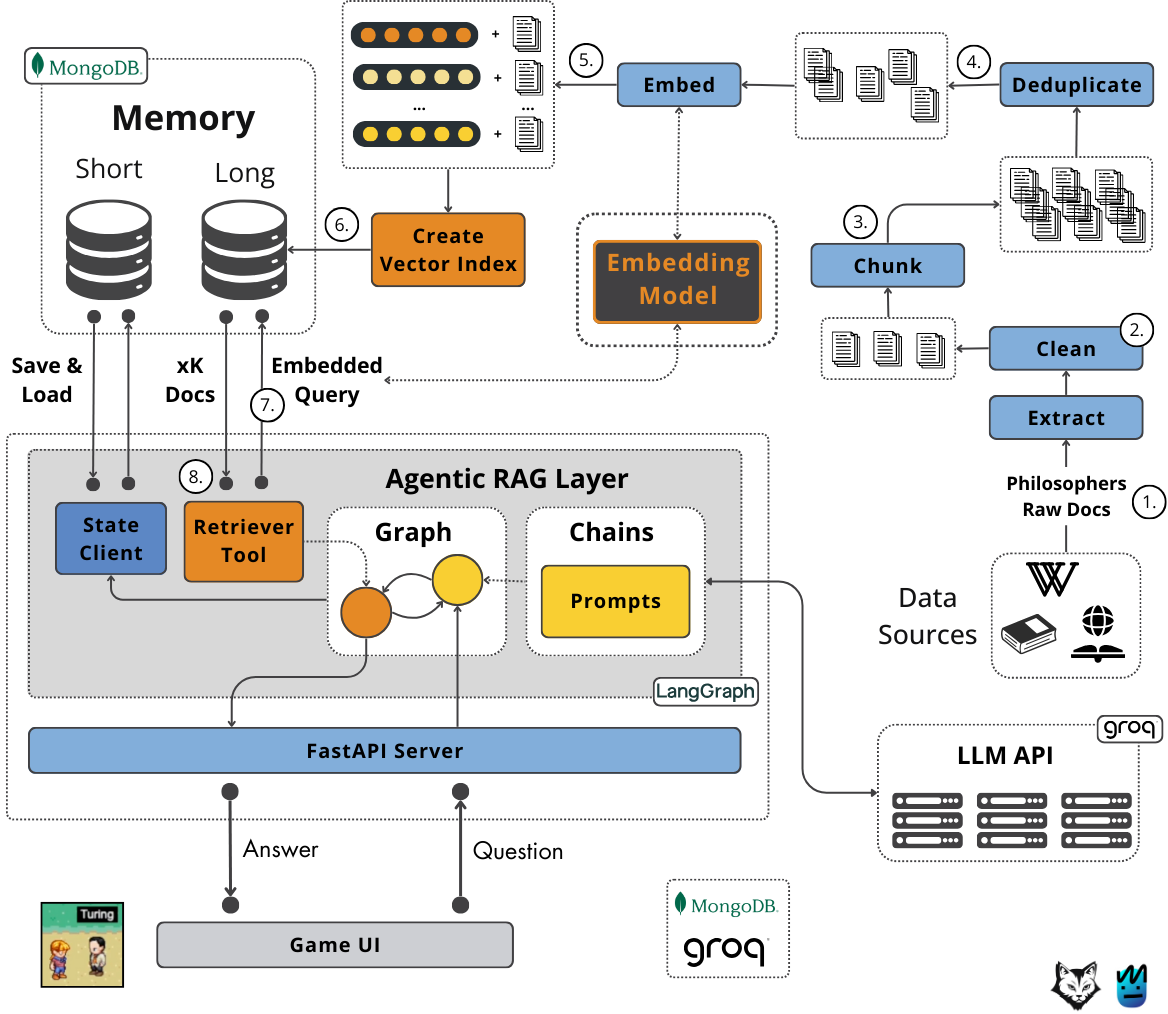
The AI Data Plane brings together Couchbase Agent Memory, an Agent Catalog for discoverable agent tooling, and an enterprise-supported self-managed MCP server to standardize model-context protocol integration. Couchbase said the platform is backed by its engineering and support organization and aims to replace point solutions that add operational complexity.
Focus on Persistent Agent Memory
A key element of the launch is Agent Memory, which Couchbase positions as a unified persistence layer for agent state, context, and retrieval. Rather than forcing teams to assemble separate vector, cache, and document stores, the company is folding those requirements into its broader operational data platform.
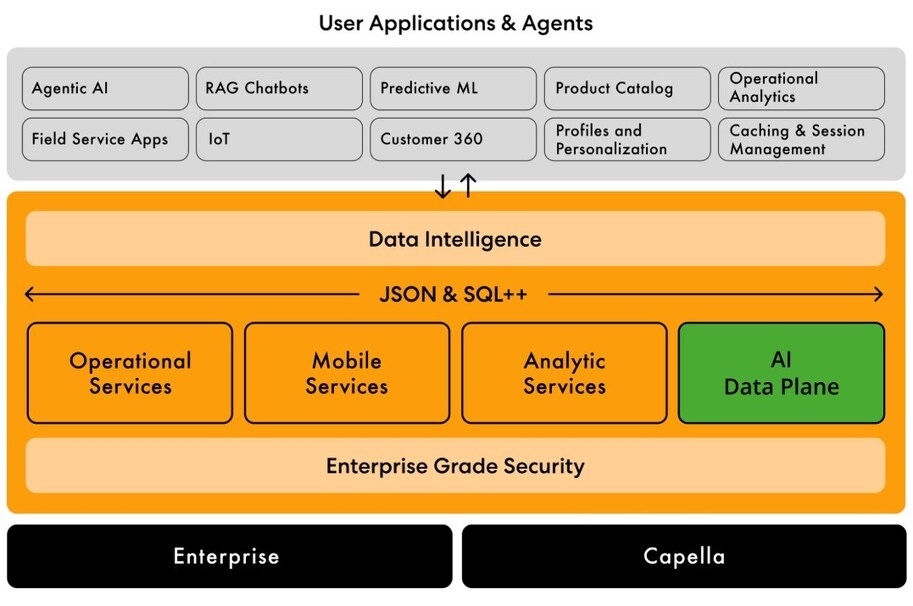
The Couchbase AI Data Plane provides enterprises with persistent agent memory, real-time context retrieval, and consistent data access from the cloud to the edge and into their lakehouse architectures.
That matters because enterprise agent deployments need more than vector similarity search. Production systems increasingly require the ability to preserve conversational and workflow context across sessions, retrieve structured operational data alongside unstructured embeddings, and maintain state through restarts and distributed execution. Couchbase says its platform is designed to support those requirements with low-latency access at the point of decision.
The company also noted that the memory layer is framework-agnostic and has been validated with LangGraph, CrewAI, and LlamaIndex. In practice, that should make it easier for engineering teams to change orchestration frameworks or support multiple frameworks without rebuilding the persistence layer underneath their agents.
Agora, which works with Couchbase as its data layer partner, said that fast and consistent retrieval remains foundational to enterprise conversational AI. The company described the backend data layer as critical to maintaining responsive interactions. They said its work with Couchbase has expanded as deployments move into more complex agentic use cases across sales, service, and related workflows.
Built for Distributed and Edge-Centric Agent Workloads
Couchbase is also leaning into the operational realities of agentic AI at the edge. Multi-step agents increasingly operate across sessions, devices, field environments, and distributed infrastructure, creating a mismatch with conventional centralized data platforms. According to Couchbase, the AI Data Plane is designed to support structured data, unstructured embeddings, synchronization, and local retrieval across cloud, edge, and endpoint environments.
Throughput is a major part of that argument. Agentic workloads can trigger repeated context lookups, memory updates, and state synchronization across many concurrent sessions, generating pressure on the underlying data platform. Couchbase says the AI Data Plane builds on its scale-out, memory-first architecture, which is already used for very high transaction-rate enterprise workloads.
Technically, the platform is built on Couchbase’s distributed, multi-model architecture, which supports JSON documents, key-value access, SQL++ queries, full-text search, eventing, and vector search in a single system. The AI Data Plane extends that foundation with agent session persistence and context retrieval, while the MCP server and Agent Catalog add integration and observability capabilities for production deployments.
Enterprise Analytics 2.2 Adds Iceberg Federation
Alongside the AI Data Plane, Couchbase introduced Enterprise Analytics 2.2, expanding its analytics stack to connect operational data to lakehouse environments better. The headline feature is Apache Iceberg federation, which allows teams to query Couchbase operational data alongside Iceberg tables without moving or duplicating data through ETL pipelines.
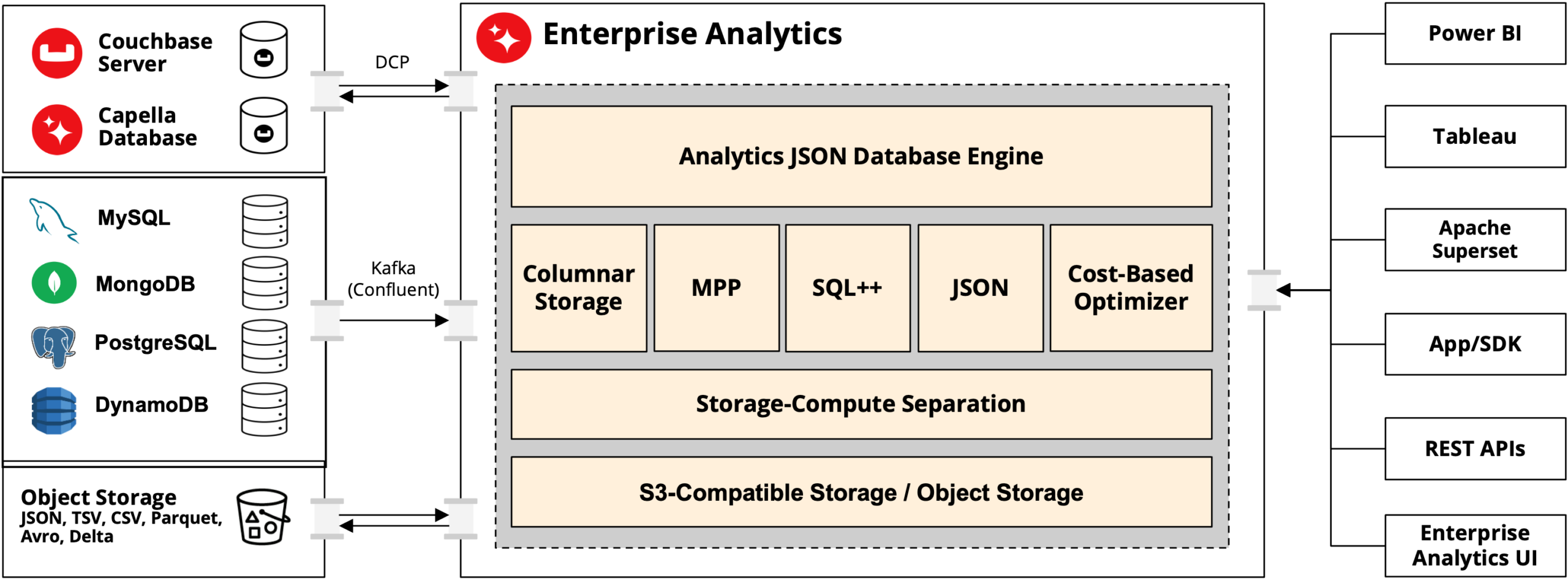
For enterprises standardizing on Iceberg, that should make it easier to combine live operational datasets with governed lakehouse tables in the same analytical workflow. The practical value is reduced data movement and faster access to mixed operational and analytical datasets for AI and analytics use cases.
Couchbase also added a set of analytics engine enhancements, including Google Cloud Storage support, JWT authentication, Oracle and SQL Server CDC, asynchronous long-running queries, an index advisor, index-only query plans, and SQL++ UPDATE support. Corresponding SDK updates are available for Java, .NET, Python, JavaScript, and Go.
Additionally, the company revealed a Trino adapter planned for Q3 calendar 2026. When available, it is expected to provide in-place SQL access to Couchbase operational data from Trino-based environments such as AWS Athena, Amazon EMR, Google Dataproc, and Starburst. That would further reduce the need to replicate live operational data into separate analytical systems before querying it.
Capella iQ and Edge Stack Updates
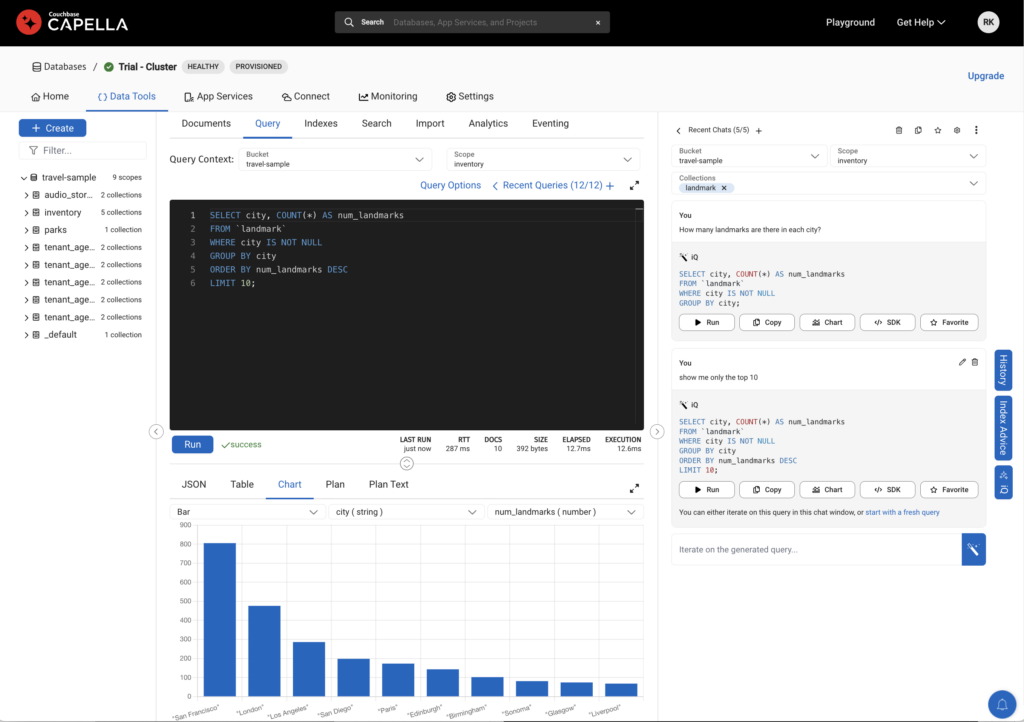
Couchbase also updated Capella iQ, its natural-language query assistant. The platform now supports model selection through AWS Bedrock and OpenAI, with access controlled through organization-level policy settings. The idea is to let administrators restrict model access by team while centrally managing compliance, residency, and inference cost controls.
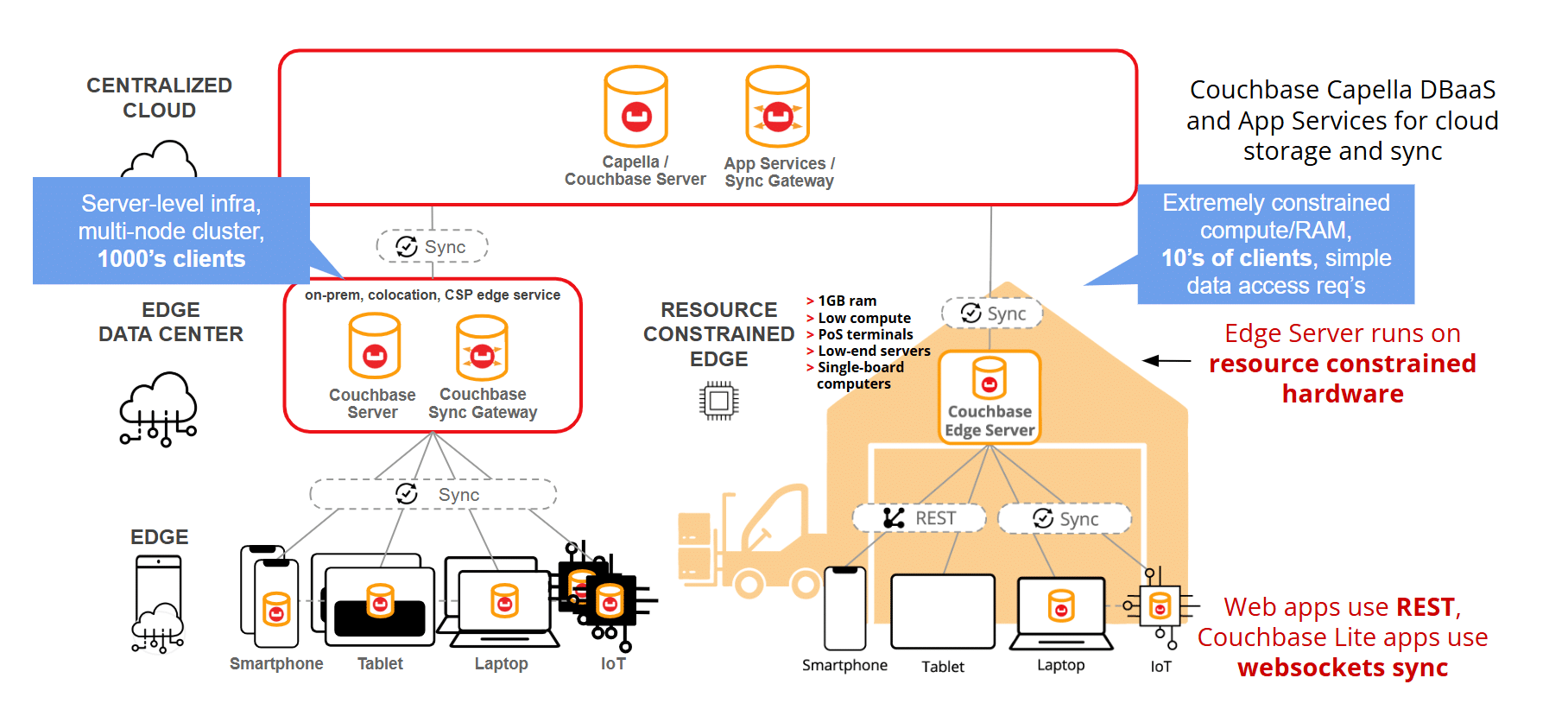
On the edge and mobile side, Couchbase expanded the distributed application stack to support more localized AI and data processing. Couchbase Lite 4.1 adds native peer-to-peer sync over Bluetooth with automatic Wi-Fi fallback, a modernized Android API featuring Kotlin @Serializable support (which simplifies serializing and deserializing data classes and objects), delta-based change detection, and new C++ API bindings for building high-performance embedded applications. A separate Edge Server 1.1 adds client-level access control for fine-grained local permissions, CORS support for browser-based edge apps, simplified credential rotation for distributed device fleets, and expanded platform support for Windows and ARM architectures. React Native 1.1 adds enterprise-grade support with Turbo Module integration, giving cross-platform mobile teams direct access to Couchbase Lite performance without bridging overhead. Sync Gateway 4.1 adds non-disruptive rolling upgrades and concurrent distributed resync for high-volume environments, available as a managed service through App Services.
Edge Server 1.1 introduces client-level access control, CORS support for browser-based edge apps, simplified credential rotation, and broader support for Windows and ARM deployments. React Native 1.1 adds enterprise support, including Turbo Module integration, to improve direct access to Couchbase Lite performance. Sync Gateway 4.1 adds support for rolling upgrades and concurrent distributed resync for high-volume environments and is available as a managed service through App Services.
Market Positioning
Couchbase’s broader message is that the database layer is becoming central to production agentic AI, particularly as enterprises recognize that memory, context management, and low-latency retrieval cannot be treated as bolt-on features. The company argues that many current deployments are slowed by the need to integrate separate vector, cache, and document systems, and that a unified persistence and retrieval layer is increasingly necessary for production-scale agents.
From an infrastructure perspective, the launch is less about adding another AI feature and more about tightening the integration among operational databases, agent memory, edge deployments, and lakehouse analytics. For enterprise buyers and technical teams, the significance of the AI Data Plane will likely hinge on whether consolidating these services into a single platform materially reduces integration overhead while preserving the performance and governance required for real production agent deployments.


 Amazon