

Modern enterprises depend on data-intensive applications and distributed users, which makes infrastructure placement a strategic decision. Where data resides, whether on premises, colocation, public cloud, or across all three, has a direct impact on performance, cost, security, and governance.
Deploying Dell PowerStore and PowerFlex inside or adjacent to Equinix Cloud-Connected Data Centers gives organizations precise control over that placement. Data and workloads can be located where they perform best, while enterprises retain ownership, visibility, and policy control. This unified, cloud-adjacent architecture minimizes latency, reduces egress charges, and enables consistent movement of applications and data across on-premises sites, Equinix facilities, and hyperscale clouds.
Dell PowerStore and PowerFlex for the Hybrid Era
Dell PowerStore and PowerFlex together form a hybrid-ready platform that combines intelligent storage with scalable, software-defined infrastructure suitable for modern, cloud-connected environments.
PowerStore provides next-generation enterprise storage with all-flash NVMe performance, a guaranteed 5:1 data reduction ratio, and scale-out capabilities designed for mixed workloads. Within an Equinix Cloud-Connected Data Center, PowerStore operates as a secure, low-latency data hub. Critical datasets remain close to cloud compute while benefiting from predictable performance, policy-driven compliance, and high-throughput access without recurring egress penalties from public cloud storage.

PowerFlex extends this capability with a flexible, software-defined architecture that converges compute and storage. It is optimized for high-performance, elastic, and automated environments, including private clouds, large database estates, and container-native platforms. Deployed in Equinix, PowerFlex turns colocation into a complete private cloud platform, enabling rapid resource scaling, workload mobility across locations, and direct integration with hyperscaler compute via Equinix Fabric private interconnects.
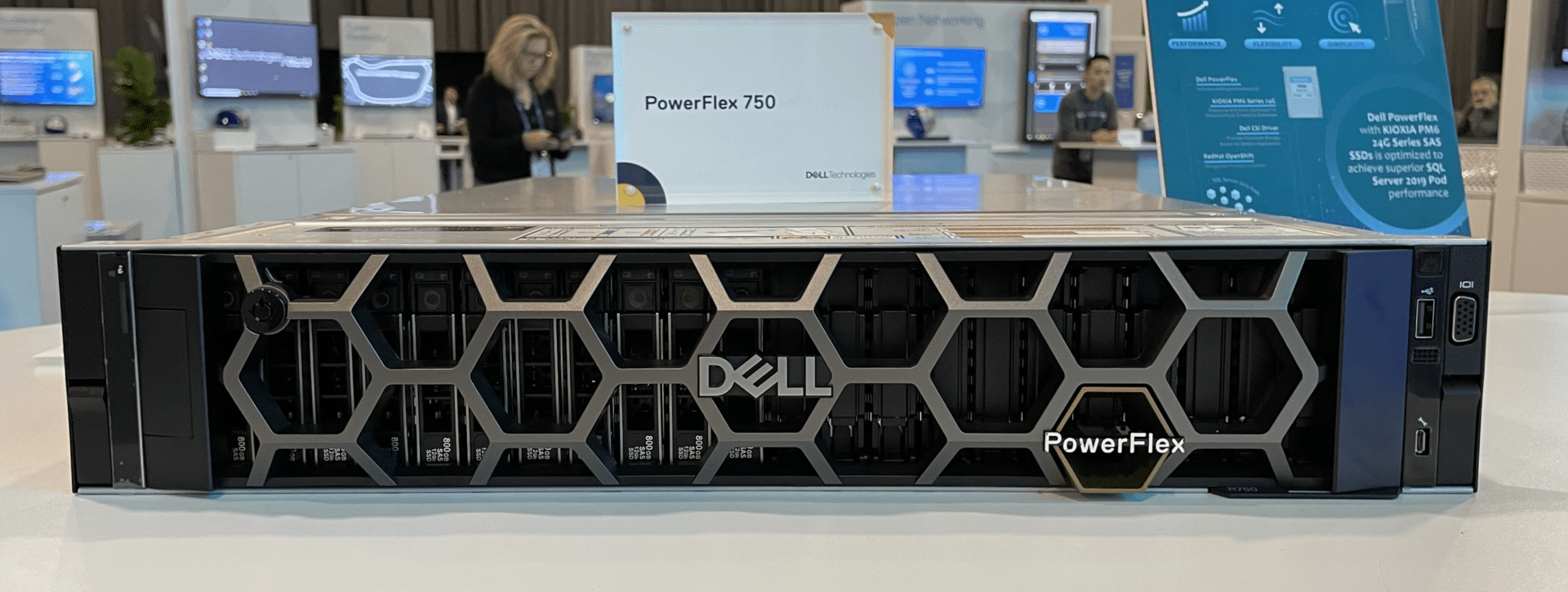
Dell PowerFlex 750
In combination, PowerStore and PowerFlex deliver an enterprise-grade stack of intelligent data services and elastic infrastructure. The result is a hybrid platform that supports performance-sensitive workloads, improves efficiency, and maintains the agility required in a multi-cloud environment.
The Cloud Adjacency Advantage
Traditional cloud-connected architectures focus on network reachability to hyperscalers. Cloud adjacency advances this model by placing enterprise data and compute next to major clouds, rather than inside them, which unlocks greater control and flexibility.
Within an Equinix Cloud-Connected Data Center, Dell PowerStore and PowerFlex enable this adjacent architecture. Cloud compute can run in AWS, Microsoft Azure, or other hyperscalers, while primary data resides on Dell infrastructure inside Equinix. PowerFlex scales compute and storage across this environment via private, low-latency links, enabling applications to benefit from near-on-premises performance with cloud-scale elasticity.
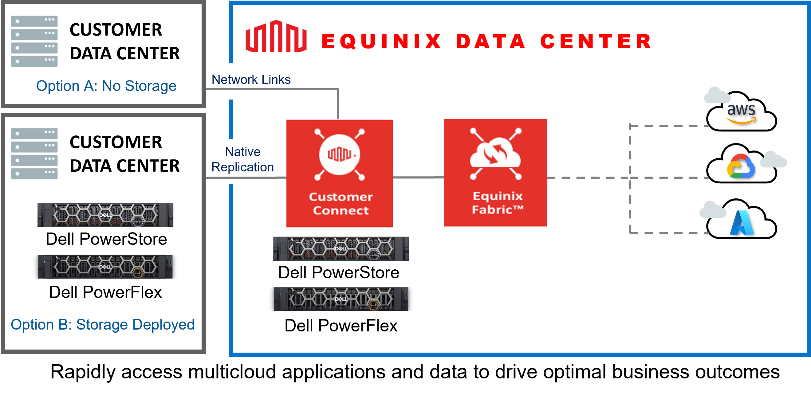
For many organizations, this configuration becomes a natural on-ramp to Dell Private Cloud. Deploying PowerStore and PowerFlex in Equinix establishes key private cloud building blocks: enterprise storage, software-defined compute, automation, and secure cloud connectivity. Over time, the same footprint can be expanded into a full Dell Private Cloud implementation, with unified management and consistent data services across regions and clouds.
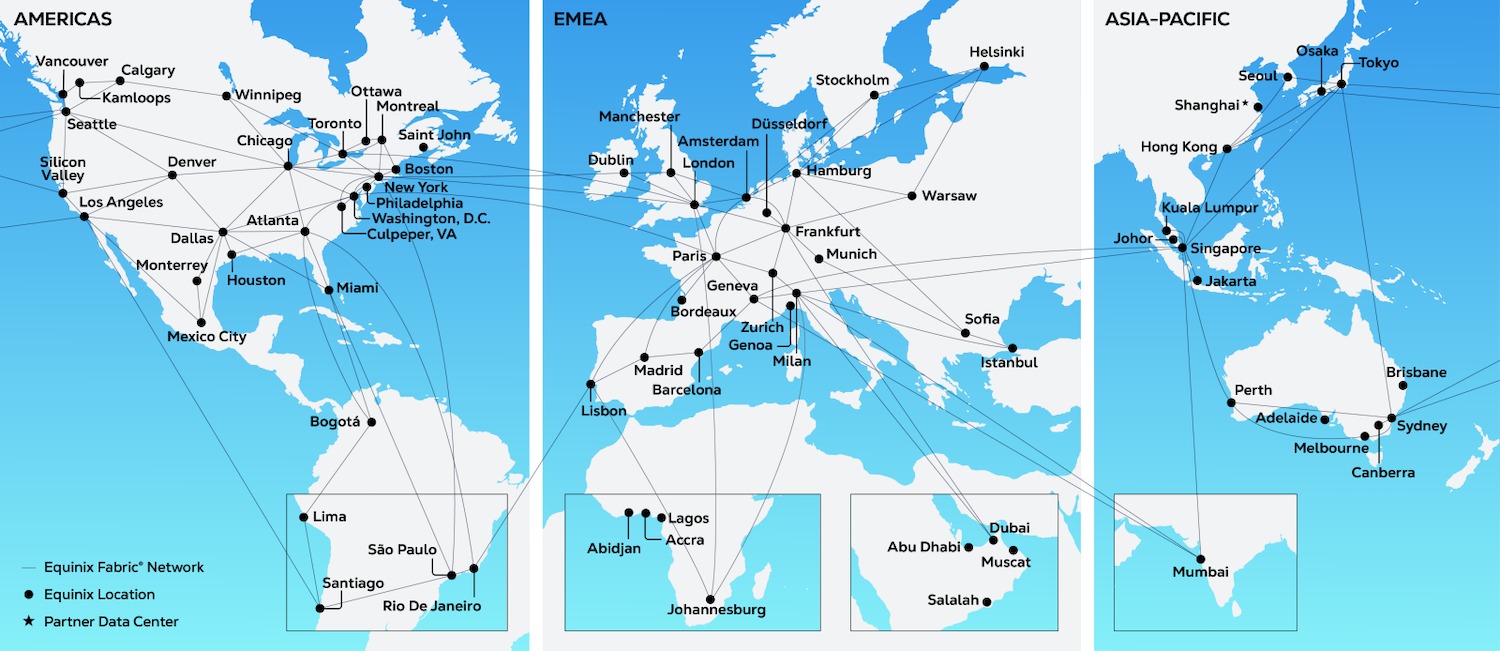
Equinix operates more than 250 data centers across over 70 markets, enabling enterprises to place Dell infrastructure near end users, cloud regions, and jurisdictional boundaries. In this model, PowerStore and PowerFlex function as extensions of the enterprise data center, offering cloud-like scalability while preserving corporate governance and compliance controls.
This adjacency architecture reduces or eliminates several historical hybrid cloud trade-offs. Data sovereignty and regulatory requirements remain enforceable because critical data sits on enterprise-controlled infrastructure in chosen regions. Cloud storage and egress costs decline when high-capacity datasets are retained in Equinix and accessed from the cloud over private links rather than stored natively in each cloud. Latency and performance variability are reduced, as data paths are shorter and more deterministic. Finally, cloud choice and workload mobility increase, as the underlying data and control plane remain consistent even when organizations adopt or change cloud providers, avoiding large-scale re-architecture.
Real-World Hybrid Use Cases
The Dell Cloud-Connected Storage solution in Equinix supports a broad set of hybrid use cases that can be adopted individually or combined as business needs evolve. Because the architecture is modular and inherently cloud-adjacent, enterprises can mix and match capabilities, including business continuity, managed services, lifecycle operations, and high-speed storage, for compute-intensive workloads.
Business Continuity and Disaster Recovery
Organizations can deploy PowerStore or PowerFlex in an Equinix facility and replicate data to another Equinix site over private, low-latency links. This approach enables fast, multi-region recovery with secure, compliant disaster recovery. Instead of maintaining fully provisioned DR data centers, enterprises can leverage on-demand compute capacity in public clouds connected to Equinix to spin up DR workloads when needed, often lowering the total cost of resilience.
Managed Infrastructure and Operations
Equinix effectively extends the enterprise data center footprint. In this model, Dell or managed service providers can operate PowerStore and PowerFlex systems on behalf of customers. In contrast, the customer retains complete control of data placement, security policies, and governance. This division of responsibility allows internal teams to focus on applications and business outcomes rather than day-to-day storage and infrastructure operations.
Data Sovereignty and Secure Regional Placement
Enterprises with strict data residency requirements can keep data and workloads regional on PowerStore and PowerFlex systems located in specific Equinix facilities. Managed services can be layered on top to simplify operations, yet governance, control, and auditability remain firmly with the organization. This is particularly useful where regulations restrict cross-border data movement or require local processing.
Copy Data Management for Test/Dev and Versioning
Equinix’s high-bandwidth connectivity and proximity to major cloud regions support efficient dev/test and lifecycle workflows. PowerStore and PowerFlex snapshot and cloning capabilities can be used to create parallel copies of production datasets for development, testing, staging, and version control. These copies can be consumed by compute in public clouds or local environments without repeatedly replicating large data volumes across long distances.
High-Speed Storage for Cloud Compute
For analytics, AI, and database-intensive workloads, organizations can run elastic compute in public clouds while keeping primary storage on PowerStore or PowerFlex in Equinix. Cloud adjacency provides ultra-low-latency access to data over private links, which avoids the performance penalties and data gravity issues that often arise when large datasets are stored natively in a single cloud. This pattern is well-suited to multi-cloud analytics, AI training and inference pipelines, and large-scale transactional or operational databases.
Edge Computing and Low-Latency Workloads
By extending Equinix Fabric connectivity to edge locations, enterprises can place workloads near users, devices, or industrial sites while keeping core enterprise data secure and centralized on Dell infrastructure. Applications that depend on real-time processing, streaming analytics, or AI inference at the edge can benefit from local responsiveness while still integrating with centralized data services, governance, and lifecycle management.
Hybrid Cloud Backup and Archiving
PowerStore and PowerFlex can participate in hybrid backup and archive workflows spanning on-premises environments, cloud-adjacent infrastructure at Equinix, and public clouds. Data can be replicated, tiered, or archived based on cost, retention, and compliance requirements. This model helps reduce long-term storage costs while maintaining the integrity and recoverability of critical datasets across multiple locations and providers.
Optional Use of On-Premises Storage
A key advantage of the Dell and Equinix architecture is deployment flexibility across on-premises and colocation environments. PowerStore or PowerFlex can be deployed exclusively in Equinix to centralize storage, simplify operations, and reduce the overhead of running traditional data centers. In this scenario, organizations may avoid frequent hardware refresh cycles and lower facility complexity by consolidating into cloud-adjacent infrastructure.
Alternatively, enterprises can maintain smaller PowerStore or PowerFlex systems on premises for location-specific requirements, such as manufacturing sites, branch operations, or latency-sensitive workloads, while operating larger systems in Equinix for cloud-connected and multi-cloud workloads. Because the stack is designed for consistent data services and unified management, this hybrid deployment model preserves a common operational experience across all locations.
Cloud Adjacency as a Driver of Storage Agility
The combination of Dell PowerStore and PowerFlex within Equinix Cloud-Connected Data Centers redefines practical hybrid infrastructure design. Rather than treating cloud connectivity as an afterthought, the architecture positions enterprise infrastructure at the edge of major cloud regions to maximize agility, control, and performance.
PowerStore delivers intelligent, efficient storage services, while PowerFlex provides scalable, software-defined compute and storage. Together, they allow organizations to consolidate their hybrid strategy into a single, global, cloud-adjacent architecture that supports consistent data services, policy enforcement, and lifecycle operations across regions and cloud providers.
In this model, physical proximity to cloud regions translates directly into lower latency, better economics, and greater architectural flexibility. By aligning Dell infrastructure with Equinix’s global platform, enterprises can place data and workloads precisely where they need to be, maintaining control while fully exploiting cloud-scale compute and services.


 Amazon