

DapuStor has introduced the R6060, a PCIe Gen5 enterprise QLC SSD with capacities scaling up to 245TB. The R6060 represents the company’s second-generation QLC platform and expands its high-capacity SSD lineup for data-intensive environments, including AI infrastructure and large-scale storage backends. The R6060 is available in E3.L and U.2 form factors, with the highest capacities enabled by the E3.L design. According to DapuStor, the 122TB version of the R6060 is already deployed with customers, while the platform now scales to 245TB per drive.
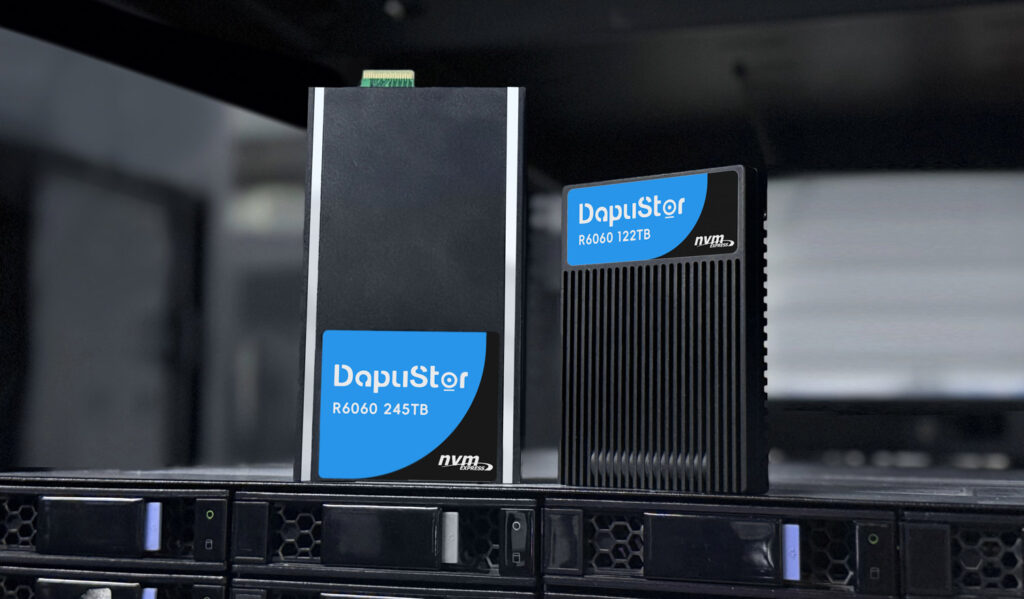
The move to 245TB places the R6060 alongside other recently announced ultra-high-capacity SSDs. Both Kioxia and Micron have previously announced or publicly demonstrated SSDs in the same capacity class, reflecting an industry-wide push toward higher-density QLC flash for enterprise deployments. DapuStor’s announcement adds another production-ready option to this emerging segment.
E3.L Form Factor Enables Higher Density
The R6060’s maximum capacity is supported by the E3.L form factor, which provides additional physical volume compared to U.2. This allows for higher NAND density, improved thermal characteristics, and power delivery suited to ultra-high-capacity SSDs. While E3.L servers have yet to ship in meaningful quantities, server vendors are now developing backplanes to accommodate these drives. The additional length compared to E3.S requires a bit of tweaking to ensure there’s both enough room and proper airflow for the SSDs.
The R6060 uses a PCIe Gen5 interface, providing additional bandwidth headroom for concurrent workloads typical of large-scale data access patterns. DapuStor notes that the drive supports Flexible Data Placement (FDP) and firmware-level data management to reduce write amplification and improve predictability at higher capacities. These features are aimed at environments where large datasets remain online and are accessed repeatedly across training, inference, and retrieval workflows.
DapuStor has shared baseline performance figures for the R6060, including the 245TB E3.L model. According to the company, the drive delivers up to approximately 14GB/s sequential read and 4GB/s sequential write performance over a PCIe Gen5 x4 interface. These figures align with the design goals of high-capacity QLC SSDs, where read bandwidth and concurrency are emphasized over sustained write throughput.
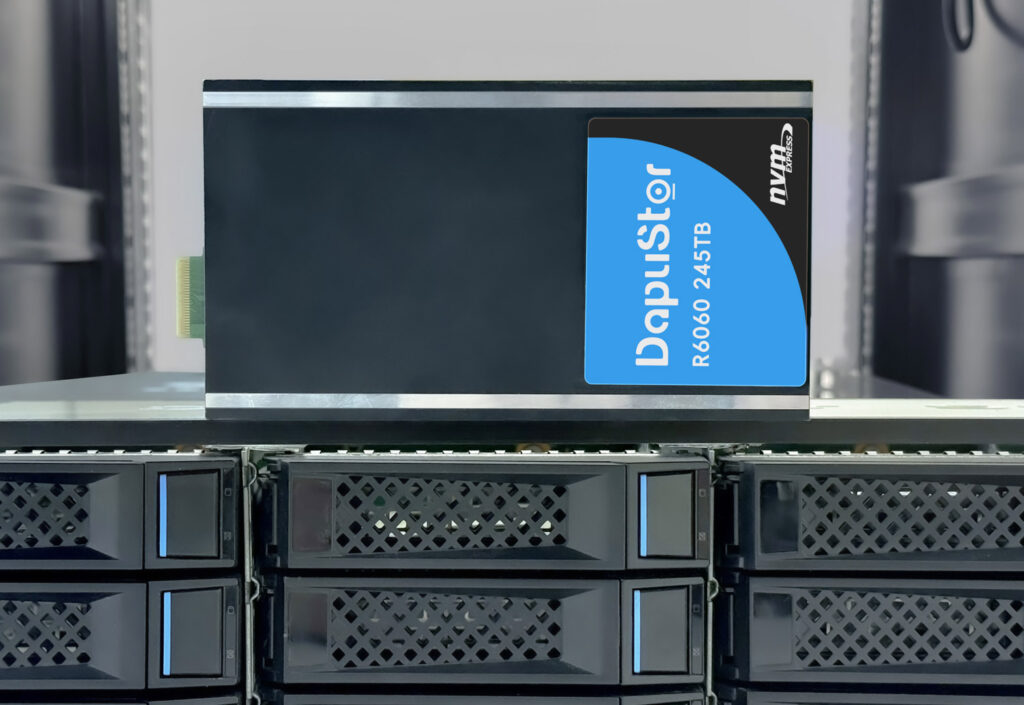 With the R6060, DapuStor expands its Gen5 QLC lineup into the 245TB capacity class, using the E3.L form factor to enable higher density within standard enterprise platforms. The drive reflects the broader industry move toward ultra-high-capacity flash for large, persistent datasets, particularly in AI and data-intensive environments. As server platforms and backplanes evolve to support E3.L at scale, SSDs like the R6060 provide a clearer view of how flash capacity continues to increase without requiring fundamental changes to deployment models.


 Amazon