

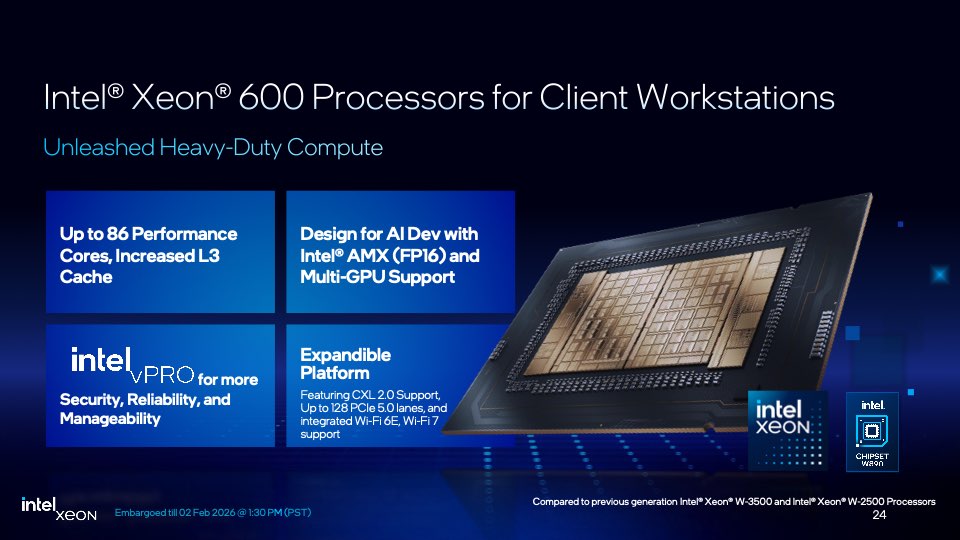
Intel is expanding its workstation portfolio with the introduction of Intel Xeon 600 processors for client workstations, a new high-end desktop platform designed for heavily threaded, memory-intensive, and accelerator-rich professional workloads. Positioned above mainstream desktop workstation CPUs, the Xeon 600 targets engineering, simulation, AI development, media production, and financial modeling environments where scale, bandwidth, and I/O flexibility matter more than peak single-thread responsiveness.
This launch comes as workstation workloads continue to blur the line between traditional CPU-bound tasks and AI-accelerated pipelines. Engineers, content creators, and researchers increasingly run mixed workloads that combine simulation, rendering, data preprocessing, and inference on the same system, often simultaneously. Intel is positioning Xeon 600 as the CPU foundation for these hybrid workflows, where sustained throughput and platform scale are more valuable than short-duration boost clocks.
The platform pairs Xeon 600 processors with the Intel W890 chipset and is scheduled to begin shipping in late March 2026.
Built For Throughput, Not Just Clocks
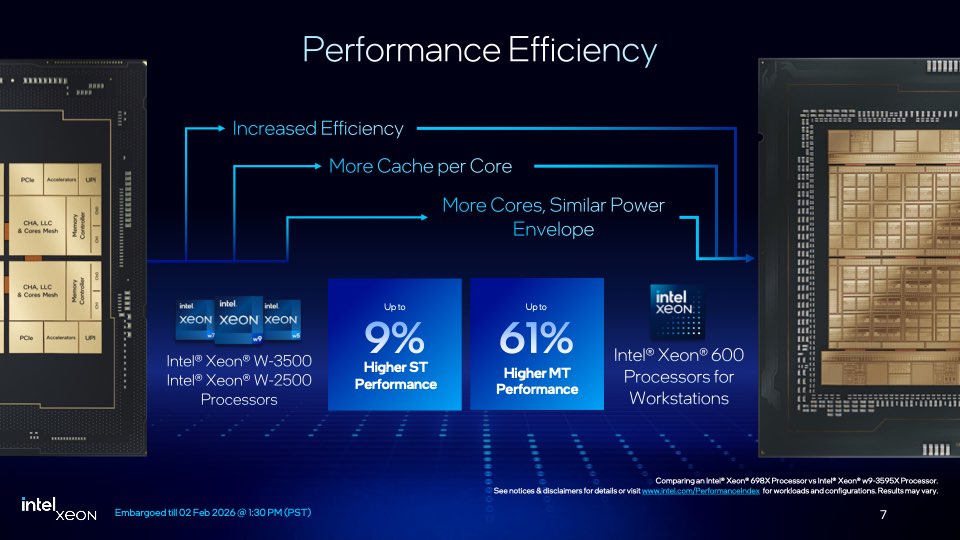
Xeon 600 workstation processors scale up to 86 performance cores, emphasizing sustained multithreaded performance and cache density over frequency-driven gains. Intel characterizes the design as delivering more cores and more cache per core within a similar power envelope to the previous generation, targeting workloads that can effectively consume parallel compute.
Intel reports up to 61% higher multi-thread performance and up to 9% higher single-thread performance over the prior Xeon W-3500 family. The results were measured using Cinebench 2026. While single-thread uplift is incremental, multi-thread gains reflect the increase in core count and architectural efficiency, which are aimed squarely at high-throughput workstation tasks.
| Intel Xeon 600 Processors for Workstation (SKU Summary) | |||||||||||
| Sku | 698X | 696X | 678X | 676X | 674X | 658X | 656 | 654 | 638 | 636 | 634 |
| P-Cores | 86 | 64 | 48 | 32 | 28 | 24 | 20 | 18 | 16 | 12 | 12 |
| Turbo Boost Max 3.0 (GHz) | 4.8 | 4.8 | 4.9 | 4.9 | 4.9 | 4.9 | 4.8 | 4.8 | 4.8 | 4.7 | 4.6 |
| All-Core Turbo (GHz) | 3.0 | 3.5 | 3.8 | 4.3 | 4.3 | 4.3 | 4.5 | 4.5 | 4.5 | 4.5 | 3.9 |
| Base Frequency (GHz) | 2.0 | 2.4 | 2.4 | 2.8 | 3.0 | 3.0 | 2.9 | 3.1 | 3.2 | 3.5 | 2.7 |
| L3 Cache (MB) | 336 | 336 | 192 | 144 | 144 | 144 | 72 | 72 | 72 | 48 | 48 |
| Base TDP (W) | 350 | 350 | 300 | 275 | 270 | 250 | 210 | 200 | 180 | 170 | 150 |
| Unlocked | Yes | Yes | Yes | Yes | Yes | Yes | N/A | N/A | N/A | N/A | N/A |
| Memory Channels | 8 | 8 | 8 | 8 | 8 | 8 | 8 | 8 | 4 | 4 | 4 |
| DDR5 Speed (MT/s) | 6400 | 6400 | 6400 | 6400 | 6400 | 6400 | 6400 | 6400 | 6400 | 6400 | 6400 |
| MRDIMM Speed (MT/s) | 8000 | 8000 | 8000 | N/A | N/A | N/A | N/A | N/A | N/A | N/A | N/A |
| Intel vPro | Yes | Yes | Yes | Yes | Yes | Yes | Yes | Yes | Yes | Yes | Yes |
| PCIe 5.0 Lanes | 128 | 128 | 128 | 128 | 128 | 128 | 128 | 128 | 80 | 80 | 80 |
| Boxed SKU | N/A | Yes | Yes | Yes | N/A | Yes | N/A | Yes | N/A | N/A | N/A |
| RCP Price (USD) | $7,699 | $5,599 | $3,749 | $2,499 | $2,199 | $1,699 | $1,399 | $1,199 | $899 | $639 | $499 |
Application-level Gains in Workstation Workloads
Intel’s performance data highlights improvements across common workstation verticals when comparing the flagship Xeon 698X to the previous Xeon w9-3595X. Using SPECworkstation 4.0, Intel reports measurable gains in AI and machine learning, energy modeling, financial services, life sciences, and media and entertainment workloads, with financial services showing the most significant relative improvement. Productivity and development workloads are roughly on par, reinforcing Intel’s message that Xeon 600 is optimized for scale rather than for lightly threaded tasks.
Beyond synthetic benchmarks, Intel points to real-world gains in simulation and content creation. The company cites faster FEA and CFD solve times, improved photorealistic rendering performance, and substantially faster CPU-based rendering in Blender. For AI-enabled media tasks, Intel highlights faster video upscaling using Intel AMX, positioning Xeon 600 as a viable CPU-side accelerator when GPUs are reserved for other stages of the pipeline.
AI-focused Instructions and Software Alignment
A core theme of Xeon 600 workstation positioning is AI development. Each core includes Intel Advanced Matrix Extensions, supporting int8, bfloat16, and FP16 data types alongside AVX-512. Intel frames this as enabling efficient CPU-based inference, preprocessing, and model testing, particularly in environments where GPU access is constrained or shared.
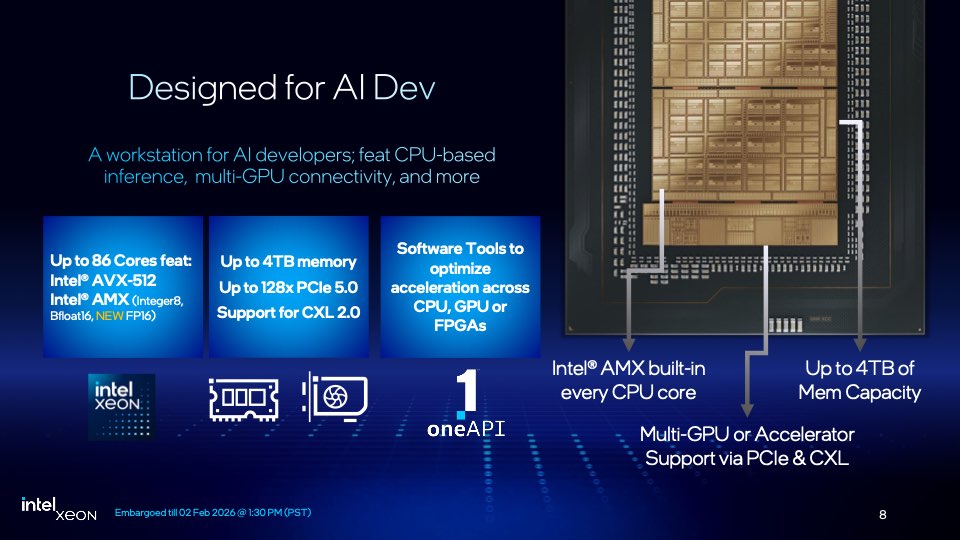
The platform is aligned with Intel’s broader software stack, including oneAPI, OpenVINO, and optimized Python libraries for NumPy and SciPy. Intel reports double-digit gains in linear algebra, extensive dataset analysis, and CPU-based AI inference testing compared with the prior-generation Xeon workstation.
Memory and I/O
The Xeon 600’s most significant differentiators are memory and expansion capabilities. The platform supports up to 8 DDR5 memory channels and up to 4TB of system memory, making it well-suited for large assemblies, simulations, and datasets that routinely exceed the limits of mainstream desktop platforms.
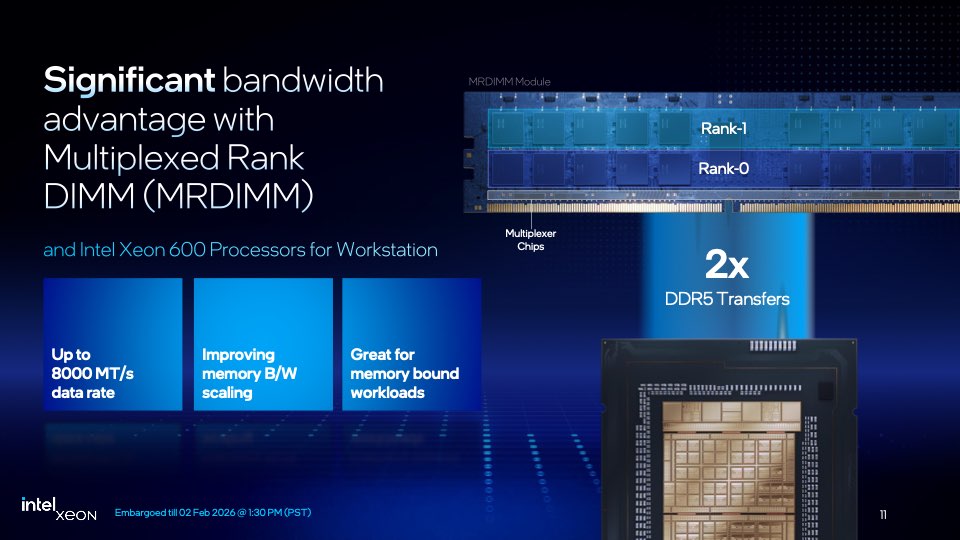
Intel also emphasizes support for MRDIMM, enabling data rates up to 8000 MT/s and improved memory bandwidth scaling. This is positioned as a key advantage for memory-bound workloads, particularly in simulation and data analytics environments.
On the I/O side, Xeon 600 provides up to 128 PCIe 5.0 lanes, enabling dense multi-GPU, high-speed storage, and accelerator configurations without compromise. CXL 2.0 support further extends the platform’s ability to scale memory and attach advanced devices, reinforcing its role as a long-life, highly expandable workstation foundation.
Platform Features
Xeon 600 workstations integrate Intel vPro technology, delivering security, manageability, and system recovery capabilities that are critical in enterprise and regulated environments. Features such as total memory encryption, remote manageability, and recovery tools are positioned to support IT-managed workstation fleets rather than standalone enthusiast systems.
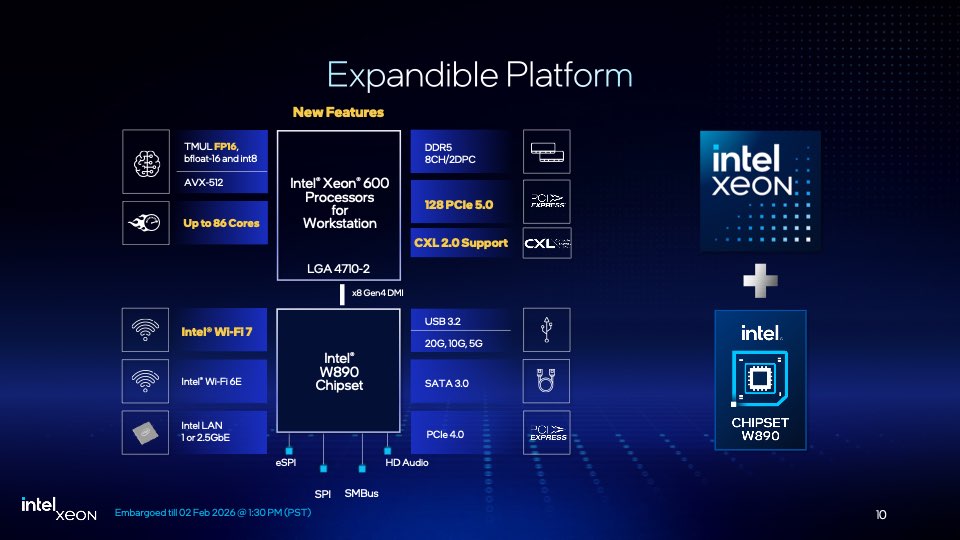
The platform uses the LGA 4710-2 socket and the Intel W890 chipset, with integrated support for modern connectivity including Wi‑Fi 6E and Wi‑Fi 7, as well as 1GbE and 2.5GbE networking options depending on system configuration.
What Will Testing Show?
The Intel Xeon 600 clearly defines the top end of Intel’s client workstation strategy, emphasizing sustained throughput, expandability, and long-term platform relevance rather than peak desktop-style clock speeds. It is aimed squarely at professionals whose workflows scale with cores, memory bandwidth, and I/O, not lightly threaded responsiveness.
For those users, the Xeon 600 represents a meaningful step forward in what a single-socket workstation can handle. As systems arrive in the coming months, we are eager to bring platforms into the lab and evaluate their performance on real-world workstation workloads to see how they stack up in an increasingly complex workstation environment.


 Amazon