

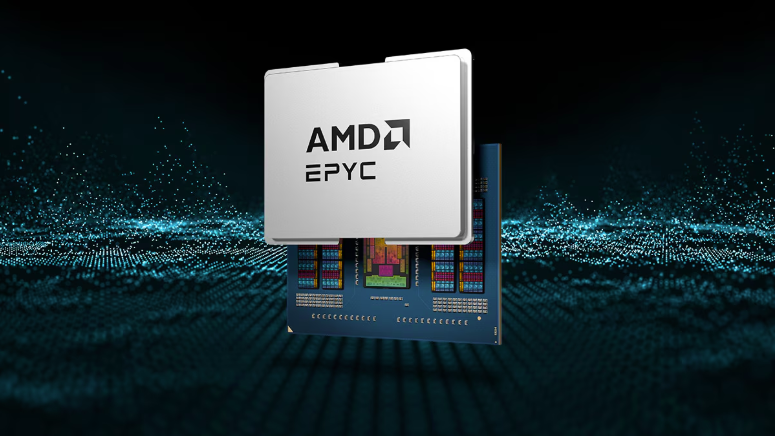
AMD has introduced its EPYC 8005 series server processors, targeting edge infrastructure, telecom deployments, and compact cloud storage nodes where power, cooling, and physical footprint remain hard constraints. The new lineup scales from 8 to 84 Zen 5 cores in a single-socket design and spans a TDP range of 70W to 225W, giving OEMs and operators more flexibility for distributed compute platforms.
Performance and Architecture
At the top of the stack, the EPYC 8635P brings 84 cores into a 225W envelope. AMD says the chip delivers up to 40% higher top-end integer performance than the previous EPYC 8004 generation, along with roughly 9.5% better performance per watt. The company also compares the 8635P directly to Intel’s Xeon 6716P-B, claiming 91% higher integer performance while offering 84 cores versus 40, and doing so at a slightly lower TDP of 225W versus 235W.
AMD is pushing more data center-class x86 compute into locations that cannot accommodate mainstream dual-socket servers or higher-power parts. For edge and telco operators, that could translate into consolidating more workloads onto fewer nodes while keeping thermal and space requirements manageable. For storage vendors, it could mean shifting more of the bill of materials toward flash and networking rather than CPU overhead.
| AMD EPYC 8635P Server CPU | Intel Xeon 6 6776P-B (Granite Rapids-D, P-core) | NVIDIA Grace CPU Superchip (Neoverse N2) | |
|---|---|---|---|
| Performance | |||
| Performance per watt | 24,408 overall ssj_ops/watt | 21,433 overall ssj_ops/watt | 13,218 overall ssj_ops/watt |
| Compute | |||
| Max core count | 84 “Zen 5” cores – 168 threads | 72 performance cores – 144 threads | 144 Arm® cores – 144 threads (no SMT) |
| Max TDP | 225 watts | 325 watts | 500 watts |
| Instruction set | x86 with AVX 512 | x86 with AVX 512 | ARMv9-A, Neon SVE2 (4×128-bit SIMD) |
| Memory | |||
| Memory | 6-channels of DDR5-6400, ECC | 8-channels of DDR5-6400, ECC | Up to 960 GB LPDDR5X on-package, ECC |
| I/O | |||
| I/O | 96 PCIe Gen 5 lanes 8 PCIe Gen 3 lanes |
32 PCIe Gen 5 lanes 16 PCIe Gen 4 lanes |
128 PCIe Gen 5 lanes in single-socket configuration |
EPYC 8005 remains focused on single-socket systems, combining DDR5 memory, PCIe Gen 5 connectivity, AVX-512 support, and enterprise RAS capabilities. AMD is framing the platform as a lower-risk modernization path for organizations extending x86 from the core data center to branch, edge, and field deployments without rewriting or requalifying software. That point is especially relevant for customers weighing Arm-based alternatives in power-constrained environments where portability and operational consistency still matter.
Use Cases
Telecom
For telecom, AMD is emphasizing vRAN and Layer 1 acceleration. The company says EPYC 8005 includes Low-Density Parity Check optimizations intended to reduce latency and speed forward-error-correction processing in 5G networks. In practice, that should free additional compute headroom for Layer 2 functions while preserving deterministic behavior under load.

AMD cited Samsung testing that placed a multi-cell vRAN deployment on a single server using the 84-core EPYC 8635P. Reported results included support for 54 cell networks, 9.5 Gb/s downlink, and 2.0 Gb/s uplink. Samsung characterized the combination of AMD processing and its commercial vRAN software as an enabler for more cloud-native and AI-ready network infrastructure.
Retail Edge AI
AMD also pointed to retail edge AI as a fit for the platform. The company highlighted compact, air-cooled in-store servers running video analytics and inference workloads, including deployments with WobotAI. The more important takeaway is the infrastructure profile, not the software vendor. EPYC 8005 is designed to provide retailers with sufficient local CPU performance to support store-level inference and analytics without requiring a large server footprint or specialized cooling.
Dense Storage
Storage is another major target for the EPYC 8005 family. The platform supports up to 96 PCIe Gen 5 lanes, six DDR5 ECC memory channels at up to 6400 MT/s, and up to 3 TB of memory capacity. That specification aligns well with dense software-defined storage nodes, where the CPU still has to handle metadata processing, caching, virtualization, security services, and background cluster tasks without displacing SSD and network investments.
AMD says a single-socket server using the EPYC 8635P can deliver about 1.23x the CephFS RADOS throughput of the previous-generation EPYC 8534P. That positions the new series as more than a core-count increase, with a stronger case around storage software efficiency in constrained platforms.
Ultimately, the EPYC 8005 bridges the gap between low-power embedded silicon and mainstream server CPUs, combining higher core density and current-generation I/O in a smaller thermal and physical footprint. That makes it a compelling fit for NEBS-aligned telco systems, air-cooled appliances, compact storage servers, and other right-sized infrastructure where space, power, and cooling are already constrained. Rather than replacing AMD’s higher-end EPYC 9005 for mainstream data center deployments, the EPYC 8005 broadens the company’s x86 portfolio with a more targeted option for edge compute, vRAN, and dense storage—areas where its real-world value will ultimately be measured.


 Amazon