

Micron Technology has introduced the Micron 3610 NVMe SSD, a PCIe Gen5 QLC client drive built on the company’s latest G9 NAND. Designed for mainstream PCs and ultra‑thin laptops, the 3610 delivers data-center-class Gen5 performance and efficiency in the client space while maintaining aggressive cost points.
The drive delivers up to 11GB/s sequential read and 9.3GB/s sequential write throughput, along with 1.5M random read IOPS and 1.6M random write IOPS. These specifications position the 3610 at the high end of client NVMe performance, enabling near‑instant application launches, low‑latency multitasking, and smooth handling of media‑rich, data‑intensive workflows common in AI‑assisted productivity and content creation.
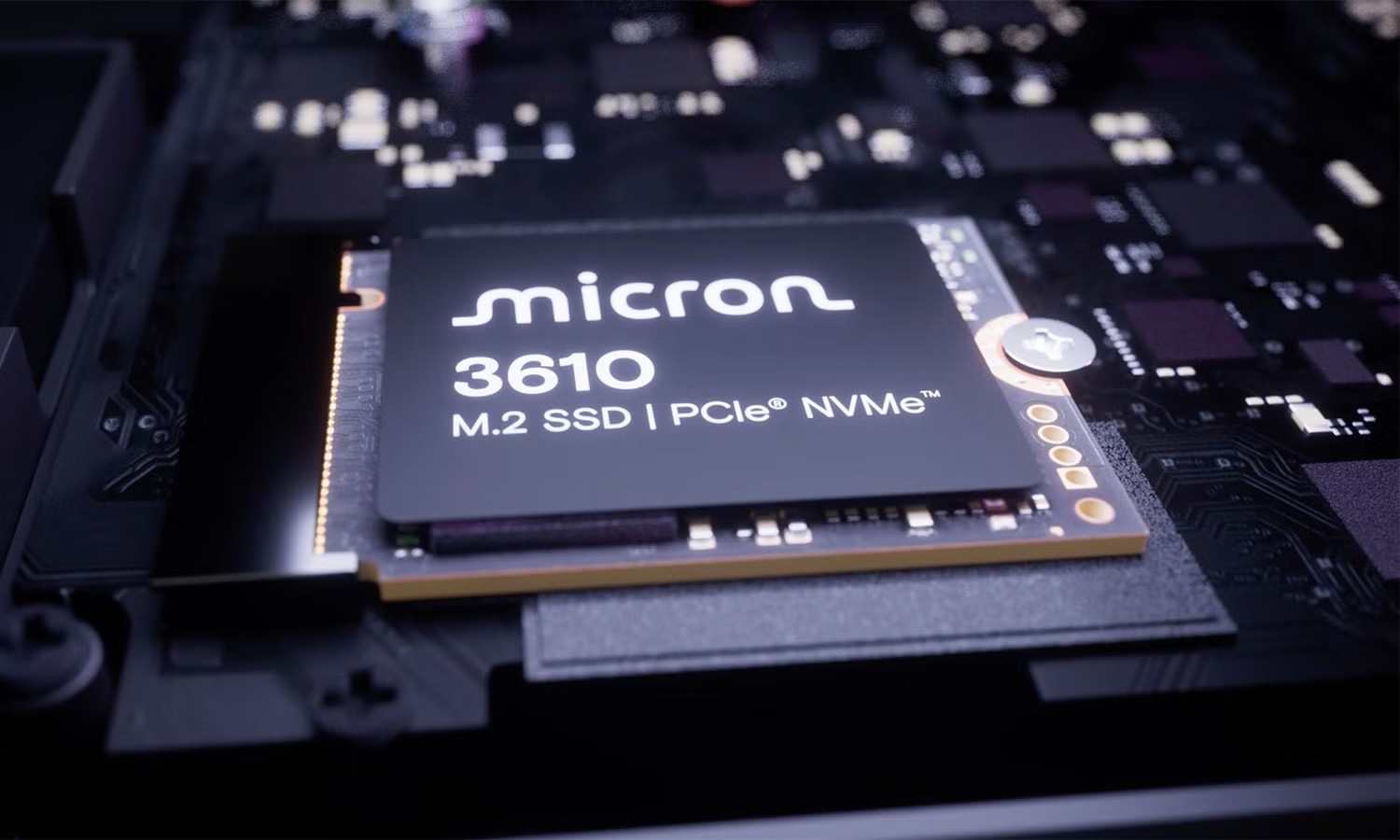
Key differentiators are capacity and packaging. The 3610 is the only 4TB SSD available in a single‑sided M.2 2230 form factor. This configuration is increasingly vital as OEMs push for thinner, lighter systems without sacrificing local storage for AI models, high‑resolution media, and large data sets. The single‑sided design helps system builders meet stringent z‑height and thermal-design targets for fanless or near‑fanless platforms.
Micron positions the 3610 as a balance of premium Gen5 performance and QLC economics. Mark Montierth, senior vice president and general manager of Micron’s Mobile and Client Business Unit, points to the combination of PCIe Gen5, G9 QLC NAND, and a single‑sided design as the basis for the product’s value proposition. According to Micron, these technologies collectively enable high performance, high capacity, and strong power efficiency in thin‑and‑light devices that must support on‑device AI, immersive streaming, and other demanding client workloads.
Performance and Efficiency for Mainstream Client Platforms
The 3610 is designed to enable OEMs to bring Gen5‑class performance to mainstream and commercial client segments, rather than reserving it only for halo gaming or workstation SKUs. With up to 11GB/s reads and 9.3 GB/s writes, plus up to 1.5M /1.6M random read/write IOPS, system integrators can expect a snappy user experience across common client scenarios. These include office productivity, browser-heavy multitasking, light content creation, and accelerated AI inference at the edge.
Power efficiency is a core design goal. The drive uses a DRAM‑less architecture with a host memory buffer (HMB) to reduce component count and power consumption while maintaining high performance. Combined with DEVSLP and other low‑power states, Micron reports a 43% improvement in performance per watt compared with its own Gen4 TLC‑based solutions. For mobile platforms, this directly affects battery life and thermal envelope planning, particularly under sustained workloads such as long video calls, continuous collaboration, or ongoing background AI inference.
AI‑Ready Local Storage
AI‑capable client devices increasingly require fast local storage to stage and run large language and vision models and to cache AI‑generated content. Micron reports that the 3610 can load 20-billion-parameter AI models in under three seconds, aligning with the needs of emerging AI PC designs that rely on a mix of CPU, GPU, and NPU acceleration, backed by high‑throughput storage. This positions the 3610 as an enabler of real‑time insights, low‑latency AI assistants, and on‑device inference workflows without sending every request to the cloud.
In benchmarked client use cases, the 3610 reportedly scores up to 30% higher and delivers 28% greater bandwidth than Gen4 QLC SSDs in PCMark 10 tests. While results will vary by platform and configuration, these results indicate a meaningful uplift in overall user experience for everyday productivity and mixed workloads. These characteristics are particularly relevant in commercial fleets and vertical solutions, where responsiveness and perceived performance directly affect productivity and user satisfaction.
Thermal Management for Ultra‑Thin Designs
Thin‑and‑light systems are often limited not by raw component performance but by how predictably they manage heat over time. The Micron 3610 includes host‑controlled thermal management, giving OEMs more granular control over thermal thresholds and performance behavior. Rather than relying solely on SSD firmware to throttle under thermal stress, system designers can align the drive’s thermal profile with overall platform policies.
This flexibility supports sustained performance in compact, thermally constrained designs, including fanless or low‑airflow configurations. It also allows OEMs and ODMs to tune performance, acoustics, and surface-temperature targets across device classes, from premium ultrabooks to compact desktop form factors.
Security and Data Protection Features
Security is an increasingly important differentiator in client storage, especially for enterprise, government, and regulated sectors. The 3610 incorporates advanced security capabilities, including Data Object Exchange (DOE) and the Device Identifier Composition Engine (DICE). These features support secure device identity, more robust attestation workflows, and stronger protection for user and corporate data.
These capabilities can be mapped into endpoint security narratives, zero‑trust initiatives, and secure supply chain requirements, especially where device identity and integrity are part of compliance frameworks.
Positioning and Availability
Within Micron’s client SSD stack, the 3610 sits between the company’s premium Gen5 4600 series and its value‑oriented Gen4 offerings. It is designed to deliver strong performance and capacity with attractive economics at scale, making it well-suited for high‑volume OEM designs that require Gen5 readiness without the cost profile of top‑end enthusiast SKUs.
The Micron 3610 SSD is now sampling with select OEM partners. It will be available in multiple form factors, with capacities from 1TB to 4TB, including the notable single‑sided M.2 2230 4TB option. These capacities and form factors give PC OEMs, integrators, and channel partners flexibility across a range of platform tiers and chassis designs.
For detailed specifications and additional product information, visit Micron’s product page.


 Amazon